Web Scraping Fundamentals for AI Data Pipelines
Identify the four functional layers and how failure in each requires different fixes.

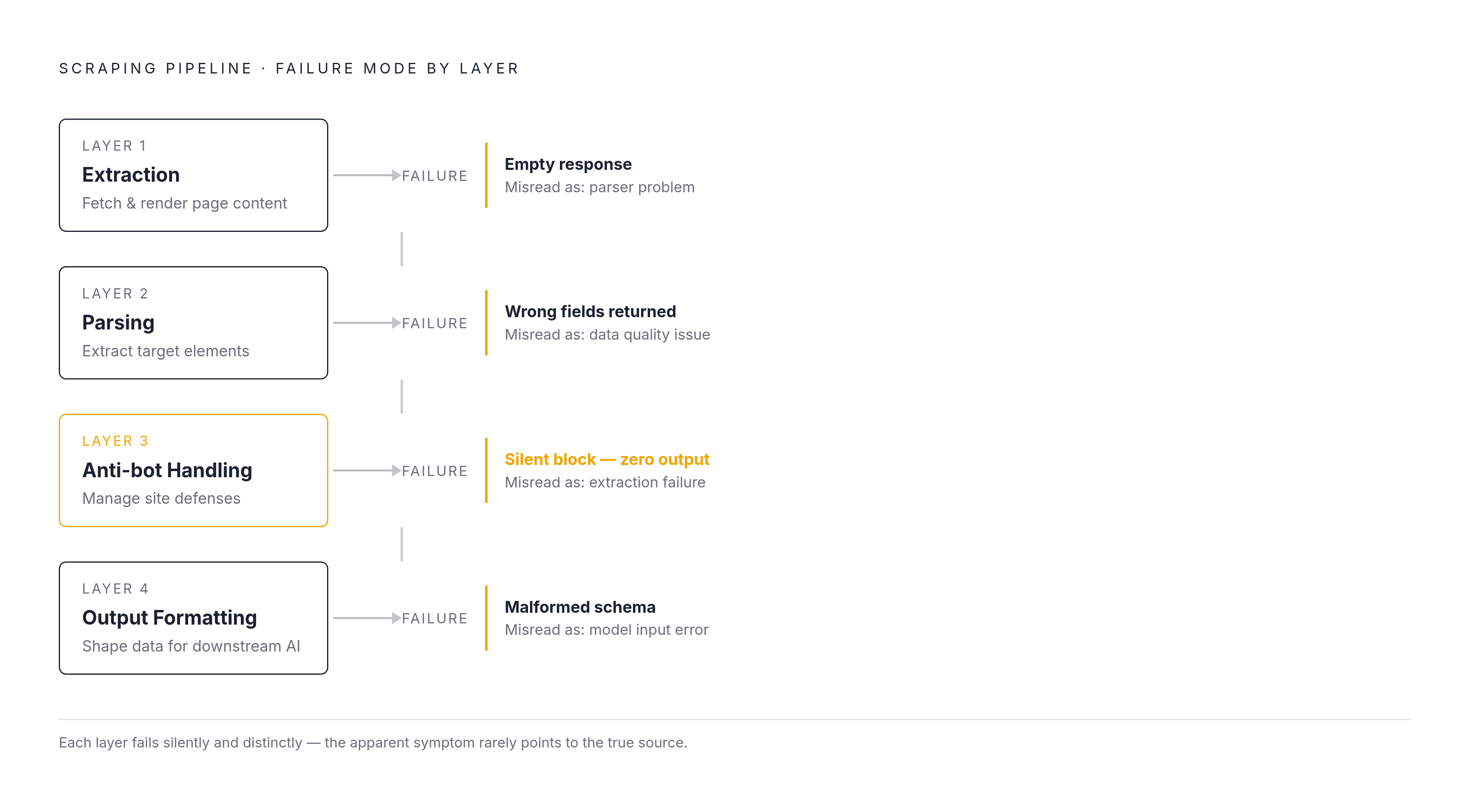
A production scraping pipeline has four functional layers: extraction fetches and renders page content; parsing pulls the right elements from that content; anti-bot handling manages the relationship between your crawler and the site's defenses; output formatting delivers data in a shape downstream AI systems can actually consume.
Each layer fails independently, and that independence is what makes debugging painful. A scraper that fetches successfully but parses incorrectly returns garbage. One that parses correctly but gets blocked returns nothing. These aren't equivalent problems, and they don't share solutions. Conflating failure modes is how you lose an afternoon to the wrong layer, which I say from direct, frustrating experience.
The first architectural decision is whether target pages are static or dynamic. Static pages, HTML served directly from the server, need only an HTTP fetch and a parser. Dynamic pages require JavaScript execution before content appears, because render-blocking JavaScript means the DOM isn't fully populated until the browser runs it, which means a headless browser. That single distinction determines which tools are even viable candidates.
Not every project needs every layer fully built out. A one-off research scrape against a static site with no meaningful bot detection is a fundamentally different problem than a recurring production crawl feeding a live RAG pipeline. Overbuilding the former wastes time; underbuilding the latter breaks in production, typically at the moment you can least afford it. The judgment call between those two scenarios is harder than the tooling decision that follows it.
Extraction tools: matching the fetching method to the page type
For static pages, Python's Requests library remains the right tool. Lightweight, fast, no browser overhead. When pages render server-side, there is no reason to spin up anything heavier.
Dynamic pages require a headless browser. Playwright and Selenium both launch real browser instances, execute JavaScript, and wait for content to load before handing the page off to the parser. Playwright has largely superseded Selenium in new projects, and if you've maintained Selenium scripts for any length of time, you know exactly why. Auto-waiting alone eliminates an entire category of fragile sleep-and-hope patterns that accumulate into serious technical debt. Selenium persists in legacy enterprise systems, and the practitioners maintaining those systems generally know they're patching indefinitely.
HTTPX functions as a modern async alternative to Requests for higher-throughput static fetching, with native HTTP/2 support that Requests lacks. For large-scale recurring crawls across many sites, Scrapy provides the full framework: async requests, configurable pipeline architecture, middleware for retries and cookies, a substantial extension ecosystem. The learning curve is real. At serious scale, it's still the right level of abstraction.
The mistake I've seen compound most often is reaching for Playwright when Requests would suffice. Playwright spins up a full browser process; against a static page, that overhead buys nothing. The inverse is worse to diagnose. Use a lightweight HTTP client against a JavaScript-rendered page and you get incomplete or empty responses that, if you don't know what to look for, look exactly like a parser problem. I watched one team spend the better part of two days tearing apart their CSS selectors before someone thought to check what the fetcher was actually receiving. The selectors were fine. The fetcher had received none of the content they were trying to parse. It's a particular kind of frustrating because the code looks correct throughout. But what if you had checked the fetcher's raw output first — would you have caught it in minutes rather than days?
It is also worth considering event-driven triggering over scheduled crawls. Triggering a scraper only when content changes, via webhooks or message queues, eliminates redundant fetches and keeps AI models fed with fresher data than a fixed-interval cron job typically delivers. It also reduces infrastructure load in ways that matter at scale, though the operational complexity of managing event triggers isn't trivial to implement well the first time.
Parsing: getting from raw HTML to structured data fields
BeautifulSoup is where most practitioners start, and for exploratory work and small scripts, that's appropriate. Readable, well-documented, forgiving of malformed HTML. It is not built for high throughput, and scaling it is less a matter of optimization than of accepting its constraints until they become untenable. selectolax, which uses optimized C engines under the hood for DOM parsing, runs up to 30 times faster in benchmark comparisons; once volume becomes a real concern rather than a hypothetical, that gap becomes difficult to rationalize away.
Traditional CSS selectors and XPath expressions work until the target site redesigns. A class rename, a CMS upgrade, a front-end refactor: any of these breaks a selector-based scraper, and it often breaks silently. No error is thrown. Wrong data flows downstream. I've come to believe that silent failures are the single most underestimated maintenance problem in scraping work, partly because they're invisible until they've been wrong for long enough to matter, and partly because teams often only discover them when a downstream system produces anomalous output and someone finally thinks to audit the data source.
AI-assisted extraction offers a different model. Instead of specifying exactly which DOM node contains a price, you pass the raw HTML or JSON to an LLM agent and instruct it to return structured fields, a pattern sometimes called LLM-based structured data extraction. The agent reads context rather than coordinates, which means it adapts when page structure changes rather than breaking. Tools like ScrapeGraphAI provide schema-based LLM extraction; Crawl4AI is oriented specifically toward producing AI-ready Markdown and JSON for downstream LLM consumption.
The risk that doesn't get enough attention is hallucination. When product descriptions are partially hidden behind JavaScript, extraction tools that guess at missing information can generate fabricated entries rather than returning null. A Vectra survey covering 2024 to 2025 found that top LLMs hallucinate between 0.7% and 29.9% of the time depending on task and model. Even the low end of that range is consequential at scale. AI-assisted extraction reduces maintenance cost; it does not eliminate the need for human spot-checks, and a pipeline with no sampling step has no mechanism for detecting what it's systematically getting wrong. That raises an important question: if your pipeline has no sampling step, how would you even know it was wrong?
Anti-bot detection and what it actually takes to avoid being flagged
Modern bot detection does not operate at a single layer. It runs simultaneously across TLS fingerprinting, HTTP/2 frame ordering, JavaScript fingerprint, and behavioral telemetry. Passing three of four checks is not a partial success; it's a flag. These systems look for any anomaly, and they're operated by teams whose full-time job is closing the gaps that scrapers exploit.
Behavioral analytics are the layer practitioners most consistently underestimate, probably because they're invisible until you're already blocked. Systems like Kasada and DataDome deploy JavaScript collectors that gather mouse movement coordinates, scroll acceleration, click timing, and keyboard event sequences from every visitor. Real users produce inconsistent, organic telemetry. Automated scripts produce linear movement, suspiciously consistent timing, or no movement at all. The gap between human and bot behavioral signatures is measurable with fairly modest statistical methods, and these vendors have trained classifiers on enormous behavioral datasets accumulated over years of adversarial refinement. There's no configuration change that permanently resolves this; it requires ongoing attention.
At the TLS layer, curl_cffi handles fingerprint spoofing, making an HTTP client's handshake resemble a real browser rather than a generic Python process. This addresses detection before any application logic runs, which matters because some systems make the block decision before serving a single byte of content.
Cloudflare's posture shift in mid-2025 changed the economics of the problem in ways that are still working through the field. Cloudflare now blocks AI crawlers by default on new domains. Its Pay Per Crawl implementation returns HTTP 402 to crawlers that haven't registered and paid for access. AI Labyrinth, its honeypot system, serves fabricated content to detected bots rather than blocking them outright, which means a scraper can be actively misled without any indication that something is wrong. Cloudflare sits in front of roughly a fifth of the web; DataDome, Akamai, and Kasada collectively cover most of what remains worth scraping commercially.
A 2026 State of Web Scraping Report found that 65.8% of professionals used more proxies in 2025 than the prior year, and 58.3% increased their proxy budgets. That's not a coincidence; it reflects how seriously the field now treats detection overhead as a recurring operational cost rather than a one-time engineering problem.
Managed scraping services such as Firecrawl and Zyte abstract much of this complexity, handling browser fingerprinting, proxy rotation, and JavaScript rendering at the infrastructure level. The tradeoff is cost and vendor dependency, and those dependencies feel acceptable until the vendor changes pricing, goes down during a critical crawl, or deprecates a pattern you relied on without announcing it clearly.
Detection systems typically impose CAPTCHAs, rate limits, and degraded or misleading responses before resorting to hard blocks. Staying beneath the detection threshold consistently, across IP reputation, request cadence, and proxy rotation, is the operational goal. Surviving any single request is not.
Cleaning scraped data before it reaches the AI system
Websites are designed for human readers using browsers. The structural consequences of that design are everywhere in raw scraper output: dates in a dozen formats across a dozen sources, currencies expressed inconsistently, fields absent or populated with staging placeholder text that never got replaced, navigation menus and cookie consent dialogs entangled with the content the pipeline actually needs.
Cleaning involves deduplication, because the same content appears at multiple URLs, in syndicated articles, and in product listings duplicated across categories; format normalization across dates, currencies, and units; boilerplate stripping before text reaches the embedder; and structural conversion from unstructured HTML to JSON or Markdown that downstream tools can parse reliably. None of this is glamorous work, and none of it is optional.
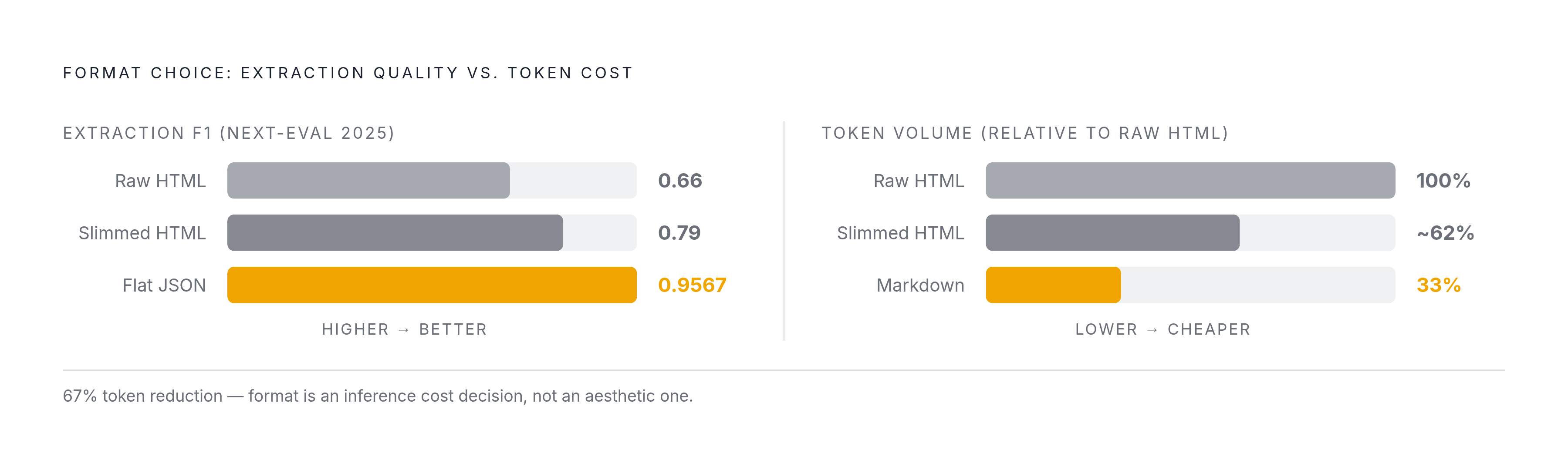
Output format matters more than most practitioners expect before they run the numbers. The 2025 NEXT-EVAL benchmark found that feeding LLMs flat JSON yields an extraction F1 score of 0.9567, substantially outperforming raw or slimmed HTML. Firecrawl's Markdown output uses approximately 67% fewer tokens than raw HTML, which affects token efficiency, inference cost, and how much content fits into a context window. These are not aesthetic distinctions. They compound directly into model performance and operating cost at any meaningful scale.
For AI training specifically, the relationship between data quality and model behavior is direct and, in my observation, still underappreciated by teams that treat cleaning as a preprocessing checkbox. Automated cleaning catches most structural problems. It does not catch demographic bias, content gaps, or systematic errors that look structurally correct. Structurally clean, semantically wrong data can shape model behavior in ways that are difficult to trace back to origin, which is part of what makes this problem so durable. Human reviewers sampling datasets remain necessary, not as redundancy, but as the only available check on what automation cannot see.
The legal boundaries practitioners are operating inside in 2026
The foundational U.S. precedent is hiQ v. LinkedIn, decided by the Ninth Circuit in April 2022, which confirmed that scraping publicly available data does not create criminal liability under the Computer Fraud and Abuse Act. That holding has not been overturned and remains the baseline for CFAA exposure analysis.
Public availability, and compliance with robots.txt directives, is necessary but not sufficient. The same conduct can still generate liability under breach of contract theory or common law tort. ToS violations, scraping through authenticated sessions, and downstream misuse of collected data represent separate exposure points that CFAA analysis doesn't touch.
Meta v. Bright Data, decided in January 2024, illustrates the boundary in practice. A federal judge found that Bright Data violated Meta's Terms of Service only if scraping occurred while logged into a Meta account. Meta couldn't establish that it did, and the case collapsed. The ruling reinforces the public-data principle while clarifying that the logged-in boundary is real and consequential, not a technicality.
AI training introduces legal exposure that competitive intelligence scraping historically has not faced at comparable scale. The New York Times sued OpenAI and Microsoft in December 2023 for copyright infringement. Anthropic settled a copyright class action for $1.5 billion in September 2025. Reddit sued Anthropic and Perplexity AI in 2025. YouTube creators filed class actions against Nvidia, Snap, and Meta in early 2026. The OECD's 2025 regulatory outlook notes that IP risks intensify specifically when scraped text or images train AI systems rather than merely retrieve information. Scale is the variable that changes the exposure calculation, and the litigation pattern reflects that with some clarity.
Regulatory pressure is tightening from multiple directions simultaneously. The EU AI Act is fully in force. U.S. FTC draft guidelines on data access address automated collection for model training directly. Cloudflare's Pay Per Crawl represents the market's preemptive response before formal regulation arrives, and it's worth taking seriously as a signal of where the broader environment is heading.
Clearview AI is the case study that should remain visible to anyone building a training pipeline. Scraping public social media photographs for facial recognition produced multimillion-dollar fines across multiple jurisdictions. "It's public" was not a defense once the downstream use came under scrutiny. Most teams building training pipelines can articulate the technical justification for what they've built. Far fewer can articulate, in legal terms, why the specific downstream use is defensible. Those are different questions. Conflating them tends to surface at the worst possible moment, usually when someone external to the team asks the question for the first time.
Practical implication: robots.txt review, ToS analysis, documentation of data sources, and legal justification for AI training use should be designed pipeline steps, not afterthoughts.
Putting the layers together into a pipeline that holds up in production
The four layers interact; they don't simply stack. Anti-bot choices constrain which fetching tools are viable. Output format requirements at the AI layer shape what the cleaning stage must produce. Legal constraints on data sources affect what can be ingested at all, upstream of any technical decision. Treating the layers as independent is how pipelines get built that work in development and break under production conditions, sometimes quietly for longer than anyone realizes.
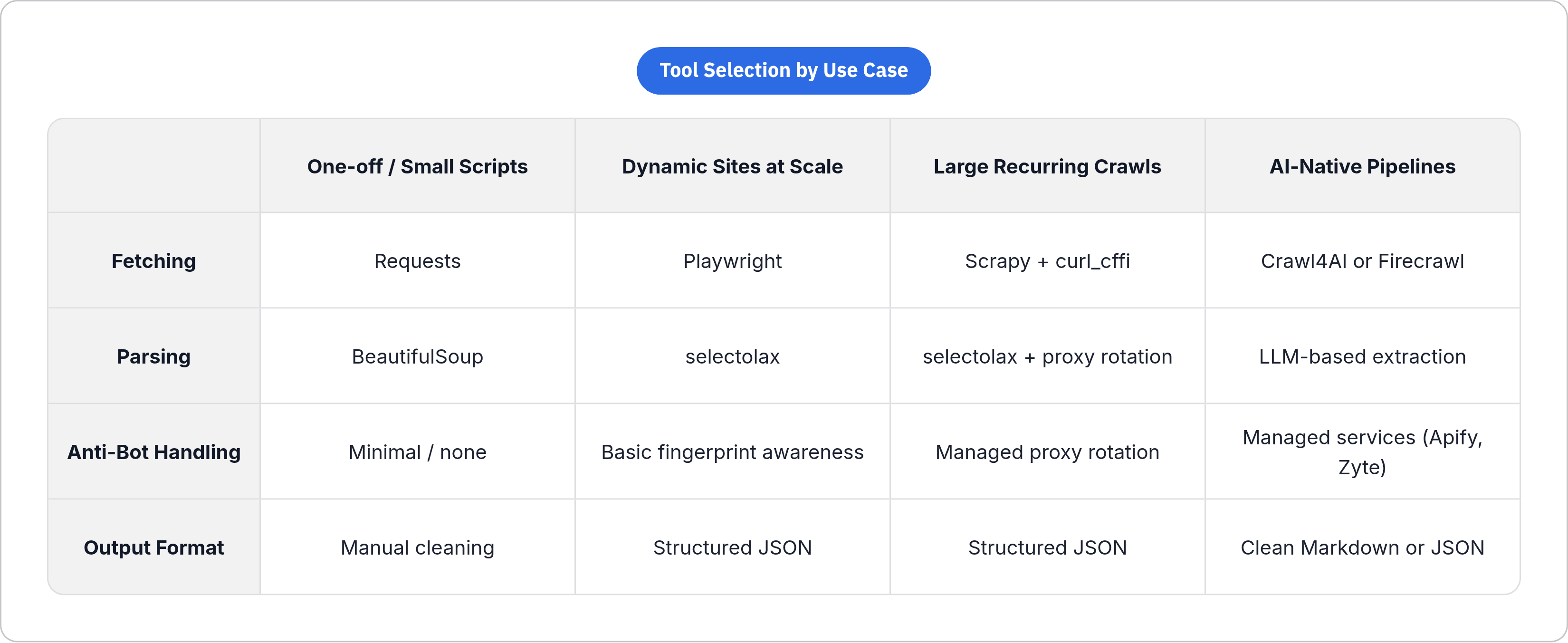
Tool selection follows use case. One-off research or small-scale scripts: Requests, BeautifulSoup, and manual cleaning are appropriate and proportionate. Dynamic sites at moderate scale: Playwright with selectolax and structured JSON output. Large recurring crawls with meaningful anti-bot exposure: Scrapy paired with curl_cffi for TLS fingerprinting, proxy rotation, and managed services for the hardest targets. AI-native pipelines serving RAG or training data: Crawl4AI or Firecrawl for clean Markdown or JSON output, paired with workflow automation tools like Make.com or n8n for scheduling and proxy management.
Managed services earn their cost in specific circumstances, particularly for teams with limited engineering headcount where the trade of monthly spend for maintenance savings actually pencils out. It doesn't always pencil out. Teams that reach for managed services to avoid building expertise sometimes find themselves unable to debug the service when it fails, and it will fail eventually, usually in a way the vendor's documentation doesn't quite cover.
The maintenance burden of selector-based scrapers is real and consistently underestimated before you've lived through a few site redesigns at inopportune times. A logistics company case study published by GroupBWT in December 2025 reported cutting scraper maintenance workload by 85% after migrating to AI-driven extraction. That figure reflects their specific context. The directional pattern, however, is consistent with what I've seen across different environments: AI-driven parsing reduces break-fix cycles, often substantially, though it introduces the hallucination monitoring problem described earlier as a replacement concern.
Quality gates should be a designed pipeline stage, not a cleanup step applied after ingestion. Sampling, deduplication checks, and format validation should run before data reaches the vector store or training pipeline. Catching problems after ingestion means discarding or reprocessing data that already consumed compute, which is a correctable mistake the first time and an operational failure if it becomes routine.
Anti-bot systems update on schedules the crawler doesn't control. Legal frameworks tighten. Site structures change without notice. What separates a pipeline that degrades silently from one that surfaces problems is observability: logging extraction failures, monitoring data quality metrics, alerting on format anomalies. You find out about problems eventually either way. But how does this affect our original promise of a pipeline that holds up in production? It comes down to whether you find out from your monitoring or from your users — and that distinction tends to determine whether the problem was manageable or wasn't.