Converting Raw Scraped HTML to LLM-Ready Text
Cleaning HTML for LLMs cuts token waste and measurably improves model accuracy.

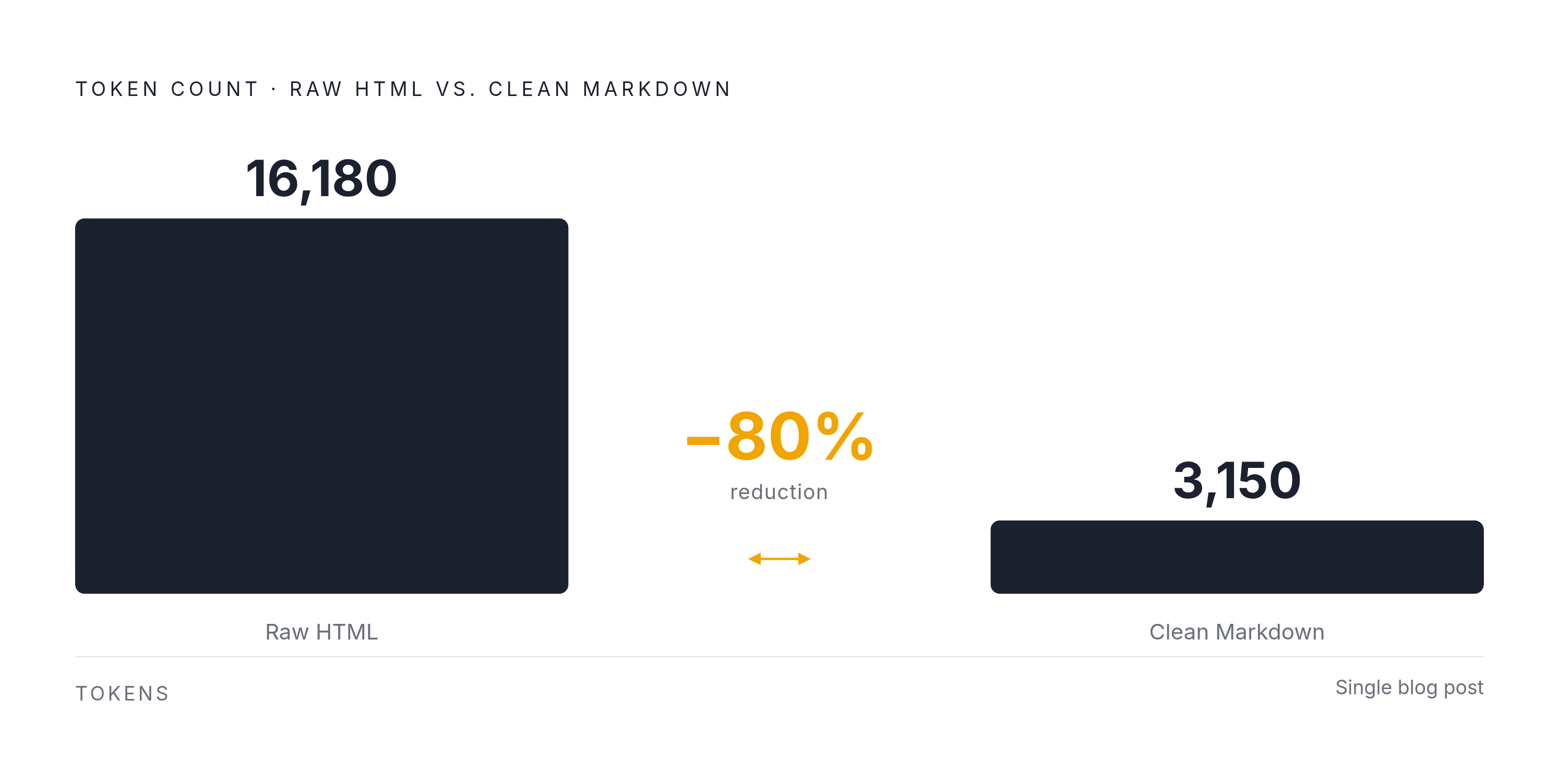
If you feed raw HTML into a language model, you are not saving a step; you are creating a problem. The markup, the boilerplate, the navigation chrome, the tracking scripts. None of it carries meaning for the model. All of it costs tokens. And token cost is not just a billing line; it is a direct tax on what the model can actually reason through before it gets to the content you care about. Think of it like handing someone a book wrapped in thirty layers of bubble wrap and asking them to summarize it — the packaging is not the story. A single blog post, analyzed by Cloudflare, came in at 16,180 tokens as raw HTML and 3,150 tokens as clean Markdown. That is an 80% reduction. Multiply that gap across every request in a production pipeline and you are not looking at a formatting preference anymore; you are looking at an infrastructure decision with real accuracy and cost consequences.
How format choice measurably changes what a model gets right
Here is the part that surprises people. The format gap is not just about token count; it actively changes whether the model gets the right answer.
A 2024 ArXiv paper on prompt formatting found that GPT-3.5-turbo's accuracy on a code translation task swung by up to 40% depending on how the same content was formatted. Same content. Different structure. Forty points of accuracy variation. GPT-4 showed a consistent preference for Markdown specifically, which the researchers attributed to heavier pretraining on structured text. The model was not being finicky; it was doing what it was trained to do. You could say it was just following its train of thought.
Tables tell the same story. Markdown table representations outperformed HTML tables in extraction accuracy in GPT-based evaluations (around 60.7% versus 53.6%). Not a huge margin in isolation, but compounded across a retrieval pipeline it adds up fast.
In January 2025, a benchmark called MDEval formalized "Markdown Awareness" as a measurable property of language models. The benchmark covered 20,000 instances across 10 subjects and evaluated nine mainstream models. Its correlation with human preference scores was 0.791. In plain terms: how well a model handles Markdown reliably predicts how useful its outputs are to real people.
The implication is simple and a little uncomfortable if you have been treating formatting as an afterthought. Format is not a presentation decision; it is a model-performance decision made at the data layer, before the model ever sees a single token.
The JavaScript rendering problem that precedes any conversion
Before you can convert anything, you have to actually get the page. And this is where a lot of pipelines quietly fail without anyone noticing.
Most modern websites are single-page applications or use lazy-loading and infinite scroll. Send a plain HTTP request and you get an empty shell. The content exists, but it lives in JavaScript that never executed. The page the model would receive looks nothing like the page a human would see.
There are two practical paths forward:
- Cloud-rendered fetching via a scraping API. JS execution happens remotely, and you receive a fully rendered DOM. You never have to maintain browser infrastructure yourself.
- Text-based browser rendering (something like lynx). This executes HTML layout rules to produce output that mirrors what a human perceives, rather than parsing the DOM directly. Research pipelines have used this approach specifically because it preserves mathematical equations and code formatting that DOM parsers tend to drop.
Rendering and extraction are separate concerns. The rendering layer gets you the real page. The extraction layer isolates the content you want. Conflating those two steps is why most AI scraping frameworks are a nightmare to debug when something breaks. Keeping them conceptually distinct makes the whole pipeline easier to reason about and fix.
Stripping structural noise: the extraction step
Once you have a rendered page, the goal is to isolate the content that actually carries meaning and throw away everything the browser needed but the model does not.
A practical two-tier approach in Python:
- Start with trafilatura for initial content extraction. It was designed explicitly for LLM preprocessing workflows. It intelligently removes navigation, ads, and boilerplate while preserving meaningful content.
- Follow with markdownify (Python) or turndown (JavaScript) when you need fine-grained control over the cleaning process.
- Use BeautifulSoup for targeted DOM manipulation before passing content to a converter.
- html2text is a solid zero-dependency option when simplicity matters more than control.
A 2026 ArXiv paper called "Beyond a Single Extractor" challenged the assumption that any one library is universally optimal. The finding: using multiple extractors in combination increases token yield while maintaining performance. For production RAG ingestion pipelines, ensemble approaches are worth considering.
What a well-executed extraction step removes versus preserves:
Removes:
- Navigation menus and breadcrumbs
- Headers, footers, sidebars
- Advertising and tracking scripts
- Inline CSS and JavaScript
- Duplicate anchor text and decorative whitespace
Preserves:
- Headings and body text
- Structured lists and tables
- Code blocks
- Meaningful links
That last list is not just about cleanliness; every item you preserve maps to something the model can actually use during retrieval and generation.
Converting extracted content to Markdown that a model can use
Extraction gets you clean content. Conversion gets you content the model is prepared to work with.
LLM-ready text is not just stripped. It is structured in a way that maps to how models were pretrained. Markdown is the right output format for most use cases because its conventions align directly with how modern models learned to read:
- Headings (# h1, ## h2) signal hierarchy and serve as semantic anchors for summarization and Q&A
- Bullet and numbered lists preserve enumerated information without noise
- Fenced code blocks (```) keep code from being misread as prose
- Markdown tables outperform HTML tables in extraction accuracy, as noted above
Done correctly, this step produces the 60–80% token reduction mentioned earlier. That is not a rounding error; it directly cuts inference costs and improves retrieval quality in RAG pipelines.
JSON is a legitimate alternative when you need structured fields (title, author, date, body) passed to downstream systems separately rather than fed as a single text block. A simple heuristic for choosing:
- Markdown: document Q&A, summarization, RAG retrieval, agent reasoning
- JSON: structured data extraction, product feeds, database ingestion, API chaining
Some commercial APIs handle extraction and conversion as a single operation, which matters for teams that want clean output without managing the library stack themselves. More on that shortly.
Chunking the converted text for retrieval without losing coherence
This is where conversion quality either pays off or falls apart. Poorly structured input produces incoherent chunks regardless of what chunking strategy you use.
A good starting point for most text content: recursive character splitting at 400–512 tokens with 10–20% overlap. This works precisely because clean Markdown provides natural split points at headings and paragraphs. The structure does half the work for you.
Adaptive chunking aligned to logical topic boundaries significantly outperforms fixed-size baselines. A peer-reviewed clinical decision support study published in MDPI Bioengineering in November 2025 found adaptive chunking hit 87% accuracy versus 13% for fixed-size baselines, with the gap confirmed at p=0.001. Those logical boundaries only exist in the text if the conversion step preserved heading structure; which is exactly why Markdown output matters upstream.
A February 2026 benchmark of seven chunking strategies across 50 academic papers placed recursive 512-token splitting first in accuracy. Semantic chunking underperformed notably, largely because it produced fragments averaging just 43 tokens. Too small to carry meaningful context.
Attach metadata to every chunk. Not as a nice-to-have. As infrastructure:
- Source URL
- Section heading (available because Markdown preserved it)
- Page number or position offset
- Parent chunk ID for hierarchical retrieval
Metadata enables citation, filtering, and parent-document retrieval. None of that works if the conversion step lost the structure in the first place.
Where retrieval breaks even when the text is clean
As of early 2026, the majority of enterprises running production RAG have moved past the pilot phase. Reference architectures matured, planning timelines compressed, and organizations either committed to the approach or abandoned it. The field grew up fast.
Despite that maturity, naive RAG pipelines fail at retrieval a significant portion of the time. The model generates a confident, well-structured answer grounded in the wrong documents. The failure is not obvious; that is what makes it dangerous.
Retrieval is now the critical bottleneck. Not generation.
Hybrid search addresses this directly:
- Vector similarity alone misses exact-match queries (product codes, names, technical terms)
- Keyword matching alone misses semantic variation
- Combining both outperforms either method alone by meaningful margins
- The large majority of enterprises that have implemented hybrid search report improved query accuracy
The pipeline implication: clean Markdown with preserved structure enables better embedding (headings encode topic), better keyword matching (terms are not buried in tag noise), and better metadata filtering.
Retrieval failure is almost always misdiagnosed as a model problem; it is almost always a data-preparation or retrieval-architecture problem. Which is why a conversion step at the very top of the pipeline has consequences this far downstream.
How commercial scraping APIs collapse the pipeline into a single call
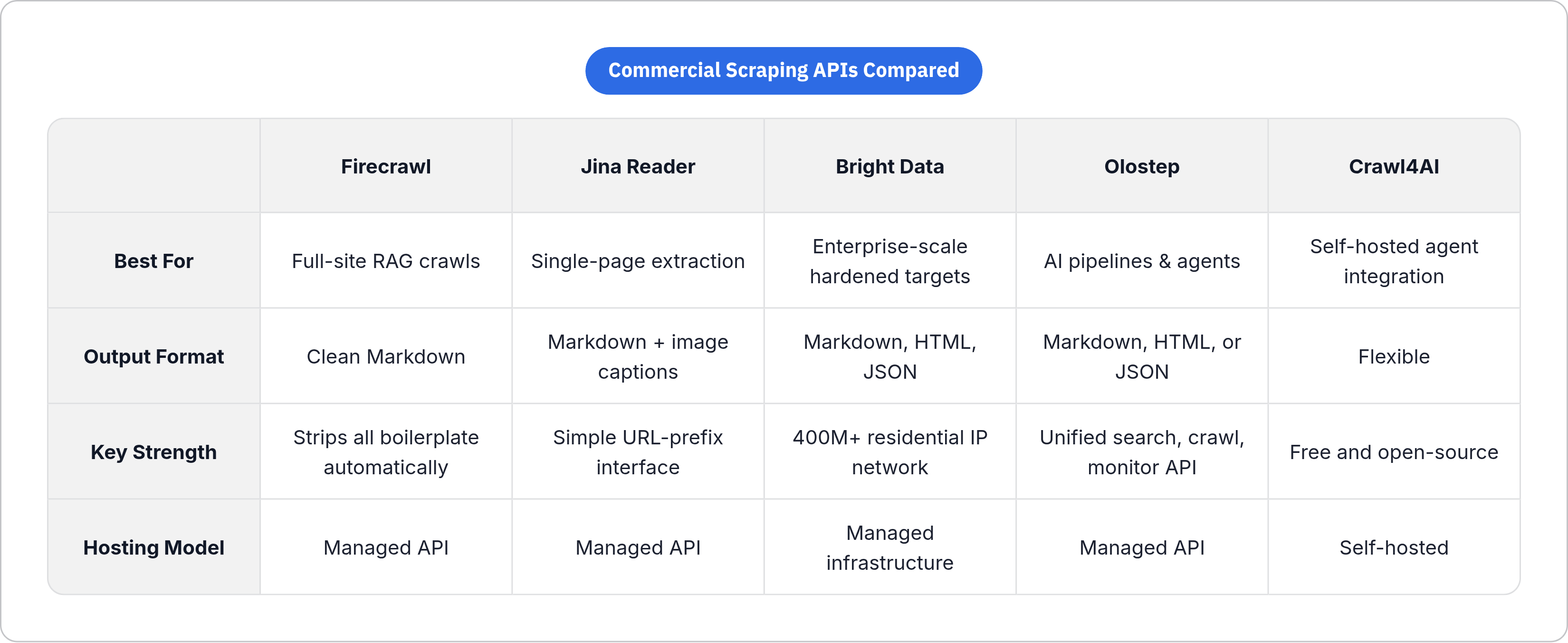
Everything described above (fetch, render, extract, convert) is what a production scraping API handles internally. You get clean Markdown or JSON. You do not touch the library stack.
Here are the main options worth knowing:
- Firecrawl: Crawls entire websites and converts every page to clean Markdown. Strips navigation, footers, sidebars, and advertising. More than 1.25 million developers and 150,000+ companies have used it, with over 5 billion requests served.
- Jina Reader API: Single-page extraction via a URL prefix (r.jina.ai/). Adds automatic image captioning as part of the output. Simple and fast for single-page use cases.
- Bright Data: Infrastructure-grade access via a residential IP network covering over 400 million IPs. Their Web MCP server, launched in August 2025, now powers over 100 million daily AI-agent interactions. The right choice for teams that need reliability at enterprise scale against hardened targets.
- Olostep: A developer web-data API covering search, scraping, and crawling at scale, with batch processing up to 10,000 URLs. Outputs clean Markdown, HTML, or JSON, and handles browser rendering, proxies, and anti-bot infrastructure so AI teams and developers do not have to.
- Crawl4AI: Open-source and self-hosted. Popular for agent integration and free for budget-constrained teams.
How to choose:
- Single pages, simple stack: Jina Reader or html2text
- Full-site crawl for RAG: Firecrawl
- Infrastructure-grade scale with anti-bot requirements: Bright Data
- Self-hosted, agent-integrated: Crawl4AI
Anti-bot hardening and what it means for pipeline reliability
Anti-bot systems have gotten genuinely sophisticated. As of 2025–2026, the leading providers use ML models automatically tuned to each website's specific traffic patterns. It is not just rate limiting anymore.
IP reputation tiers matter in practice:
- Datacenter IPs: Lowest trust. Blocked most aggressively.
- Residential IPs: High trust. Used by most professional scraping infrastructure.
- Mobile IPs: Highest trust, due to Carrier-Grade NAT sharing IPs across many real users.
In independent benchmarks, the top infrastructure providers achieve success rates in the high 90s on heavily hardened targets. That is the upper bound for what serious infrastructure investment can deliver.
For teams building their own fetch layer, the failure modes to design around:
- CAPTCHAs inserted mid-crawl
- Dynamic CSS selectors that break extraction logic
- Fingerprinting beyond IP (browser headers, TLS signatures, timing patterns)
Self-healing scrapers that use LLMs to detect layout changes and re-map extraction logic automatically address a real maintenance burden. Researchers at McGill University found in 2025 that AI methods maintained accuracy in the high 90s even when page structures changed, with setup time dropping from weeks to hours.
The operational reality: anti-bot infrastructure is not a peripheral concern. It is the fetch layer the entire conversion pipeline depends on. If the fetch fails, nothing downstream matters.
Putting the pipeline together: what each step is actually doing for the model
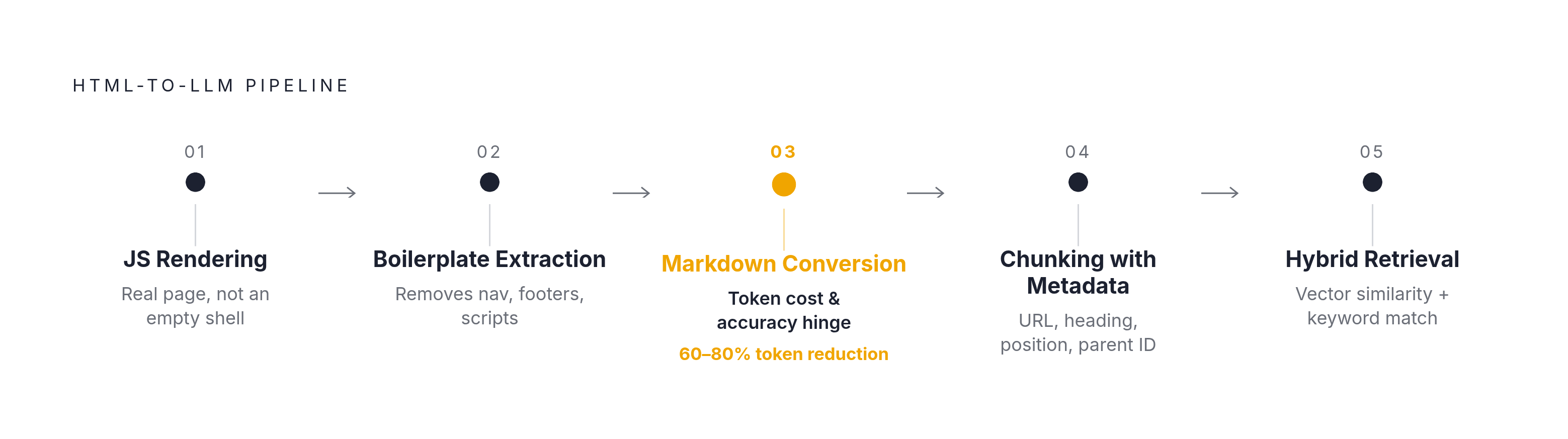
This pipeline is not a sequence of formatting choices; it is a sequence of signal-preservation decisions, and each one has downstream consequences for model accuracy and cost. Every step is like clearing fog from a window — the view on the other side does not change, but how much of it the model can actually see does.
Here is what each stage is actually doing:
- JS rendering: Ensures the model sees the page a human would see, not an empty shell. Without this step, a large portion of modern web content is simply invisible.
- Boilerplate extraction: Removes cognitive load. Every nav link, footer, and tracking script the model has to process before reaching actual content is a token spent on noise. This step eliminates that overhead.
- Markdown conversion: Translates structure into a language the model was trained to read. Headings become semantic anchors. Lists become parseable enumerations. Code stays code. The 60–80% token reduction is a byproduct of doing this correctly.
- Chunking with metadata: Turns a document into retrievable units without losing coherence or context. The metadata attached here is what makes citation, filtering, and hierarchical retrieval possible later.
- Hybrid retrieval: Finds the right chunks using both semantic similarity and exact-match signals. Clean Markdown input makes both signal types stronger.
The model at the end of this pipeline is not smarter than it was before; but it is working with better inputs, which is the only lever you actually control. Every step in this pipeline is an act of removing something the model would have had to ignore anyway. You are just doing that work before the inference call, where it costs less and matters more.