Real-Time Scraping Triggers for Event-Driven Agents
Detect the signals that matter before wasting scrapes on noise.

Not every page change deserves a response. You learn this quickly, usually after you've already wasted a week chasing noise. Think of it like fishing: you don't cast your line into every ripple on the water — you wait for the kind of movement that means something is actually beneath the surface.
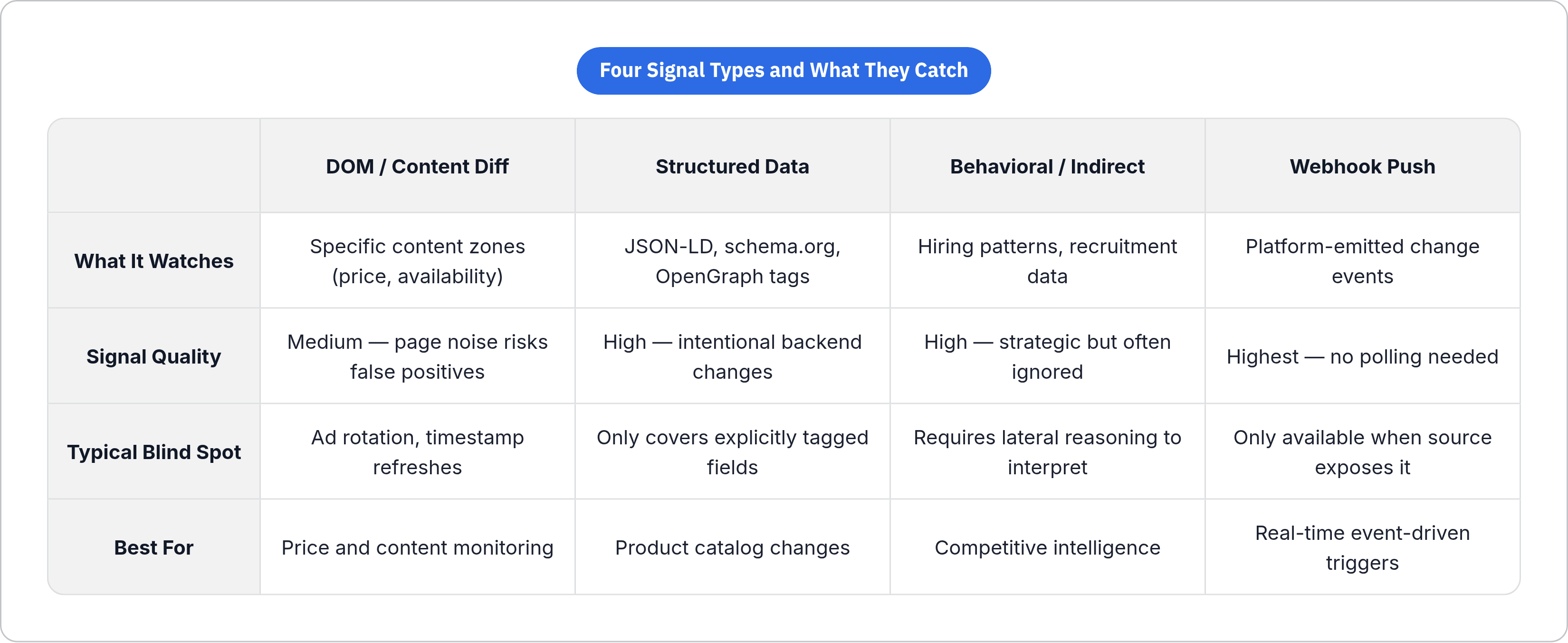
The engineering challenge doesn't start with scraping. It starts with figuring out what you're actually looking at before anything fires. Meaningful triggers shake out into roughly four categories, and they're not equal.
DOM or content diffs. A hash of the specific content zone you care about changes. Not the whole page. The price field. The availability flag. The headline. Watch the whole page and you'll spend your day firing on ad rotation and cookie banner re-renders.
Structured data changes. JSON-LD blocks, schema.org price attributes, OpenGraph tags. Cleaner signals because they're machine-readable by design. When a product's structured data updates, something intentional happened on the backend.
Behavioral or indirect signals. This one gets ignored more than it should. A competitor posts six job listings for solutions engineers in the healthcare vertical in one week. No product page changed. No price moved. But that hiring pattern is a strategic signal if you're watching for it. One team caught exactly this, inferred a compliance product launch was coming, accelerated their own roadmap by two quarters, and closed major healthcare deals before the competitor ever shipped. The trigger was recruitment data, not content.
Webhook pushes from upstream sources. When an e-commerce platform, news aggregator, or public API emits a change event directly, you subscribe. No polling. The event shows up in your queue.
That hiring example is worth sitting with. It illustrates something important: what your detection layer watches determines what your agent can know. If you only watch for price changes, you will never catch a competitive threat that announces itself through a recruiting pattern. Signal classification is an architecture decision, not a feature someone adds later.
The flip side is noise, and there's a lot of it. Cosmetic updates fire constantly. Timestamps refresh. Ads rotate. If those trigger scrape jobs, you've built a very expensive way to learn nothing. That's the failure mode people underestimate. It's not that the pipeline breaks. It's that it runs constantly and tells you nothing useful.
How Agents Detect and Classify Web Events Before Deciding to Scrape
Three detection patterns actually hold up in production.
Periodic baseline plus diff. A lightweight crawl establishes a content fingerprint. Subsequent lightweight fetches compare against it. Only a mismatch escalates to a full scrape job. You're running a cheap comparison most of the time and only spending money when something changes.
Webhook subscription. When the source exposes it, use it. Change events get pushed directly into a message queue. No crawling, no polling, no wasted cycles.
Hybrid schedule-plus-signal. A low-frequency scheduled crawl keeps things fresh for slow-moving sources. A parallel signal layer watches for high-velocity events and can interrupt the schedule when something urgent appears. Most pipelines that have been running for a while end up here, not because someone planned it that way, but because reality forced them there.
Once a diff is flagged, the next question is whether the change actually matters. This is where LLM-based classification does real work. The agent isn't asking "did the page change?" It's asking "does this change warrant a downstream action?" That's a reasoning task. String comparison doesn't get you there.
Natural-language extraction tools let developers describe what to watch for semantically instead of writing brittle CSS selectors. This matters because the detection layer has the same fragility problem as the extraction layer when you rely on selectors. Pages restructure. Selectors break. A semantic description holds up longer.
The failure mode that catches people early: they detect everything, scrape everything, and drown the downstream pipeline in low-value data. Detection without classification is expensive polling with extra steps.
Wiring the Trigger to the Scrape Job: The Pipeline Handoff
The handoff sounds simple. Signal arrives, job fires. In practice this is where most event-driven pipelines fall apart, quietly and at the worst possible moment.
A detected signal has to produce a scrape job with the right parameters, right priority, through the right channel, fast enough that the data is still useful when it arrives. Each of those qualifiers is a failure point. Here's what a working handoff actually requires:
- Event bus. Signal lands here first. Kafka, SQS, Redis Streams, a webhook receiver. The bus decouples detection from execution so a spike in signals doesn't directly spike your scraping workers.
- Job dispatcher. Consumes the event, constructs the scrape job spec (URL, render requirements, output format, priority tier), and enqueues it. This is where business logic lives. Not in the scraper, not in the agent.
- Scraping workers. Pull from the queue, scale horizontally in response to volume spikes.
- Result handler. Receives structured output, routes it to the agent or downstream store.
Orchestration frameworks like LangChain, LangGraph, CrewAI, and AutoGen manage the agent's planning loop. They don't fill the fetch layer. The pipeline handoff is exactly the gap they leave open.
One thing people get wrong here: when a trigger fires on a JavaScript-rendered target, a lightweight HTTP fetch won't resolve it correctly. You'll get back an empty shell and the agent will see a result without knowing it's meaningless. That's a quiet failure. It doesn't throw an error. It just poisons the reasoning downstream. Browser-action agents that own the full browser environment are heavier to run, but for those targets they're not optional.
During major e-commerce events, agent traffic to retail sites has surged dramatically from pre-holiday baselines, based on observed 2025 traffic patterns. A pipeline that can't burst under that kind of load either over-provisions constantly or accepts queue backlog exactly when signal freshness matters most. A pipeline that can't burst fast enough turns a real-time trigger into a delayed scrape. Which is just scheduled scraping with extra steps.
What the Scraping Infrastructure Must Handle Once the Job Fires
Event-driven pipelines create spiky, unpredictable load. Infrastructure sized for average throughput will fail during event clusters, and event clusters are exactly when you need the infrastructure most.
Parallel request capacity is the first real constraint. Benchmarks across major providers show meaningful degradation starting at high volumes, and you will hit that ceiling during the exact moments when triggers are firing fastest. That's not a coincidence. That's the nature of event-driven systems.
Anti-bot systems don't play fair, and they don't stay static. Modern bot management uses ML models tuned per site, adapting to traffic patterns over time. Rate thresholds shift based on observed baselines. A triggered burst that looks like normal polling from your side will look like an anomaly to the target, because from the target's perspective, it is one. You just caused it.
Some hardened sites return successful responses at frustratingly low rates even for capable providers. When your pipeline hits one of those at the wrong moment, it returns nothing useful. Your agent then has to decide whether silence means "nothing changed" or "we got blocked." Those are very different situations that look identical in the response.
Proxy routing for event-driven load requires actual thought:
- Datacenter proxies for unprotected targets. Residential proxy costs are significantly higher per GB, and routing correctly saves real money on the targets where residential isn't necessary.
- Residential proxies reserved for high-value, protected targets. Save the expensive resource for where it matters.
- Smart routing at the infrastructure layer, not bolted on as an afterthought.
Provider concentration risk is worth taking seriously. In early 2026, Google disrupted a large residential proxy network spanning millions of devices after finding it had been built on malware-laden SDKs. Teams depending on those providers lost access overnight. Resilience means avoiding reliance on a single vendor as infrastructure.
Formatting Scraped Output So the Agent Can Reason With It Immediately
The trigger-to-scrape loop is only useful if the output lands in a format the agent can work with. Raw HTML is not that format, and every step between raw HTML and something an LLM can reason over is a place where latency and accuracy problems accumulate.
Markdown is the default for document-type content. Most state-of-the-art LLMs trained heavily on Markdown, including GitHub READMEs, technical documentation, and forums. The model interprets headers, blockquotes, and tables natively. One analysis found Markdown meaningfully more token-efficient than JSON and dramatically more efficient than raw HTML while retaining full structural hierarchy. In a pipeline processing millions of triggered scrapes, token efficiency is a direct cost lever.
Stripping navigation, footers, and ads before content reaches the model also matters more than people expect. Firecrawl has reported delivering far fewer input tokens compared to raw HTML when this stripping is done correctly. At high frequency, that reduction compounds.
JSON is the right format for structured targets. Product records, API-adjacent pages, anything with discrete fields the agent needs to compare or store. Competitor pricing, job listings, catalog attributes. These all land better as structured records than as Markdown documents.
Multi-modal extraction that combines DOM analysis, NLP, and computer vision can pull attributes from both text and embedded visuals. The practical value isn't just better extraction. It's durability. When extraction logic adapts to page shifts rather than breaking on them, maintenance overhead drops.
Here's the thing most people miss: output format should be decided at job-dispatch time. The dispatcher constructs the scrape job spec. It should encode the target format based on what the downstream agent expects. Adding that decision later adds latency and ambiguity, and it turns a clean pipeline into one where everyone is guessing at the handoff.
The conversion step between raw web and LLM-ready format is where most latency and accuracy problems in event-driven pipelines actually live. The vast majority of web data is unstructured. The work of making it useful isn't the scraping. It's the transformation that comes after.
Where Event-Driven Pipelines Break and How to Design Against the Failure Modes
Five failure modes are worth understanding before you build.
Signal flooding. A site redeploys and every page hash changes simultaneously. The job queue saturates. Scrapes that matter get delayed alongside ones that don't. Design against it with priority tiers in the job queue, signal deduplication at the event bus layer, and change-type classification before dispatch. Not every trigger deserves the same lane.
False positives in change detection. Cosmetic updates fire scrape jobs repeatedly on content that hasn't meaningfully changed. You burn compute and proxy budget learning that an ad rotated. Zone-scoped hashing that watches only the content zone carrying the signal fixes most of this. An LLM-based materiality check on the diff before dispatch catches the rest.
Cold-start latency. A triggered scrape on a JavaScript-heavy target takes several seconds to render. By the time the result arrives, the event window is gone. Pre-warm browser workers for known high-value targets. Distinguish render-required from static-fetch targets at dispatch time, not at execution time.
Infrastructure loss. A proxy provider or scraping vendor fails or gets disrupted. All in-flight triggered jobs fail silently. Your agent has no idea. HTTP errors are easy to catch. Silent failures are not. Design for this with fallback routing to a secondary provider, dead-letter queues for failed scrape jobs, and alerting on anomalous empty-result rates.
Agent acting on stale data it believes is fresh. The trigger fired correctly. The scrape returned. But the page had already changed again by the time the agent processed the result. Timestamp the scrape result at fetch time, not at queue entry time. Let the agent compare fetch timestamp against decision timestamp before acting. This sounds like a minor detail until it isn't.
When a pipeline handles all five of these reliably, the compounding effect is real. An enterprise B2B vendor monitoring thousands of target company sites for buying signals lifted lead conversion from 8% to 12.4% over nine months. The system only works because the pipeline was reliable enough to catch signals when they appeared. Miss the signal, miss the window. The reliability isn't the headline but it's the whole story.
Evaluating Whether to Build the Trigger-and-Scrape Infrastructure or Buy It
The build-vs-buy question for event-driven pipelines is more interesting than it is for batch scraping, mostly because the stakes are higher and the failure modes are less forgiving.
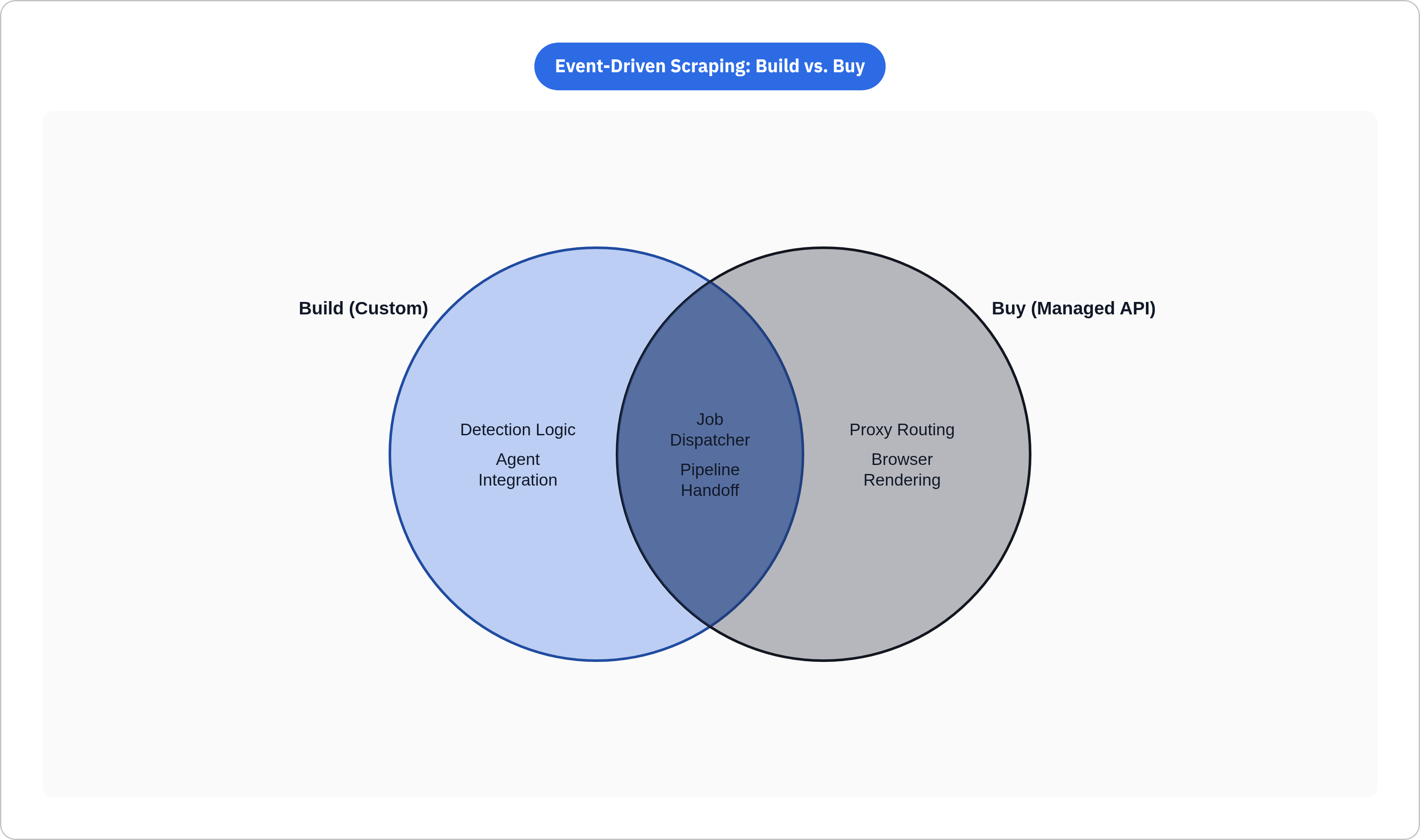
The detection layer and job dispatcher almost always need to be custom. They encode business logic about what signals matter in your specific market. No vendor decides for you what a meaningful trigger is. The agent integration is also typically custom. But scraping execution, proxy routing, rendering, and output formatting? Those often aren't worth building yourself.
Self-hosted scraping costs more than the infrastructure line item suggests. At average developer rates, maintaining a moderately complex self-hosted setup can run over a thousand dollars a month in engineering time alone, before infrastructure. Event-driven pipelines are operationally more complex than scheduled crawlers, so that number goes up, not down.
At high volumes, the economics shift sharply. Collecting tens of millions of pages can cost tens of thousands of dollars or more once proxies, retries, infrastructure, and honest accounting of engineering time are factored in.
Managed API pricing as of mid-2026, for reference: Zyte API at $0.13 per 1,000 simple HTTP requests on pay-as-you-go, Firecrawl's Hobby tier at $16 per month for 5,000 pages, and Bright Data's Web Scraper API at $1.50 per 1,000 records or from $499 per month for volume plans. These move, so verify before you budget.
Most teams land on the same practical split: build the detection and orchestration layers, buy or use a unified API for execution, routing, rendering, and formatting. Olostep, for instance, is a web scraping and crawling API that handles browsers, proxies, and anti-bot infrastructure for developers, covering search, scraping, crawling, and output formatting through a single endpoint rather than requiring teams to stitch separate tools together.
A single API that handles search, scraping, rendering, output formatting, and monitoring eliminates the integration surface where event-driven pipelines typically break. Every handoff between separate tools is a failure point under burst load. Fewer handoffs, fewer places for things to go wrong at 2 AM when the queue is backing up.
The right question isn't whether you can build this. You can. The question is what maintaining it actually costs when the pipeline is running at the volume and reliability an event-driven agent requires. That number is almost always higher than the first estimate. And it keeps going up. As one engineer put it after his third late-night incident page: "I didn't build a scraping pipeline — I built a very expensive alarm clock that only goes off when I'm asleep."