Headless Browser Use in AI Agent Workflows
Headless browsers let AI agents interact with modern websites the way humans do.

The web most people navigate looks nothing like what a Python script sees when it fetches a URL. A significant share of modern websites render their meaningful content through JavaScript that executes after the initial HTML loads, a pattern often called client-side rendering: prices, inventory counts, personalized dashboards, interactive menus. Tools like curl or Python's requests library retrieve only the initial shell. Session state (meaning login cookies, localStorage, multi-step form progress) evaporates between stateless requests. This is the default architecture of the contemporary web, not an edge case.
A headless browser is a full browser engine (including JavaScript runtime, DOM, network stack, and cookie store) running without a visible graphical interface and controlled programmatically. It renders pages exactly as a user's browser would: executing scripts, applying styles, firing events, following redirects, persisting session state. From the web server's perspective, it is indistinguishable from a human opening Chrome.
An HTTP library and a headless browser do not address the same problem. Conflating them is how projects get into trouble early, and I have watched that happen more times than I would like to count.
The more consequential distinction, though, is between scripted browser automation and a browser agent. A Playwright or Puppeteer script follows a fixed sequence of developer-written instructions. It is deterministic, and brittle: when a button's CSS class changes from btn-primary to button-main, the script fails. A browser agent adds an AI reasoning layer on top of the browser control primitives. It reads the current page state, decides what action to take next, and adapts when the page looks different than expected. That same button, described semantically as "Submit," gets clicked regardless of its underlying class name.
The headless browser is the execution layer. The LLM is the reasoning layer. Each is insufficient without the other. But what if that pairing is still not enough on its own? That is the question the sections below try to examine.
How the agent-browser integration actually works at the technical level
The core loop is simple to state and difficult to implement reliably: perceive page state, reason about what to do, act, perceive the updated state, repeat — a pattern researchers call the perceive-reason-act cycle. The interesting engineering lives inside each step. So do a lot of the interesting failures.
Getting page state to the LLM
Two main approaches have emerged, and choosing between them involves tradeoffs that are not obvious from reading documentation alone.
The accessibility tree approach, used most prominently through Playwright's MCP server, sends a structured semantic representation of the page rather than raw HTML or a screenshot. A submit button is described as Role: button, Name: Submit regardless of its underlying CSS class names, inline styles, or position in the DOM tree. Raw HTML is noisy in ways that matter: scripts, tracking pixels, inline styles, and advertising tags all compete for space in the context window, consuming tokens that could otherwise carry task-relevant state and forcing the LLM to infer semantic meaning from syntactic structure. The accessibility tree strips that noise and surfaces meaning directly, which is why it dominates agent integrations despite not being the most intuitive first choice.
The visual approach, used by tools like Skyvern, takes a screenshot of the current browser state and passes it to a vision-capable LLM to identify and locate target elements. It can operate on websites the agent has never encountered without any custom configuration, reasoning from appearance rather than structure. More generalizable, more computationally expensive. Neither approach is obviously correct across all tasks; in practice the choice often depends on how predictable the target surfaces are and how much tolerance the project has for inference cost. One might argue that the accessibility tree is strictly superior — but that conclusion breaks down quickly on sites where the semantic markup is poorly maintained or missing entirely.
Session persistence
Multi-step workflows (a checkout flow, a government form filing, an invoice download from a vendor portal) require maintaining cookies, localStorage entries, and auth tokens across actions. Each action in the sequence depends on state established by the previous one. Losing that continuity mid-task is a failed task, not a degraded one. This sounds obvious stated plainly. It is also the kind of thing that gets underspecified in early architectural discussions, then surfaces as a production incident at the worst possible moment, usually when volume has scaled enough that the failure rate is suddenly visible.
MCP as the wiring standard
Anthropic announced the Model Context Protocol in November 2024 as an open standard for connecting AI assistants to external systems. OpenAI adopted it in March 2025. Playwright and Selenium have both released MCP servers, making browser control a standardized capability that AI agents can invoke through a consistent interface. The analogy circulating among practitioners: MCP serves the same function for AI tool integration that USB-C serves for hardware. One standard port, many compatible devices. Chrome DevTools now has an MCP server as well, letting AI coding assistants debug live browser behavior directly rather than reasoning about code in the abstract.
The tool landscape: automation frameworks, agent platforms, and managed infrastructure
The market organizes into three distinct layers. Conflating them produces poor architectural decisions more reliably than almost any other mistake teams make early in a browser agent build.
Layer 1: Automation frameworks
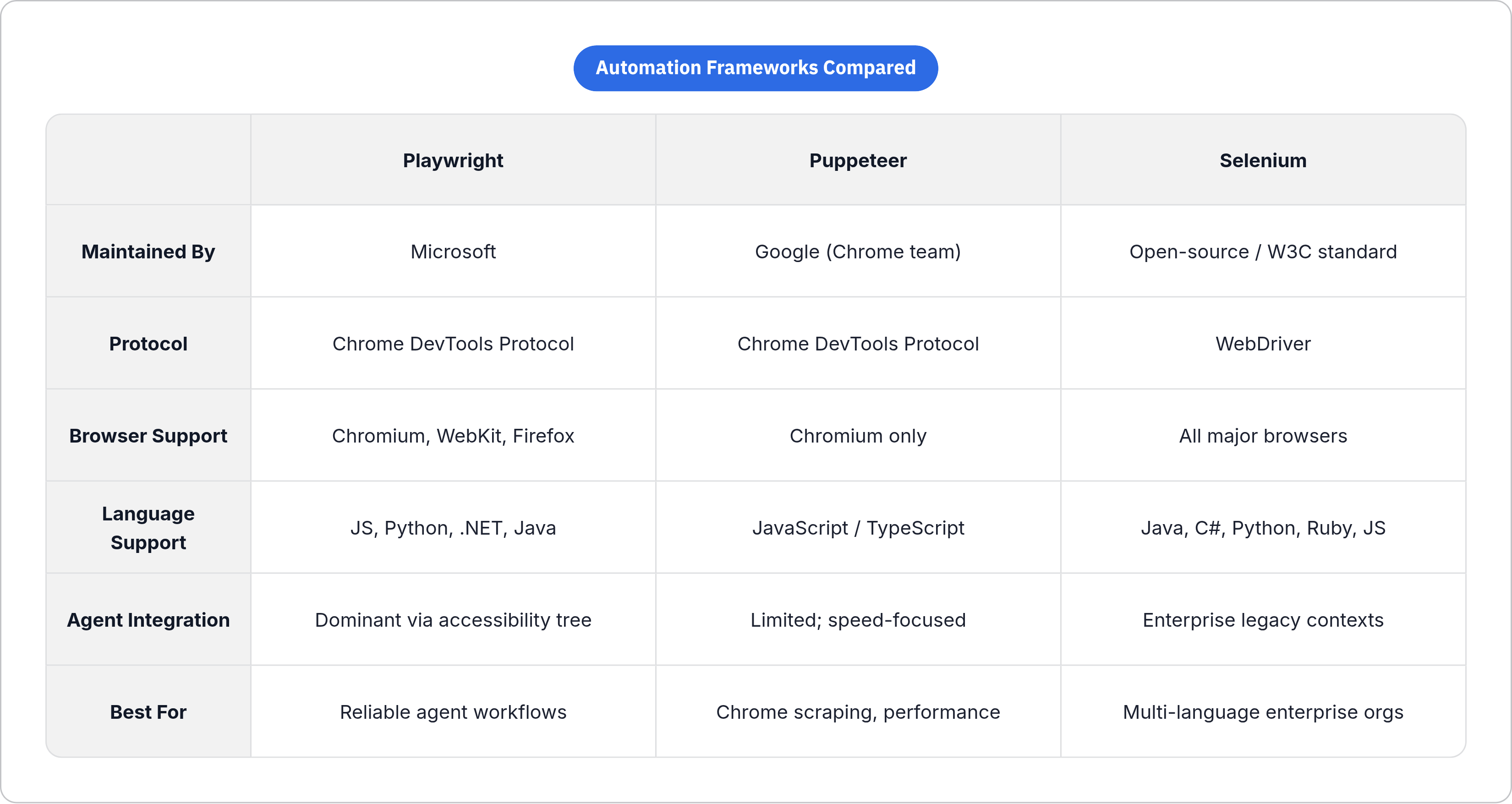
Playwright, maintained by Microsoft, is the current standard for reliability in agent contexts. Its auto-wait mechanism prevents the element-not-found errors that plague timing-sensitive automation; it supports Chromium, WebKit, and Firefox; and its accessibility tree output is the primary reason it dominates agent integrations rather than any particular advantage in raw execution speed.
Puppeteer runs meaningfully faster than Playwright on raw Chromium tasks by staying closer to the Chrome DevTools Protocol. That speed advantage makes it the right choice for Chrome-focused scraping, screenshot generation, and performance monitoring where cross-browser flexibility is irrelevant.
Selenium remains unmatched for multi-language enterprise environments requiring Java, C#, Python, Ruby, and JavaScript support from a single framework. The WebDriver protocol introduces latency compared to Playwright and Puppeteer, both of which communicate directly over the Chrome DevTools Protocol. It is the choice when organizational constraints outweigh performance considerations, which happens more often than engineers who haven't worked inside large enterprise environments might expect.
Vercel's agent-browser is a headless CLI designed specifically for AI agent integration as an MCP server, letting Claude Code connect to and control a real browser session for sites with anti-bot protection or heavy JavaScript rendering. Its 12,100-plus GitHub stars suggest meaningful adoption in a narrow but real use case.
Layer 2: AI-native agent frameworks
Browser Use is the leading open-source framework for AI browser agents, achieving an 89.1% success rate on the WebVoyager benchmark across 586 diverse web tasks. Its 97,000-plus GitHub stars as of 2025 reflect developer adoption at a scale that simply was not present three years ago.
Skyvern uses computer vision and vision-capable LLMs to identify elements from screenshots rather than DOM selectors. Backed by Y Combinator, with 22,200-plus GitHub stars and 30,000-plus users, Skyvern also built the Web Bench benchmark covering more than 5,700 tasks across over 450 websites, which has become a meaningful empirical reference point for evaluating agent performance against real-world conditions rather than synthetic ones.
Lightpanda is worth noting for a different reason. Written from scratch in Zig rather than forked from Chromium, it claims a dramatically smaller memory footprint and substantially faster execution than Chrome. Its current market share is not the point; the point is that some engineers have concluded the resource cost problem requires a structural solution rather than optimization of existing engines. That is a different kind of signal than a framework adding features.
Layer 3: Managed cloud infrastructure
Browserbase raised a $40 million Series B at a $300 million valuation in June 2025 and processed 50 million sessions in 2025 across more than 1,000 customers. Its product is managed browser infrastructure purpose-built for agent workflows: persistent sessions, session recordings for debugging, and drop-in compatibility with standard Playwright and Puppeteer APIs.
Browserless brings eight years in production, more than 173 million Docker pulls, and 99.9% uptime, integrating with LangChain, Claude Computer Use, and custom frameworks through standard APIs.
Cloudflare Browser Rendering runs Playwright serverlessly via Cloudflare Workers and converts webpage content to Markdown for direct LLM consumption, collapsing two steps of the pipeline into one. It is also worth considering whether that convenience introduces its own tradeoffs for any specific use case; the answer is not always obvious before you have run something through it at volume.
Framework choice is ultimately a reliability, integration, and operational decision. Performance is rarely the deciding variable, even when teams initially assume it will be.
What browser agents are being used for in production
Production use clusters around tasks that are high-frequency, rules-based in intent but variable in execution, and previously required human time at a screen.
Competitive intelligence and pricing extraction, a subset of web scraping, are among the most common applications: pulling competitor pricing across many sites to feed dynamic pricing models requires fresh data on demand, not periodic crawls, and no competitor offers an API for this. Enterprise RPA-style workflows cover job application assistance, invoice downloading, and form filings for newly formed companies (all documented production cases). Government and regulated-industry interactions, including healthcare system portals, IT onboarding and offboarding flows, and government form submissions, represent workflows where the interface is fixed but the data varies per run. Seventy-three percent of enterprises in 2025 rely on automated web data extraction for business intelligence, which suggests the practice has moved well past early adopter territory.
The pattern across these use cases holds: the website is the only available interface, no API exists, and the workflow has enough volume or frequency that human execution is the actual bottleneck. Browser agents do not expand what is theoretically possible; they expand what is economically viable to automate.
Consumer-facing browser agents represent a parallel track. Perplexity Comet, launched in July 2025, embeds autonomous navigation and form filling into a full Chromium browser. OpenAI's ChatGPT Atlas, launched in October 2025, puts ChatGPT reasoning into every browser tab. These products shift the same headless-browser capability into user-facing interfaces, which means the population of people encountering this architecture is about to grow substantially, whether or not they know what a headless browser is.
The real costs and failure modes teams underestimate before deploying browser agents
Some of these failures are predictable from first principles. Others are the kind you only internalize after watching a production system degrade in ways that weren't in any benchmark, at a moment when the cause is neither cleanly diagnosable nor easy to fix quickly.
Resource overhead is structural
Each browser instance consumes somewhere between 200 and 500 megabytes of memory and runs several times slower than equivalent HTTP requests. The bottleneck in agentic browser workflows is not LLM inference speed; it is waiting for JavaScript to render. Faster models do not change this. Token costs scale linearly with volume: processing a million pages costs a thousand times more than processing a thousand pages, unlike traditional infrastructure where marginal costs tend to decline with scale. Teams that budget carefully for LLM costs and treat browser infrastructure as a rounding error tend to discover this mismatch at volume.
Anti-bot detection has outpaced basic evasion
Detection now operates on device fingerprints, behavioral analysis, TLS fingerprints, and header validation through techniques collectively known as browser fingerprinting (far beyond IP-blocking and cookie inspection). Cloudflare Turnstile, Akamai, and similar systems look for automation signals like consistent window sizes or missing font renders. CAPTCHAs now include honeypot elements invisible to real users but visited by automated agents. Skyvern's Web Bench benchmark found that proxy failures, CAPTCHAs, and authentication blocks account for a meaningful share of agent task failures even when the agent's reasoning is entirely correct. The infrastructure can fail the task even when the model succeeds. That failure mode is particularly painful because it does not surface cleanly in evals; the model looks fine and the system is broken.
Headless versus headful is no longer a simple default
Headless remains the right choice for scalable, API-first extraction and CI automation. Headful browsers are increasingly necessary for agentic workflows on high-friction surfaces because a real browser window is substantially harder to fingerprint as automated. The practical pattern that has emerged: managed headless infrastructure for bulk extraction, headful browsers for agent workflows where resembling a real user is the actual requirement. Teams that treat headless as the universal default discover the exception through production failures rather than planning.
Compound failure rates
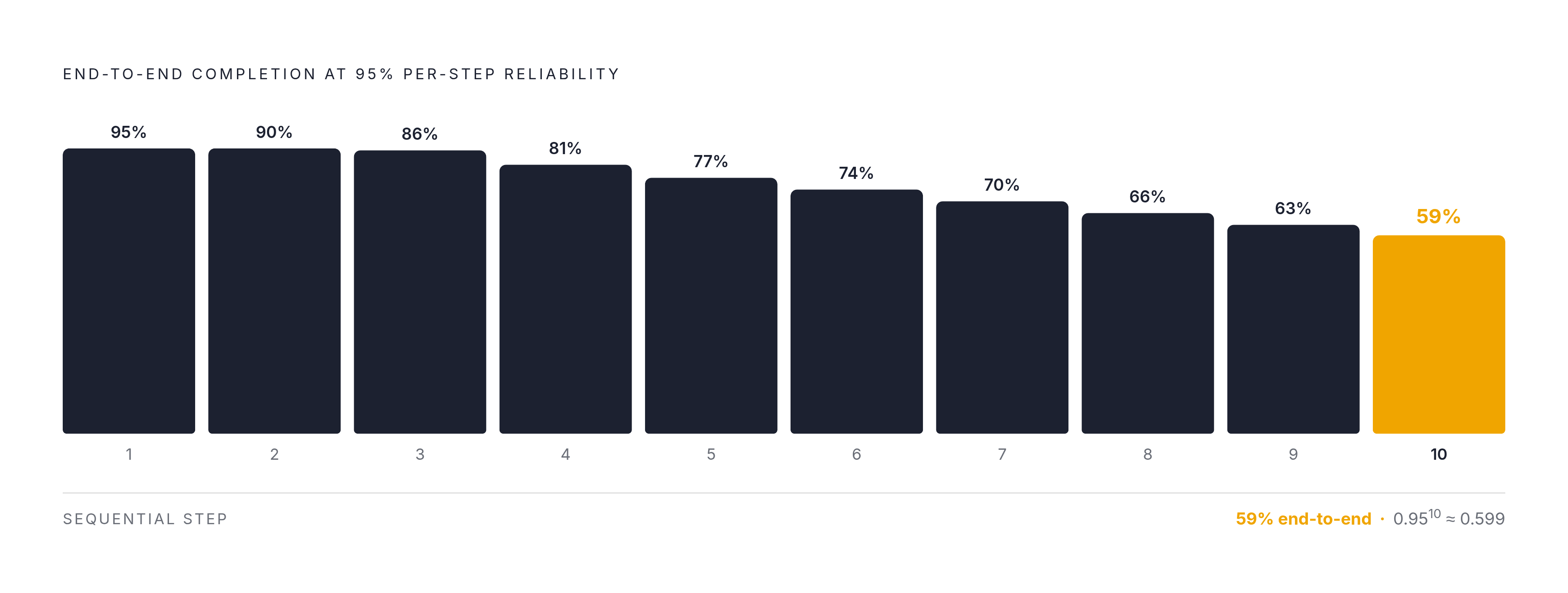
Vendor-reported success rates in published benchmarks typically land in the low-to-mid nineties. A five to ten percent per-step failure rate sounds modest until you work through the arithmetic: a task requiring ten sequential browser actions at 95% per-step reliability produces an end-to-end task completion rate below 60%. This is not a complicated calculation. It is, however, an easy one to avoid making until a workflow that looked fine in testing becomes unreliable at scale. Demo environments are precisely where compound failure rates stay invisible; production is where they surface all at once.
The MCP security surface
MCP was designed for simplicity and connectivity, not with authentication and encryption as primary constraints. Known attack vectors include tool poisoning (where malicious descriptions are embedded in MCP tool definitions), silent definition mutation, and cross-server tool shadowing (where a malicious agent intercepts calls meant for a trusted one). Teams deploying browser agents at scale through MCP should treat its trust model as an open engineering question. The convenience of a standardized interface does not automatically confer the security properties of a mature protocol, and the two are easy to conflate when you're moving fast.
Why headless browser infrastructure has become a distinct engineering discipline within AI agent development
Three signals, taken together, suggest this is a durable shift rather than enthusiasm around an immature capability.
Open-source adoption: Browser Use at 97,000-plus GitHub stars and Firecrawl crossing 130,000-plus stars, landing in GitHub's top 100 repositories in 2025, reflect developer demand that did not exist three years ago. Repositories reach those numbers because practitioners are solving real production problems with them. Marketing does not produce that kind of traction; accumulated frustration with inadequate alternatives does.
Investment: Browserbase's $40 million Series B at a $300 million valuation in June 2025, for a company whose entire product is managed browser infrastructure for AI agents, is a meaningful data point. Investors pricing that valuation are not betting on a niche feature; they are pricing a large and growing market for what is essentially picks-and-shovels infrastructure. That framing may prove too optimistic, but the underlying bet is coherent.
Standardization: MCP adoption by both Anthropic and OpenAI, with Playwright and Selenium both releasing MCP servers, suggests the integration pattern is converging toward a stable interface. Fragmented ecosystems consolidate when a problem is real and recurring. This one is consolidating.
For teams building on AI agents, the practical implication is direct. Any agent system that must interact with the live web requires a considered answer to the browser execution layer question. Framework choice, managed versus self-hosted infrastructure, headless versus headful mode: these are architectural decisions with downstream consequences for reliability, cost, and anti-bot resilience. The Web Bench benchmark results, showing infrastructure failures as a leading cause of agent task failures, make concrete what is otherwise easy to dismiss as an implementation detail. Browser infrastructure quality and agent model quality are co-determinants of task success, not independent variables.
The teams that treat browser infrastructure as a commodity abstraction tend to find out they were wrong in production. Why exactly does that keep happening? At this point, the most honest answer is that the cost of the assumption stays invisible right up until the moment it isn't — and by then, the system is already in production.