Legal and Ethical Boundaries of Web Scraping
Most web scrapers operate legally by staying on the right side of four clear boundaries.

Web scraping has a reputation problem. Developers talk about it like it's jaywalking. Technically fine, probably, but you never quite know when someone's going to make an example of you. That reputation is mostly unearned. The legal ground around scraping public data is more settled than most people realize, the ethical side is more navigable than the discourse suggests, and the actual risks are specific and largely avoidable once you know what you're looking at.
Start with the finding that most developers have heard but don't quite believe: scraping publicly accessible data without bypassing access controls is legal in the United States under settled case law.
Not "probably legal." Not "legal-ish." Settled.
Most of the anxiety comes from treating every cease-and-desist letter like a preview of criminal prosecution. Courts have drawn a clear line, and if you're on the right side of it, you're fine. The CFAA (Computer Fraud and Abuse Act), which is the federal statute everyone worries about, has been narrowed so many times it's simply not the threat most developers imagine.
Here's how we got here:
- hiQ Labs v. LinkedIn (Ninth Circuit, 2019): Scraping publicly accessible data without bypassing technical access controls is not a CFAA violation. LinkedIn sued hiQ for scraping public profiles. hiQ won. The court's logic: if you can see it without logging in, the CFAA doesn't protect it.
- Van Buren v. United States (2021): The Supreme Court narrowed the CFAA further still. Misusing authorized access doesn't constitute "exceeding authorized access" under the statute. This is the moment contract law became the primary weapon for data owners. Not criminal law.
- Meta v. Bright Data (January 2024): A federal court confirmed via summary judgment that logged-out scraping of public pages is not a CFAA violation. Judicial skepticism toward treating Terms of Service as a criminal legal barrier is real, and it keeps growing.
The consistent thread across all three cases is the same distinction: public and accessible versus behind an authentication wall. Courts keep landing on the same side of that line.
What these rulings do NOT protect is equally clear:
- Scraping that bypasses logins or CAPTCHAs
- Targeting personal data
- Causing measurable harm to servers
Stay on the right side of those three things and the CFAA is largely a non-issue. The real exposure, as Van Buren made plain, comes from contract law and data privacy regimes. Not federal criminal statutes.
Where the Meta v. Bright Data ruling cuts the other way
People hear "Bright Data won" and stop reading. The same case produced a split result, and you have to hold both halves together to actually understand what it means.
Bright Data won on the CFAA question. Logged-out public scraping: not a violation.
Bright Data lost on something else. Scraping done contrary to contractual restrictions. The court sided with Meta on breach of contract, even after dismissing the criminal liability angle. So the operative question shifted. It's no longer simply "is the page public?" It's "did I agree to terms that restrict what I do with it?"
This is where the clickwrap versus browsewrap distinction matters in practice:
- Clickwrap: You saw a box, you clicked "I Agree." Courts enforce these. You're bound.
- Browsewrap: Terms buried in a footer, applied passively to anyone who visits. Courts are far less likely to enforce these against someone who never created an account.
The practical decision rule comes down to two questions:
- Did I create an account on this site?
- Did I accept terms during signup?
If both answers are yes, you have contract exposure. If you never created an account and never clicked "I Agree," browsewrap terms alone are unlikely to create legal liability for scraping public pages. That's not a loophole. That's how contract formation works.
The four legal boundaries that actually determine exposure
These are the four things that can actually get you in trouble. Everything else is secondary.
Authentication
Do not bypass logins, CAPTCHAs, or any other technical access control. This is where CFAA liability survives. The moment you're working around a gate the site deliberately erected, you've crossed from "scraping public data" into something courts treat very differently.
Personal data
Scraping personally identifiable information triggers GDPR and CCPA immediately, regardless of whether the page is technically public. GDPR fines go up to €20 million or 4% of global annual turnover, whichever is higher. The rule of thumb: if the data could identify a natural person, treat it as regulated data. "But the page was public" is not a defense under GDPR. The page being accessible doesn't change what the data is.
Copyright
Extract facts and structured information, not creative expression. The test isn't whether the page exists publicly. The test is whether you're reproducing protected expression verbatim. Facts aren't copyrightable. The specific way someone expressed those facts is.
Rate limiting
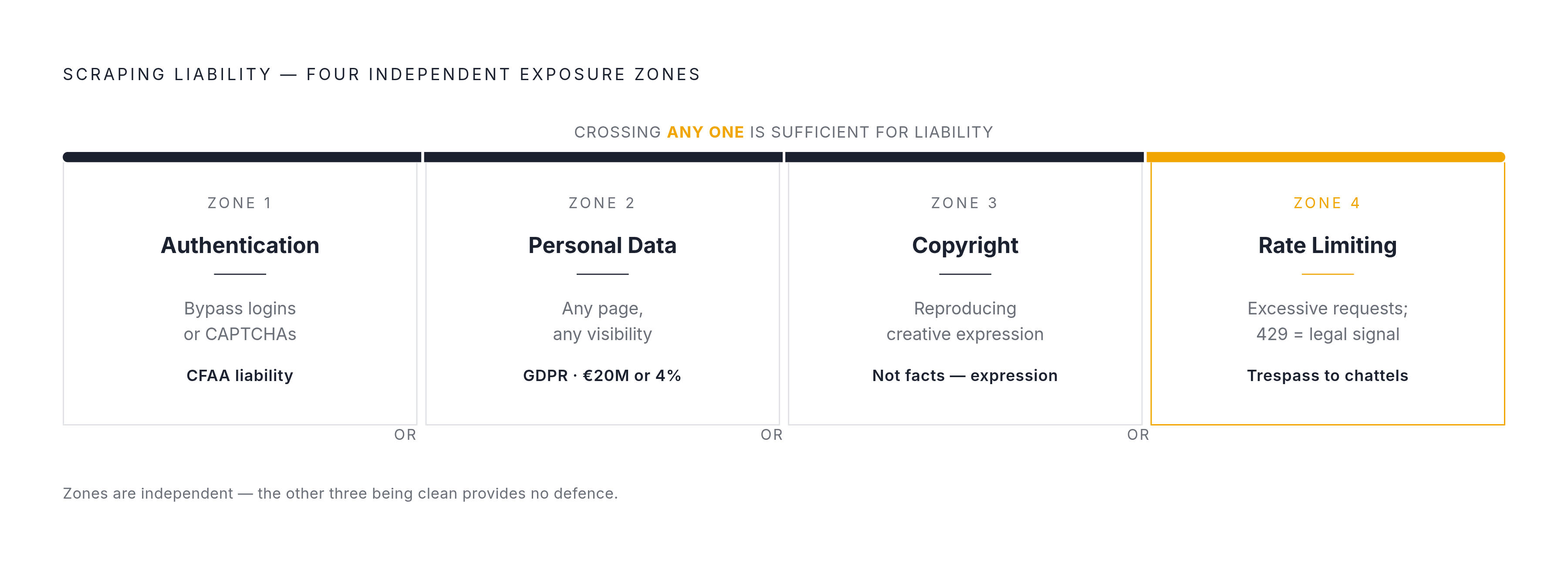
Excessive request rates can activate trespass-to-chattels claims under common law. The theory requires actual damage or impairment to the system, but the bar is lower than most people expect. A 429 (Too Many Requests) response or an IP block is a legal signal, not just a technical inconvenience. Pushing through it is how compliant scraping becomes actionable. When a site tells you to slow down, slow down.
These four boundaries are independent. Crossing one is enough. You can be perfectly compliant on three and still face real liability on the fourth.
AI training data is where the legal ground is still moving
Everything above applies to scraping for operational use. AI training data is a separate, actively litigated question, and anyone telling you the law is settled here is either uninformed or has something to sell you.
The US baseline is that scraping publicly accessible data to train foundational models is generally considered fair use, provided the model doesn't reproduce copyrighted works verbatim. Every major LLM was built on datasets assembled by crawling billions of pages. GPT, Claude, Gemini, Llama. All of them. The practice is foundational to the AI era.
The legal argument runs on transformativeness. AI developers argue that training is transformative because you're learning patterns, not copying expression. Content owners argue that volume, commercial value, and the ability of model outputs to substitute for the original work weigh against fair use. Neither side has won at the appellate level yet.
The U.S. Copyright Office issued a report on Generative AI Training in 2025 and declined to adopt a categorical rule. Fair use in AI training must be assessed case-by-case. The cases that will shape the answer are still in progress:
- The New York Times Co. v. Microsoft Corp. (filed December 2023) is still pending
- Anthropic settled a copyright class action for $1.5 billion in September 2025
- Reddit sued Anthropic and Perplexity AI in 2025
- YouTube creators filed class actions against Nvidia, Snap, and Meta in early 2026
The EU AI Act adds a layer. It requires disclosure of training data sources and mandates honoring machine-readable opt-outs as the legal basis for the lawful-use exception. Not a courtesy. A legal requirement.
The AI Accountability for Publishers Act was introduced in February 2026. It would require permission and payment before scraping for training purposes. It hasn't passed, but it signals where legislative attention is focused.
If you're building AI training pipelines, document your data provenance now. Which domains, which crawler, which date range. This is a compliance requirement for EU users today, not a best practice you can defer until things shake out.
How robots.txt, ai.txt, and purpose-based signals have become legal instruments
Robots.txt is a thirty-year-old text file. It was designed to tell search crawlers which pages to skip. It was never intended to referee dozens of AI crawlers competing to pull content for training and real-time answers. That's what it's doing now, and its legal weight has increased materially.
In the EU, machine-readable opt-outs carry formal legal weight. France's CNIL explicitly considers robots.txt compliance in Legitimate Interest assessments. The Hamburg Higher Regional Court ruled in December 2025 that natural language opt-outs in terms of use are insufficient. Opt-outs must be machine-readable, whether that's robots.txt, TDM Reservation Protocol Headers, or ai.txt metadata.
Ignoring robots.txt is not a standalone US federal crime. But it serves as strong evidence of bad faith, and bad faith colors the entire legal picture when you end up in front of a judge.
A few developments that shifted the defaults quickly:
- Cloudflare flipped its default (July 1, 2025): New domains now block AI crawlers by default. Cloudflare sits in front of roughly 20% of the public web. A lot of the internet went from open-by-default to closed-by-default for AI training, almost overnight.
- Millions of websites now block OpenAI's GPTBot, with the number climbing steeply through late 2025.
- Purpose-based access control is now a real thing. Site owners can allow search and attribution crawlers while blocking training crawlers. Same content, different permissions depending on what you're using it for.
There's also llms.txt, a proposed standard that tells AI systems what to prioritize rather than what to avoid. Adoption is still early, and Google has explicitly said it doesn't support it. Worth respecting where you see it, but not a reliable system to build on.
These signals are becoming the evidentiary record of whether a scraping operation acted in good faith. Treating them as optional is a choice, and it has consequences.
The ethical lines that legal compliance does not cover
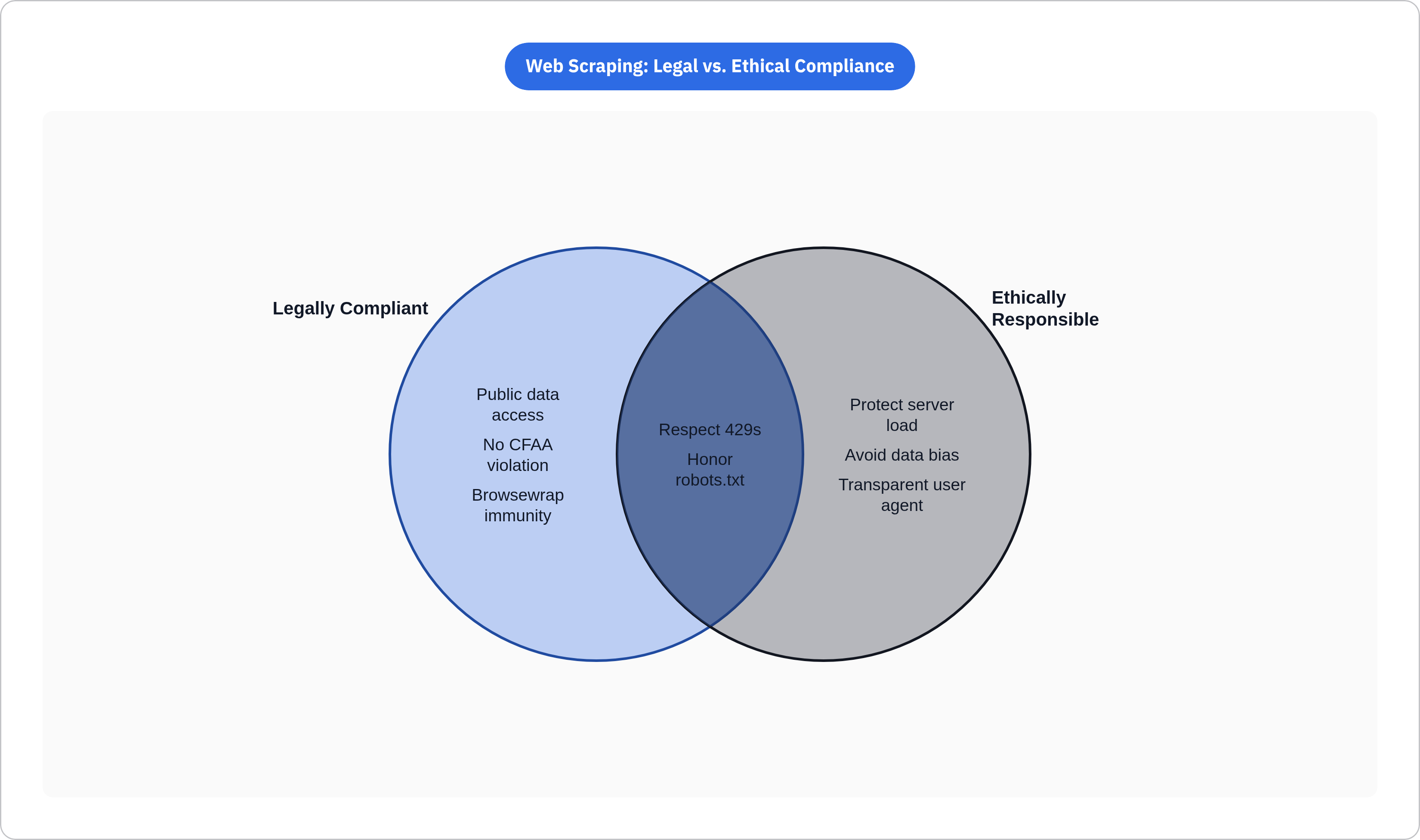
You can be completely legally compliant and still cause real harm. That's the part the legal analysis doesn't cover, and it's worth being honest about.
Server load. A scraper that's technically within its legal rights can still degrade a small site's availability. The Wikimedia Foundation reported a significant bandwidth surge from AI scraper bots in 2025. That's from ostensibly legitimate crawlers. The infrastructure harm at scale is real, even when nobody's technically breaking the law.
Data quality and bias. AI models inherit the quality of their training data. Selectively scraped inputs introduce skewed perspectives that propagate into pricing decisions, product design, and customer targeting. The ethical problem is also a product quality problem.
Transparency. Using a clear, identifiable user agent string and providing a contact address reduces both legal and operational risk. It also signals that someone is accountable for the crawl. Hiding behind a generic browser string isn't clever. It's the kind of thing that looks bad in discovery.
Respecting 429s and IP blocks. The ethical and legal lines converge here. These are signals to slow down, not obstacles to route around. Treating them as routing problems to solve is how compliant scraping turns into actionable harm.
There's also a practical argument worth making explicitly. Developers building AI products on scraped data have a direct interest in the health of the web ecosystem they depend on. Extractive practices that degrade sources, suppress publisher willingness to stay publicly accessible, or burn through site resources ultimately harm the data supply. A healthy, open web is good for everyone who builds on it, including you.
What compliance looks like in a scraping pipeline built at scale
Good intentions don't hold up when you're managing billions of requests. The right defaults have to be built in, because you can't manually check every decision at that volume.
Here's what a compliance-conscious scraping pipeline actually looks like in practice:
- Robots.txt and machine-readable signal parsing built into the crawler layer. Not a per-request manual check. Automated, consistent, logged.
- Rate limiting and exponential backoff built into the request logic. A 429 response triggers a backoff, not a retry loop. IP blocks are rate signals, not routing problems.
- Audit logs. Which domains were fetched, by which crawler, at what time. This is required for EU AI Act compliance and it's the first thing a regulator or opposing counsel asks for.
- Named, identifiable user agent strings with a contact URL. This establishes good faith in the evidentiary record and means someone can actually reach you if there's a problem.
- PII handling. Personal data encountered during a broad scrape must be identified and either excluded or handled under a lawful basis. Storing it by default is not a defensible position.
- Purpose separation. If the same infrastructure handles both search/attribution crawling and AI training, those pipelines need distinct user agents and configurations. Purpose-based access controls on target sites only work if you're actually communicating your purpose.
- Data provenance documentation at ingest. Domain, crawler identity, date range. This isn't reconstructable retroactively once data is pooled. Record it when you collect it.
The case law is settled where it's settled and actively contested where it's contested. The gap between "legal" and "responsible" is real but it's manageable. Build systems that respect the lines by default, and you're ahead of most people doing this work. Olostep, a developer API for large-scale web data collection that handles robots.txt parsing, rate limiting, and anti-bot infrastructure as part of the managed crawl layer, is one example of infrastructure built with these defaults in mind. Some of the tension here doesn't resolve cleanly, and that's just where things stand right now.