Web ScrapingLong read
Web Scraping Fundamentals for AI Agent Pipelines
AI agents need web scrapers built on different foundations than traditional pipelines.
Contributing Editor · · 14 min read

There is a version of web scraping that most engineers learned, the one built around a fixed URL, a fixed CSS selector, and a fixed schema. You run it, you get rows, you move on. That model served an entire generation of data pipelines well enough that it became the default mental frame for anyone who needed to pull content from the web programmatically. It is also, for AI agent pipelines, almost entirely wrong.
The wrongness is not obvious at first. A scraper is a scraper, the reasoning goes: fetch the page, extract the data, hand it off. What changes when the consumer is an LLM-backed agent rather than a database? It turns out, nearly everything. The requirements diverge not at the margins but at the foundation, across rendering, output format, session continuity, anti-bot evasion, and data freshness. Each layer surfaces a different class of failure, and each failure is capable of undoing everything upstream.
The maintenance burden of traditional scraping was already substantial before agents entered the picture. Industry analysis suggests roughly 20% of scraping work involves building and 80% involves maintaining, patching selectors when sites redesign, rewriting parsers when schemas shift, chasing layout changes at 2 AM. That ratio was tolerable when the scraper sat in a cron job, ran, and stopped; when the scraper is embedded inside an autonomous reasoning loop, the same fragility cascades through the agent's entire plan.
The sections that follow examine each layer where agent requirements diverge from traditional scraping assumptions. The goal is not a product survey; it is a structural argument about why the stack that worked before is the wrong starting point now.
## Why JavaScript rendering is the first problem an agent pipeline has to solve
React, Vue, and Angular applications frequently return something close to an empty container on first load, a `
` that holds nothing until JavaScript executes, fetches data, and populates the DOM. An HTTP-only scraper requesting that URL receives the skeleton. When an agent calls that scraper as a tool, the returned content is not just incomplete; it is, in most cases, completely unactionable.
This was a known problem before agents existed. What changed during 2024 and 2025 is the proportion of production sites running SPA architectures. The population of sites that return meaningful content to a plain HTTP request has been shrinking; the agent developer who defaults to an HTTP client and tests against documentation pages or static marketing sites will build something that fails in production on an expanding share of real targets, particularly those built on single-page application frameworks.
Browser automation is the fix. Playwright launches a full Chromium, Firefox, or WebKit instance, executes JavaScript, waits for the DOM to settle, and returns rendered content. The fix is real. The cost is also real. Each headless browser instance carries a memory footprint measured in hundreds of megabytes. Rendering is orders of magnitude slower than a raw HTTP request. In most agent pipelines, the bottleneck is not LLM inference; it is waiting for pages to load.
This cost shapes a practical decision rule that production teams arrive at through iteration rather than theory: not every page needs a browser. Static HTML, documentation, most informational pages, most blogs, return full content to an HTTP client and should be fetched that way. SPAs, login-gated content, and pages that load data asynchronously require browser automation. Routing logic at the fetch layer, detecting whether a given URL needs rendering before dispatching the request, is a standard pattern in mature pipelines. It is not elegant, but it is necessary.
Playwright has largely superseded Selenium for new builds on the merits: async support, built-in auto-waiting, faster context management, a more coherent API. Selenium persists in legacy enterprise environments where migration cost exceeds tolerance; for anything built today, Playwright is the default.
The cost implication of browser rendering at scale is not a detail to resolve later; it structures the entire tooling decision, including whether to run browsers locally, containerized, or through a managed API. That question arrives in a later section, but it originates here.
## How output format determines whether extracted content is usable in an LLM context
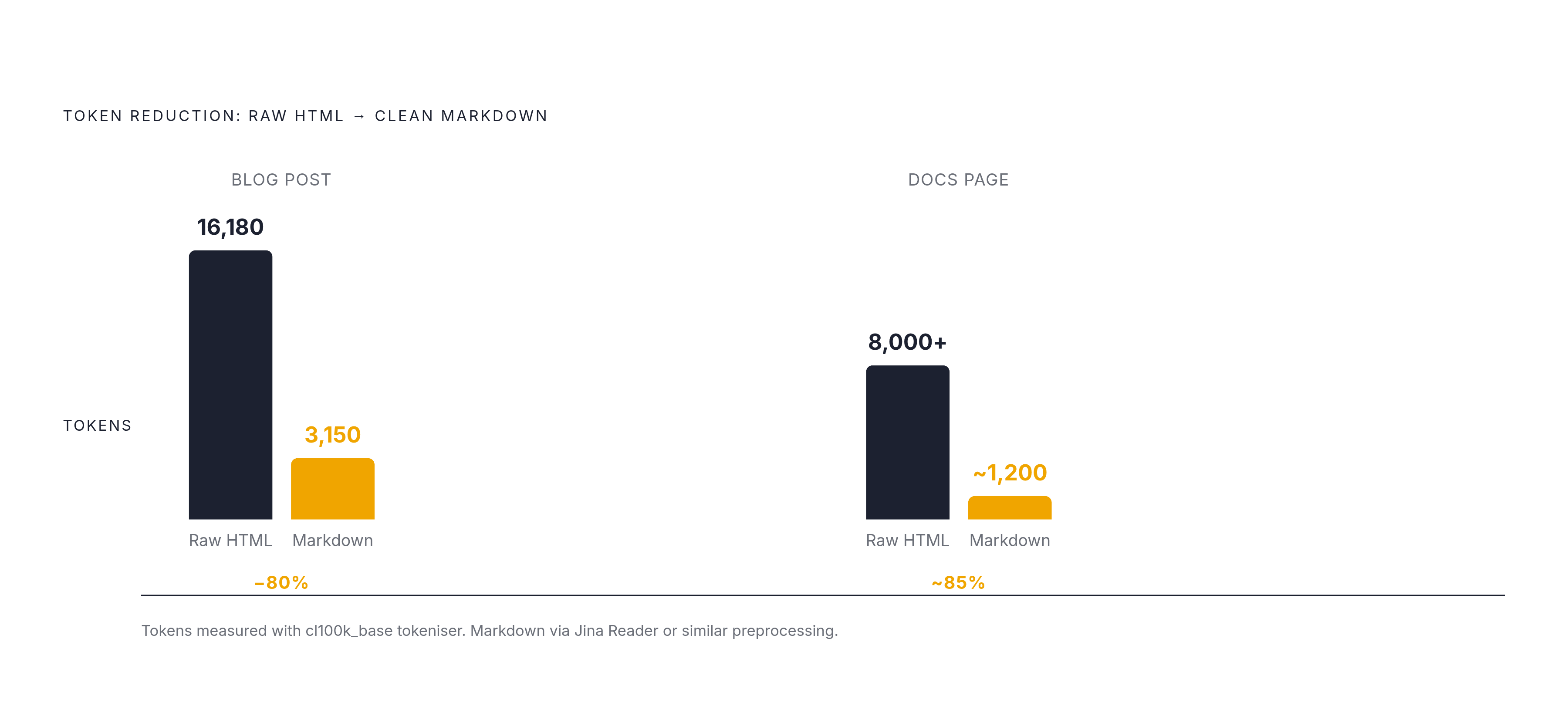
Passing raw HTML into an LLM context window is a mistake that compounds across three dimensions simultaneously. First, tokens: markup, attributes, inline styles, and boilerplate consume context window budget without contributing semantic content. Second, accuracy: the 2025 NEXT-EVAL benchmark found that Flat JSON extraction achieved an F1 score of 0.9567, a meaningful performance advantage over raw or thinly processed HTML. Third, latency and cost, because larger context windows produce slower inference and higher per-call cost. None of these effects is minor in isolation; together, they make format selection a first-order pipeline decision rather than a cleanup task.
Markdown has become the practical default intermediate format for LLM-bound content. Its token efficiency relative to raw HTML is substantial, roughly two-thirds fewer tokens while preserving the semantic structure, headings, lists, links, that LLMs use for reasoning. At the scale of thousands of pages re-crawled on a recurring schedule, that compression compounds into differences that are legible in cost and latency.
JSON is the right format when the agent needs specific, structured fields: price, availability, publication date, author, jurisdiction. Schema-based extraction, whether defined via CSS or XPath selectors or via natural language prompt, is preferable to asking the LLM to parse prose and extract structure on its own. The latter works; it is also slower, more expensive, and less reliable than providing structure at the ingestion layer.
Boilerplate removal is not optional and not cosmetic. Navigation menus, cookie consent banners, footer links, sidebar ad slots, and related-content widgets all arrive in the DOM. They consume tokens. They dilute the semantic signal the agent needs. A page about pharmaceutical pricing that arrives with three hundred tokens of navigation markup and four hundred tokens of footer content is a worse input to a reasoning system than the same page stripped to its body content, even if the raw information was technically present in both versions.
The format decision is made once, at ingestion time, but its effects propagate through every downstream step. Retrieval quality, chunk coherence, and hallucination rate all depend on what format the content arrives in. Teams that treat format as a cosmetic concern tend to discover this the hard way, after retrieval starts returning plausible-looking but semantically diffuse chunks.
## How session management breaks down when scraping is embedded in multi-step agent reasoning
Traditional scraping jobs run fast. The scraper starts, makes its requests, finishes; the session, if one exists, lives and dies within a narrow window. AI agents operate differently. They reason between tool calls. A single plan can span minutes, and within that plan, the agent may call a scraping tool multiple times, returning to the same authenticated site across distinct steps in its reasoning process.
The failure mode is predictable once you have seen it once. The agent authenticates, retrieves some content, reasons about what it found, decides it needs more, calls the scraping tool again, and the target site sees what appears to be a new session. Without cookie and header state persisted across tool calls, the agent's second request arrives without the authentication context the first request established. The agent logs in again. The site's security systems observe two login events from the same account in a short window, a signal consistent with credential stuffing or account takeover. The session is flagged. A CAPTCHA appears, or the account is temporarily locked.
What session persistence actually requires in an agentic context is more specific than it sounds. Cookie state must survive across tool calls, not just within a single HTTP session object. Browser context must be reused so that the agent's fingerprint to the target site remains consistent across calls. Timeout and re-authentication logic must exist for cases where sessions expire mid-plan, which they will. These are architectural requirements, not anti-bot countermeasures; they are necessary regardless of whether the target site runs any bot detection at all.
Pipelines built on stateless scraping tool calls will encounter this failure in production. It tends not to surface in testing because test tasks are short, single-session, and complete before any session could reasonably expire; the failure is a property of deployment at realistic task duration, not of the code itself.
## What modern anti-bot systems actually detect and why fingerprint spoofing alone is insufficient
The scale of deployment clarifies the stakes. Cloudflare serves a significant fraction of the web's traffic, and in July 2025, Cloudflare began blocking AI-based scraping by default. That is not a policy edge case; that is a structural shift in the default posture of a substantial portion of the internet toward automated content retrieval.
Modern bot detection systems operate across several detection layers simultaneously, and understanding each is necessary to understanding why addressing only one of them is insufficient.
TLS fingerprinting identifies the client library from the shape of its handshake. Python's `requests` library produces a recognizable fingerprint that flags immediately on systems looking for it; `curl_cffi` spoofs this fingerprint to match a real browser. That matters, and it is also only the first layer.
JavaScript environment fingerprinting examines the browser context for signs of automation. Headless Chromium leaks via `navigator.webdriver=true`, missing browser plugins, incorrect screen dimensions, and other artifacts that differ from a real user's environment. Stealth patches address some of these; the arms race between detection and evasion on this layer has been running for years.
Behavioral biometrics are where the detection sophistication becomes qualitatively different. Systems from vendors like DataDome and Kasada collect mouse coordinate sequences, scroll acceleration curves, click timing intervals, and keyboard event patterns. These feed machine learning classifiers that produce a human/automated confidence score. The score is not based on any single signal; it is based on the statistical consistency of the full behavioral profile over the session.
IP reputation is, at this point, nearly deterministic for some scenarios. Datacenter IP ranges are catalogued and flagged; residential proxy or mobile IP pools are required for access to heavily protected targets.
Active CAPTCHA systems like Cloudflare Turnstile score behavioral signals invisibly before surfacing a challenge; reCAPTCHA v3 assigns a session-level risk score without user interaction.
The 2025 evolution that changes the calculus further is intent-based detection. DataDome's systems moved beyond asking whether a visitor is a bot and toward asking what the visitor is trying to accomplish. Navigation patterns that suggest systematic data collection, methodical progression through pages, no dwell time, no scroll variation, no incidental navigation, trigger flags even when every individual fingerprint is clean. DataDome also added explicit LLM crawler detection in 2025, a response to the fact that LLM crawler traffic across their customer base quadrupled during that year, rising from a small fraction of verified bot traffic in January to a substantially larger share by August.
DataDome runs tens of thousands of customer-specific machine learning models, according to analysis from Scrapfly, meaning each protected site presents a distinct detection challenge. A technique that succeeds on one site may fail on the next, not because of configuration differences but because the underlying model was trained on that site's specific traffic patterns.
The practical implication for agent pipelines is that the behavioral layer is the hardest to address, and it is also the layer where agent behavior is most obviously non-human. An agent navigates methodically, quickly, without variation, without distraction; that is, by design, the opposite of how a person uses a website.
## Data freshness as the pipeline failure that undoes everything upstream
Static retrieval-augmented generation systems show materially higher hallucination rates due to knowledge decay: content that was accurate when scraped but no longer reflects current state. This is not a theoretical concern. It is, by most practitioner accounts, the leading production RAG failure, outranking retrieval algorithm quality and chunking strategy as a source of incorrect outputs. The enterprise adoption of RAG has been rapid, with deployment rates growing from a small fraction of enterprises in early 2024 to a substantial majority by 2026, according to developer community surveys; most of those deployments are now encountering the freshness problem at scale.
What "stale" means is domain-specific. Pricing and inventory data can become misleading within hours. News, regulatory filings, and research output needs daily re-ingestion to remain reliable. Product documentation and company information may tolerate weekly update cycles or change-triggered re-crawls. The TTL, or time-to-live, is not a universal parameter; it is a domain decision that has to be made explicitly, not defaulted.
Freshness is a pipeline design decision, not a retrieval one. It cannot be addressed by improving the retrieval algorithm or tuning chunk size; it must be addressed at the scraping layer, through scheduled re-crawls, change detection monitoring, or event-triggered re-ingestion. Retrieval quality improvements compound on top of fresh content; Anthropic's contextual retrieval approach, which prepends document-level context to each chunk before embedding, reported a substantial reduction in retrieval failures relative to naive chunking approaches. That gain only holds if the underlying content is current. A retrieval system operating on stale data with better chunking still returns stale data, more precisely.
Caching interacts with freshness in ways that are easy to get wrong. Aggressive caching reduces the cost of browser rendering but delays updates. The right TTL is domain-specific, and teams that default to long cache windows for cost reasons frequently discover the trade-off when an agent confidently reports a price or availability status that is no longer accurate.
## The current tool landscape and how to match tools to pipeline requirements
The most useful way to organize the tooling landscape is by layer, not by product. Every pipeline has the same layers; the right tool for each depends on volume, target complexity, and whether the downstream consumer is a structured database or an LLM.
For HTTP fetching of static pages, HTTPX handles async requests efficiently. When TLS fingerprint spoofing is required, `curl_cffi` is the practical choice. For HTML parsing at high volume, `selectolax` operates on optimized C engines and is substantially faster than BeautifulSoup for large workloads; BeautifulSoup remains appropriate for low-volume scripts and for learning. For browser rendering, Playwright is the default for new builds; Selenium is a maintenance reality for existing enterprise pipelines, not a recommendation for new ones. For large-scale crawling, Scrapy handles high-volume HTML pipelines with mature tooling; Crawlee for Python provides a unified HTTP and browser API for workloads that mix both.
For pipelines where the primary requirement is LLM-ready output, a distinct set of tools has emerged. Crawl4AI is open-source under the Apache 2.0 license, with substantial community adoption on GitHub, and outputs clean Markdown and JSON. It runs offline with local LLMs and preserves full data sovereignty, which matters for teams with privacy constraints or cost sensitivity at scale. ScrapeGraphAI uses natural language prompts for extraction, adapts to layout changes automatically, and is suited for ad-hoc work where maintaining CSS selectors is impractical. Firecrawl is purpose-built for LLM pipelines with native integrations into LangChain and LlamaIndex; its paid tiers support up to hundreds of thousands of pages per month and suit developer teams building RAG applications under time pressure.
For heavily protected targets or large-scale scheduled crawling, managed scraping APIs, including Apify, ScraperAPI, ScrapingBee, and Scrapfly, handle residential IP rotation, CAPTCHA management, and browser rendering at infrastructure scale. Apify is a common recommendation for workloads above a thousand pages with daily re-indexing requirements and heavily protected targets. Many production teams run a managed API alongside Firecrawl via MCP, the Model Context Protocol, using each for the scenario it handles best.
For RAG orchestration, LangChain and LangGraph both reached version 1.0 in October 2025. LlamaIndex is preferred when retrieval quality is the explicit bottleneck. LangGraph handles durable, stateful agent orchestration. Enterprise teams often pair LlamaIndex for ingestion with LangGraph for agent control, treating the two as complementary rather than competitive.
The cost structure of LLM-based extraction deserves explicit attention because it shapes the tool decision at scale in ways that are not obvious upfront. LLM-based extraction has no economies of scale; processing a million pages costs exactly a thousand times more than processing a thousand pages. Traditional scraping infrastructure, by contrast, has declining marginal cost; once built and tuned, per-page cost drops significantly at volume. For pipelines above a certain monthly page volume, the economics favor traditional extraction as the default path, with LLM-based extraction used selectively for pages where layout variability or unstructured content makes selector-based approaches impractical.
## How self-healing scrapers shift the human role rather than eliminate it
The core capability is worth describing precisely. Self-healing scrapers use LLMs to detect layout changes in real-time and re-map extraction logic without human intervention. When a CSS selector breaks because a site redesigned its class names, the system detects the failure, examines the new DOM, identifies the equivalent element, and updates its extraction logic; the 2 AM incident becomes a queue entry the system resolves before anyone notices.
Research from McGill University, cited in Kadoa's 2026 analysis, found that AI-assisted extraction methods maintained accuracy in the high nineties even when page structures changed significantly, with setup time dropping from weeks to hours. That is a real operational improvement; it changes the cost curve of maintaining scrapers against sites that redesign frequently.
What it changes in practice is the distribution of human attention. Before self-healing systems, engineers fixed broken selectors, validated output format, and reran failed jobs. After, the system handles structural adaptation; engineers validate data quality, manage exceptions, and set freshness thresholds. The role shifts toward oversight and away from reactive maintenance.
What it does not change is worth naming directly. Intent-based detection flags behavioral patterns regardless of how elegantly the scraper adapts its selectors. A self-healing scraper that navigates like an agent still navigates like an agent. Data quality validation still requires human judgment: the system can extract confidently from the wrong element, producing well-formatted output with the wrong content. Cost at scale is unchanged; self-healing does not reduce the per-page LLM cost of the extraction calls that power it.
The genuine shift is from reactive maintenance to proactive quality management. That is a meaningful improvement; it is not, however, the elimination of human judgment from the pipeline. The judgment migrates; it does not disappear. Teams that deploy self-healing systems expecting to remove the human from the loop tend to discover, at the worst moments, that the loop was load-bearing.
The honest conclusion from building these pipelines is that the complexity does not decrease as the tooling improves. It relocates. Better rendering tools make the output format question more consequential. Better format handling makes session management failures more visible. Better session management surfaces anti-bot detection as the binding constraint. Better evasion surfaces freshness as the next failure. The stack is a sequence of solved problems that reveal the next unsolved one; understanding the sequence, rather than any single layer in isolation, is what separates a pipeline that works in production from one that worked in a notebook.
` that holds nothing until JavaScript executes, fetches data, and populates the DOM. An HTTP-only scraper requesting that URL receives the skeleton. When an agent calls that scraper as a tool, the returned content is not just incomplete; it is, in most cases, completely unactionable.
This was a known problem before agents existed. What changed during 2024 and 2025 is the proportion of production sites running SPA architectures. The population of sites that return meaningful content to a plain HTTP request has been shrinking; the agent developer who defaults to an HTTP client and tests against documentation pages or static marketing sites will build something that fails in production on an expanding share of real targets, particularly those built on single-page application frameworks.
Browser automation is the fix. Playwright launches a full Chromium, Firefox, or WebKit instance, executes JavaScript, waits for the DOM to settle, and returns rendered content. The fix is real. The cost is also real. Each headless browser instance carries a memory footprint measured in hundreds of megabytes. Rendering is orders of magnitude slower than a raw HTTP request. In most agent pipelines, the bottleneck is not LLM inference; it is waiting for pages to load.
This cost shapes a practical decision rule that production teams arrive at through iteration rather than theory: not every page needs a browser. Static HTML, documentation, most informational pages, most blogs, return full content to an HTTP client and should be fetched that way. SPAs, login-gated content, and pages that load data asynchronously require browser automation. Routing logic at the fetch layer, detecting whether a given URL needs rendering before dispatching the request, is a standard pattern in mature pipelines. It is not elegant, but it is necessary.
Playwright has largely superseded Selenium for new builds on the merits: async support, built-in auto-waiting, faster context management, a more coherent API. Selenium persists in legacy enterprise environments where migration cost exceeds tolerance; for anything built today, Playwright is the default.
The cost implication of browser rendering at scale is not a detail to resolve later; it structures the entire tooling decision, including whether to run browsers locally, containerized, or through a managed API. That question arrives in a later section, but it originates here.
## How output format determines whether extracted content is usable in an LLM context
Passing raw HTML into an LLM context window is a mistake that compounds across three dimensions simultaneously. First, tokens: markup, attributes, inline styles, and boilerplate consume context window budget without contributing semantic content. Second, accuracy: the 2025 NEXT-EVAL benchmark found that Flat JSON extraction achieved an F1 score of 0.9567, a meaningful performance advantage over raw or thinly processed HTML. Third, latency and cost, because larger context windows produce slower inference and higher per-call cost. None of these effects is minor in isolation; together, they make format selection a first-order pipeline decision rather than a cleanup task.
Markdown has become the practical default intermediate format for LLM-bound content. Its token efficiency relative to raw HTML is substantial, roughly two-thirds fewer tokens while preserving the semantic structure, headings, lists, links, that LLMs use for reasoning. At the scale of thousands of pages re-crawled on a recurring schedule, that compression compounds into differences that are legible in cost and latency.
JSON is the right format when the agent needs specific, structured fields: price, availability, publication date, author, jurisdiction. Schema-based extraction, whether defined via CSS or XPath selectors or via natural language prompt, is preferable to asking the LLM to parse prose and extract structure on its own. The latter works; it is also slower, more expensive, and less reliable than providing structure at the ingestion layer.
Boilerplate removal is not optional and not cosmetic. Navigation menus, cookie consent banners, footer links, sidebar ad slots, and related-content widgets all arrive in the DOM. They consume tokens. They dilute the semantic signal the agent needs. A page about pharmaceutical pricing that arrives with three hundred tokens of navigation markup and four hundred tokens of footer content is a worse input to a reasoning system than the same page stripped to its body content, even if the raw information was technically present in both versions.
The format decision is made once, at ingestion time, but its effects propagate through every downstream step. Retrieval quality, chunk coherence, and hallucination rate all depend on what format the content arrives in. Teams that treat format as a cosmetic concern tend to discover this the hard way, after retrieval starts returning plausible-looking but semantically diffuse chunks.
## How session management breaks down when scraping is embedded in multi-step agent reasoning
Traditional scraping jobs run fast. The scraper starts, makes its requests, finishes; the session, if one exists, lives and dies within a narrow window. AI agents operate differently. They reason between tool calls. A single plan can span minutes, and within that plan, the agent may call a scraping tool multiple times, returning to the same authenticated site across distinct steps in its reasoning process.
The failure mode is predictable once you have seen it once. The agent authenticates, retrieves some content, reasons about what it found, decides it needs more, calls the scraping tool again, and the target site sees what appears to be a new session. Without cookie and header state persisted across tool calls, the agent's second request arrives without the authentication context the first request established. The agent logs in again. The site's security systems observe two login events from the same account in a short window, a signal consistent with credential stuffing or account takeover. The session is flagged. A CAPTCHA appears, or the account is temporarily locked.
What session persistence actually requires in an agentic context is more specific than it sounds. Cookie state must survive across tool calls, not just within a single HTTP session object. Browser context must be reused so that the agent's fingerprint to the target site remains consistent across calls. Timeout and re-authentication logic must exist for cases where sessions expire mid-plan, which they will. These are architectural requirements, not anti-bot countermeasures; they are necessary regardless of whether the target site runs any bot detection at all.
Pipelines built on stateless scraping tool calls will encounter this failure in production. It tends not to surface in testing because test tasks are short, single-session, and complete before any session could reasonably expire; the failure is a property of deployment at realistic task duration, not of the code itself.
## What modern anti-bot systems actually detect and why fingerprint spoofing alone is insufficient
The scale of deployment clarifies the stakes. Cloudflare serves a significant fraction of the web's traffic, and in July 2025, Cloudflare began blocking AI-based scraping by default. That is not a policy edge case; that is a structural shift in the default posture of a substantial portion of the internet toward automated content retrieval.
Modern bot detection systems operate across several detection layers simultaneously, and understanding each is necessary to understanding why addressing only one of them is insufficient.
TLS fingerprinting identifies the client library from the shape of its handshake. Python's `requests` library produces a recognizable fingerprint that flags immediately on systems looking for it; `curl_cffi` spoofs this fingerprint to match a real browser. That matters, and it is also only the first layer.
JavaScript environment fingerprinting examines the browser context for signs of automation. Headless Chromium leaks via `navigator.webdriver=true`, missing browser plugins, incorrect screen dimensions, and other artifacts that differ from a real user's environment. Stealth patches address some of these; the arms race between detection and evasion on this layer has been running for years.
Behavioral biometrics are where the detection sophistication becomes qualitatively different. Systems from vendors like DataDome and Kasada collect mouse coordinate sequences, scroll acceleration curves, click timing intervals, and keyboard event patterns. These feed machine learning classifiers that produce a human/automated confidence score. The score is not based on any single signal; it is based on the statistical consistency of the full behavioral profile over the session.
IP reputation is, at this point, nearly deterministic for some scenarios. Datacenter IP ranges are catalogued and flagged; residential proxy or mobile IP pools are required for access to heavily protected targets.
Active CAPTCHA systems like Cloudflare Turnstile score behavioral signals invisibly before surfacing a challenge; reCAPTCHA v3 assigns a session-level risk score without user interaction.
The 2025 evolution that changes the calculus further is intent-based detection. DataDome's systems moved beyond asking whether a visitor is a bot and toward asking what the visitor is trying to accomplish. Navigation patterns that suggest systematic data collection, methodical progression through pages, no dwell time, no scroll variation, no incidental navigation, trigger flags even when every individual fingerprint is clean. DataDome also added explicit LLM crawler detection in 2025, a response to the fact that LLM crawler traffic across their customer base quadrupled during that year, rising from a small fraction of verified bot traffic in January to a substantially larger share by August.
DataDome runs tens of thousands of customer-specific machine learning models, according to analysis from Scrapfly, meaning each protected site presents a distinct detection challenge. A technique that succeeds on one site may fail on the next, not because of configuration differences but because the underlying model was trained on that site's specific traffic patterns.
The practical implication for agent pipelines is that the behavioral layer is the hardest to address, and it is also the layer where agent behavior is most obviously non-human. An agent navigates methodically, quickly, without variation, without distraction; that is, by design, the opposite of how a person uses a website.
## Data freshness as the pipeline failure that undoes everything upstream
Static retrieval-augmented generation systems show materially higher hallucination rates due to knowledge decay: content that was accurate when scraped but no longer reflects current state. This is not a theoretical concern. It is, by most practitioner accounts, the leading production RAG failure, outranking retrieval algorithm quality and chunking strategy as a source of incorrect outputs. The enterprise adoption of RAG has been rapid, with deployment rates growing from a small fraction of enterprises in early 2024 to a substantial majority by 2026, according to developer community surveys; most of those deployments are now encountering the freshness problem at scale.
What "stale" means is domain-specific. Pricing and inventory data can become misleading within hours. News, regulatory filings, and research output needs daily re-ingestion to remain reliable. Product documentation and company information may tolerate weekly update cycles or change-triggered re-crawls. The TTL, or time-to-live, is not a universal parameter; it is a domain decision that has to be made explicitly, not defaulted.
Freshness is a pipeline design decision, not a retrieval one. It cannot be addressed by improving the retrieval algorithm or tuning chunk size; it must be addressed at the scraping layer, through scheduled re-crawls, change detection monitoring, or event-triggered re-ingestion. Retrieval quality improvements compound on top of fresh content; Anthropic's contextual retrieval approach, which prepends document-level context to each chunk before embedding, reported a substantial reduction in retrieval failures relative to naive chunking approaches. That gain only holds if the underlying content is current. A retrieval system operating on stale data with better chunking still returns stale data, more precisely.
Caching interacts with freshness in ways that are easy to get wrong. Aggressive caching reduces the cost of browser rendering but delays updates. The right TTL is domain-specific, and teams that default to long cache windows for cost reasons frequently discover the trade-off when an agent confidently reports a price or availability status that is no longer accurate.
## The current tool landscape and how to match tools to pipeline requirements
The most useful way to organize the tooling landscape is by layer, not by product. Every pipeline has the same layers; the right tool for each depends on volume, target complexity, and whether the downstream consumer is a structured database or an LLM.
For HTTP fetching of static pages, HTTPX handles async requests efficiently. When TLS fingerprint spoofing is required, `curl_cffi` is the practical choice. For HTML parsing at high volume, `selectolax` operates on optimized C engines and is substantially faster than BeautifulSoup for large workloads; BeautifulSoup remains appropriate for low-volume scripts and for learning. For browser rendering, Playwright is the default for new builds; Selenium is a maintenance reality for existing enterprise pipelines, not a recommendation for new ones. For large-scale crawling, Scrapy handles high-volume HTML pipelines with mature tooling; Crawlee for Python provides a unified HTTP and browser API for workloads that mix both.
For pipelines where the primary requirement is LLM-ready output, a distinct set of tools has emerged. Crawl4AI is open-source under the Apache 2.0 license, with substantial community adoption on GitHub, and outputs clean Markdown and JSON. It runs offline with local LLMs and preserves full data sovereignty, which matters for teams with privacy constraints or cost sensitivity at scale. ScrapeGraphAI uses natural language prompts for extraction, adapts to layout changes automatically, and is suited for ad-hoc work where maintaining CSS selectors is impractical. Firecrawl is purpose-built for LLM pipelines with native integrations into LangChain and LlamaIndex; its paid tiers support up to hundreds of thousands of pages per month and suit developer teams building RAG applications under time pressure.
For heavily protected targets or large-scale scheduled crawling, managed scraping APIs, including Apify, ScraperAPI, ScrapingBee, and Scrapfly, handle residential IP rotation, CAPTCHA management, and browser rendering at infrastructure scale. Apify is a common recommendation for workloads above a thousand pages with daily re-indexing requirements and heavily protected targets. Many production teams run a managed API alongside Firecrawl via MCP, the Model Context Protocol, using each for the scenario it handles best.
For RAG orchestration, LangChain and LangGraph both reached version 1.0 in October 2025. LlamaIndex is preferred when retrieval quality is the explicit bottleneck. LangGraph handles durable, stateful agent orchestration. Enterprise teams often pair LlamaIndex for ingestion with LangGraph for agent control, treating the two as complementary rather than competitive.
The cost structure of LLM-based extraction deserves explicit attention because it shapes the tool decision at scale in ways that are not obvious upfront. LLM-based extraction has no economies of scale; processing a million pages costs exactly a thousand times more than processing a thousand pages. Traditional scraping infrastructure, by contrast, has declining marginal cost; once built and tuned, per-page cost drops significantly at volume. For pipelines above a certain monthly page volume, the economics favor traditional extraction as the default path, with LLM-based extraction used selectively for pages where layout variability or unstructured content makes selector-based approaches impractical.
## How self-healing scrapers shift the human role rather than eliminate it
The core capability is worth describing precisely. Self-healing scrapers use LLMs to detect layout changes in real-time and re-map extraction logic without human intervention. When a CSS selector breaks because a site redesigned its class names, the system detects the failure, examines the new DOM, identifies the equivalent element, and updates its extraction logic; the 2 AM incident becomes a queue entry the system resolves before anyone notices.
Research from McGill University, cited in Kadoa's 2026 analysis, found that AI-assisted extraction methods maintained accuracy in the high nineties even when page structures changed significantly, with setup time dropping from weeks to hours. That is a real operational improvement; it changes the cost curve of maintaining scrapers against sites that redesign frequently.
What it changes in practice is the distribution of human attention. Before self-healing systems, engineers fixed broken selectors, validated output format, and reran failed jobs. After, the system handles structural adaptation; engineers validate data quality, manage exceptions, and set freshness thresholds. The role shifts toward oversight and away from reactive maintenance.
What it does not change is worth naming directly. Intent-based detection flags behavioral patterns regardless of how elegantly the scraper adapts its selectors. A self-healing scraper that navigates like an agent still navigates like an agent. Data quality validation still requires human judgment: the system can extract confidently from the wrong element, producing well-formatted output with the wrong content. Cost at scale is unchanged; self-healing does not reduce the per-page LLM cost of the extraction calls that power it.
The genuine shift is from reactive maintenance to proactive quality management. That is a meaningful improvement; it is not, however, the elimination of human judgment from the pipeline. The judgment migrates; it does not disappear. Teams that deploy self-healing systems expecting to remove the human from the loop tend to discover, at the worst moments, that the loop was load-bearing.
The honest conclusion from building these pipelines is that the complexity does not decrease as the tooling improves. It relocates. Better rendering tools make the output format question more consequential. Better format handling makes session management failures more visible. Better session management surfaces anti-bot detection as the binding constraint. Better evasion surfaces freshness as the next failure. The stack is a sequence of solved problems that reveal the next unsolved one; understanding the sequence, rather than any single layer in isolation, is what separates a pipeline that works in production from one that worked in a notebook.Sources
Filed underWeb Scraping