Scraping APIs vs Direct HTML Scraping
Weighing custom scraping maintenance costs against managed API fees.

If you've spent any real time building data pipelines, you already know the pitch: "just scrape it." It sounds simple; it is not simple. The choice between rolling your own scraper and using a managed scraping API is one of those decisions that looks obvious upfront and bites you six months later. The goal here is to make the real tradeoffs visible before that happens.
One quick framing note before we get into it. When people say "scraping API," they usually mean one of three things: an official API built by the platform itself, custom code you write to fetch and parse HTML directly, or a third-party managed service that does the scraping under the hood and hands you clean data. This piece is about the second and third. Official APIs are a different conversation entirely, and that conversation got a lot shorter between 2023 and 2025 when Reddit, X, and LinkedIn either shut down or put steep price tags on API access that used to be free. What was once a clean integration is now a paywall, which means more teams are back to asking: do we scrape it ourselves, or do we pay someone else to scrape it for us?
That's the decision worth unpacking.
What Direct HTML Scraping Requires You to Own End-to-End
Here's the full list of what you're signing up for when you build a scraper from scratch:
- HTTP request management and retry logic
- JavaScript rendering for dynamic pages (Playwright, Puppeteer, headless browsers)
- HTML parsing and selector maintenance
- Proxy rotation and IP management
- Anti-bot detection handling: CAPTCHAs, fingerprinting, rate limits
- Output transformation from raw HTML to something your pipeline can actually use
None of these are one-time problems. That's the part people underestimate.
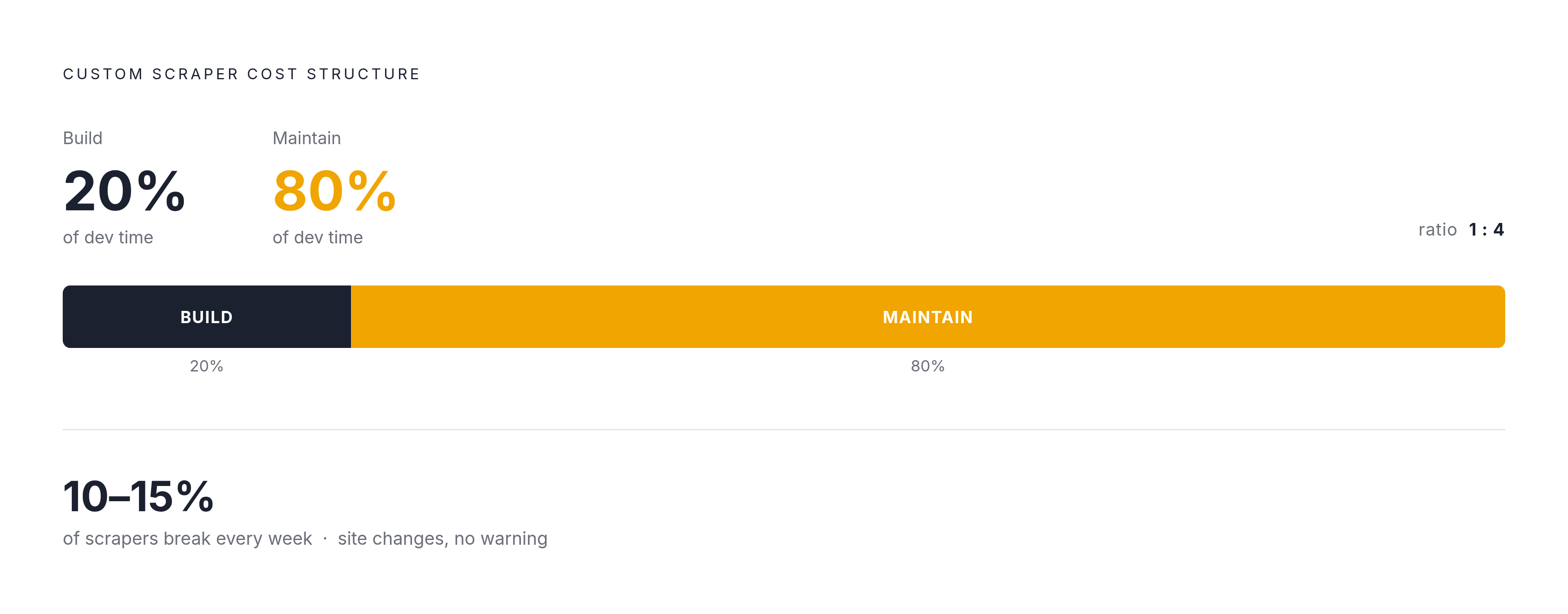
Developers in scraping communities consistently report somewhere around 10 to 15 percent of scrapers breaking every single week due to site changes. A CSS class gets renamed. A div gets restructured. A team switches JavaScript frameworks. Any of those events silently kills your extraction logic, and you often don't find out until your downstream data looks wrong.
Kadoa put a number to this in 2026 that I think is the most honest framing of the build-vs-buy question: in traditional scraper workflows, roughly 20 percent of time goes to building and 80 percent to maintaining. Read that again. You spend one part building the thing and four parts keeping it from falling apart.
The upfront cost of custom scraping always looks cheap; the ongoing cost is where it compounds.
What a Third-Party Scraping API Offloads and What It Doesn't
A managed scraping API takes several of the hardest problems off your plate:
- Proxy infrastructure and IP rotation
- JavaScript rendering at scale
- Anti-bot bypass (CAPTCHA solving, browser fingerprinting)
- Request retries and failure handling
Many of them also return structured output, Markdown or JSON, rather than raw HTML. That last part matters more than it appears, and we'll get to it in the next section.
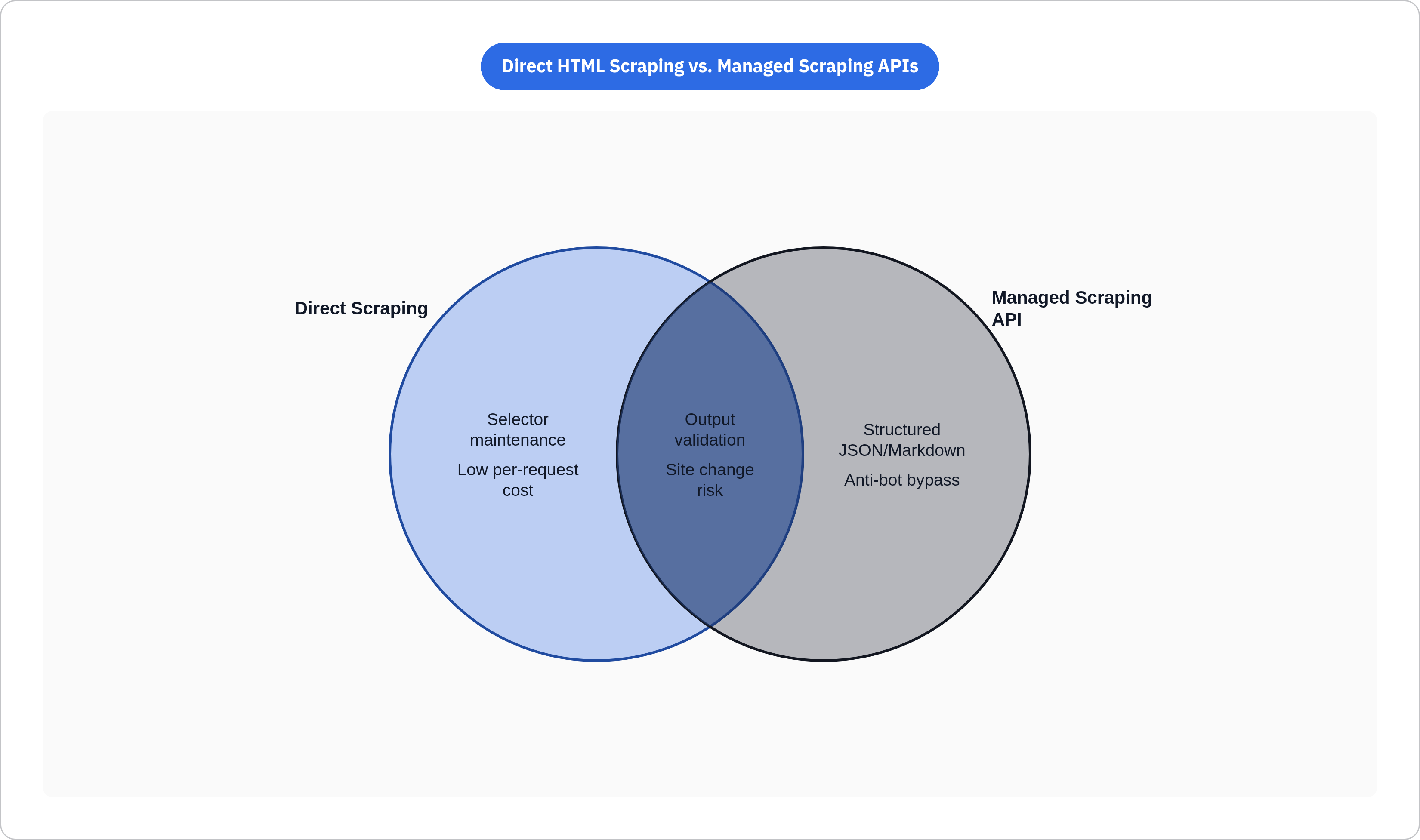
But here's what a scraping API does not remove from your life. If the API returns raw HTML, you still own the parser. You still own all of its maintenance. Target-side changes can still degrade the results you get back. And you still own data validation, pipeline integration, and formatting for your specific downstream use case.
The critical distinction to understand is this: an API that returns clean Markdown or structured JSON is a fundamentally different product from one that just returns raw HTML. The first shifts parsing responsibility to the provider; the second only shifts proxy management. You're still doing all the parsing work yourself, just with someone else's infrastructure underneath you.
That distinction is worth keeping in your head for everything that follows.
How Data Format at the Point of Extraction Changes the Total Cost of the Pipeline
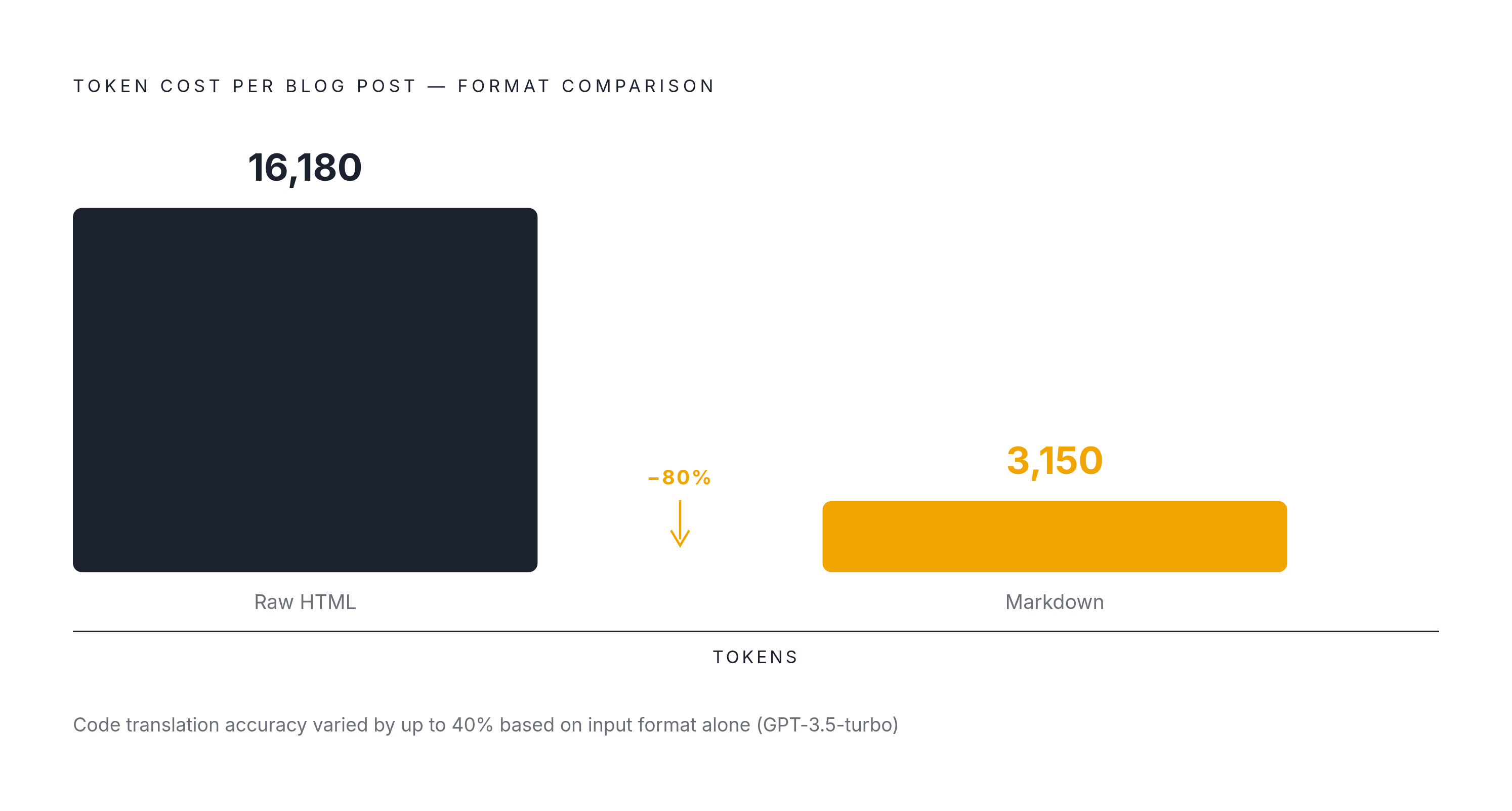
Here's a number that should permanently change how you think about raw HTML. A Cloudflare analysis found a single blog post consuming 16,180 tokens as raw HTML versus 3,150 tokens as equivalent Markdown; that's an 80 percent reduction.
This isn't just an efficiency argument. Format actually affects how well models reason about the content.
A 2024 ArXiv paper ran identical prompts in plain text, Markdown, JSON, and YAML across GPT models. On a code translation task, GPT-3.5-turbo accuracy swung by up to 40 percent depending purely on format. GPT-4 consistently preferred Markdown, which researchers attributed to heavier pretraining on structured text. A separate study on extraction tasks found that Flat JSON achieved the best extraction accuracy (an F1 of 0.9567) compared to raw HTML or hierarchical structures.
So what does this mean practically?
- Markdown is best for RAG systems. It preserves document structure while staying token-efficient.
- Flat JSON is best for structured extraction and fine-tuning datasets.
- Raw HTML is expensive, noisy for models, and requires a parsing layer you have to maintain yourself.
The real cost comparison is never just $0.001 per page (raw HTML API) versus $0.002 per page (structured API); it's those prices plus the engineering hours to build and maintain the parser that the raw API forces you to own. When you frame it that way, the structured output option gets a lot more competitive.
How Anti-Bot Complexity Scales and Why It Concentrates Provider Options at the Top
Not all targets are the same. Casual rate limiting is a completely different category of problem from enterprise-grade bot protection like Kasada, DataDome, and PerimeterX; the engineering required to handle one doesn't transfer cleanly to the other.
Proxyway's 2025 independent benchmark tested 11 scraping APIs against 15 highly protected targets. Only four providers maintained a success rate above 80 percent. Some targets were brutal across the board: Shein averaged just 21.88 percent success across all providers tested, and G2 averaged 36.63 percent. Zyte ranked first overall, achieving a 93.14 percent success rate at 2 requests per second, delivering over 15,000 results per hour.
At scale, the gap between a 98 percent and an 85 percent success rate is not abstract. At 10 million requests per month, a 13-point difference in success rate produces roughly 1.3 million additional failed requests. Each one of those failures consumes retry infrastructure, delays downstream pipelines, and costs someone's time to diagnose.
JavaScript rendering multiplies costs in a different direction. At ZenRows, credit costs scale: 1x for basic requests, 5x for JS rendering, 10x for premium proxies, and 25x when both are required simultaneously.
For heavily protected or JavaScript-heavy targets, direct scraping is not just a maintenance problem; it is an arms-race problem. The platform's security team gets better, you have to get better, they respond, you respond. That loop requires sustained engineering investment just to stay in place.
The Build-vs-Buy Cost Comparison When You Account for the Full Engineering Picture
The numbers here are real, even if they're uncomfortable. Building an in-house scraping solution with a three-person engineering team costs an estimated $80,000 to $150,000 annually when you factor in salaries, infrastructure, and ongoing maintenance (2026 estimate). Managed scraping services range from roughly $199 per month for basic volume up to enterprise pricing exceeding $100,000 per year at high scale.
2024 industry research found that organizations using APIs for data integration reduced data processing costs by 40 percent, while those relying on custom scraping faced 2.5x higher maintenance costs. Those figures deserve some honest scrutiny. They reflect well-run managed deployments, not the average case. But the direction they point is consistent with what you see in practice.
Volume changes the math in both directions. At 100,000 requests per month, almost any provider is affordable and the managed premium is basically noise. At 10 million or more requests per month, per-page cost differences start to compound, and the case for managed solutions depends entirely on whether they actually avoid the retry and maintenance overhead that makes custom scraping expensive at that scale.
The most honest framing: managed scraping APIs are not always cheaper per request; they are cheaper per reliable, pipeline-ready result over time. That distinction matters a lot when you're accounting for real engineering costs and not just the invoice.
Where LLMs Are Changing the Maintenance Equation for Scrapers
The classic scraper failure goes like this: a CSS class changes, an XPath breaks, a div gets restructured. The scraper fails, either quietly or loudly, and someone has to manually diagnose and rewrite selectors. This is a boring problem that nonetheless eats real hours.
LLMs are changing this in a few ways. Feeding updated HTML into a model like GPT-4o or Claude to regenerate a working selector cuts debugging from hours to minutes; that's increasingly standard in production scraping workflows now, not a novelty.
Self-healing scrapers go further. They use LLMs to detect layout changes in real-time and re-map extraction logic automatically, without a human having to intervene. This doesn't eliminate human oversight. It shifts the role from fixing broken selectors to validating data quality and managing edge cases, which is a better use of time.
ScrapeGraphAI's framing captures the broader shift well: instead of asking "how do we deliver HTML faster?", the question becomes "why should the developer parse HTML at all?" LLM-powered extraction lets you describe what you want in natural language and receive structured JSON back. Because it reasons about page content rather than fixed selectors, it degrades more gracefully when markup changes; the pipeline doesn't hard-fail because a class got renamed.
To be clear: this is a tradeoff, not a free pass. Token costs, latency, and accuracy validation add their own overhead. LLMs make the maintenance problem more manageable; they do not make it disappear.
How to Match the Approach to the Use Case
Direct HTML scraping makes sense when:
- Your targets are a small, stable set of sites that don't change markup frequently
- Volume is low enough that engineering time isn't the bottleneck
- You already have scraping infrastructure and the marginal cost of adding a target is low
- Your data requirements are highly specific and a general-purpose API output doesn't fit your schema
A third-party scraping API makes sense when:
- Targets include heavily protected sites where maintaining bypass logic is an ongoing arms race
- Volume is high enough that reliability percentages translate directly to failed-request costs
- Your downstream consumer is an LLM pipeline or RAG system, where clean Markdown or JSON at ingestion is worth paying for
- Engineering capacity is the real constraint and maintenance overhead would pull the team away from product work
Hybrid pipelines are common in production and often the most sensible answer. You might use an official API for structured metadata and scraping for the content the API doesn't expose. You might use a managed scraping API for high-difficulty targets and direct scraping for stable, low-protection targets where the cost premium isn't justified.
There's also an emerging consideration worth naming. As AI agents become primary consumers of scraped data, the interface between the agent and the scraper starts to matter. MCP-based tools let agents request data on demand within a single reasoning loop rather than polling batch jobs; that's a different architectural need than a weekly ETL pipeline, and the right scraping approach is different too.
One honest caveat to close with: no approach eliminates the need to validate output. Whether you're parsing raw HTML yourself or receiving structured JSON from a managed API, data quality monitoring is not optional at production scale. The source of your data changes; the need to verify what came back does not.