Anti-Bot Detection and Scraping Resilience
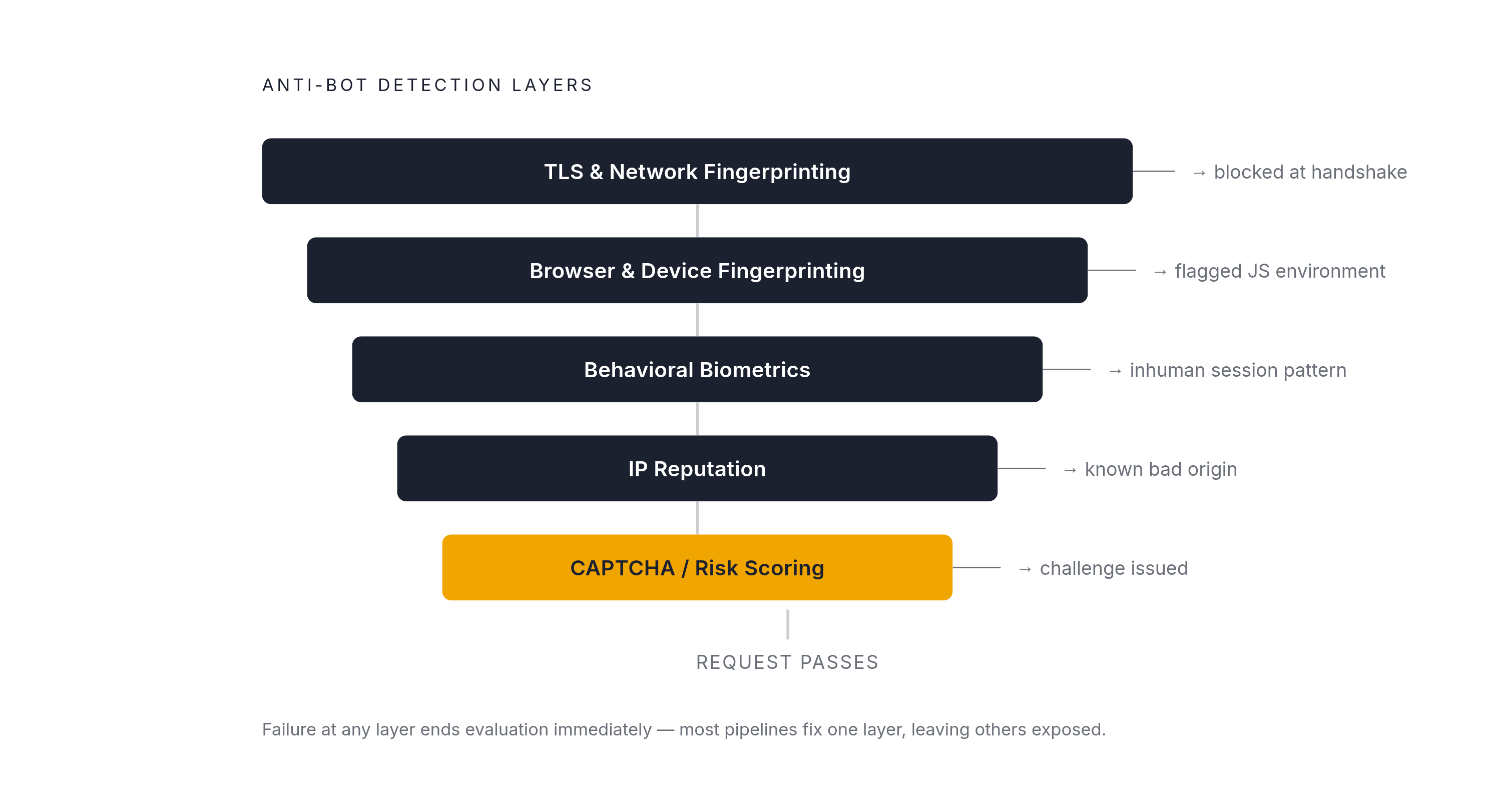
Legitimate automated clients must pass five sequential detection layers or get blocked immediately.

Bot traffic surpassed human traffic on the global web for the second consecutive year in 2025, accounting for 53% of all activity, per the 2026 Thales/Imperva Bad Bot Report. Bad bots specifically claimed 40% of that, up from 37% in 2024. HUMAN Security's State of AI Traffic report found AI bot traffic grew 187% from January to December 2025 while human traffic grew just 3.1%. That asymmetry is not a spike. It reflects a compounding structural shift in how automated systems are built and deployed.
The consequence for anyone running a data pipeline is that the web's default posture is now adversarial toward automated clients. Detection infrastructure was built, and continues to be funded, primarily to stop credential stuffers, inventory scalpers, and scrapers violating terms of service. Legitimate pipelines sit in that crossfire. Detection systems do not distinguish intent; they distinguish signal patterns, from autonomous system numbers to behavioral entropy. Understanding those patterns is the prerequisite to operating as an automated client without being indiscriminately blocked.
The single most important thing to understand about modern anti-bot detection is that it is not a gate. It is a cascade. Each layer adds signal. A request must clear all of them, and a failure at any point does not require any of the others to fire.
Inspection begins at the edge, not at the origin server. Cloudflare, Akamai, and DataDome all operate at the CDN or WAF perimeter, where inline traffic inspection happens before your request ever touches the application. DataDome, named a Leader in the Forrester Wave Bot Management 2024 report, analyzes thousands of signals per request in real time. Top-tier systems reach a verdict in under two milliseconds.
The layers, ordered by where they intercept a connection: TLS and network fingerprinting, which inspects the handshake before encryption is established; browser and device fingerprinting, which inspects the JavaScript-exposed environment; behavioral biometrics, which inspects how the session unfolds over time; IP reputation, which inspects the origin before any content is evaluated; and CAPTCHA or invisible risk scoring, which challenges or scores residual uncertainty that earlier layers failed to resolve.
Fixing one layer while leaving the others broken is precisely how scrapers get caught. A residential IP running a Python-default TLS stack still fails at the network layer. A correctly configured browser fingerprint attached to a datacenter IP still fails on reputation. Consistency across all layers simultaneously is the actual problem, and most pipelines treat it as several separate problems. I have watched teams spend weeks hardening their fingerprint profiles while their TLS handshake was broadcasting automation to every edge node they touched. The work was not wasted, but it was sequenced wrong.
What TLS Fingerprinting Sees Before Your Headers or Cookies Are Read
TLS fingerprinting captures the unique signature of a client's handshake, specifically the ClientHello message: the cipher suites it offers, the extensions it advertises, the ALPN values it supports, the elliptic curves it prefers. This all happens before encryption is established and before any HTTP data is exchanged. If the fingerprint fails, headers, cookies, and session tokens are never evaluated.
JA3 and JA4 are the standard methodologies. JA4, developed by FoxIO, extends into a family of sub-fingerprints covering the server hello (JA4S), HTTP headers (JA4H), TCP characteristics (JA4T), and HTTP/2 framing (JA4L), giving detection systems a richer composite than JA3 alone could provide.
What makes TLS fingerprinting particularly consequential is this: unlike browser fingerprinting, it cannot be blocked or spoofed by browser settings or extensions. It lives below the application layer. A Python script using the requests library connects to a Cloudflare-protected endpoint, and Cloudflare's database already contains the exact JA3 hash for Python's OpenSSL stack. Blocking happens before any HTTP data is exchanged. The same problem applies to httpx, aiohttp, Go's net/http, and Node.js axios; each library's platform-default TLS stack produces a fingerprint no real browser would generate.
Even Puppeteer is not immune. It uses a custom Chromium build that can lag the official release by several versions, producing a JA3 fingerprint that diverges from current Chrome. A nominally "real browser" automation tool can still fail this check, which surprised more than a few engineers I have worked alongside who assumed browser-based tooling solved the problem by definition.
There is an additional wrinkle worth understanding. Chrome 110 and Firefox 114 introduced randomization of TLS extension order per connection, meaning the same browser produces different JA3 hashes across connections. The industry responded with JA3N and JA4 to regain stability, but the evolution illustrates how quickly both sides iterate.
The highest-confidence signal this layer produces is a mismatch: the HTTP layer claims Chrome 124 while the TLS fingerprint matches a Python/OpenSSL stack. That contradiction alone is sufficient for edge systems to score a request as automation. The implication is a configuration requirement, not a behavioral one: browser-grade TLS stacks. Tools like curl-impersonate and tls-client exist specifically to replicate Chrome and Firefox handshakes at the library level.
What Browser and Device Fingerprinting Adds on Top of TLS
Once a connection is established, client-side JavaScript opens a second inspection surface. Anti-bot scripts collect HTTP headers, Canvas rendering outputs, WebGL renderer strings, screen resolution, installed fonts, timezone, available media devices, and locale. Individually, these signals are weak. Combined, they produce a device fingerprint that can recognize a returning automated client even after IP rotation.
The consistency problem is more subtle than it first appears. A scraper claiming to be Chrome on Windows must produce Canvas and WebGL outputs consistent with that hardware and operating system combination, the same checks headless browser detection routines run first. A Linux headless virtual machine producing Windows font metrics is a high-signal anomaly. Timezone and locale must align with the proxy's claimed geolocation. Every dimension you control for creates another dimension that must remain internally consistent with it. The dependencies compound in ways that are tedious to track.
Anti-detect browsers, including Multilogin, GoLogin, and Dolphin Anty, exist specifically to manage this consistency at scale. They modify Canvas, WebGL, User-Agent, and related signals to produce coherent profiles across sessions. For custom Playwright or Puppeteer contexts, the same work must be done manually: real font sets, accurate GPU strings, correct media device enumerations, locale and timezone aligned to the proxy's geography.
Honeypots operate at this same layer. Invisible links or form fields inject a behavioral trap that a fingerprinted client may trigger without any visible indication. A client that presents a clean fingerprint but also activates a honeypot is flagged with high confidence, because the two signals together eliminate most benign explanations.
One data point from DataDome's 2025 testing of nearly 17,000 websites deserves careful attention: only about 7% blocked advanced anti-fingerprinting bots. Fingerprint evasion still succeeds broadly. The sites that do check it rigorously, however, tend to be the high-value targets where most legitimate pipelines actually need to operate. The 93% that don't block effectively are not the problem.
How Behavioral Biometrics Distinguishes a Human Session From a Scripted One
The behavioral layer monitors signals that accumulate across a session rather than at a single connection point. Mouse movement reveals acceleration curves, micro-corrections, and subtle waviness characteristic of a hand on a physical device; automated input produces straight lines or mathematically precise arcs. Keystroke dynamics vary for humans based on word familiarity and cognitive load; automated input is metronomically consistent. Request cadence between page loads reflects human hesitation and reading time. Navigation paths wander and backtrack in human sessions; scripted sessions beeline directly to target data.
A 2026 peer-reviewed study by Modi et al., published by Springer, found keystroke-based classification models achieved 99.98% accuracy and mouse-movement models achieved 99.72% accuracy in distinguishing human from automated sessions. These are not heuristics; they are near-certain classifiers operating at scale on measurable signal. In 2025 head-to-head testing, behavioral biometric systems achieved 87% bot detection accuracy, outperforming Google reCAPTCHA's 69%.
Traditional rule-based detection fails against scrapers that have already learned to mimic human behavior at a surface level. Modern systems use ensemble models trained on real attack data, and per Stanford AI Lab research published in early 2025, such models can reach 97% accuracy with false positive rates below 0.05%. The models adapt to new evasion patterns continuously.
What this implies for resilience is that simulating plausible imperfection matters more than simulating perfect behavior. Occasional missed clicks, corrected typos, variable scroll speed, irregular inter-request timing, and uneven time-on-page distributions: these are signals of humanity precisely because they are inconsistent. Perfect behavior is itself an anomaly, which is a counterintuitive insight that tends to get lost when engineers are optimizing for reliability. The behavioral layer also enables detection of Bots-as-a-Service ecosystems, which the 2025 Imperva Bad Bot Report identifies as a growing market where AI is used to analyze failed evasion attempts and iteratively refine them.
What IP Reputation and Proxy Type Signal to Detection Systems
A datacenter IP carries an implicit high-suspicion prior before a single behavioral signal is evaluated. The autonomous system number alone flags a request. Request velocity compounds this: too many requests from one IP in too short a window triggers rate limiting or blocking regardless of how clean the fingerprint is.
Twenty-one percent of bot attacks in 2024 used residential proxies to evade detection, per the 2025 Imperva Bad Bot Report. That figure tells two things simultaneously: residential proxies work well enough that bad actors have adopted them at scale, and detection systems are increasingly trained on their misuse patterns. The signal-to-noise problem for defenders is that blocking residential and mobile IPs aggressively would block genuine users on those ISPs; the collateral damage risk constrains how forcefully they can act.
The practical hierarchy for proxy selection runs from residential proxies, which use IPs from real consumer devices and ISPs, are spatially diverse, and pass basic reputation checks by default; to mobile proxies, which use carrier IPs shared across many real users, making per-IP action especially costly for defenders; to datacenter proxies, which are fast and economical but blocked by default on high-value targets; to rotating ISP proxies, which combine datacenter infrastructure with registered ISP prefixes to approximate residential reputation at higher throughput.
Forty-four percent of advanced bot traffic targeted APIs in 2024, per Imperva. API endpoints are subject to the same IP reputation scoring as browser-facing pages, often more aggressively, because API traffic can be analyzed at higher velocity with less behavioral noise. A residential IP sending requests from a Python/OpenSSL TLS stack still fails at the network layer regardless of reputation. Proxy choice and TLS configuration are independent decisions in name only, though they are frequently treated as if they were.
How Modern CAPTCHA Systems Shifted From Visual Puzzles to Invisible Risk Scoring
reCAPTCHA v3, introduced in 2018, removed all user interaction. It produces a continuous risk score, ranging from 0.0 to 1.0, from background behavioral signals. A headless browser gets flagged without ever encountering a checkbox. Cloudflare Turnstile, generally available since 2023, verifies visitors using background browser tests rather than visual challenges, combining token validation, risk scoring, and behavioral signals invisibly. Google's policy-based challenge keys became generally available in October 2025, allowing site owners to trigger visible challenges selectively based on score thresholds.
Cloudflare's Ephemeral IDs represent a newer signal designed to detect repeated abuse even when attackers rotate IP addresses, moving the defensive stack away from IP-centric detection and toward client-identity detection that persists across sessions and addresses.
When visible challenges do appear, the economics are unfavorable for automation. Automated CAPTCHA solving costs between $1 and $3 per thousand requests and introduces latency of ten to sixty seconds per challenge. Top general AI models achieved only 28% to 60% success rates on standard reCAPTCHA v2 in recent benchmarking.
CAPTCHA is a symptom, not the primary gate. A scraper that reaches a visible challenge has already been scored as suspicious by upstream layers. Operators who orient their remediation effort around solving CAPTCHAs are working on the wrong problem. The intervention belongs earlier in the stack, at the layers that produced the suspicious score in the first place. I have seen this misdiagnosis more times than I can count, and it is expensive precisely because it feels productive.
What Scraping Resilience Actually Requires Across All Detection Layers Simultaneously
The core failure mode in most pipelines is piecemeal remediation. Operators rotate IPs without fixing TLS stacks, or they deploy stealth Playwright without aligning the browser fingerprint to the proxy's geolocation. Each fix in isolation produces a pipeline that passes one layer and fails another.
Layer-by-layer consistency requirements, taken together, form the actual specification. At the TLS layer: browser-grade stacks, not default library configurations; tools like curl-impersonate or tls-client replicate Chrome and Firefox handshakes at the library level. At the browser and device layer: managed profiles using tools like BotBrowser or Multilogin, or carefully constructed Playwright contexts with real fonts, accurate GPU strings, correct media device enumerations, and locale and timezone aligned to the proxy's geography. At the behavioral layer: randomized delays, variable scroll speeds, occasional navigation backtracking, simulated input imperfection — not random noise but plausible human variance. At the proxy layer: residential or mobile IPs matched to the geographic and device profile being presented, with request velocity managed to stay within plausible human rates.
Session management extends the consistency requirement beyond individual requests. Cookies, local storage, and referrer chains should reflect a plausible browsing history. Cold-start sessions on every request are themselves anomalous; real browser sessions accumulate state.
API targets require the same stack discipline as browser-facing pages. The 44% figure for advanced bot traffic targeting APIs should dispel the notion that API endpoints are a softer target; they are often guarded by the same edge infrastructure with less tolerance for behavioral noise.
The adversarial dynamic does not resolve. BaaS ecosystems and AI-assisted evasion refinement mean detection systems are continuously retrained on new attack patterns. Resilience is a maintenance posture, not a one-time configuration. Managed scraping infrastructure that abstracts proxy rotation, TLS stack management, and fingerprint consistency can reduce the surface area a pipeline must manage; Olostep, a web scraping and crawling API that handles browsers, proxies, and anti-bot infrastructure so AI teams can collect structured web data at scale without maintaining that stack themselves, is one such option. The tradeoff is reduced transparency about exactly what is being presented to the target.
How the Bot Management Market Is Evolving and What That Means for Scrapers Going Forward
The bot security market reached $0.67 billion in 2024 and is projected to reach $3.24 billion by 2033, at roughly 18.7% compound annual growth. Capital is flowing into this problem at a pace that guarantees the detection stack will keep advancing.
AI operates on both sides of this dynamic. On the defender side, machine learning ensembles trained on vast behavioral datasets are moving detection away from static rules and toward models that adapt to novel evasion patterns continuously. The Stanford AI Lab research cited earlier represents one published data point in a much larger body of ongoing work. Detection accuracy is improving and false positive rates are declining, which removes one of the historical pressures on defenders to tolerate ambiguous traffic.
On the attacker side, AI is accelerating evasion sophistication. The BaaS ecosystem the 2025 Imperva report describes represents a commoditization of evasion capability: operators who previously needed deep technical knowledge to construct coherent fingerprints can now purchase that functionality off the shelf. The 187% growth in AI bot traffic documented by HUMAN Security is partly an artifact of this commoditization.
The structural implication is that the gap between a detectable scraper and an undetectable one will narrow from the top rather than from the bottom. Detection systems will improve faster than most individual pipeline operators can keep pace with, unless those operators draw on shared infrastructure that aggregates evasion research at scale. The sites most aggressively defended will become increasingly difficult to scrape reliably using commodity tools, and the 7% of sites that currently block advanced anti-fingerprinting bots will likely become a larger percentage as adoption of enterprise bot management platforms grows.
What strikes me, after years of working inside these systems on both sides of the question, is how poorly the "puzzle" framing serves anyone trying to build reliable pipelines. Puzzles have solutions. This does not. It is an adversarial system with continuous feedback loops, and the operators who maintain functional pipelines over time are the ones who understand the detection architecture well enough to reason about what signal they are generating at each layer — not just the ones who found a configuration that worked last quarter.