LLM-Based Data Extraction vs Rule-Based Parsers
Pick the right tool based on how your data changes, not which seems smarter.

Rule-based parsers and LLM-based extraction aren't rivals fighting for the same job. They're two different tools that happen to get lumped together because both spit out structured data at the end. Which conditions make each one the right call matters more than which one wins, and most teams running high-volume pipelines in 2026 end up using both, stitched together at a handoff point that's more interesting than either tool on its own.
Neither approach is legacy. Neither is universally better. A parser built on CSS selectors from years back is still running in production right now, quietly doing its job on a vendor feed that hasn't changed its HTML in six years. Meanwhile, an LLM is reading a scanned legal contract nobody's ever seen the layout of before, pulling out a termination clause based on what it means rather than where it sits on the page. Both of those are correct engineering decisions. Knowing which situation you're in makes the difference.
Three variables decide it: how stable the source markup is, how much volume is coming through, and whether the field you need is defined by position or by meaning. Get those three answers and the rest of the decision more or less makes itself. This piece covers both web page extraction and document parsing, PDFs, invoices, forms, because the same logic runs through both.
What rule-based parsers do and where they hold up
CSS selectors, XPath, keyword anchors, coordinate-based zonal OCR: all of it finds data by position or pattern, not by meaning. The parser doesn't know what an invoice date is. It knows the string "Invoice Date:" appears, and it grabs whatever comes right after it. That's the whole trick, and it's a good trick when the layout behind it never moves.
The upside of that dumbness is consistency. Same input, same output, every single time. That matters more than people give it credit for, especially for change-detection pipelines, audit trails, or regression tests where "did the number move or did the parser hallucinate" is a question you need answered with certainty. When a rule-based extraction fails, you can point at the exact rule that broke. Try doing that with an LLM output. Tracing a wrong answer back to its cause in a language model is a lot more like detective work, and a lot less like reading a stack trace.
Cost is the other selling point. Once the rules are written, there's no per-page inference bill, no token budget to babysit. It runs on a laptop fan, basically.
The best-fit conditions:
- Markup stays the same across runs, same template, same vendor, same CMS
- Volume is high enough that cost-per-page actually matters
- The field lives at a fixed spot ("third column of the table," "value after the label 'Invoice Date:'")
- Repeatability and audit trails aren't optional
The catch, and it's a real one, is maintenance. Rule-based systems need constant upkeep whenever the source format shifts, and a single vendor redesigning their invoice template can knock out an entire extraction layer overnight. According to parsio.io, this style of parsing is great for emails, order confirmations, and other fixed-phrase structured text, and it breaks the moment layout or wording changes. That's not a flaw so much as the deal you signed up for.
What LLM-based extraction does and where it earns its cost
An LLM reads cleaned text or a document image and finds fields by what they mean, not by where they sit. It doesn't need "Invoice Date:" to appear verbatim. It can spot a date, understand context clues around it, and figure out that's probably the invoice date even if the label says "Billed On" instead.
For web extraction, the pipeline runs four stages: fetch, render, clean, extract. The LLM only touches the last one. Webscraping.ai notes that projects often fail at fetch and render, long before the model ever sees anything. That means the conversation people have is often about the wrong small slice of the pipeline.
The real strength appears on documents that vary in structure but not in intent, contracts, resumes, NDAs, invoices that don't follow a single house style. Writing rules for every variation would take forever and break constantly. An LLM handles the variation without anyone touching a line of config.
Schema-pinned extraction from cleaned text is a reading-comprehension task, not a reasoning task, and that surprises people. That is exactly why model choice matters far less than the AI hype cycle suggests. You don't need the smartest model in the world to find a total payable amount in a clean paragraph. You need clean input.
Best-fit conditions look almost like the mirror image of the rule-based list:
- Markup varies across suppliers, publishers, or document versions
- The field is defined by meaning ("the termination clause," "the total payable amount") rather than a fixed label or coordinate
- The document type is novel, or low-volume enough that hand-writing rules isn't worth the engineering hours
- Zero-shot adaptability beats lowest-cost-per-page as a priority
Cost is the tradeoff, and it's not subtle. LLM extraction can run up to 100x more expensive per page than a traditional SDK, webscraping.ai notes. That price only makes sense in the cases where rules genuinely can't do the job, which is most of the argument right there.
Not every instance of a term in a source document corresponds to something that should actually get extracted, and fine-grained data lineage, tracing exactly which sentence produced which field, is hard to achieve. Not every instance of a term in a source document corresponds to something that should actually get extracted, and fine-grained data lineage, tracing exactly which sentence produced which field, is hard to enforce with an LLM in the loop. Add to that a data residency wall: plenty of sensitive documents legally can't leave a building to hit a cloud inference endpoint, which rules out LLM extraction entirely for some regulated workflows, no matter how good the model is.
How input format shapes LLM extraction accuracy before the model ever runs
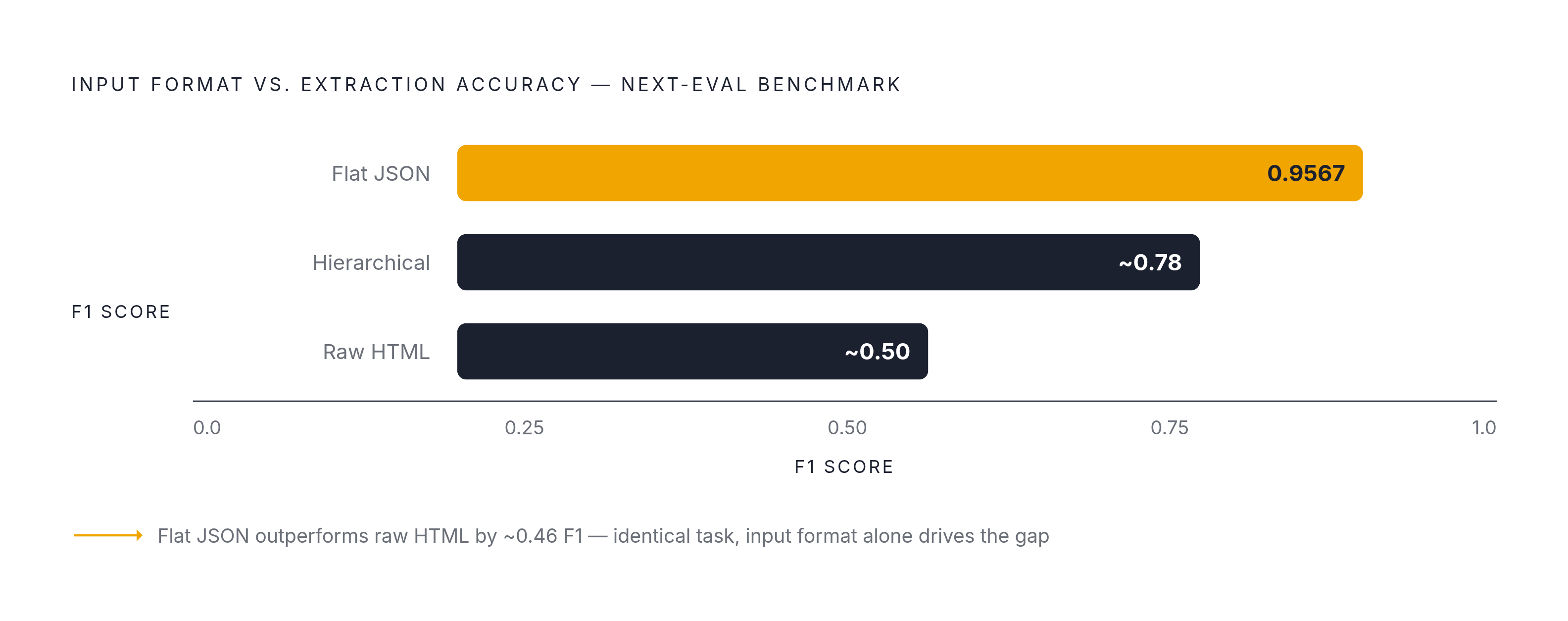
In 2026, the bottleneck lies in what you feed the model. It's what you feed it. The 2025 NEXT-EVAL benchmark, reported by firecrawl.dev, found LLMs hitting F1 scores above 0.95 on structured web extraction, but only when the input arrives properly formatted. Hand the same model raw HTML soup and watch that number fall off a cliff.
The most useful finding out of NEXT-EVAL, reported by firecrawl.dev: flat JSON gave the best extraction accuracy, F1 of 0.9567, beating both raw HTML and hierarchical structures on the identical task. That's a genuinely actionable result. If your pipeline is dumping raw HTML into a prompt and hoping, you're leaving accuracy on the table for free.
Webscraping.ai identifies cleaning HTML down to plain text before prompting as the single biggest lever for cost, substantially reducing the tokens that reach the model. Model tier is the second lever, worth another 10 to 25x on top of that. Stack both and the savings compound fast.
Here's a small thing that trips up a lot of engineers: most "context limit" errors aren't actually context limit errors. They're "I sent raw HTML" errors. Cleaned pages typically run 2,000 to 8,000 tokens, and webscraping.ai notes that any model with a reasonably large context window eats that for breakfast. The complaint gets filed under "the model can't handle long documents" when the real bug is upstream, in the preprocessing step nobody budgeted time for.
That preprocessing step isn't some optional nice-to-have bolted onto the front of the pipeline. It decides whether the whole extraction setup is accurate or affordable, or neither.
Document parsing raises its own version of this question. Feed the model a rendered image of a PDF, or convert it to markdown first and feed that instead? The Fraunhofer/arXiv study (arXiv:2509.04469) put this to the test across GPT-5, Gemini 2.5, and Gemma 3, and found native image processing generally beat the markdown-first approach. Turning a document into text before showing it to a vision-capable model, in other words, can throw away information the model would've used if it just looked at the page.
Where rule-based metrics give a misleading picture of parser quality
Metrics like TEDS and GriTS measure how close two structures look on the surface. They don't measure whether the actual information got preserved correctly, and that gap is bigger than most benchmark tables let on.
A parser that reorganizes a table into a structurally different but semantically identical shape gets punished by these metrics. A parser that keeps the exact same structure but quietly corrupts the numbers inside the cells gets an inflated score. That's exactly backwards from what anyone evaluating a pipeline actually cares about, per the Offenburg University/arXiv benchmark (arXiv:2603.18652).
The score ranges make the distortion concrete. Traditional rule-based TEDS scores across the 21 parsers tested in that study clustered inside a 22% band, 0.66 to 0.88, squeezing parsers that look visibly different on manual inspection into a narrow, nearly indistinguishable range. LLM-based semantic scores on the same parsers spanned 38%, from 5.75 to 9.55, doing a far better job of separating good from mediocre. The same study found LLM-as-a-judge evaluation correlated with human judgment at r=0.93, compared to 0.68 for TEDS and 0.70 for GriTS, validated against more than 1,500 human quality judgments.
So the metric you pick to judge a parser is itself a decision with consequences. Rule-based metrics will tell you a bunch of parsers are roughly equivalent when they aren't. That matters most on table-heavy documents, financial reports, scientific papers, technical specs, where structural fidelity and semantic accuracy can drift apart sharply without a surface-level metric ever noticing.
How leading document parsers perform on complex extraction tasks in 2026
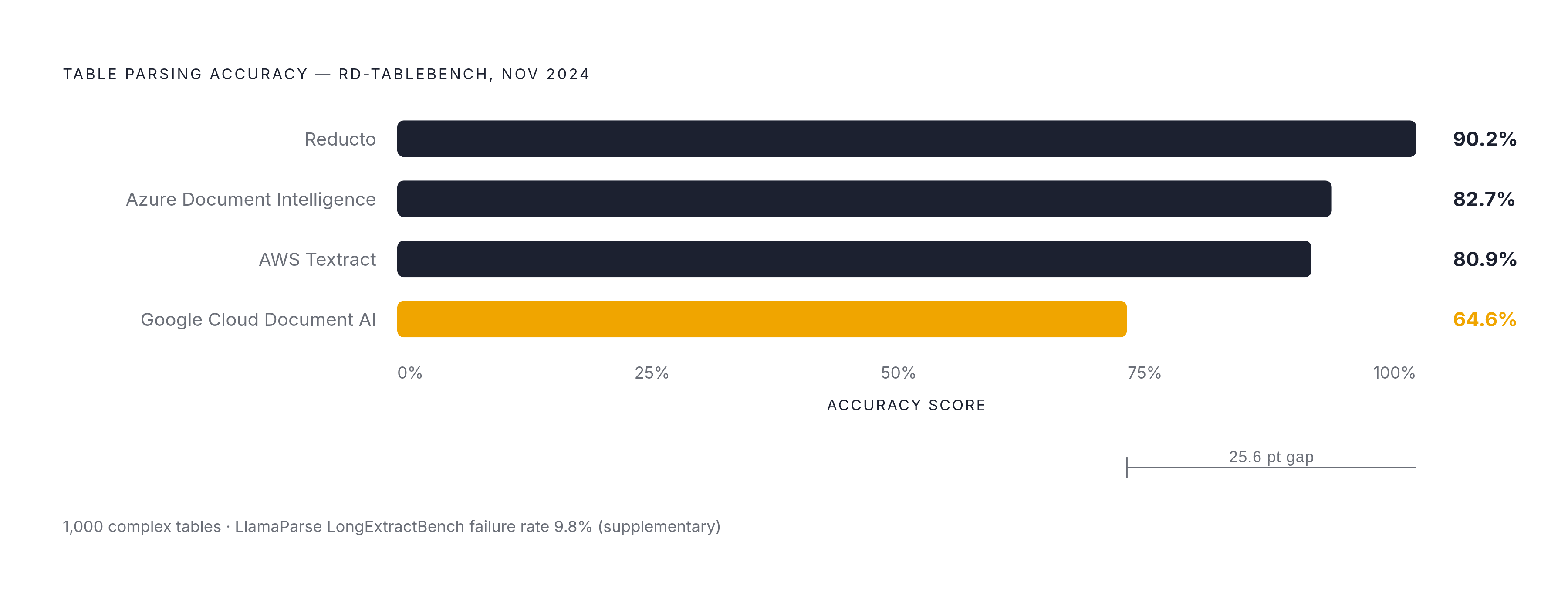
Two benchmarks anchor this comparison: LongExtractBench, independently audited and published by micro1, covering 225 long documents across seven systems, and RD-TableBench, Reducto's 1,000-complex-table benchmark from November 2024.
Reducto, an agentic document platform combining vision-first processing with a VLM and multi-pass Agentic OCR, came out on top of LongExtractBench: 99.6% precision, 99.6% recall, zero failures across all 225 documents. Reducto.ai reports that the other six systems in that benchmark failed on anywhere from 3.6% to 48.4% of the corpus. On RD-TableBench, Reducto posted 90.2% average table accuracy. It's already deployed at Harvey, Scale AI, and Vanta, with more than 4 billion pages processed in production, and it ships in cloud, VPC, on-prem, and air-gapped configurations, relevant for anyone boxed in by data residency rules.
Azure Document Intelligence scored 82.7% on RD-TableBench's complex tables, reducto.ai reports. It's strong on financial and business paperwork and fits best inside Microsoft-heavy stacks where the extracted data is headed straight into another Azure service anyway. Less flexible once layouts get weird.
AWS Textract landed at 80.9% on the same benchmark. Reliable on structured documents, handwriting support included, but it loses ground on anything highly unstructured or visually busy. Best fit is regulated workloads already built on AWS infrastructure.
Google Cloud Document AI scored 64.6%, reducto.ai reports, the widest gap from the top of the field on this particular test. It's still a solid pick for classification tasks and batch processing, and it makes sense for teams already standardized on GCP feeding data into BigQuery or Vertex AI. Irregular layouts are where it struggles most.
LlamaParse, from LlamaIndex, runs a mode ladder from 1 credit per page (Fast) up to 45 credits per page (Agentic Plus), with 10,000 free credits monthly and $1.25 per 1,000 after that, reducto.ai reports. Its Agentic sub-product, LlamaExtract, failed on 9.8% of documents in the micro1-published LongExtractBench results. LlamaIndex open-sourced a lighter sibling called LiteParse, which is local, with no cloud dependency, no GPU requirement, and no LLM calls, built for real-time pipelines that need speed more than accuracy on gnarly layouts.
ABBYY Vantage / FlexiCapture is the prototypical rule-based enterprise IDP system, reducto.ai reports. Fed a known, fixed template, its accuracy is high; hand it something with layout drift and it degrades fast. It fits compliance-heavy environments where auditability outweighs zero-shot adaptability, and it suits slower-moving enterprise programs better than a fast-shipping engineering team.
Docling, the open-source document conversion toolkit, offers strong layout preservation and local processing, a solid foundation for feeding documents into a GenAI pipeline. It functions as a toolkit rather than a managed platform with built-in validation, one that integrates with LlamaIndex and expects Python skills and some local infrastructure planning on the user's end.
The gap between the top and bottom of the RD-TableBench field, 90.2% versus 64.6%, isn't a rounding error. On complex tables, that's a difference large enough to throw off whatever LLM reasoning happens downstream of the extraction step.
How web scraping tools handle the extraction decision at the infrastructure level
Web scraping tools differ in how much of the fetch-render-clean-extract pipeline they hide from the developer, and in exactly where they draw the line between rule-based and LLM-based extraction.
One open-source browser agent is Browser Use. An LLM drives an actual browser toward a plain-language goal, clicking, navigating, extracting, the way a human would work through a site rather than the way a scraper traditionally would. It's a different category from the fetch-and-parse tools, closer to giving a model hands and a mouse than giving it a static HTML dump.
Beyond that, cost and quality numbers vary a lot by vendor. One open-source crawler paired with GPT-4o for structured extraction hit 100% accuracy on a 20-item test, but the time cost per page jumped from 2 seconds to 25 seconds once the LLM got involved, a real tradeoff between speed and correctness that occurs in production the moment volume climbs. Self-hosting an open-source crawler at 100,000 pages a month runs somewhere around $485 or more once compute, proxy costs, and engineering time all get counted, a number that surprises teams who assumed "open source" meant "free."
Markdown output quality also varies more than people expect. Noise ratios in cleaned output can range from a modest share up past a much larger one depending on the tool, and that noise feeds directly into the token-cost and accuracy math from earlier in this piece: dirtier markdown means more tokens spent and worse extraction downstream. Throughput numbers vary just as widely, with some infrastructure built to prioritize raw pages-per-second and others built to prioritize clean, low-noise output over speed.
The pattern across all of it is the same one running through this entire piece. Rules and LLMs aren't fighting for the same job. The infrastructure layer's real job is deciding, page by page, which of the two should handle what's in front of it, and building a clean enough handoff that neither one has to cover for the other's blind spots.
Sources
- Benchmarking PDF Parsers on Table Extraction with LLM-based Semantic Evaluation
- Best LLM‑Ready Document Parsers in 2026: Methods and Trade‑Offs
- PDF Parsing Methods Compared: Rule-Based, Zonal OCR, AI, and LLM Approaches
- Multi-Modal Vision vs. Text-Based Parsing: Benchmarking LLM Strategies for Invoice Processing
- Beyond String Matching: Semantic Evaluation of PDF Table Extraction