Caching and Freshness Management in Agent Scraping
Stale cached data silently corrupts agent decisions at enterprise scale.

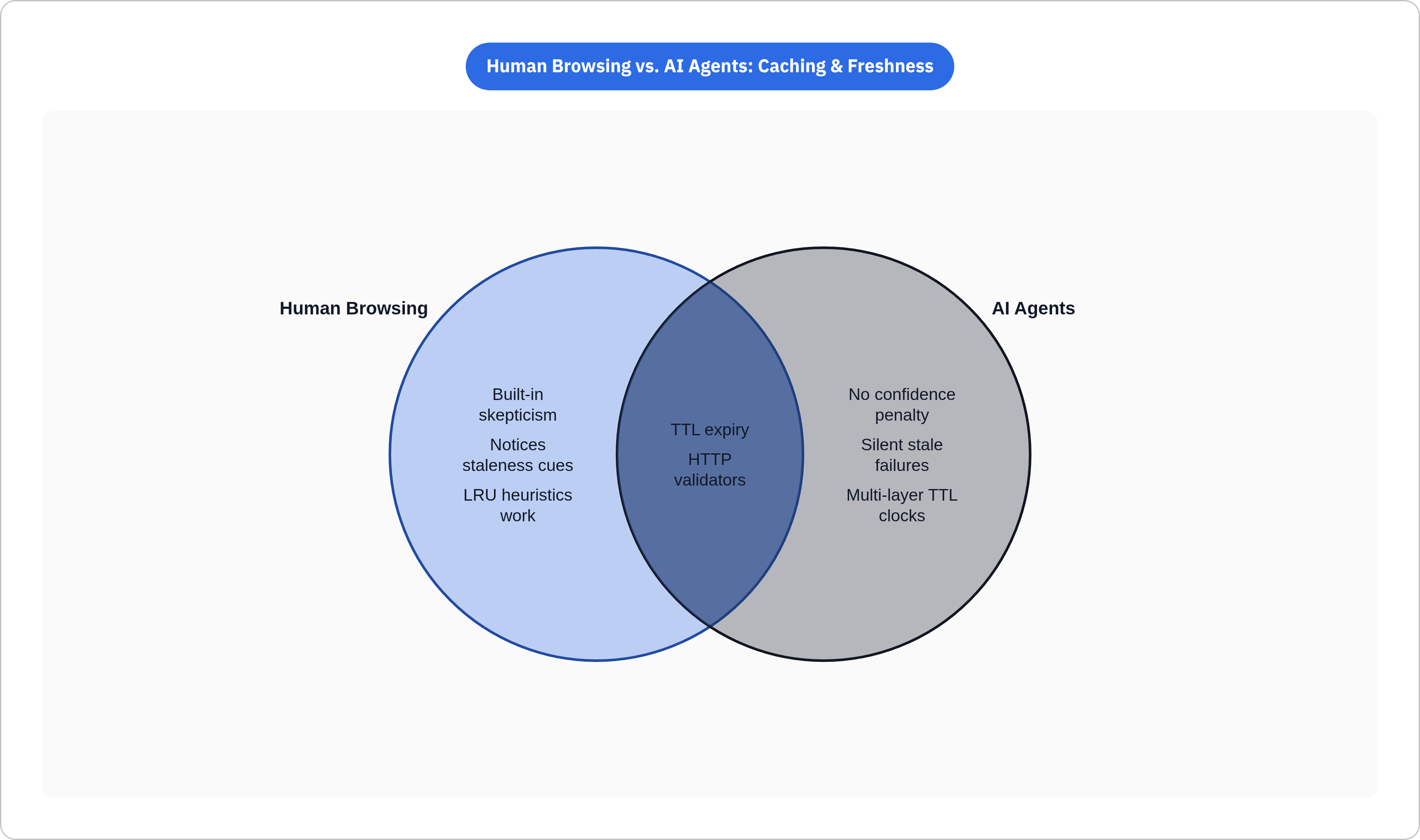
Human browsing comes with built-in skepticism signals. You see the publication date. You notice the "last updated" banner. Something feels off and you go check another source.
Agents have none of that.
An LLM grounding its response on a cached page from six months ago produces output that reads exactly like output grounded on data from this morning. No confidence penalty for age. No asterisk. The user gets a clean, authoritative answer, and the invisible expiration date on that answer stays completely hidden.
That's what makes this a correctness problem. It's like handing someone a carton of milk with the expiration date blacked out: looks fine, pours fine, and only reveals itself when it's too late. And it scales badly. A significant majority of enterprises now use web scraping to feed AI and ML projects, according to Mordor Intelligence. Stale data isn't just affecting one agent's output in one session. It propagates through enterprise-wide AI decisions, at volume, silently.
Traditional caching heuristics were designed for human browsing. Cache everything, evict by LRU, set TTL to 24 hours. Those defaults made sense when the consumer was a person who would glance at a cached news article and notice something felt off. They don't map onto agents that loop over dozens of URLs per task, extract structured data, and pass it directly into reasoning chains with no human in the loop. Nobody's glancing at anything.
How Staleness Harms Agent Decisions Differently Depending on the Data Type
Not all web data ages at the same rate, and a caching policy that treats a live pricing page the same as a regulatory document will either over-fetch constantly or serve dangerously stale data. You need a mental model for volatility.
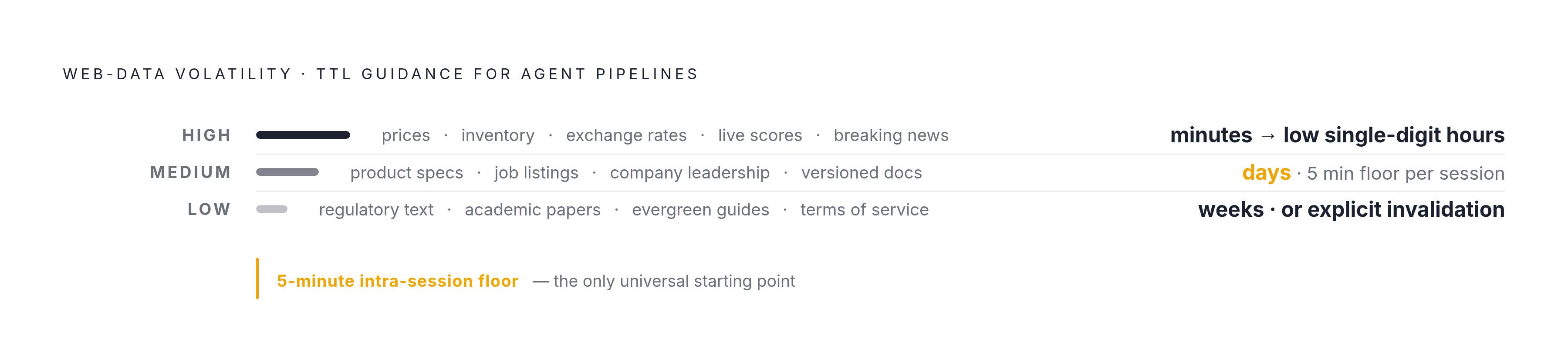
High-volatility data covers prices, inventory levels, exchange rates, live scores, breaking news. These can shift within minutes. If your agent reasons off a stale version of any of these, it isn't slightly wrong. It is factually wrong. Wrong price quoted. Out-of-stock item recommended. Superseded policy cited as current.
Medium-volatility data covers product specs, job listings, company leadership pages, versioned documentation. These change on a scale of days to weeks. The harm from staleness here is subtler. The agent's advice is technically accurate but no longer best practice, which is actually the harder failure mode to catch because it looks right on the surface.
Low-volatility data covers regulatory text, academic papers, evergreen guides, terms of service. Stable for months. Aggressive caching isn't just acceptable here, it's the right call. Re-fetching these obsessively is wasteful, and the cost of over-fetching is real.
One thing people miss: the domain matters as much as the data type. A "product page" in e-commerce is high-volatility by default. The same category of page for a physical book published in 1987 is low-volatility. You can't just tag a URL class and move on. You have to think about what actually changes on that specific page.
Research published in mid-2025 found that over 70% of pages cited by ChatGPT were updated in the past year, and more than a third pointed to content updated in the last three months. The freshness bar for AI-cited content is already higher than it is for traditional search. Your caching policy needs to respect that.
Assigning TTLs to Volatility Classes: A Practical Decision Framework
TTL is not a technical setting. It is a business decision expressed as a duration.
The question to ask yourself is: what is the worst realistic decision my agent makes if this data is N hours old? Work through it concretely.
- If the answer is "quotes a price that changed," your TTL should be measured in minutes to low single-digit hours.
- If the answer is "recommends a tool that shipped a new version," days is fine.
- If the answer is "cites a statute that hasn't changed in five years," your TTL can be weeks, or you skip time-based expiry entirely and rely on explicit invalidation.
A useful anchor: a 5-minute TTL is widely documented as reasonable for the same documentation page fetched multiple times within a single agent conversation. It prevents redundant hits without risking meaningful drift. That's your floor for medium-volatility content inside a single session.
For the structure of TTL policy itself, there are three real options.
Per-URL TTLs are the most precise. They are also expensive to maintain at scale. If you have thousands of URLs, you are not individually configuring each one.
Per-domain with content-type overrides is where most production pipelines land. You set a domain-level default and override it when you know a specific path pattern is higher or lower volatility.
Per-content-type global defaults work well for greenfield agents that don't yet have domain-specific knowledge. Not perfect, but it gets you most of the way there on day one.
Whatever policy you choose, store the TTL class alongside the cached content. Pair it with the fetch timestamp and the assigned expiry time. Downstream agent logic can then reason about freshness without triggering a re-fetch just to find out whether the data is still valid.
The most common mistake I see: TTL assignments get set once and forgotten. Someone repurposes a research agent for live market monitoring and it inherits the wrong TTL defaults because nobody actively changed them. The agent's task domain should drive TTL policy, and when the domain changes, the policy has to change with it. This sounds obvious until you're six months in and wondering why your market agent is citing week-old pricing data.
HTTP Cache Validators as a Low-Cost Freshness Check Before Committing to a Full Re-Fetch
When a TTL expires, you have more options than just fetching the whole thing again. HTTP gives you lighter tools for asking a much simpler question: has anything actually changed?
Two mechanisms make this work.
ETags are server-issued tokens that represent a specific version of a resource. When your cached response carries an ETag, you can send a conditional request using the If-None-Match header. If the resource hasn't changed, the server returns a 304 Not Modified with no body. You confirm your cache is still valid at a fraction of the bandwidth cost.
Last-Modified is a timestamp header. Pair it with If-Modified-Since on subsequent requests and you get the same result: 304 if unchanged, full response body only if something actually updated.
This matters operationally. A 304 response returns no body, per RFC 9110. For agents fetching large HTML pages, the bandwidth savings stack up fast. ETags also serve a secondary purpose: they help prevent race conditions where two agent instances overwrite each other's cached versions of the same resource at the same time.
Here's the catch though. Not all scraping targets honor these headers consistently. Dynamic pages rendered at the edge, pages behind CDNs with misconfigured cache headers, and JavaScript-heavy single-page applications frequently omit them. You cannot rely on validators being there.
When they're absent, you fall back to TTL-based expiry. Which is exactly why correct TTL assignment matters more than the validator logic built on top of it. The validators are an optimization. The TTL is the foundation.
The pattern that works in practice: always store ETag and Last-Modified values alongside cached content when they're present. On TTL expiry, attempt conditional validation first. Only perform a full re-fetch if the server returns a 2xx with a new body.
The Structural Reason AI Crawlers Break CDN Caching — and Why Agent Pipeline Designers Must Account for It
Most agent pipeline designers overlook something: your scraping doesn't just consume the web. It changes the caching behavior of the infrastructure serving it.
CDN cache logic, typically LRU (least recently used), assumes that recently requested content will be requested again soon. Human browsing patterns support that assumption. AI crawlers don't. They scan broadly across many URLs and don't revisit in patterns that LRU can predict. The result is sharply higher cache miss rates, which means origin servers absorb more load, and the operators of target sites notice.
How much do they notice? Cloudflare CEO Matthew Prince reported that bots now generate over half of HTML web traffic across Cloudflare's network (excluding video, email, and gaming), with AI crawlers and AI-search bots accounting for a significant and growing share of verified bot traffic. The web is not ignoring this.
The response has been measurable. The share of crawler requests served with 2xx responses dropped substantially between mid-2025 and mid-2026, while 4xx blocks climbed significantly in the same period, according to Cloudflare Radar. That's not noise. That is a structural shift in how the web treats automated requests.
What this means for your freshness strategy is that a live re-fetch now has a real probability of returning nothing useful. A cached response, even a slightly stale one, is more reliable than a fresh attempt that comes back as a 403 or a 429.
This reframes the whole tradeoff. A well-managed local cache isn't just a cost optimization. It's a resilience mechanism. When live re-fetches are increasingly unreliable, the cache is your fallback, not your shortcut.
Cache Invalidation Failure Modes Specific to Agent Pipelines
Most cache bugs in agent pipelines are not storage bugs. They are invalidation bugs. Knowing how to store cached data is the easy part. Knowing when to invalidate it is where things actually fall apart.
Cache pollution. The same page scraped at different times can produce different representations. Varying whitespace. Different ad injection. A/B test variants. These create multiple cache entries for what is semantically the same page, inflating cache size and degrading hit rates. The fix is normalization before caching: strip whitespace, remove non-semantic variation, store the clean version.
CDN temporal inconsistency. If you are scraping from geographically distributed edge servers, you will receive different cached versions of the same URL. A price correct in one region, stale in another. Your agent's data consistency becomes dependent on which node happens to respond. Tag cached entries with the source node or region when this matters for your use case.
Two-layer staleness. An agent caches a page, and then a downstream tool caches the agent's extracted output. Each layer's TTL is set independently. They do not align. A freshness event at the scrape layer doesn't automatically propagate to the extracted-output layer. You now have two independent expiry clocks on what is conceptually the same piece of information. Think of it as two wristwatches set to slightly different times: each one looks authoritative on its own, but when you need them to agree, they don't.
LLM context layering adds a third clock. Vector DB indexes, feature stores, and prompt template data can each carry stale versions of the same underlying content. An invalidation at the scrape layer must cascade through all of them, or the fix is incomplete. This is typically where teams discover they have a problem, after noticing that their agent's behavior didn't actually change after they updated the source data.
Silent failure. This is the one that really stings. Unlike a server error, a stale cache hit returns a 200. The agent has no signal that anything went wrong. Staleness-induced errors only surface when someone evaluates the agent's output for correctness, often much later, often in production, often at the worst possible moment.
A few practices that help:
- Normalize content before caching to prevent pollution from multiple representations.
- Tag cached entries with source CDN node or region when scraping geo-distributed sites.
- Design invalidation events to cascade. When a scrape cache entry is invalidated, mark derived vector store entries as stale too.
- Emit staleness metrics. Treat cache age as an observable signal, not a background assumption.
When to Skip the Cache Entirely and Trigger a Live Fetch
The goal is not maximum freshness. It is freshness sufficient for correct agent decisions, at minimum request overhead. Those are genuinely different targets, and chasing the first one without accounting for the second gets expensive fast.
Re-fetch triggers that should always override TTL:
- The agent's task explicitly requires real-time data. A pricing comparison, a live inventory check, a breaking-news summary. If real-time is a stated requirement, the cache doesn't apply.
- A prior agent step has already flagged the domain as high-volatility for this specific task.
- The cached version produced output that was corrected or flagged as wrong. That is a feedback signal. The TTL for this URL class needs tightening.
- A monitored change signal, a webhook, a sitemap diff, an RSS feed update, indicates the target page has actually been modified.
But a live re-fetch has real costs, and they're easy to underestimate.
Token spend is one. Sending raw HTML to a model on every run, without caching, is expensive. Layering caching with token-reduction techniques can cut total token costs dramatically compared to naive implementations, according to MindStudio's analysis of production pipelines. Not a marginal improvement.
Detection risk is another. Every outbound request is a footprint. Agents that re-fetch unnecessarily accumulate detection surface, and detection rates are climbing.
Reliability risk is the one teams underestimate most. With 4xx block rates elevated across crawler traffic, a live re-fetch now has a non-trivial chance of coming back empty. You trigger a fresh fetch and get nothing at all.
So the actual call is this: re-fetch when the expected harm from acting on stale data exceeds the combined cost of a live request (token spend plus detection risk plus failure probability). Serve from cache in every other case. If you can, design your agent to express freshness requirements explicitly as a parameter on the data-fetch call rather than relying on implicit TTL defaults buried in infrastructure. When freshness requirements are explicit, the tradeoff is auditable. You can tune it without touching application logic.
Production Caching Infrastructure for Agent Scraping Pipelines
An in-memory TTL dictionary is fine for a single-session agent. The moment your agent runs across multiple sessions or multiple instances, you need a persistent, shared cache.
Redis is the standard production choice. Native TTL support means keys expire automatically without application-level cleanup logic. Shared state across agent instances prevents redundant fetches when multiple agents address the same URL concurrently. Redis also handles central rate-limit coordination, helping distribute requests more evenly and avoid concurrency limit breaches, which is a documented best practice across scraping infrastructure providers including ScraperAPI.
What to store per cache entry, beyond the content itself:
- Fetch timestamp
- Assigned TTL class and expiry time
- ETag and Last-Modified values, when available
- URL, title, and section headers for source attribution in RAG contexts
- Volatility class tag, so downstream consumers can reason about freshness without inspecting the content
Two operational patterns make a meaningful difference at scale.
Scheduled re-crawls for medium-volatility content. Rather than relying entirely on agent-triggered re-fetches, a background process refreshes high-priority URLs on a fixed schedule. This decouples freshness maintenance from agent request latency. The agent doesn't wait for a fresh fetch at query time because the background job already handled it.
Incremental scraping wherever possible. Fetching only new or updated items via sitemaps, RSS feeds, or timestamp filters is the single largest lever on bandwidth reduction. When proxy traffic is billed per GB, skipping unchanged pages directly cuts cost. Per DataImpulse best practices, this is one of the most consistently underused optimizations in production scraping pipelines. Teams that implement it are often surprised by how much waste it eliminates.
Tools like Olostep, a web scraping and crawling API built for AI teams and developers, address the operational side of this by handling the infrastructure needed to fetch and process URLs at scale, which lets pipelines trigger targeted re-fetches without building browser, proxy, and anti-bot management in-house. That shifts your TTL logic from being the primary freshness mechanism to being a safety net, which is the right role for it.
Production caching infrastructure for agent pipelines isn't complicated to build, but it is specific. It has to carry more metadata than a traditional cache, support invalidation cascades, and assume that live re-fetches will sometimes fail. Build it that way from the start and the freshness problem is manageable. Retrofit it after things break and you spend a lot of time chasing silent failures in production, usually right when you can least afford to.