Proxy vs Reverse Proxy in Web Crawling Infrastructure
Reverse proxies block crawlers through layered detection beyond IP reputation alone.

Start with the target. That's what you're actually up against.
A reverse proxy sits in front of a web server and intercepts every request before it reaches the real application. As a crawler operator, you will never touch the origin server directly. You can't. The reverse proxy is in the way, and that's the whole point. You're dealing with a gatekeeper who doesn't care how persistent you are — like a bouncer who's already read every fake ID in the book.
Here's what it's doing while your requests are flying in:
- Rate limiting. It counts your requests per IP within a sliding time window. Go over the threshold and you get throttled, or outright banned. This is the most common reason scrapers get blocked, and also the most misunderstood. Engineers keep fixing the symptom (banned IPs) without touching the actual cause (predictable request patterns).
- WAF inspection. The Web Application Firewall analyzes your traffic for bot signals. Not just volume. The cadence between requests, which headers you're sending (or not sending), your TLS fingerprint, behavioral anomalies that don't look like a human sitting at a browser.
- Load balancing. Traffic gets distributed across backend servers. For crawlers, this means the infrastructure is more resilient. A flood that would take down one server just gets absorbed and spread around.
- Origin concealment. Even if you resolve the domain's IP, you're getting the proxy's IP. The real servers stay hidden behind it.
What makes this genuinely hard is that modern protected sites don't run a single reverse proxy layer. They stack them. A request passes through a global CDN first, then a cloud load balancer, then an application-level proxy with its own independent ruleset. Clearing the first layer doesn't mean you've cleared all of them.
Commercial anti-bot vendors like Cloudflare, DataDome, and Kasada plug directly into this architecture as middleware. They're not separate systems bolted on from outside. They're embedded in the request path itself. That's why bypassing rate limiting alone gets you nowhere on a heavily protected site. You've cleared one layer, and there are three more behind it.
How the anti-bot layer has matured and what it means for crawling in practice
The WAF market reached multi-billion-dollar scale in 2025. That number exists because protecting web infrastructure from automated traffic is a serious, well-funded industry. The defenders have not been standing still.
Early bot detection was mostly IP reputation. Block known datacenter IP ranges, flag unusual request volumes, done. That era is over. Modern detection has moved to behavioral fingerprinting: mouse movement patterns, scroll behavior, JavaScript execution timing, TLS handshake characteristics. Things that reveal not just where a request came from, but how it was made. If IP reputation was a padlock, behavioral fingerprinting is a lie detector — one that's running the whole time you're in the building.
DataDome's research showed that only a small fraction of protected sites can reliably detect bots using IP-layer signals alone when those bots are using residential proxies. The defenders know this. It's exactly why they moved away from IP-based detection as a primary signal in the first place. IP rotation is a solved problem for crawlers, so the defenders stopped treating it as a meaningful signal. That's the dynamic you're operating inside, whether you've thought about it in those terms or not.
What this means practically for crawler engineering right now:
- Your IP pool size matters less than it used to.
- Headers, cookies, rendering behavior, and request cadence all need to look human simultaneously. Getting one signal right while failing on three others is still a failure.
- Even well-built in-house scrapers fail quickly on hardened domains for exactly this reason.
There's also a structural shift worth knowing about. Cloudflare has begun piloting a 402 "Pay Per Crawl" model. Instead of a binary block or allow, sites can charge AI crawlers directly for access. This isn't adversarial evasion anymore. It's commercial negotiation. Forward proxy pipelines built purely for IP rotation have no mechanism for payment rails or per-domain cost tracking. That infrastructure doesn't exist in most crawler stacks yet, but it will need to.
The reverse proxy layer is not a solved problem. Treat it as static and your pipelines will break on a schedule someone else is setting.
The forward proxy toolkit: what each proxy type is actually suited for
Forward proxies act on your behalf. They make requests, mask your identity, and distribute your traffic across many IP addresses so the reverse proxy layer sees many different visitors instead of one relentless crawler.
The four types you'll actually choose between:
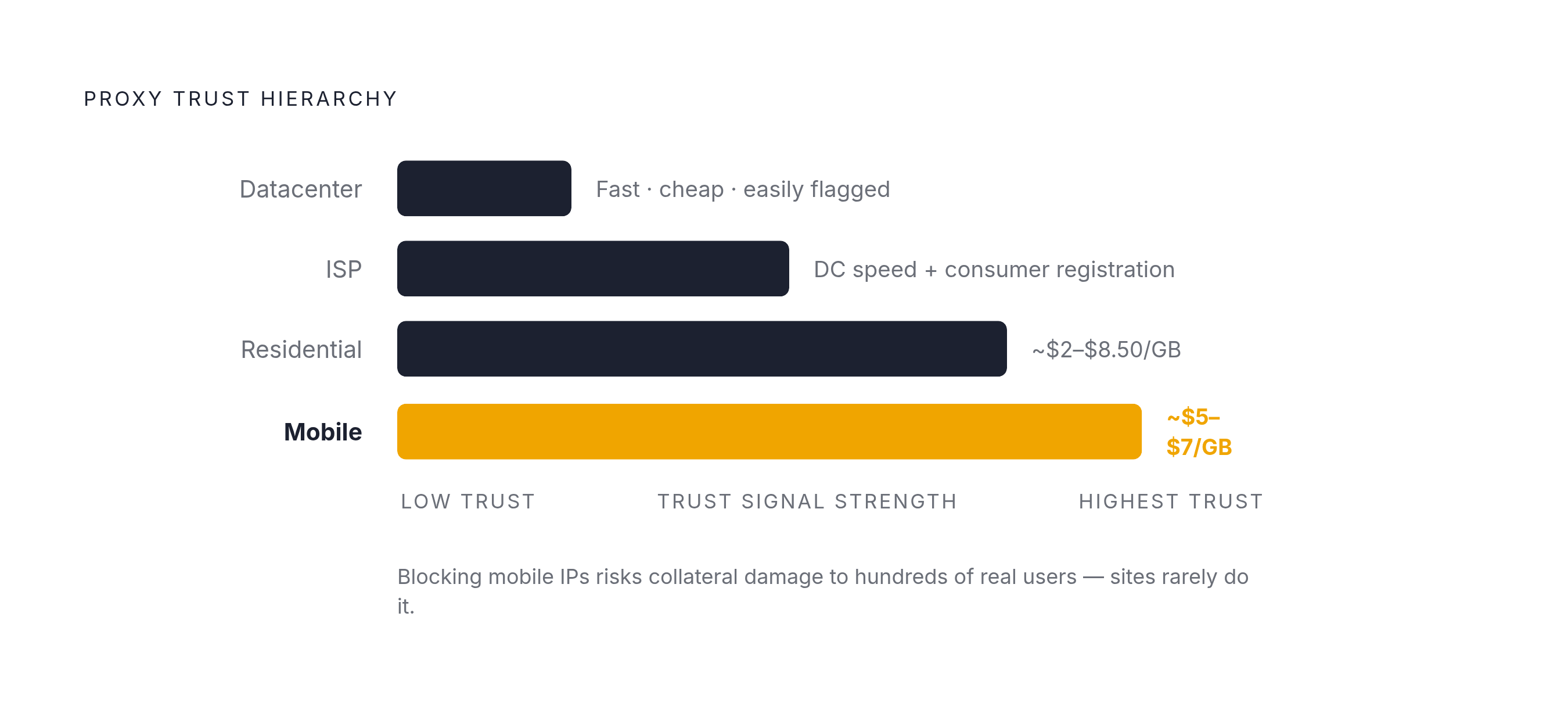
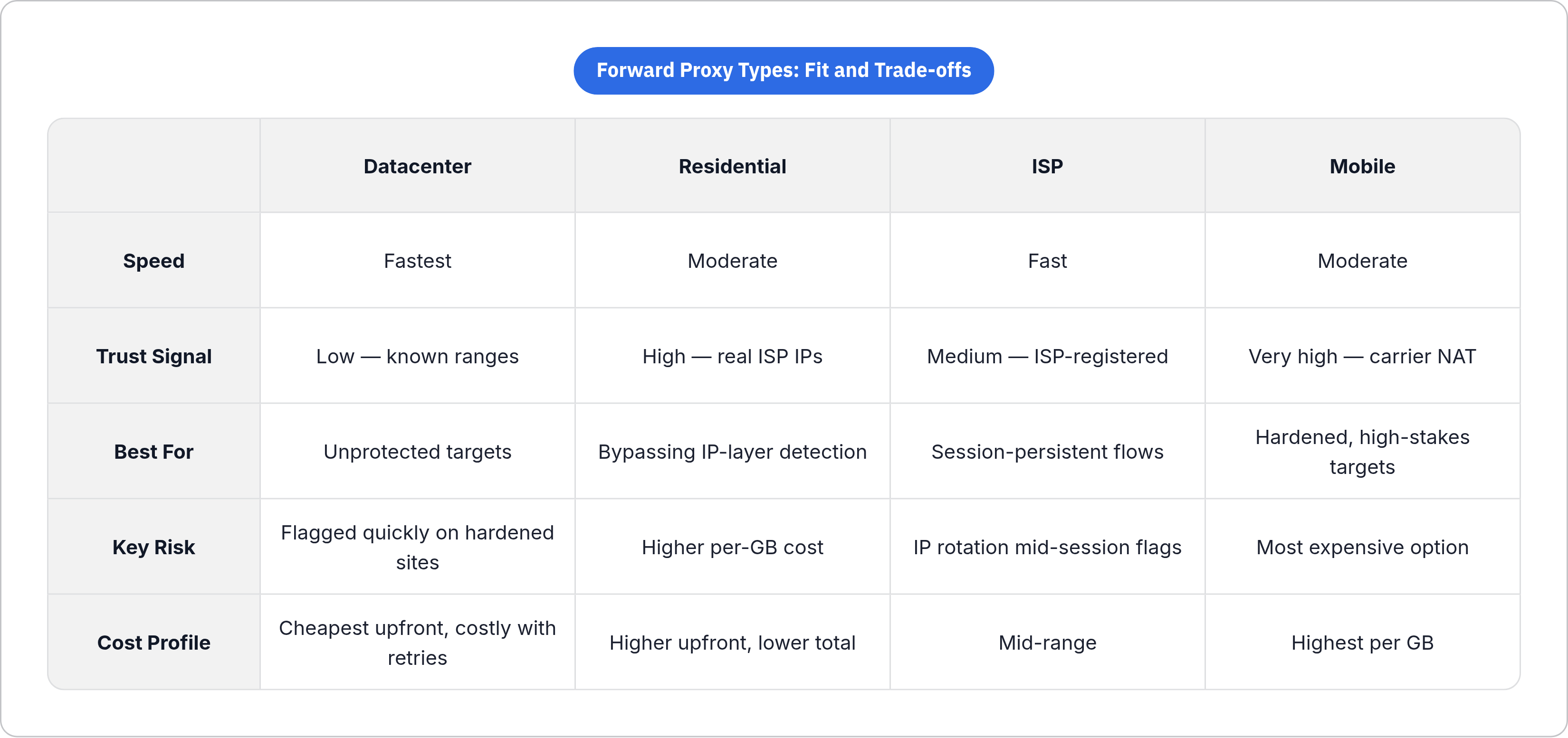
Datacenter proxies are fast and cheap. They live in data centers, which is also why they get flagged easily. The IP ranges are well-known. On lightly protected or unprotected targets, they're perfectly fine. On hardened targets, success rates can fall low enough that the cost of retries makes them less economical than they look on paper. The math gets counterintuitive fast.
Residential proxies use IPs assigned by real ISPs to real consumer devices. They're the primary tool for bypassing IP-layer detection on protected sites. They cost more per gigabyte, but they produce meaningfully higher success rates on tough targets. Higher upfront cost, lower total cost. Usually.
ISP proxies are a hybrid. Datacenter infrastructure, but with IPs registered to consumer ISPs. You get the speed of a datacenter with better trust signals. This makes them well-suited for session-persistent flows: multi-step logins, paginated browsing, shopping cart interactions. Workflows where rotating your IP mid-session is itself a red flag.
Mobile proxies route through carrier-grade NAT on cellular networks. Because many real users share the same exit IP through carrier NAT, blocking a mobile IP risks blocking hundreds of legitimate smartphone users at once. Defenders know this and are conservative about mobile IP blocks. That's what makes mobile proxies exceptionally trustworthy. They're also the most expensive. Proxyway's 2025 market research puts mobile proxy costs at around $6.90/GB at low volume, dropping to roughly $5.06/GB at higher volume.
On top of any of these, you'll almost certainly use a rotating backconnect gateway. One endpoint, and the provider handles IP selection and rotation behind it. You configure session persistence (hold one IP across a multi-step flow) or rotation mode (new IP on every request or on an interval). You can also filter by geography, which matters because WAF rules sometimes flag requests that originate from regions mismatched to the target's primary audience.
Two things vendor marketing tends to gloss over:
First, supply chain risk. In January 2026, Google Cloud took down IPIDEA, which was the world's largest residential proxy network at the time. The investigation revealed that multiple branded proxy providers were secretly reselling the same compromised device pools under different names. Claimed pool size is no longer a reliable quality signal. How a provider sources its IPs matters more than how many IPs they claim to have.
Second, legal context. A 2025 lawsuit against a scraping vendor invoking DMCA Section 1201 is a reminder that publicly visible data does not automatically mean legally scrapable data. Compliance considerations are now part of the architecture decision, not a footnote.
What it actually costs to run proxy infrastructure at scale
Most engineers underestimate the bandwidth math until they've run it once and felt it in the invoice.
Here's the thing that bites people: failed requests still consume bandwidth and still get billed. At a success rate that can realistically fall well below 100% for datacenter proxies on protected sites, collecting one million records requires significantly more total requests. You're paying for the failures. Every retry loop, every blocked request, every JavaScript render that returns a bot-detection page instead of content. All of it costs money.
Residential proxy pricing across major providers in 2025 and 2026 runs from roughly $2/GB on high-volume annual commitments up to $8.50/GB on pay-as-you-go plans.
The billing model changes your risk profile significantly:
- Per-GB pricing is cheap for lightweight HTML pages. It gets expensive fast when JavaScript rendering inflates page size, or when retry loops burn bandwidth on failures.
- Per-request pricing gives you a predictable unit cost, but multipliers on hard targets shift the math quickly. ScrapingBee charges 5 credits for JavaScript rendering, 25 for premium proxies, and 75 for stealth proxies. The headline rate and the effective rate can be very different numbers.
- Per-success pricing has a higher unit cost but eliminates retry risk entirely. When you're targeting heavily protected sites and failure rates are hard to predict, this model can produce lower total spend even though it looks more expensive on the rate card.
For context on managed platforms: Zyte API is $0.13 per 1,000 simple HTTP requests pay-as-you-go. Firecrawl's Hobby plan is $16/month for 5,000 pages.
Failure rate is a cost multiplier, not just a performance metric. The proxy type with the lowest sticker price frequently produces the highest total spend when you run it against a protected target and account for retries. Teams pick datacenter proxies to save money and end up spending three times as much once the retry loops are factored in. It happens more often than people admit, because the failure cost isn't visible until you're already committed to the billing model. Run the numbers on your actual success rate before you lock in.
When to stop managing proxies and route through a crawling API instead
A backconnect proxy gateway gives you raw IP rotation at the network layer. That's it. Everything else, including headers, cookies, JavaScript rendering, retry logic, and anti-bot handling, is still your problem. The proxy is the ingredient, not the meal.
The gap between a proxy pool and a working scraper on a protected target is where most engineering hours actually go. It's also where most costs hide, because that gap gets filled with developer time, and developer time is expensive.
A crawling API closes that gap. What you get:
- JavaScript rendering without managing your own browser farm
- Anti-bot evasion handled at the request layer
- Structured output (Markdown, JSON, or clean HTML) instead of raw responses that need post-processing
- Webhook events, batch processing, and monitoring endpoints so pipelines can be event-driven instead of polling
The case for self-managed proxy infrastructure is real, but narrow. It makes sense if you have dedicated infrastructure engineers on staff, strict data residency requirements, or scraping volume that exceeds roughly $5,000 a month in managed platform costs. Below that threshold, the engineering overhead of managing your own stack usually costs more than the savings on paper.
For AI pipelines specifically, this matters even more. Raw HTML is token-heavy and full of noise: scripts, stylesheets, navigation elements, tracking pixels. That noise distorts LLM reasoning and inflates API costs. A 2024 ArXiv paper found that GPT-3.5-turbo's accuracy on a code translation task swung significantly based purely on input format, with no change to the underlying content. GPT-4 showed a consistent preference for Markdown. The reverse proxy layer is one problem. Getting data into a format an LLM can actually use is a second, separate problem. A raw proxy pool addresses neither.
The web scraping market is on track to grow substantially over the coming years at a strong CAGR. That volume of extraction workloads makes operational efficiency a first-order engineering concern, not a secondary one.
Reading the two-sided architecture together: what resilient crawler design looks like
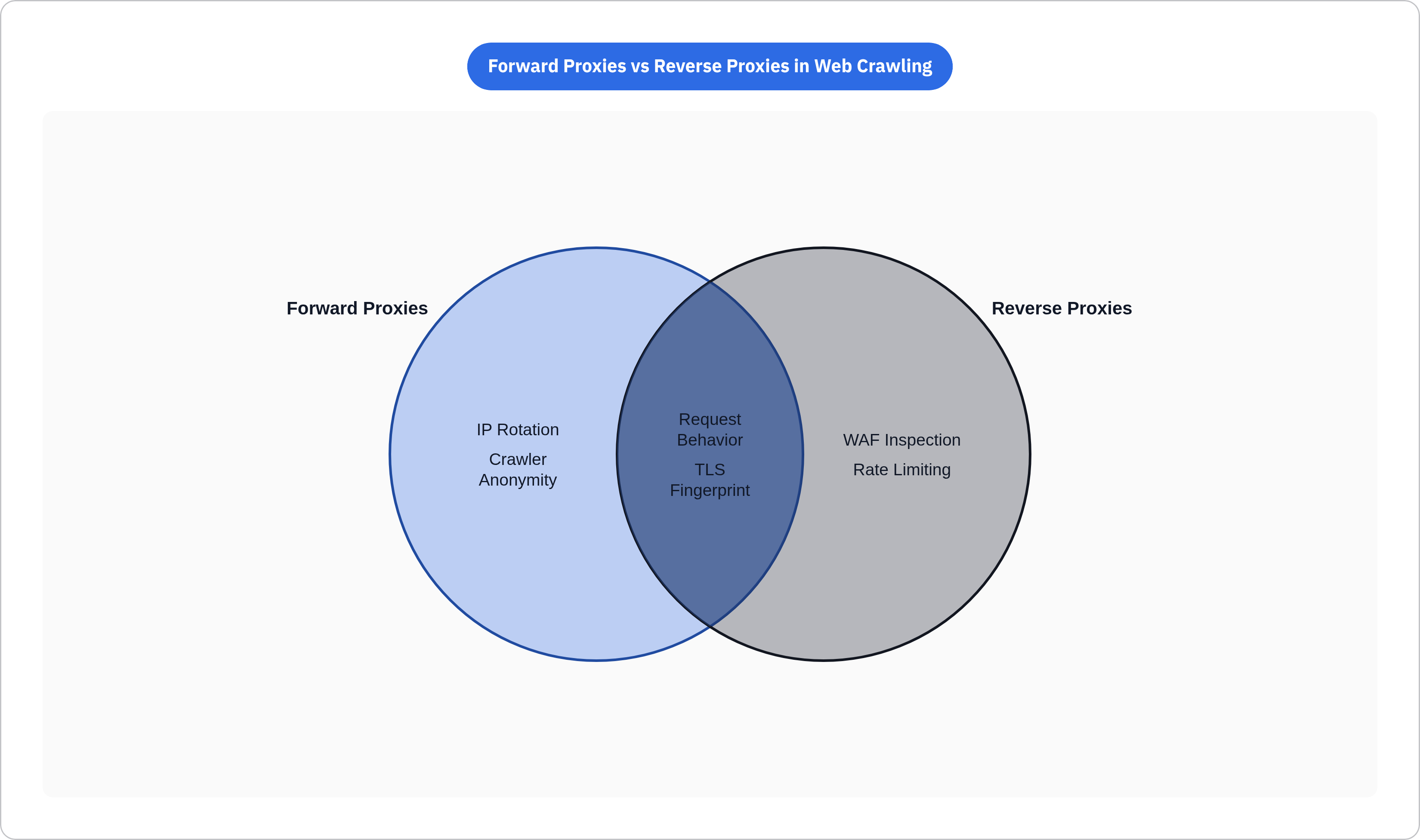
A crawler engineer who only understands forward proxies is fighting half the battle. Your forward proxy is your tool. But what you're trying to get past is a reverse proxy architecture that's been built, funded, and actively maintained by people who know exactly what you're doing and have strong financial incentives to stop you.
Understanding what that defensive layer actually does is what makes evasion strategy coherent instead of trial-and-error. Here's how the matching logic works in practice:
- Rate limiting by IP. Use rotating residential or ISP proxies with session-aware switching. Don't rotate faster than a human would actually navigate.
- Behavioral fingerprinting in the WAF. Proxy rotation is not enough. You need browser rendering, realistic headers, and human-like request cadence. The WAF doesn't care about your IP. It cares about how you behave.
- Layered CDN plus application WAF. At this level, a self-assembled proxy stack often isn't sufficient. A managed crawling API that handles the full evasion stack is frequently the more practical path.
- 402 pay-per-crawl infrastructure. When this becomes common, your pipeline needs payment negotiation logic. IP rotation becomes secondary to the commercial layer entirely.
The supply chain question is now an architecture question. After the IPIDEA takedown, you can't evaluate proxy providers on pool size and price alone. You need to understand how they source their IPs and what oversight they have over their network. That's due diligence now, not optional research.
For AI agent pipelines, the picture extends one step further. Even a request that clears every anti-bot layer still returns raw HTML that an LLM can't use efficiently. The full pipeline runs from IP rotation through clean, structured output. You can solve those as two separate problems with two separate tools, and plenty of teams do. But solving one without the other leaves you with something that technically works but practically doesn't. Most teams figure that out later than they should.
Design against the defense stack you expect to face, not the proxy type you're most comfortable with. Revisit that design every time a major platform ships a meaningful update to its detection capabilities. They ship them regularly, and they don't announce them in advance.