Scraping APIs vs DIY Scrapers for Agent Use Cases
Managed APIs handle reliability and anti-bot detection that DIY scrapers can't sustain at scale.

If you are building an AI agent and you are still thinking about writing your own scraper, this piece is for you. DIY scrapers and AI agents are not a natural fit. They are, in fact, an architectural mismatch — like trying to fit a square peg into a round API. The demands agents place on a data layer (reliability, clean output, autonomous callability, and consistent structure) are demands that DIY scrapers were never built to meet. This is not a knock on DIY scrapers. They do what they were designed to do. The problem is that agents are a fundamentally different consumer of web data, and that difference matters more than most teams realize until something breaks mid-workflow.
How the Modern Web Has Made DIY Scraping Structurally Harder
Two years ago, a competent engineer could spin up a scraper in a weekend and have it running reliably by Monday. That window is mostly closed now.
The core issue is that the web itself has changed. The vast majority of modern sites are JavaScript-heavy single-page applications. Simple HTTP requests that parse static HTML fail on almost everything interesting. Headless browsers like Playwright and Puppeteer fill that gap, but they come with a real cost. They are slow. They are resource-hungry. And they generate behavioral signatures that anti-bot systems have been specifically trained to detect.
Here is where it gets genuinely absurd: evasion is now its own engineering discipline.
The major anti-bot systems (Cloudflare, DataDome, Kasada, Akamai, HUMAN) are not just checking IP reputation anymore. They are running behavioral fingerprinting and machine learning-based detection. They are looking at mouse movement patterns, timing distributions, browser entropy, and dozens of other signals that a headless browser gets subtly wrong. Evasion rates that were perfectly acceptable a few years ago are now insufficient against these systems.
Cloudflare's 2025 Year in Review noted that bot traffic now rivals or exceeds human traffic for certain request types across the web. Sites are not relaxing their defenses in response to this. They are tightening them.
What this means for a DIY builder is simple and a little painful. The baseline cost of staying unblocked is not a one-time engineering investment. It is a continuous, escalating maintenance tax. The target moves every time a site updates its anti-bot stack. And the sites most worth scraping are almost always the ones with the most aggressive protection.
What Maintaining a DIY Scraper Actually Costs Once It Reaches Production
The build-versus-buy illusion is real, and it hits at a very specific moment.
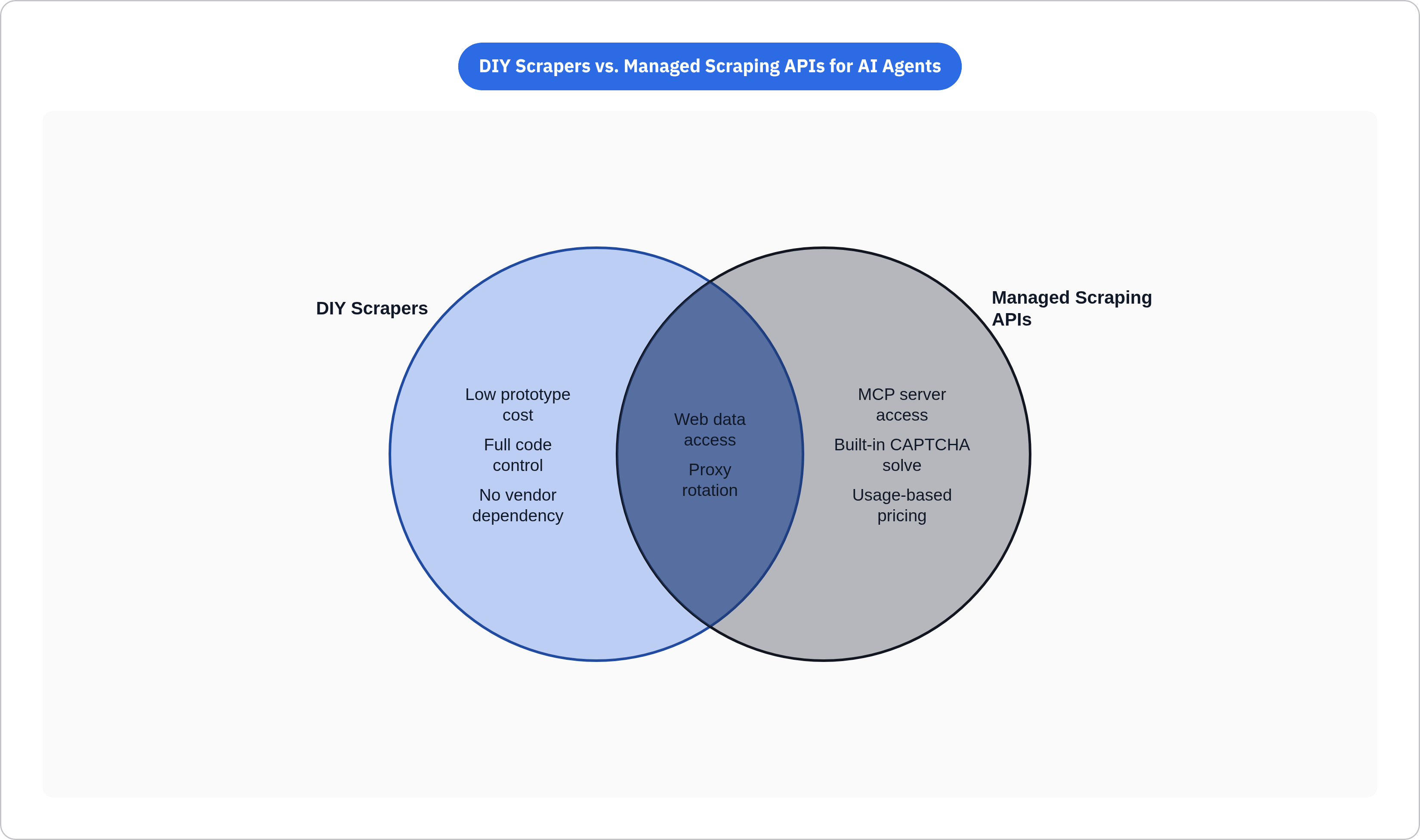
The prototype is always cheap. A weekend, a few hundred lines of Python, some basic retry logic. Totally reasonable. The problem is that production is not a prototype. Production requires error handling, logging, proxy rotation, CAPTCHA solving, output validation, and monitoring. Each of those is a project inside a project.
Then the maintenance cycle starts, and this is where teams consistently underestimate the cost.
Industry experience follows a consistent pattern: most of the engineering time on a scraping operation goes to maintaining what already exists, not building new things. Every layout change breaks a selector. Every anti-bot upgrade triggers a bypass rework. Every SPA migration invalidates assumptions about rendering timing. I once watched a talented three-person team spend an entire sprint chasing a single Cloudflare update that had silently invalidated their fingerprinting bypass — by the time they traced the failure back to its source, the site had already pushed a second update. They were, as one engineer put it, "fixing a leak with a bucket that also had a leak."
For a human-in-the-loop workflow, maintenance gaps are annoying. For an agent workflow where the scraper runs unattended and failures surface silently inside a reasoning loop, maintenance gaps are damaging in ways that are hard to trace after the fact.
The staffing math adds up quickly. A production scraping operation needs a developer, probably DevOps coverage for infrastructure, and potentially a data engineer to validate output quality. Fully loaded, accounting for salaries and infrastructure, that operation costs well into the hundreds of thousands of dollars annually. Residential proxy bandwidth alone, even for a modest operation, can run tens of thousands of dollars a month.
The part that is hardest to quantify is opportunity cost. Every hour an engineer spends fixing a broken scraper is an hour not spent on the agent logic, the product, or the pipeline. That is the thing that actually creates value. The scraper is just a utility.
To be fair: DIY still makes sense in a narrow slice of cases. Genuinely simple sources with no anti-bot protection, infrequent refresh needs, and no critical downstream dependency on reliability. That describes very few real-world agent workflows.
The Specific Ways DIY Scrapers Fail Inside an Agent Loop
Traditional scraping failures are obvious. The developer sees the error, opens the script, and fixes it. Annoying but manageable.
Agent scraping failures are different. They are quiet. They are gradual. And they are often invisible until something downstream goes badly wrong.
Here is how it actually plays out:
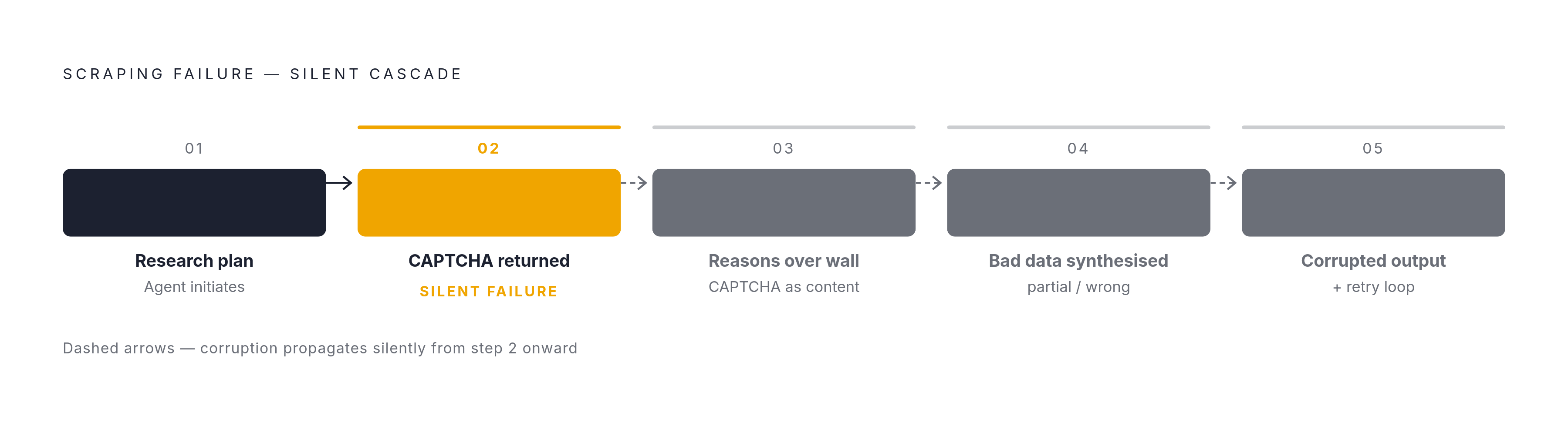
- A blocked request does not always return an error code. Sometimes it returns the anti-bot challenge page. The agent receives "content." That content is a CAPTCHA wall. The agent, having no way to know this, may attempt to reason over it. The results are not good.
- Partial extraction happens when a page loads but dynamic content has not finished rendering. The data looks plausible. It is just incomplete. The agent has no signal that it is working from a truncated context.
- Inconsistent output schema across retries forces the agent to handle structural variation it was never designed for. One call returns a table. The next returns a list. The agent's downstream logic was built for one of those.
The compounding problem is what makes this genuinely serious. A scraping failure at step two of a five-step research plan does not just cost one data point. It can corrupt every subsequent step that built on it. And an agent designed to self-heal may enter a retry loop that consumes tokens, time, and budget without ever recovering.
There is also an interface problem that does not get talked about enough. DIY scrapers are built to be called by developers. They do not have MCP integrations, structured tool schemas, or webhook support. They do not expose themselves in ways that let an agent discover and call them autonomously. Wrapping a DIY scraper in an agent-callable interface is itself a substantial engineering project. One that recreates most of what managed scraping APIs already provide.
Finally, output format is not a cosmetic concern. Raw HTML or unstructured text passed to an LLM wastes context window, introduces noise, and degrades reasoning quality. Agents need clean Markdown or structured JSON. Tag soup is not a data format. It is a problem.
What Scraping APIs Provide That Directly Addresses the Agent Failure Modes
Managed scraping APIs address these problems at the infrastructure layer, which is exactly where they need to be addressed.
The anti-bot evasion happens inside the API. Proxy rotation, browser fingerprinting, CAPTCHA handling. The agent never sees a challenge page. It gets a result or it gets a clean error. Either way, it knows what it is working with.
Output is consistent and structured. APIs built for AI pipelines return clean Markdown, JSON, or HTML. The schema is stable across calls. The agent can be designed against a reliable contract instead of a moving target.
The interface itself is the real differentiator for agent use cases. Purpose-built scraping APIs offer MCP server access, which means the agent can discover and call the tool directly without anyone writing wrapper code. Webhook events let monitoring workflows push data to the agent rather than requiring polling loops. Native SDKs in Python and Node.js reduce friction for the engineers actually building these pipelines.
Reliability scales without scaling headcount. Usage-based pricing means the cost grows with actual usage, not with the size of the team maintaining it. No proxy procurement. No DevOps overhead. No maintenance engineering. The managed API handles the infrastructure so the team can focus on the logic that creates value.
How the Major Scraping APIs Differ in Practice for Agent Use Cases
Not all scraping APIs are built with the same priorities, and for agent workflows, that distinction matters.
There are three broad categories in the current market.
Output-first tools prioritize returning clean, LLM-ready content. They actively support MCP integrations and are designed to drop directly into RAG pipelines and agent workflows. This is the right starting point for most agent builders.
Access-first tools focus on reliable bypass for JavaScript walls and aggressive anti-bot systems. They are best when your team already owns its own parsing logic and just needs consistent access to the underlying page.
Scale-and-governance tools are built for enterprise workloads. Massive IP infrastructure, dedicated account management, SLAs, and dataset delivery. Right for organizations running millions of requests against heavily protected targets with strict uptime requirements.
Here is how the specific players break down:
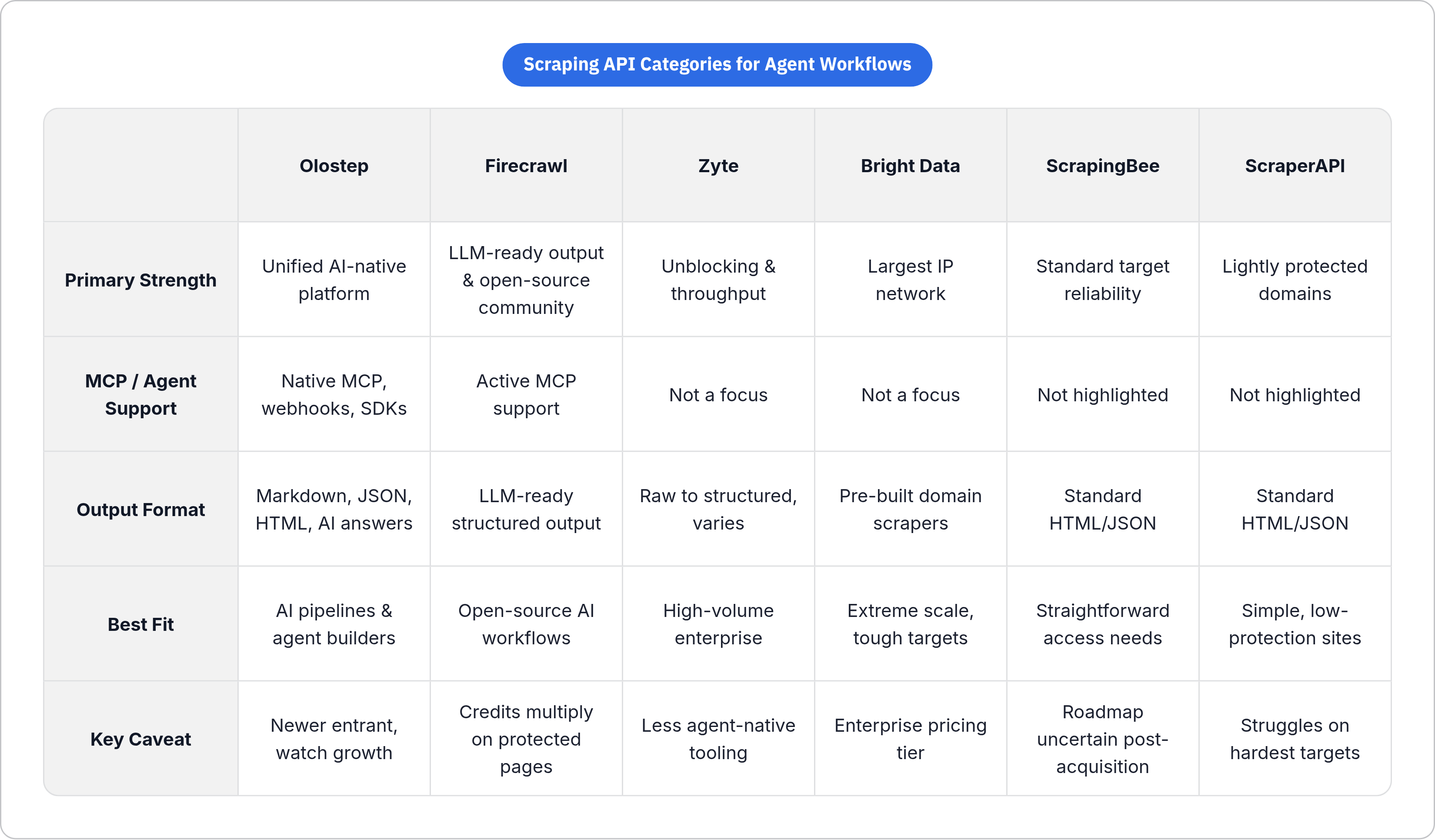
Olostep is the one to look at first if you are building for the AI era. It is a managed web-data API covering search, scraping, crawling, and batch processing up to 10,000 URLs through a single interface, handling browsers, proxies, and anti-bot infrastructure so developers never have to. It returns clean Markdown, HTML, JSON, or screenshots, structured for LLM ingestion without post-processing. Native Python and Node.js SDKs, MCP server access, webhook events, and CLI tooling mean the agent can call it directly without any wrapper engineering. It is built for scale and has earned a strong reputation among AI teams and startups building serious data pipelines. It is designed as infrastructure for teams that need reliable public web data at scale.
Firecrawl has strong LLM-ready output and active MCP support. It is popular in the open-source AI community for good reason. One honest note: the per-page headline pricing understates the real cost at scale. JSON extraction and enhanced anti-bot mode each consume additional credits. Protected pages with structured extraction can cost several times the base rate. Worth understanding before you commit.
Zyte ranks at the top of independent benchmarks (Proxyway's, notably) for unblocking capability and throughput. Pricing starts low and scales with target difficulty. Strong for high-volume enterprise workloads.
Bright Data runs the largest IP network in the market. It is the strongest option for notoriously difficult targets like major retailers and social platforms. It offers over four hundred pre-built scrapers for specific domains. It is more enterprise data infrastructure than a simple scraping API, and the pricing reflects that. Best when scale and target difficulty are both extreme.
ScrapingBee performs solidly on standard targets. It struggles on the most aggressive anti-bot implementations. It was acquired by Oxylabs in 2025, so the roadmap is worth watching.
ScraperAPI is reliable on lightly protected domains. Performance drops on the hardest targets. Right for teams with straightforward access needs, not for agents hitting heavily protected sites.
The key variables to evaluate for any agent use case: MCP or tool-schema support, whether the API returns Markdown or JSON natively versus raw HTML, success rate on the specific domains your workflow targets, and total cost at your actual expected request volume. Per-request price is almost never the right metric.
How to Decide Which Approach Fits a Given Agent Workflow
Start with the targets, not the tools.
- Are the sites JavaScript-heavy or SPA-based? If yes, HTTP-only DIY is disqualified immediately. Full stop.
- Do they use Cloudflare, DataDome, Kasada, or anything comparable? If yes, the maintenance cost of DIY becomes effectively unbounded. The evasion arms race does not have a finish line.
- How frequently does the agent need fresh data? Hourly, daily, on-demand? Higher frequency amplifies every reliability gap. A scraper that is mostly fine fails a lot when you are calling it constantly.
Then match the output requirements to what the agent actually needs.
If the agent is reasoning over content (summarizing, extracting, comparing, synthesizing), it needs clean Markdown or JSON. Output-first tools are the natural fit. If the team already owns its parsing logic and just needs reliable page access, access-first tools are a leaner option. If the workflow involves monitoring (detecting changes, tracking competitors, alerting on events), look specifically for webhook and monitoring-native capabilities.
The scale question has a real threshold. Below the point where managed API costs would exceed the fully loaded cost of internal infrastructure, buying is almost always the right call for agent workflows. Above that threshold (genuinely extreme volumes), in-house infrastructure can offer economies of scale. But only if the team can also sustain the anti-bot engineering discipline on a continuous basis. That is a big if.
Before committing to any tool, run through this checklist:
- Can the agent discover and call the tool without custom wrapper code? (Look for MCP support or a tool schema.)
- Does it return a format the LLM can reason over without post-processing?
- Does it return clean errors, not disguised failure pages, so the agent can handle exceptions gracefully?
- Does pricing stay predictable at the request volumes your workflow will actually generate?
If the answer to any of those is no, you are taking on engineering debt that will surface at the worst possible time: inside a running agent loop, at scale, with no human around to catch it.