Hallucination Reduction Strategies for Research Agents
Four types of hallucination require different fixes matched to their root causes.

A lawyer files a brief full of citations that look airtight. None of the cases exist. A travel chatbot promises a discount that was never offered, and now customer service has to honor a price the company never set. Both are called "hallucination," as if that one word explains what went wrong. It doesn't. Research agents fail in four structurally different ways, drawn from a 2026 architectural analysis.
A factual hallucination is a claim that contradicts a fact about the world, and the rest of this piece refers back to these four types by name. A grounding hallucination is a claim that contradicts the document the agent was actually given. A citation hallucination is a source that doesn't exist, or exists but says nothing like what it's credited with saying, and this one is the dominant failure mode for research and legal agents right now. A reasoning hallucination is the strangest of the four: the facts are right, the source is real, and the conclusion drawn from them is still wrong.
The distinction isn't academic. A 2025 survey (arXiv:2510.06265) lays out a full taxonomy of hallucination types and traces root causes across the entire LLM development pipeline, and the throughline is that each type has its own cause and its own primary remedy. Treat all four as one undifferentiated bug and every fix starts looking like a crapshoot. Matching the fix to the layer makes most of them stop looking mysterious.
Part of why this keeps happening is structural: language models are optimized to produce the most statistically likely next word, not the truest one. Research out of OpenAI (Kalai et al., arXiv:2509.04664) shows that because most benchmarks score a confident wrong answer the same as an honest "I don't know," models learn that guessing beats admitting uncertainty. Hallucination, in that sense, is a rational response to a bad incentive, the model equivalent of answering "C" on a multiple-choice test you didn't study for because blank answers get zero credit either way.
How often this happens depends heavily on the shape of the task. Deepchecks' 2026 benchmark report puts extractive question-answering at the low end of hallucination rates and multi-step agent workflows at the high end. More steps means more chances for something to go sideways, which is the thread the rest of this piece pulls on.
Why factual hallucinations resist fixes that work on the other three types
Factual hallucination is a memory problem, and it's a specific kind of memory problem: the model is answering from parametric weights that were frozen the moment training ended. That memory is finite. It's also lumpy, dense in well-documented areas and thin everywhere else, the long tail of knowledge nobody wrote enough about for the model to learn reliably.
The International AI Safety Report 2026 describes this as "jagged" capability: systems that ace genuinely hard reasoning tasks while tripping over something a search engine would answer correctly in half a second. Confidence doesn't scale down with accuracy, either. As tasks get longer, models keep generating false statements with the same self-assured tone they use for true ones.
The AA-Omniscience benchmark, as of June 2026, makes the scale of the problem concrete. Even the leading frontier models score poorly on knowledge reliability, and on hard questions they're wrong at least as often as they're right, regardless of how large or expensive the model is. Bigger doesn't fix this. More parameters just means a more confident wrong answer.
Retraining helps at the margins. Fine-tuning can tighten accuracy in domains where training data is thick, but it can't solve staleness, because any fixed training corpus starts aging the day it's collected. Research agents live at exactly the point where this matters most: tracking a regulatory change from last week, a stock move from this morning, a court filing from an hour ago. No amount of retraining reaches content that didn't exist yet when the model was trained.
That leaves one honest conclusion: factual hallucination is the one failure type where the fix has to come from outside the model, not from improving the model itself. The research agent needs a live source of truth sitting in front of it at the moment it answers.
Live web grounding as the primary fix for factual hallucinations
Giving a research agent live web access is the single most effective documented fix for factual hallucination. Research from suprmind.ai found hallucination rates dropping by roughly three-quarters to more than four-fifths once web access was switched on. That's not a marginal improvement, it's close to removing the failure mode entirely for the cases it covers.
The reason live grounding beats a static retrieval index comes down to timing. Standard retrieval-augmented generation (RAG) draws from a corpus that was indexed at some point in the past, and indexing takes time, so the corpus is never perfectly current. The dangerous part isn't that stale retrieval produces no answer. It produces a confident one, grounded in a fact that used to be true. Live web access skips the indexing lag and reaches content published minutes earlier, closing a gap a fixed corpus structurally cannot close. For a research agent tracking competitor pricing, watching for a regulatory change, or following a story as it breaks, that gap is the whole job.
None of this works, though, if what the agent retrieves is a mess. Hallucination rates drop dramatically with well-structured retrieval sources compared to unstructured ones, which means the layer handing web content to the model matters as much as the decision to go to the web at all. Feeding a model raw HTML, complete with navigation menus, cookie banners, and ad scaffolding, is like handing someone a research packet where half the pages are still stapled to the printer.
"LLM-ready" retrieval has a specific shape. It means clean markdown that keeps headings, lists, tables, and link text intact while stripping out the chrome around them. It means structured fields, price, author, publish date, product ID, returned as typed values instead of buried somewhere in a paragraph. What "LLM-ready" retrieval means in practice is content pre-processed for direct model consumption rather than raw scraped text. It means fewer tokens and predictable chunking, both of which matter because of the "lost in the middle" effect documented by Liu et al. (arXiv:2307.03172): models reliably lose track of facts sitting in the middle of a long context, even when the model is specifically built for long contexts. Clean retrieval is a grounding quality issue with the same weight as deciding to search the web in the first place.
An infrastructure question decides the whole outcome: can the system handle JavaScript-rendered pages, get past anti-bot systems, and handle a page's DOM mutating mid-load? That layer determines whether the model sees the real page or a broken approximation of it. A research agent is only as reliable as the ugliest page it has to read.
Grounding hallucinations: when the right document fails the model anyway
Retrieval can do everything right, hand the agent exactly the document it needs, and the agent can still get it wrong. That's a faithfulness failure rather than a factuality failure, and a different animal. The correct source is sitting in the context window. The model contradicts it, misreads it, or quietly drifts away from what it says. Adding live web access doesn't touch this, because the problem was never about what the model had access to.
The "lost in the middle" effect is partly to blame here too. Even accurate, present information loses influence over the model's output if it happens to land in the middle of a long context rather than near the start or end. A fact can be fully there and still functionally invisible.
Two fixes actually move the needle. The first is simply trimming context down: pass the single most relevant chunk instead of the whole document, because less surrounding noise means less chance for the model to drift. The second is a stricter rule for how the model is allowed to talk at all: require it to cite a specific retrieved passage by ID for every factual claim, and instruct it to abstain if no passage backs the claim up. Benchmarks built for exactly this, FActScore and RAGTruth, show this citation discipline cuts unsupported claims substantially compared to a model generating freely at the same size.
There's also a way to catch faithfulness failures without checking them against any outside source. Farquhar et al., writing in Nature in 2024, describe "semantic entropy": sample the same question multiple times, and if the answers disagree with each other in meaning (not just in wording), that disagreement itself signals a likely hallucination. It's a way of catching the model contradicting itself before it ever contradicts a fact, the research equivalent of noticing a witness has told the story three different ways and deciding that's worth a second look regardless of which version turns out true.
Citation hallucinations and the strict citation contract that catches them at decode time
Citation hallucination is the failure mode research and legal agents hit hardest, and it's the one most likely to end up in a headline. The model fabricates a paper title, an ArXiv ID, or a quote, and attributes it to a source that's real but contains nothing of the kind. The output looks exactly like a properly cited answer. Nothing about its surface gives away the fabrication, which is precisely what made the lawyer's brief and the travel chatbot's phantom discount so costly: nobody caught the problem until someone else went looking.
The mechanism behind it is architectural: the model isn't retrieving a citation, it's predicting what a citation to a source like that would plausibly look like, and in an academic or research context, a well-formatted fake citation is exactly the kind of high-probability text the model was trained to produce. That's also why reviewing the output after the fact barely helps. Fabricated citations are syntactically indistinguishable from real ones. Manually checking every citation in a research pipeline doesn't scale. The error stays invisible until somebody clicks the link or looks up the paper, by which point it's already in the filing, the chat log, or the customer's inbox.
The fix has to happen earlier, at the moment the text is generated rather than after. Require every claim to point at a specific passage ID that actually exists in the retrieved context, and flag any claim pointing at an ID that doesn't. That turns citation checking from a post-mortem into a gate the output has to pass through before it reaches anyone. Had the travel chatbot's answer been required to point to an actual retrieved passage listing that discount, the discount would never have made it to the customer, because no such passage would have existed to cite.
Agentic RAG introduces its own twist on this: synthesis hallucination, where an agent stitches together two retrieved chunks about two different subjects and produces a claim that neither chunk actually supports. Requiring per-claim attribution to a specific chunk ID catches most of these too, because a synthesized claim with no single supporting passage simply has nothing to point to.
Reasoning hallucinations that survive all retrieval-layer fixes
Reasoning hallucination is the type that makes the other three look almost manageable. The facts are correct. The citation checks out. The inference built on top of all of it is still broken, and every fix discussed so far, live web grounding, tighter chunking, citation contracts, leaves this one completely untouched, because none of them were built to catch a bad conclusion drawn from good evidence.
This failure type is most visible in multi-step agent workflows, where the agent has to chain several inferences together to reach an answer. One shaky link early in that chain gets treated as settled fact by every step after it, the same way a rumor passed down a line of people keeps its confident tone long after it's lost any connection to the original fact.
A security survey from Deng et al. (Swinburne University / Tianjin University) classifies planning threats and hallucination as distinct internal execution risks: reasoning failures don't just produce wrong text, they produce wrong plans, wrong API calls, and wrong actions taken by the agent itself.
Tool argument spoofing makes this concrete. An agent calling an external tool sometimes invents arguments or IDs outright, because the tool's schema has drifted out from under it or because generating a plausible-looking argument is easier than generating a correct one. That's not a retrieval failure. The data was fine. The reasoning deciding what to do with the data broke.
A different class of tool helps here: chain-of-thought prompting, self-consistency sampling, and span-level evaluation. Chain-of-thought prompting, where the model lays out explicit intermediate steps, lets each step be checked on its own instead of only judging the final answer. Self-consistency sampling runs multiple reasoning paths for the same question and flags disagreement between them for a human or verifier, rather than defaulting to whichever answer sounds most fluent. Span-level evaluation goes a step further, attaching a check to each individual reasoning span rather than scoring the response as a whole, because a high average groundedness score across a long response can quietly hide a meaningful per-claim error rate sitting inside it.
How cascading errors turn small per-step failures into large pipeline failures
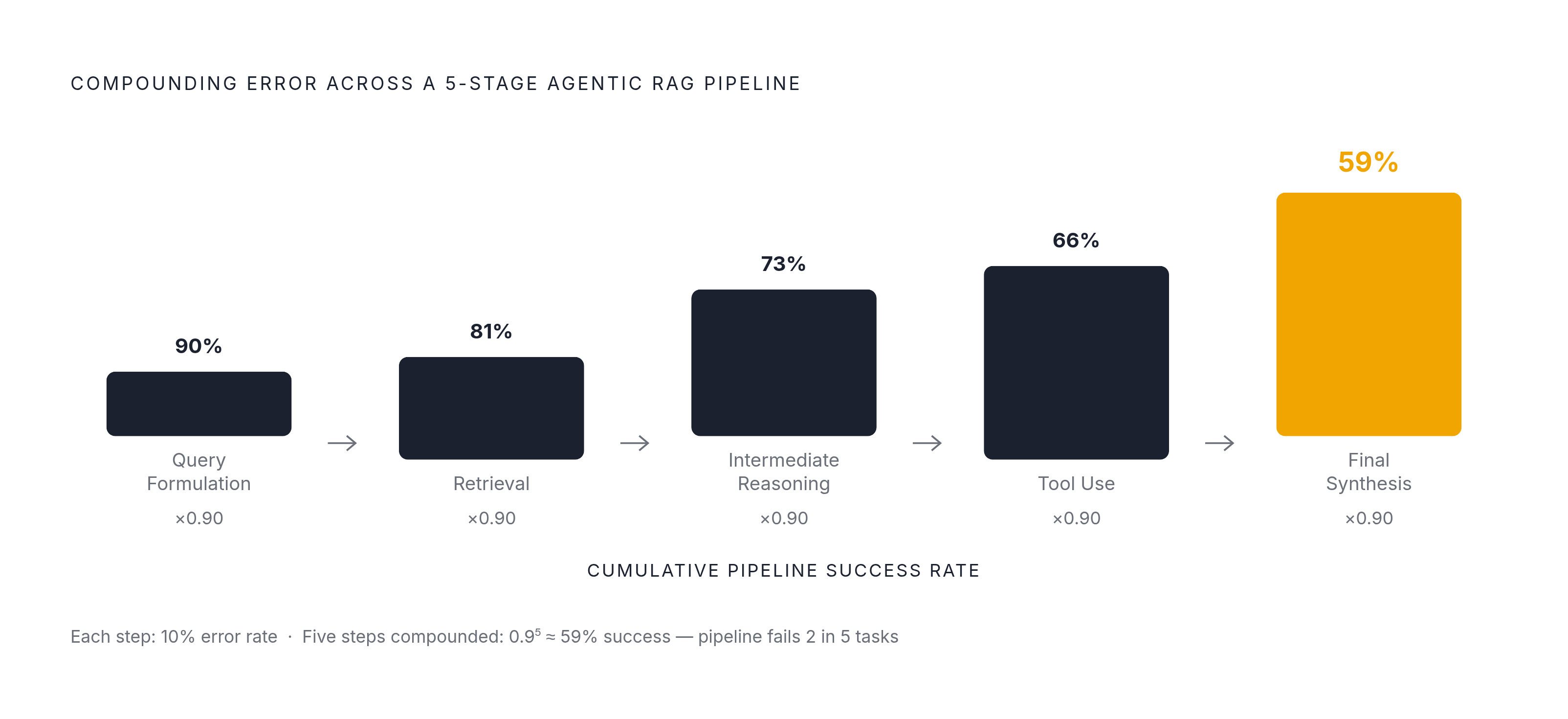
None of these four failure types stays politely inside its own layer once an agent runs multiple steps in sequence. A hallucination at any early stage becomes the input every later stage treats as settled, because the pipeline has no built-in instinct to doubt its own earlier output.
A standard agentic RAG pipeline runs through five stages in order: Query Formulation, Retrieval, Intermediate Reasoning, Tool Use, and Final Synthesis. Each stage hands its output to the next as fact. A grounding hallucination that occurs during Retrieval anchors everything Intermediate Reasoning and Tool Use build on top of it.
Compounding across steps makes the math unforgiving. A modest error rate at each individual step compounds across five sequential steps into a much larger error rate for the full trajectory. A fix that looks perfectly adequate tested in isolation at one layer can still leave a pipeline that fails on most complex, multi-step tasks, simply because five small risks multiplied together stop being small.
A June 2026 paper tries to address that compounding problem head-on. Saroj Mishra, of the University of North Dakota, introduced the CHARM framework (Cascading Hallucination Aware Resolution and Mitigation, arXiv:2606.04435), built around four components, the first of which is stage-level fact verification. The logic behind it tracks everything this piece has laid out: catching an error at the layer where it happens, before it gets treated as fact by every stage downstream, beats trying to untangle it five stages later when it's been dressed up as a confident, fully-cited, perfectly-reasoned conclusion.
Sources
- suprmind.ai
- How to Reduce LLM Hallucinations in 2026: 7 Proven Strategies
- How to Reduce LLM Hallucinations
- AI Agents Under Threat: A Survey of Key Security Challenges and Future Pathways
- Large Language Models Hallucination: A Comprehensive Survey
- Cascading Hallucination in Agentic RAG: The CHARM Framework for Detection and Mitigation