Python Web Scraping Library Selection for AI Projects
Understand the five-layer stack that separates competing libraries into complementary tools.

Most tutorials present Python scraping libraries as a flat list of competitors, like flavors at an ice cream shop where you just pick your favorite. That framing is wrong, and it causes real problems. The ecosystem is actually a stack of composable layers. Each layer does a completely different job. Mixing them up is like using your kitchen blender to wash dishes. Technically it runs, but not well.
Here is what the stack actually looks like:
Layer 1. HTTP Fetching
This is the actual request to the web. Everything starts here.
- Requests: Synchronous, simple, near-zero setup. Fine for small, static targets where you are not in a hurry.
- AIOHTTP: Async via asyncio. Gives you control over connection pooling, streaming, and WebSockets.
- HTTPX: A modern async-compatible alternative. Pairs well with lightweight pipelines.
- curl_cffi: The interesting one. It spoofs TLS and JA3 fingerprints at the connection level. Relevant when a target has bot detection that fires before it even reads your request body.
Layer 2. HTML Parsing
Once you have the page, you need to pull structure out of it.
- BeautifulSoup: Pythonic, beginner-friendly, actively maintained. Works with lxml, html5lib, or the built-in parser.
- lxml: C-backed, fast, XPath support. The pick when throughput and strict schema matter.
- selectolax: Hyper-fast, less expressive. Built for millions of pages where parse speed is the actual bottleneck.
- Scrapling: Built for resilience to DOM drift and class name changes. Relevant for pipelines that need to survive site redesigns without quietly breaking.
Layer 3. Crawling Frameworks
These coordinate fetching and parsing across many pages.
- Scrapy: Battle-tested. Built-in middleware, CSS and XPath selectors, auto-throttling, exporters for JSON, CSV, and XML. Uses Twisted under the hood, which creates friction with modern Python async tooling. Version 2.7 improved asyncio support, but the seams still show.
- Crawlee for Python: Unified HTTP plus native Playwright browser automation, with built-in fingerprinting. A better default for SPAs and dynamic targets.
Layer 4. Browser Automation
For pages that render in JavaScript and cannot be scraped with a plain HTTP request.
- Playwright: Communicates directly via Chrome DevTools Protocol, no separate driver needed. The clear choice for new projects targeting dynamic sites.
- Selenium: Still alive in enterprise maintenance contexts. Not a new-project choice.
Layer 5. AI-Output and LLM-Native Tools
These operate above the parser layer entirely and are built specifically for LLM consumption. Crawl4AI and ScrapeGraphAI live here. More on both in a moment.
The point of understanding this structure is simple: most production AI pipelines compose two or three of these layers, not one. You pick an HTTP client, a parser, maybe a framework or browser layer on top. Knowing which floor each library lives on prevents you from comparing Scrapy to Playwright as if they are alternatives. They are not. They solve different problems.
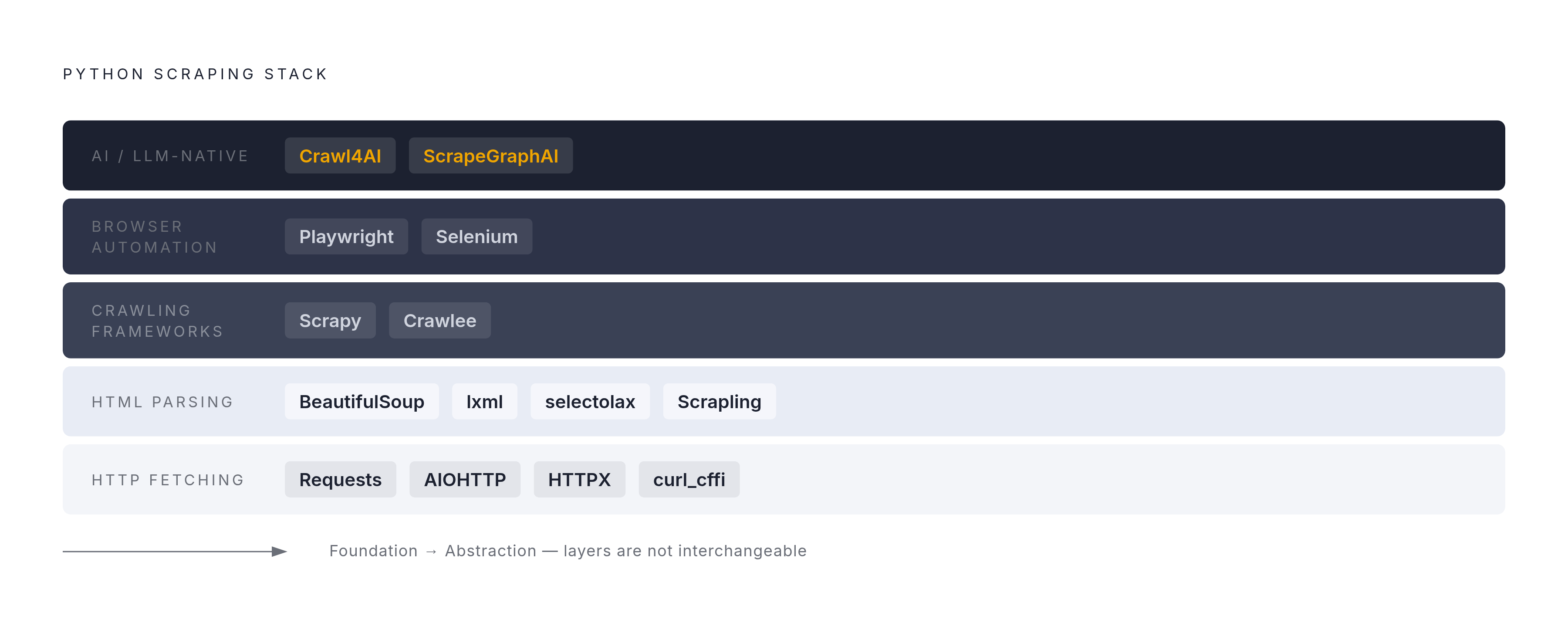
What the Target Content Type Demands Before Any Framework Decision
Content type is the first filter. It eliminates large parts of the library landscape before you even think about pipeline stage. Get this wrong and you will spend real time debugging the wrong tool for the job.
Static HTML
An HTTP client plus a parser. That is it. No browser overhead, no headless Chrome eating your memory. For recurring crawls across many static pages, Scrapy plus lxml is the high-throughput default. If parse speed becomes the bottleneck, swap lxml for selectolax.
JavaScript-Rendered and SPA Targets
You need a real browser. There is no shortcut. Playwright is the current default for new projects. Crawlee wraps Playwright with fingerprinting and a unified API, which cuts boilerplate when you are dealing with a mix of static and dynamic pages in the same pipeline.
Bot-Protected Targets
This is where things get expensive, fast. TLS fingerprinting from services like Cloudflare, DataDome, and Kasada will block a naive HTTP client within seconds of deployment. curl_cffi handles TLS-level spoofing. Playwright with stealth configuration handles behavioral evasion. If your team is spending more engineering time on evasion than on data quality, that is a clear signal to consider delegating to a managed API layer instead.
Structured Targets: APIs, JSON Feeds, Sitemaps
An HTTP client alone is often sufficient. The parser layer is unnecessary entirely. Add Pydantic for schema validation on the way out and you are done.
Frequently Changing Layouts
Hard-coded CSS or XPath selectors break silently. This is one of the most common and most quietly damaging pipeline failure modes in production. Scrapling was designed specifically for resilience to DOM drift. For severe layout instability, LLM-based extraction via ScrapeGraphAI is an alternative. It trades cost and latency for flexibility, so it is not a free upgrade.
Matching Library Capabilities to Each Pipeline Stage
Once you know your content type, pipeline stage is the second filter. Each stage has different priorities, and what counts as a good tool in one stage can be a liability in another.
Stage 1. Bulk Data Collection
Training data, large crawls, recurring ingestion jobs. Priorities here are throughput, reliability, export format, and cost per request.
- Scrapy plus lxml plus Pydantic: Rigorous schemas, built-in exporters, proven at scale for static targets. The asyncio improvements in version 2.7 meaningfully help for large-scale projects.
- Crawlee: Better choice for mixed static and dynamic targets at scale.
- At this stage, proxies stop being optional and start being infrastructure. There is no way around it.
Stage 2. Preprocessing and Cleaning for LLM Consumption
This stage gets underestimated a lot. Raw HTML is the wrong unit for an LLM. It wastes tokens and quietly degrades extraction accuracy in ways that are hard to trace back to their source.
- Crawl4AI: Local-first, outputs clean Markdown without external API calls. Its BM25 content filter retains only query-relevant sections. It crossed 68,000 GitHub stars in under a year after launch, which is a real practitioner signal worth noting.
- Firecrawl: A managed option. Returns clean Markdown by default. Also provides raw HTML, screenshots, metadata, and structured JSON via schemas for teams that do not want to manage their own infrastructure.
Stage 3. Feeding LLMs and RAG Stores
Priorities shift toward chunk-ready output, relevance filtering, minimal token waste, and low retrieval latency.
- Crawl4AI plus a local or remote LLM: Query-filtered extraction. Good for teams that care about data sovereignty.
- The basic architecture: query, web search, scrape top results, inject into prompt before generation. Simple on paper. Fragile if the scraping layer is not solid.
- ScrapeGraphAI: Right when layout is unstable or data spans multiple non-uniform page regions. LLM calls make it slower and more expensive as volume grows. Not suited for high-volume bulk extraction.
Stage 4. Agent-Driven, On-Demand Research
This is the hardest stage to get right. Agents trigger scrapes reactively: memory gap, scrape, inject into the vector store, back to the agent. Latency has to stay within seconds. And stale data is a first-class failure mode here, not just an inconvenience.
An agent acting on outdated ground truth might send an email, update a price, or trigger a purchase. Irreversible actions on bad data are a real problem that shows up fast in production.
- Crawlee plus Crawl4AI: Unified HTTP and browser API, Markdown output, BM25 filtering.
- Managed APIs like Firecrawl absorb anti-bot complexity. The agent's tool call returns clean data without retry logic or evasion code living inside the agent itself. That is a meaningful architectural simplification, not just a convenience.
The Role-Based Stack Recommendations That Follow from the Framework
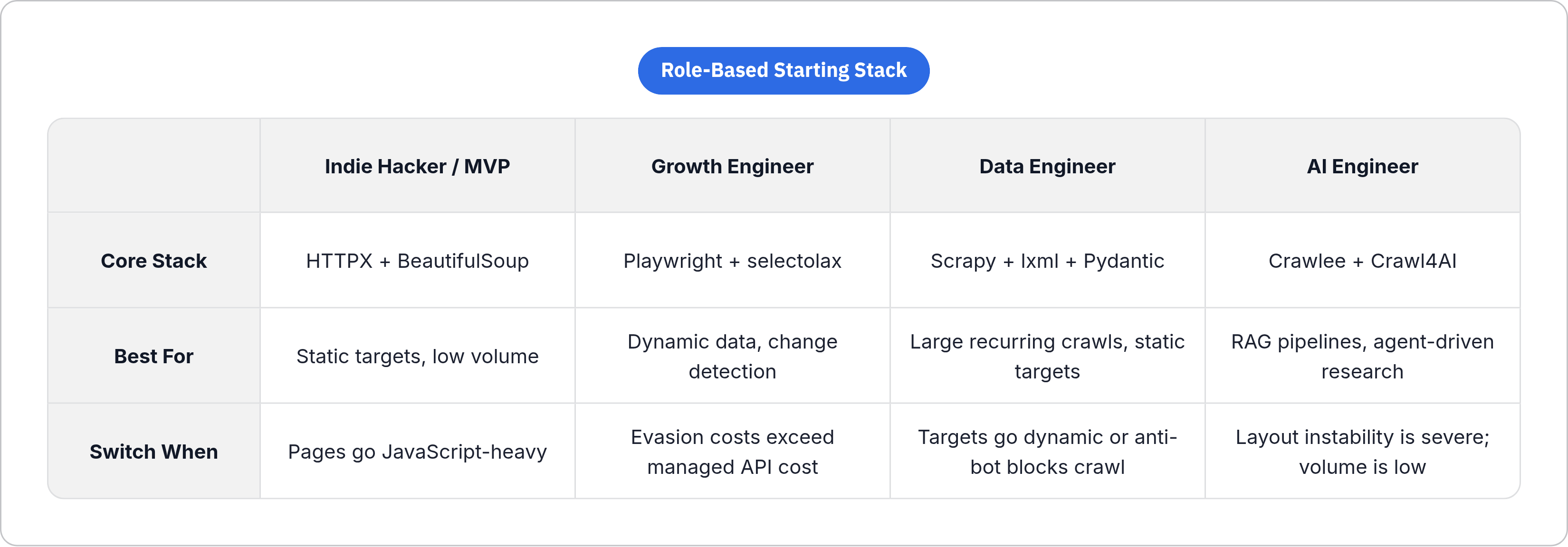
Here are the concrete starting points, organized by who is actually doing the work.
Indie Hacker or MVP Builder
Start with HTTPX plus BeautifulSoup. Lowest setup cost, minimal dependencies, works well for static targets at small volume. Switch when you hit JavaScript-heavy pages or when you need Markdown output for an LLM.
Growth Engineer or Monitoring Workflow
Playwright plus selectolax. Handles dynamic data with fast parsing. Right for competitive intelligence loops and change detection. Switch when evasion overhead starts costing more than a managed API would.
Data Engineer or Pipeline Owner
Scrapy plus lxml plus Pydantic. Rigorous schema enforcement, proven exporters, scales for recurring large crawls on static targets. Switch when targets go JavaScript-heavy or when anti-bot protection invalidates the crawl at the source.
AI Engineer Building RAG or Agents
Crawlee plus Crawl4AI. Or a managed web data API for teams that need zero infrastructure overhead. Crawlee handles browser automation natively. Switch to ScrapeGraphAI's LLM-led extraction when layout instability is severe and volume is low enough to absorb the cost.
These are starting points, not permanent decisions. The stack should evolve as your pipeline stage and content type change. The mistake is treating an early choice as a commitment.
Where Selector-Based Extraction Ends and LLM-Native Extraction Begins
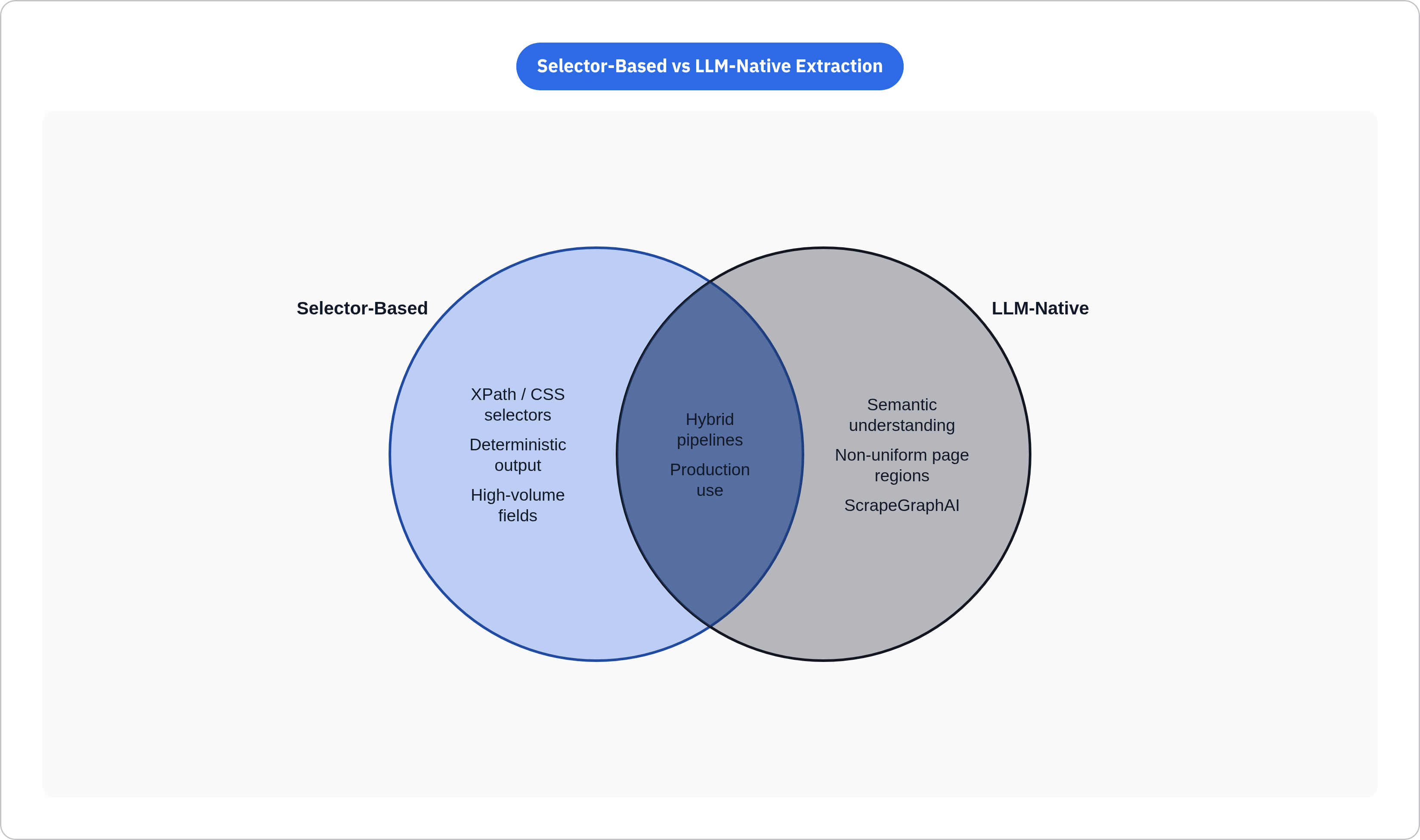
Selector-based extraction is fast, cheap, and deterministic. When a page has a predictable structure and you know exactly what field lives in what element, selectors win. There is no good reason to burn LLM tokens on something an XPath expression can handle in microseconds.
LLM-native extraction earns its place in three situations:
- The target schema changes frequently
- The data is scattered across non-uniform page regions
- Meaning matters more than markup position
ScrapeGraphAI orchestrates LLMs in graph-style pipelines. It supports OpenAI, Groq, Azure, Gemini, and Ollama for local runs. It includes prebuilt graphs for single-page, multi-page, and script-generation tasks. It is genuinely useful. It is also genuinely expensive and slow at scale. Those two things are both true at the same time.
The hybrid pattern is what production pipelines actually use. Selectors for stable, high-volume fields. LLM extraction for unstable or semantically complex fields. Both together when a workflow needs predictable cost with flexible extraction at the edges.
The selector-versus-LLM decision should be made field by field within a pipeline, not as a whole-pipeline call. Treating it as binary is how teams end up either paying too much for extraction or breaking silently on layout changes. Neither failure mode announces itself loudly.
Anti-Bot Infrastructure as a First-Class Constraint on Library Selection
The hard part of scraping in 2026 is not the HTTP request. It is surviving what happens after. Cloudflare, DataDome, Kasada, and PerimeterX are not static defenses. They adapt. TLS fingerprinting, behavioral analysis, and CAPTCHA challenges now break traditional scrapers within days or weeks of deployment, not months.
Two events in particular reshaped the landscape recently. Google deployed SearchGuard in January 2025, forcing widespread retooling across the scraping community. Then in September 2025, Google deprecated the num=100 parameter, which forced teams to make ten times as many requests for the same search coverage. That happened overnight. Teams that were not paying attention woke up to an infrastructure cost multiplier they had not budgeted for.
Library-Level Responses
- curl_cffi: Handles TLS and JA3 spoofing at the connection level. Effective against fingerprint-based blocks that fire before any content is exchanged.
- Playwright with stealth configuration: Behavioral evasion for browser-level detection. Mimics realistic human interaction patterns to avoid triggering behavioral analysis.
- Scrapling: Resilience to DOM changes after a site redeploys to lock you out. Keeps your extraction logic working even when the markup shifts underneath it.
Infrastructure-Level Responses
No library-level fix helps if your IP is flagged. That is an infrastructure problem. Rotating across providers, not just across IPs, is the operational reality for anyone doing this at scale. A meaningful share of scraping professionals now run multiple proxy providers simultaneously because a single provider's IP pool can get burned fast.
Anti-bot infrastructure is not a problem you solve once and move on from. It is a continuous maintenance cost. It needs to be factored into your library selection from the beginning, not retrofitted later when you start seeing blocks. If your chosen stack cannot survive the defenses on your target sites, the rest of the framework does not matter.