The Web Data Stack AI Agent Builders Actually Standardize On
Discovery, extraction, and structuring are separate jobs, even behind one API.

A unified web data API for AI agents brings search, scraping, and crawling into one service, but reliable agents still need three distinct capabilities, namely discovery, extraction, and structuring. Builders are standardizing on this layered stack because finding a page, reading it cleanly, and turning it into usable fields are different jobs. One API can simplify the plumbing without making those distinctions disappear.
Why agents fail in production: the stale context problem
An agent can reason well and still answer badly when its evidence is stale, unstructured, or missing. The web supplies current pricing, regulations, product updates, and company signals more reliably than a model’s training weights. That gap calls for infrastructure improvements. Mastra CEO Sam Bhagwat puts it plainly. “Stale context produces confident-sounding wrong answers. Fast, fresh, citable search is what separates demos from agents that ship.”
An agent may give a polished answer without showing that its source was out of date or that the page it needed never arrived. Confidence is not a freshness certificate. Teams that leave web access until the end therefore risk improving the presentation of an answer while leaving its evidence untouched. Reliable production behavior depends on treating that evidence supply as infrastructure.
The three-layer model that production agent builders converge on
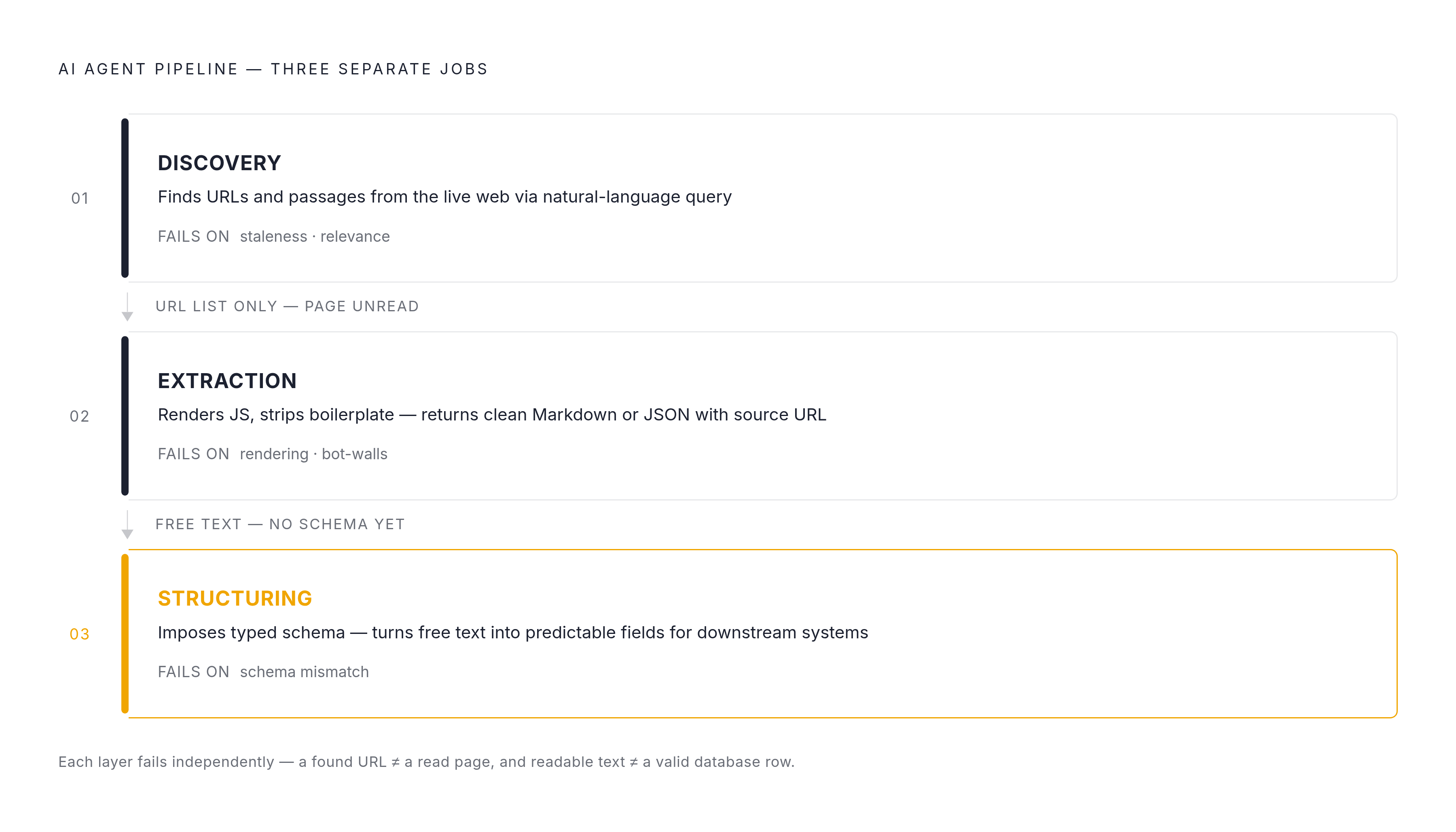
Discovery finds the right URLs and passages from the live web in response to a natural-language query. Extraction fetches their full content, handles JavaScript rendering, strips boilerplate, and returns usable Markdown or JSON. Structuring then imposes a typed schema to turn free-form text into predictable fields for downstream systems. These are separate jobs, even inside one service. A successful search does not prove that a page was read correctly, and readable text does not prove that it fits a database.
WebShell’s 2026 research at Yonsei University shows why access models cannot simply be piled together without trade-offs. Search-augmented agents struggle with navigation when clean text omits page controls, while browser-based agents face lengthy, noisy observations that hinder broad information gathering. More access can mean more interpretation work. The useful distinction is therefore between unifying the interface and blurring the responsibilities beneath it. Discovery needs evaluation for relevance and freshness, extraction for rendering and anti-bot handling, and structuring for schema reliability.
The discovery layer: what search API output do AI agents need?
An agent-ready search API returns evidence the model can reason over. Traditional SERP-style APIs generally return titles, URLs, and snippets, leaving a second fetch to retrieve the page. With AI-native search APIs, one request may instead return extracted Markdown, relevance-scored passages, or the content of a full page. That difference changes the retrieval workflow immediately. A pointer is useful, but it is not the parcel.
The selection criteria follow from that distinction. Fresh data and strong retrieval on natural-language queries help the agent find useful evidence, while structured titles, URLs, snippets, dates, and metadata help it interpret the response. Source transparency supports citations. Latency, rate limits, and pricing then constrain the agent’s ability to afford another search. Index size alone cannot answer those questions.
An agent may search, reason over the results, and search again as the question becomes clearer, so delay and cost accumulate across the loop. Hosted MCP access is another practical criterion because it lets an agent invoke search mid-conversation without a custom integration. Providers that also fetch full pages or crawl deeper can support more of that loop within one service. Even within one service, discovery ends when the agent starts reading the page it has chosen.
The extraction layer: turning a URL into something a model can use
Once the agent has chosen a URL, extraction decides whether it gets content it can use or a heap of page furniture. The job includes rendering JavaScript, removing boilerplate, and returning clean Markdown or JSON with the source URL attached. A URL is only the beginning of retrieval. In-house scripts can break when layouts change, pages depend heavily on JavaScript, or bot protection changes, leaving the reasoning step with silently degraded input.
WebShell gives an academic basis for separating access from usable representation. The research finds that combining search and browser access broadens task coverage but can impose substantial costs through repeated webpage interpretation. Browser observations are often lengthy and noisy. A browser-based agent can perform interactions, but that does not make its observations the best input for every information-gathering task. Managed extraction addresses the narrower need for clean content while moving rendering, proxy rotation, and anti-bot work out of brittle application scripts.
For retrieval-augmented generation, the boundary extends beyond one page. Crawling that follows subpage links and preserves heading hierarchies in clean Markdown supports the later chunking stage, whereas single-page fetching leaves multi-page retrieval to the agent. That is a different orchestration burden. Frameworks such as LangChain, LangGraph, CrewAI, AutoGen, and LlamaIndex sit above this work, supplying graphs, state machines, and tool registries. Their plans still need fetch code that returns something worth reading.
The structuring layer: going from clean text to typed, queryable data
Clean Markdown is readable, but a CRM does not run on readability alone. Agents that write to databases or trigger workflows need typed, schema-enforced fields. Structuring supplies that contract between a page and its destination. In production, the most common approach uses LLM-based extraction with function calling or structured output mode, so the system can handle layouts it has never seen without training data. ScrapeGraphAI uses natural-language extraction through a graph-based pipeline so it relies less on page layouts staying fixed.
Deterministic scrapers avoid hallucination risk in the extraction step and avoid a per-LLM-call cost. Their weakness is generalization to genuinely novel layouts without schema updates. LLM-based approaches are more adaptable across page structures, but that flexibility comes with different cost and reliability considerations. Schema enforcement sets the form of the fields, while the extraction method decides how to get what goes into them.
The decision rule starts with the target sites. For static, well-structured pages, a scraping API returning Markdown is cheaper and more reliable. LLM-based structuring becomes useful when layouts change frequently or when summarization, classification, or scoring already belongs in the pipeline. Neither approach wins every workload by default. The practical differences become clearer when the three layers are applied to sales enrichment, monitoring, and batch research.
How the stack applies in practice: sales enrichment, monitoring, and batch research
Sales enrichment starts with collecting data, then enriching it, then using it for outreach. Apollo has a B2B contact database with hundreds of millions of verified profiles, along with email verification and outreach, so it fits small teams that need data and simple sequencing. Clay combines sources through waterfall enrichment, while Claygent researches unstructured signals such as funding announcements, hiring patterns, and product launches. Those signals may be outside the usual contact databases. Apify’s AI Company Lead Enrichment & Sales Intelligence Actor turns company names, websites, or CSV lists into structured JSON profiles for CRM and MCP workflows. When an enrichment agent needs fresh company pages, a managed extraction API gets them for the domain-specific enrichment platform, which stays in place.
Monitoring looks for what has changed in the information it finds. Agent-ready monitoring needs callable tools through MCP, webhooks that push changes into workflows, and clean structured output. Visualping provides plain-English summaries of content, image, or element changes and has an official MCP server, although default AI Mode excludes CSS-only visual layout changes. Apify’s Website Change Monitor tracks conditions including price drops, restocks, uptime, and page text changes, with notifications to automation platforms or custom webhooks. Here, the clock is part of the architecture. Developers seeking custom comparison logic can combine n8n’s Schedule Trigger, HTTP Request node, AI workflow components, storage, and notifications around a recurring extraction step.
Batch research changes the economics within the same basic layers. An agent answering a live query may need results in one to two seconds, while an overnight rank tracker can wait for queued work. DataForSEO uses a standard-queue task model with low per-SERP pricing, while SerpApi offers instant JSON responses and cleaner documentation but costs more per search on its Developer plan. Apify’s Google Search Results Scraper captures organic results, ads, People Also Ask, AI Overviews, and Google AI Mode, extending SERP collection into AI visibility measurement. For full-page research, batch extraction supplies clean content from many pages to RAG pipelines or SEO monitors.
MCP and integration frameworks as the connective tissue between layers
MCP lets agents use natural language to call tools across the web data stack, so less glue code is needed to connect services that were separate before. An agent can research a competitor, retrieve content, and reason over it within the same session. The workflow connects separate steps directly, an operational change that still calls for evaluation of the tools behind the interface.
Integration breadth also affects where the stack can run. Agent frameworks supply tool registries and execution logic, while automation platforms connect retrieval to schedules, storage, and notifications. These tools work alongside the data layers, which still do their own jobs. A search or extraction service with suitable integrations can be invoked from the surrounding workflow without bespoke wiring for every operation. An integration’s usefulness depends on its ability to expose the capability the workflow actually needs.
There is still a context budget to respect. MCP tool descriptions and search results both use tokens, so turning on every tool comes at a cost. A crowded toolbox can fill the workbench before work begins. Teams should set limits on which tools are enabled and how much content they return to keep the context window from filling up.
What treating each layer as a first-class choice actually looks like in a team
Teams that build reliable agents test each layer on its own before joining the layers together. Discovery can fail without warning when results are stale or miss the point, extraction when rendering behaves unexpectedly or hits a bot wall, and structuring when the schema assumes a layout that a new page does not have. One “web access” label hides those differences. Separate uptime, cost, and quality criteria make it possible to distinguish when retrieval fails from when rendering fails instead of treating every bad answer as a model defect.
The practical evaluation follows those failure modes. Teams should assess discovery on retrieval quality, freshness, and latency, then assess extraction on rendering fidelity, anti-bot reliability, and cost per clean page. Structuring needs a schema that can change and an extraction method that fits how often the target sites change. WebShell frames the broader design around operability for information gathering and interaction, consistency of representation, and persistence of documents for selective access.
Teams can test each layer on its own even when one service supplies all of them. Olostep is one managed option whose search endpoint returns structured, LLM-ready results without builders managing proxy rotation or index freshness, while the same API covers scraping and crawling so retrieval can pass directly into extraction. Its integrations span LangChain, n8n, Zapier, Mastra, Apify, Relay, and MCP, giving teams several routes into agent and automation workflows without custom glue code. That breadth simplifies wiring, but the evaluation criteria remain separate.
For most builders, the starting point is extraction. Pick a managed API for that layer first, because it is commonly underestimated and commonly responsible for silent agent failures. Establish a stable baseline for getting clean content from the pages the agent needs. Then add discovery and structuring on top.