Evaluating MCP Servers for Web Scraping Use Cases
A practical guide to picking an MCP server for agent web scraping.

With MCP server access for AI agent web data, an agent can discover and call tools for live scraping, search, and extraction through a standard integration. Hosted options such as Geekflare MCP and Apify MCP Server let agents pull web data without maintaining their own scrapers, while Browserbase MCP provides managed browser interaction. The right choice depends more on architecture, usable output, and reliability inside the agent’s reasoning loop than on the longest feature list.
Why MCP changes what "good scraping infrastructure" means for an agent
A developer reading a CSV can spot a strange column, fix a value, or rerun a request. An agent needs those decisions supported by the tool itself. Traditional scraping measures such as latency, success rate, and price per request remain useful, but they do not establish whether the agent can discover the right operation, supply valid arguments, or understand what came back. A fast response is little help when its contents require detective work.
MCP, or Model Context Protocol, is an open standard that lets agents discover tools, read their typed schemas, and invoke them at runtime. No human needs to write a wrapper function for every endpoint. Discovery, typing, and invocation become part of the integration rather than separate engineering chores. That shifts the evaluation from whether a server can fetch a page to whether its tools help an agent finish a job.
Five criteria that actually predict how a scraping server performs inside an agent loop
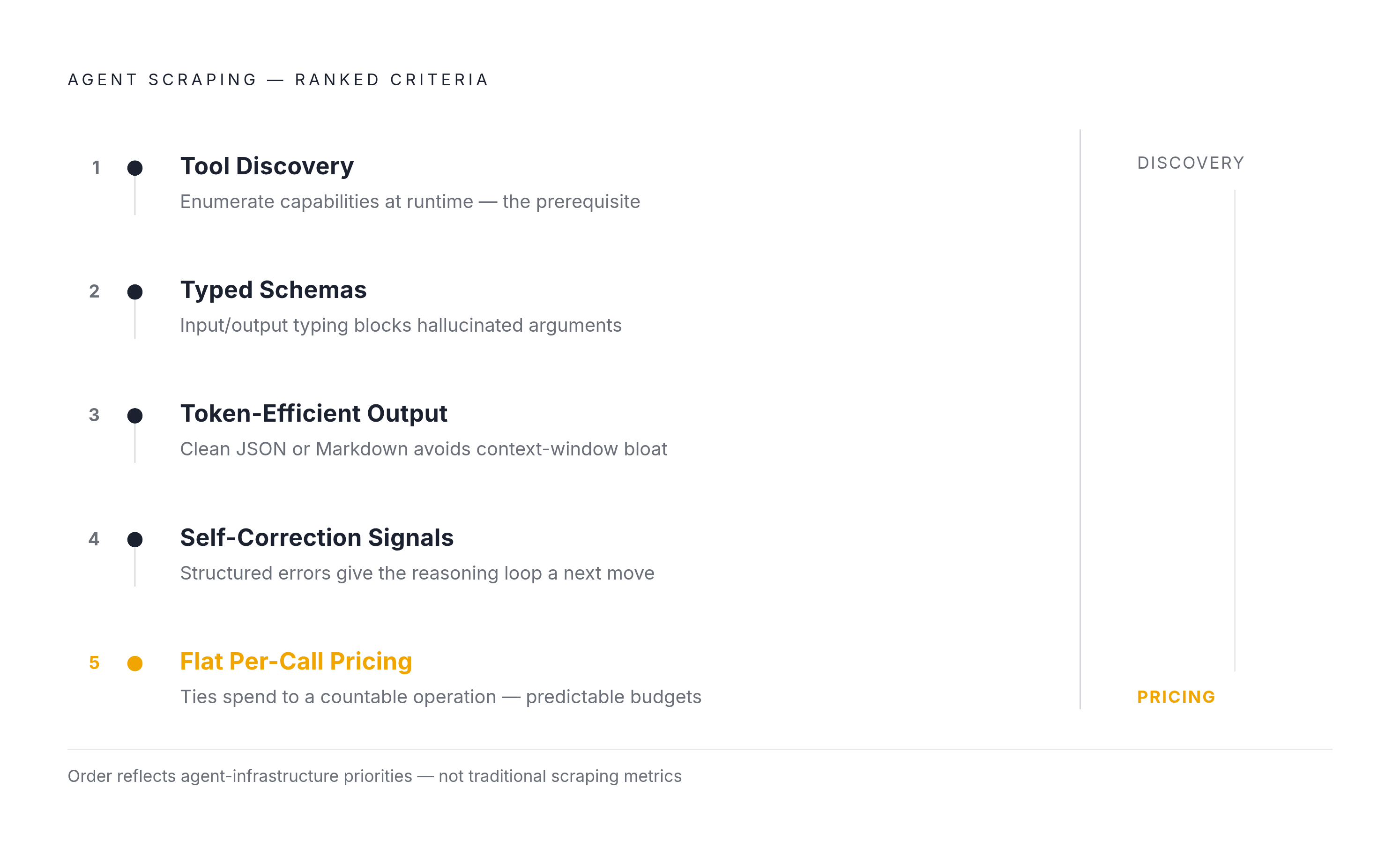
A tool that the agent cannot find is effectively absent. Tool discovery therefore comes first. The server should let the agent enumerate its capabilities at runtime and inspect typed parameter schemas, rather than depend on a developer to wire up each operation. MCP’s 2026 roadmap proposes progressive discovery, starting with a small entry point and expanding access as a conversation narrows. As catalogs grow, exposing tools and making them discoverable become different problems.
Loosely typed, string-in, string-out endpoints leave the model to guess parameter names and work out what a response means, which can lead to hallucinated arguments and silent failures. Typed input and output schemas reduce that ambiguity. They describe what a tool accepts and what the agent should expect back, so a successful invocation is not merely a response that happens to contain text.
Even a correct response can clog the context window. Raw HTML brings boilerplate that consumes tokens without helping the model reason about the page. Token-efficient output means clean Markdown or structured JSON suited to the task. Output format belongs in the infrastructure evaluation because the agent pays to process what the scraper returns.
When a request fails, an opaque error leaves the agent without a next move. Self-correction signals make failure usable. A structured error gives the reasoning loop something it can act on, unlike a silent timeout. This criterion is separate from success rate because occasional failures are not the same problem as failures the agent cannot interpret.
An autonomous loop may invoke tools dozens of times, while per-byte or per-proxy-gigabyte billing makes the final bill depend on more than call count. Flat per-call pricing makes budgets controllable. It makes the cost of repeated calls understandable before the invoice arrives.
The architectural split that determines everything else: MCP-native versus REST-wrapped
These criteria expose a deeper distinction between an MCP-native server and a thin MCP wrapper around a REST endpoint. Native servers make tool discovery, schemas, and invocation the full integration surface. The agent can use the tools in a catalog without glue code. A REST-first wrapper may offer a fetch operation but leave the developer to write the code for structured extraction, research, and analysis.
That difference predicts how much work remains outside the protocol. A wrapper does not become agent-ready simply because an MCP client can reach it. If the developer still has to write tool definitions, make sense of loose responses, and build the higher-level operations, discovery and typing are still work they must do to connect the tools. Native MCP has the stronger fit for breadth, generality, and autonomous operation.
A bespoke REST integration for a known, stable target can outperform a general-purpose native server when the team can maintain it. Apify’s Actor ecosystem illustrates the related tradeoff between coverage and consistency. Site-specific scrapers can cover sites well, but the data they return takes different shapes, so discovering many tools does not ensure that their data will have the same shape. The options below belong on the tool-catalog side of this comparison, rather than being interchangeable fetch wrappers, but their tools serve very different jobs.
What MCP servers let AI agents pull live web data, and where does each fit?
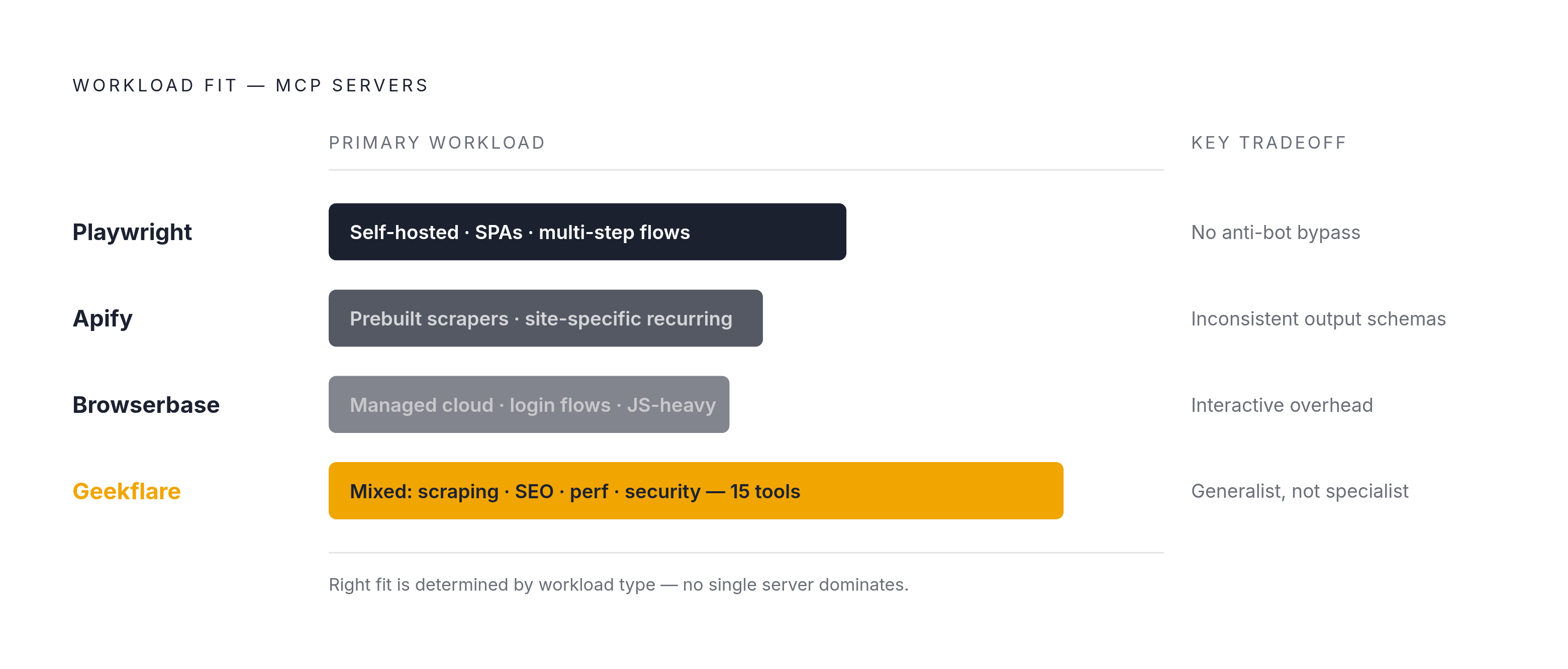
Microsoft’s Playwright MCP gives an agent browser control through navigation, clicks, form fills, scrolling, screenshots, and content extraction. It uses structured accessibility snapshots rather than raw DOM and supports Chrome, Firefox, WebKit, and Edge. It is free, open source, and self-hosted. Its fit is interactive pages, SPAs, and multi-step flows where the agent must behave like a user. This is a browser, not a scraping API. Selector maintenance remains a cost when layouts change, and there is no built-in anti-bot bypass.
Apify MCP Server connects agents to tens of thousands of prebuilt Actors, including scrapers for Amazon, LinkedIn, Google Maps, and TikTok. It is hosted or runnable locally through npx -y @apify/actors-mcp-server, and its free plan includes a small monthly usage credit for Store Actors or custom Actors. Discovery at scale is its distinctive strength. Teams that need structured data from known platforms again and again can use ready-made scrapers. The tradeoff is output consistency, because schemas vary from Actor to Actor.
Browserbase MCP provides managed headless browsers in the cloud, removing the need for local Chrome. Its Stagehand framework combines natural-language instructions for exploratory steps with deterministic code for steps that need reliability. Browserbase’s documentation lists LangChain, CrewAI, and Mastra integrations as well as its MCP server. It is a good fit for JavaScript-heavy sites, login flows, form fills, and multi-step navigation. Browser operations are managed, but the workload is still interactive. It serves a different need from a tool whose main job is to return cleaned page content.
Geekflare MCP exposes 15 tools across scraping, search, performance, SEO, and network/security through one connection. Its scraping tool returns Markdown, HTML, JSON, or text and supports JavaScript rendering, stealth mode, proxy routing, and device emulation. The tool has an aiPrompt parameter for text, list, and schema extraction. It is available through a hosted URL or locally through npx -y @geekflare/mcp, with a limited credit allowance on the free plan. Transparent per-call pricing addresses budget predictability. Its strongest fit is work that combines web content with site-health, SEO, and security signals, including monitoring workflows that would otherwise require separate servers.
For that mixed workload, Geekflare is a reasonable starting point. Apify is the more targeted option when prebuilt platform scrapers are the main need, while Browserbase fits managed browser interaction and Playwright fits self-hosted browser control. The descriptions leave some things to test, especially whether errors are structured and whether the tools return output in the same shape.
How the workload type determines which criteria to weight most heavily
For RAG pipelines and LLM ingestion, token-efficient output takes priority because the usual path runs from an MCP scrape tool through cleaned content into an embedding pipeline. Boilerplate wastes tokens and degrades what gets embedded, while typed schemas support consistent chunking. Latency also counts because tool calls block the reasoning loop. Freshness is the deciding qualification. For stable content that rarely changes, a well-indexed RAG store can beat live scraping on latency, while live MCP access is strongest when current content is needed.
For structured data extraction, typed outputs matter more. When a response contains Markdown or raw HTML, the agent still has to parse fields, which uses up context and leaves room for errors. Schema-based extraction is therefore a baseline expectation for this workload. Failure handling comes next. When the requested schema cannot be matched, the agent needs a structured signal rather than a response that looks successful but cannot support the next step.
Web monitoring and change detection put cost predictability and self-correction under recurring pressure. Calls accumulate, pages become unreachable, and persistent monitoring introduces another question beyond whether a server can scrape. Can it detect a change as a native capability, or must the developer schedule requests and compare results? Data access is not a trigger mechanism. SEO-oriented servers such as Ahrefs MCP give access to rank and audit data but have no trigger to start an agent action through MCP alone, so developers must poll and compare. Site-health tools can help with monitoring even if they lack that trigger.
Batch scraping makes the billing model especially consequential. Per-byte or proxy-gigabyte charges make high-volume autonomous runs hard to budget, while flat per-call pricing ties spending to a countable operation. Anti-bot capability also becomes a reliability multiplier because blocked requests weaken both useful output and cost efficiency. The orchestration layer adds another bill. Zapier consumes tasks from a shared allowance for successful MCP calls, and reaching that allowance stops MCP calls account-wide until it resets or the plan is upgraded. Self-hosted orchestration through n8n removes that per-task overhead, which belongs in the decision framework just as much as the scraper’s price.
A practical decision framework for picking a server before you build
Three questions narrow the field before a team studies feature pages. First, is the content static or interactive? For blog posts, product pages, and documentation, a scraping API with clean Markdown can be sufficient, while full browser control adds latency and complexity without a useful return. Login walls, interactive SPAs, and multi-step forms call for browser automation. Playwright and Browserbase fit that branch, as does Skyvern, with selector-maintenance costs to plan for on Playwright and visual-reasoning overhead on Skyvern.
Second, does the job call for general-purpose crawling or for a site-specific scraper? Unpredictable URLs and page structures favor broad tool discovery and typed schemas through native MCP. A fixed set of recurring targets may favor Apify Actors because site-specific output can be more useful than a general-purpose result. Accept the schema tradeoff consciously. Whether the tools for the chosen sites return data the rest of the workflow can use matters more than how many sites a catalog names.
Third, what will a complete run cost? For autonomous loops, flat per-call pricing is the basis for a predictable budget, and production calculations need to include both orchestration and the scraping bill. A cheap fetch is not the whole transaction. Monitoring and batch jobs make this distinction especially important because recurring calls multiply costs outside the scraper itself.
Before comparing further features, confirm compatibility with the stack already in use, including LangChain, n8n, Zapier, Mastra, or MCP clients such as Claude Desktop and Cursor. Even a server that can do the job brings back the glue code MCP was meant to remove if it needs a custom adapter. Then test the candidate against the five failure modes on the actual job rather than giving it an overall score for its features. Does the agent find the tool, supply valid inputs, receive useful output, understand failures, and operate within a predictable budget?
Start with the job the agent must finish. Most agents doing real work need two or three servers, so add only the capabilities the workload cannot do without. A mixed research and site-health workflow may justify one broad connection, while interactive navigation or recurring platform extraction may justify a specialist. The lightest stack that covers the work is the most maintainable one.