Hallucination Reduction in Research Agent Outputs
Cascading errors in agent workflows compound at each reasoning step.

Multi-step research agents hallucinate far more than a single prompt-and-response LLM call does, and the gap is structural. Every extra reasoning step is another chance for the agent to get something wrong, and then build on that wrong thing like it was solid ground.
Hallucination rates climb in lockstep with how many steps a task takes. Deepchecks LLM Evaluation Benchmarks 2026 puts extractive question-answering at one error band, open-ended generation higher, and multi-step agent workflows at the top of that range. These models are built to answer from parametric knowledge, which explains the pattern. An LLM answers from parametric knowledge, meaning patterns it absorbed during training, and it has no built-in way to point back to the specific document that justifies any given claim. So when a retrieval step comes up empty, or never runs at all, the model doesn't pause. It fills the gap with whatever tokens sound most plausible.
Three failure modes appear repeatedly in the research literature, and each one is more dangerous than a model just making something up out of thin air. Grounding hallucination happens when a claim contradicts the context it was supposedly pulled from, which is the failure that matters most in regulated industries, since the supplied context is the actual source of record there. Citation invention is the second: fabricated URLs, invented paper titles, ArXiv IDs that lead nowhere, quotes attributed to real sources that never said them. GPTZero audited ICLR 2026 submissions with its Hallucination Check tool and found over 50 hallucinated citations, showing how often this occurs even in work meant for expert peer review. Cascading hallucination is the third and the one this piece spends the most time on, because it's the failure mode built specifically for multi-step agents: an error at an early stage propagates forward, gets amplified at each subsequent stage, and produces a final answer that sounds completely confident and is completely wrong.
A fourth failure mode is specific to agents that call tools. Tool argument spoofing happens when the model invents arguments or IDs mid-call, and the corruption stays silent inside the agent loop until something downstream breaks or, worse, doesn't visibly break at all.
Parametric memory reasoning and cascading error
Cascading hallucination doesn't start as a bug. It starts as the model doing what it was trained to do. The pretraining objective rewards a plausible-sounding continuation, not a faithful lookup, so when the model is uncertain about something, it doesn't say "I don't know." It generates a confident, high-probability answer that happens to be invented.
That tendency gets worse with time, because a model's weights are frozen at whatever moment training ended. A research agent asking that model about live business data, current regulations, or recent science is really asking a snapshot of the world how the world is doing right now, and the snapshot can't answer that question honestly. It answers anyway, and the staleness reads as confidence rather than age.
Even when the right document is sitting in the context window, the model can miss it. Long context windows don't get read evenly. Attention favors the beginning and end of a prompt, so a correctly retrieved passage buried in the middle can get ignored entirely, and the model falls back on parametric memory even though the right answer was right there on the page. Tool schemas make this worse in a different way: a model fills in arguments that used to be valid for a given tool but have since changed, and that small mismatch compounds every time the chain calls the next tool.
The cascade mechanic is simple to describe and brutal in practice. Each reasoning step treats the previous step's output as settled fact. One wrong guess early in the chain poisons every inference that follows. The CHARM paper, authored by Saroj Mishra at the University of North Dakota, formalizes this as a distinct failure mode, one that output-level detectors miss because they only check the final answer, not the stages that produced it, and the CHARM framework reports an 82.1% reduction in error propagation when stage-level checks are added.
Researchers at Mayo Clinic and the University of Pennsylvania studied this exact dynamic in radiology. A single agent handling every cognitive task internally, without a verification step along the way, produced cascading errors that looked like accurate reports right up until an expert checked them. The errors aren't sloppy or obviously wrong, which should worry anyone deploying a research agent for anything consequential.
The data ingestion layer as a hallucination source
A well-grounded model can still hallucinate if the data it's grounded in is garbage. This is the part of the pipeline that gets the least attention and causes a surprising share of the damage.
Some APIs hand back raw HTML mixed in with the content an agent actually wants: navigation menus, cookie-consent banners, ad scripts, footer boilerplate. A model asked to summarize that page will summarize all of it, faithfully, because that's what was in front of it. Practitioners working this problem have traced a real chunk of what looked like hallucination back to this exact cause: the model wasn't inventing anything, it was accurately reporting noise.
Web pages also move. When an agent asks a model to produce a CSS selector for scraping a page, the model's best guess drifts the moment the site's layout changes, and the agent then confidently reports zero results. Scrapfly practitioners found that switching to Markdown input removes this failure mode outright, for a simple reason: there's no selector to guess at if there's no DOM structure to navigate in the first place.
Passing raw HTML straight to a language model and asking for structured data back carries its own separate risk. Outputs come back non-deterministic, which causes real problems in production pipelines. One practitioner-documented enterprise pilot compared a traditional scraping platform against a direct LLM extraction tool on pricing data, and the tool came back with prices off by 20% in some cases, because it couldn't reliably tell a price that included VAT from one that didn't. Clean data is a precondition for the model to have any chance of being right.
What live web grounding does that vector-store RAG cannot
Vector-store RAG is a real improvement over an ungrounded model, and it works by anchoring answers to retrieved passages instead of pure memory. It also has a ceiling it can't get past: it can't fix staleness, and staleness is what makes agents confidently wrong about anything that changes over time.
The strongest version of RAG enforces a citation contract: every factual claim has to point to a specific retrieved passage by ID, and the model has to abstain if no passage backs the claim up. A Preprints.org manuscript on the subject found hybrid RAG architectures show a 35 to 60% reduction in hallucination rates compared to baseline methods, the most reliable intervention tested so far. But a vector store is built by indexing documents at a point in time, and it prioritizes conceptual closeness over freshness. That's a design choice baked into the architecture.
There's a sharper objection on top of that, sometimes called RAG Collapse, laid out in a paper under arXiv:2608.22118. As more of the open web fills up with LLM-generated content, a RAG system's second retrieval pass can surface a previous model's hallucination and present it back as authoritative evidence, simply because the retrieved document was itself written by a model and models don't flag their own fiction.
Live web retrieval removes staleness at its root by querying current data instead of a fixed index. A vector store hands the model a photograph of the world taken at index time. Live web retrieval hands it something closer to a window, continuously updated, as current as the web itself. The more useful refinement is grounding every intermediate reasoning step in live data, because a single retrieval at the start of a chain still leaves every step after it exposed to the same parametric drift described earlier.
The real trade-offs in live web grounding: freshness, latency, cost, and security
None of this comes free, and pretending otherwise would be its own kind of dishonesty. Live web grounding solves staleness but introduces four trade-offs worth taking seriously.
Freshness costs speed. A vector database answers in milliseconds. A live web search takes longer, though latency-optimized modes can return results at a median around 200 milliseconds, which is fast enough to keep most agent loops moving without stalling.
Caching helps with cost but quietly reintroduces staleness, since cached answers can go out of date. An agent asking for live data might get handed a cached answer that's minutes old, so live-search modes need to be invoked explicitly to skip the cache. The practical rule: cache aggressively for facts that don't move much, and bypass the cache entirely for anything live-state.
Regulated industries add a privacy constraint on top of all this. An agent researching a patient's medical history or a client's legal matter can't be pointed at a search API that retains or mines query data. Zero-data-retention options exist for these use cases specifically.
Grounding through MCP-connected live data cuts hallucination and opens a new attack surface at the same time. Poisoned configuration files, malicious marketplace skills, and exposed MCP servers running without authentication have all shown up as documented incidents in 2026. Agent infrastructure deserves the same scrutiny any other third-party software dependency gets. And the RAG Collapse risk doesn't stay confined to vector stores. Live-retrieved pages can themselves be LLM-generated, so provenance checking belongs in the pipeline.
None of these four trade-offs are fatal. They're engineering problems with known answers, and the rest of this piece is about building around them rather than pretending they don't exist.
Structuring a multi-step research agent for grounding at each reasoning step
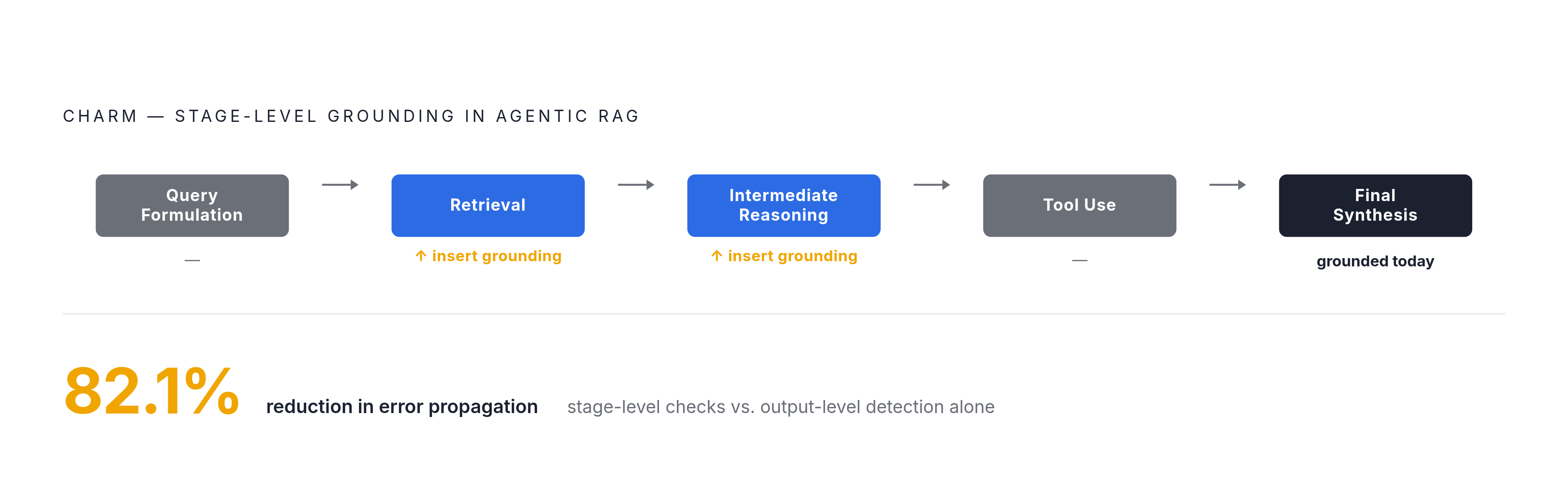
Fixing cascading hallucination takes an architectural decision, applied at every stage.
A standard agentic RAG pipeline runs through five stages: query formulation, retrieval, intermediate reasoning, tool use, and final synthesis. That's five separate points where parametric drift can sneak in, and grounding needs to happen at retrieval and at intermediate reasoning, not just at the final synthesis step where most teams currently put it.
The CHARM framework, again from Saroj Mishra at the University of North Dakota, gives this a concrete shape with four components: stage-level fact verification, cross-stage consistency tracking, confidence propagation monitoring, and cascade resolution triggering. It runs alongside a standard agentic RAG pipeline rather than replacing it, and it cuts error propagation by 82.1% compared to relying on output-level detection alone. That's the single clearest number in this entire argument: catching errors at the stage where they happen beats catching them after they've already spread.
A separate research thread is converging on the same conclusion from a different angle. Tracing the Cascade, by Xinshun Feng and coauthors under arXiv:2608.00711, introduces a topology-aware evaluation framework called SCHEMA, which includes a trajectory hallucination pipeline built specifically to audit intermediate reasoning steps rather than just the final output.
Uncertainty routing adds a useful layer on top: token-level confidence estimates, or disagreement across multiple sampled decodes, can flag a shaky intermediate answer and send it back for a fresh retrieval call instead of letting the agent walk forward on a guess.
None of this works if the data feeding each step is still raw HTML. Every retrieval call should hand the reasoning layer structured Markdown or JSON, not a wall of markup, because that's what removes selector hallucination and boilerplate summarization before the model ever gets a chance to misread either one. And the operational cost of running all this at scale has dropped: MCP's stateless architecture, version 2026-07-28, now under the Linux Foundation's Agentic AI Foundation, removes the session-affinity requirement that used to make live-web MCP servers a pain to run. Grounding servers can now run as Kubernetes pods, serverless functions, or Cloudflare Workers, with no special configuration needed.
WebMCP and the shift toward publisher-side structured data for agents
A newer development puts responsibility for cleaning the data on the publisher instead of the agent. WebMCP shipped as an early preview in Chrome Canary in February 2026, built jointly by Google and Microsoft through the W3C Web Machine Learning Community Group. It moves the job of formatting data for agents off the agent's scraping layer and onto the publisher of the content.
The mental model is the same one MCP already established, just moved into the browser. A website becomes something like an MCP server in its own right, and any agent visiting it can discover what that site offers and use it directly, with the site itself defining the terms rather than an agent guessing at them from the outside.
That shift has a direct effect on hallucination rates. An agent reading structured, schema-enforced content from a WebMCP-compliant site has far less room to misread the page's structure, because the failure mode caused by navigating messy, unstructured HTML doesn't have anywhere to happen. The publisher has already defined the contract, so there's nothing left for the model to guess at.
Grounding at every reasoning step, on clean data, retrieved live, is the architecture that keeps a research agent honest. WebMCP points toward a version of the web where that clean data is simply what publishers hand over by default. The agent spends less effort cleaning up after the web and more effort actually reasoning about what it found.