Source Evaluation and Credibility Scoring for AI Agents
AI agents researching the web need to verify what they find before trusting it.

This is a piece about AI agents doing their own research on the open web, and nobody's checking their work. Agentic AI has moved from science project to production system at most large companies, with plenty more running pilots right now. Almost none of them have solved the boring problem underneath: how does a machine know if the thing it just read is actually true?
A human reading a sketchy article does a bunch of things without thinking about it. You check who wrote it, notice the site looks like it was built in 2003, feel like something's off, and close the tab. That's credibility judgment, and it's messy and intuitive and mostly unavailable to a language model.
An agent can't feel that a site is sketchy. It needs credibility broken down into pieces it can actually compute. A few categories carry most of the weight. Domain authority: is this a recognized publisher, a university, a government site, or a random Squarespace page someone abandoned in 2019. Author signals: is there a named person attached, do they have a track record, can you even verify they exist. Temporal signals: when was this published, when was it last touched, when did you retrieve it, because those are three different questions with three different answers, and mixing them up is where a lot of pipelines quietly go wrong. Content signals: does the page say anything specific, does it cite anything, is it internally consistent. Structural signals: does the page load real content, or is it a login wall wearing a 200 status code like a costume.
Here's a distinction that trips up a lot of pipelines. A source can be completely legitimate and still be wrong for the moment you're asking about. A real document, correctly retrieved, that's just old, can mislead an agent that treats "found it" as "true." Loading fine, no CAPTCHA, no error, doesn't guarantee value either, because page-type validation has to happen before you even get to the question of trust.
This is the whole argument for why open web retrieval needs scoring in the first place. A curated database is safe but small; it only knows what someone already decided to put in it. The open web knows everything, but "everything" includes forum posts from 2011 and a pricing page nobody's touched since the last CEO left. Credibility scoring is what makes that second option usable at scale.
The main failure mode credibility scoring is designed to prevent: post-rationalized citations
Retrieval augmented generation, RAG for short, is how most production agents work now. Grab documents, ground the answer in them, don't just make stuff up. It fixed the obvious version of hallucination. The sneaky version is a separate problem entirely, and it's much harder to catch.
Here's the sneaky version: the model answers from memory, the way it always could, then goes and finds a real document that sort of matches and slaps it on as a citation. The citation is genuine, and the retrieval happened, and the document exists. None of that means the answer actually came from the document.
Picture an agent asked about current enterprise pricing limits. It pulls a pricing guide, cites it, answers confidently. The guide is a year old, and the limits changed six months back. Every link in that chain looks fine on paper: URL resolves, domain is recognizable, retrieval succeeded. The failure stays invisible unless someone's specifically checking dates against claims.
Obvious hallucination is at least a made-up URL you can catch on sight, which makes it the easier problem by comparison. This is a real URL attached to the wrong moment in time. Which means credibility scoring can't stop at "is this domain trustworthy." It needs a temporal layer sitting right next to the domain-quality layer, or the agent keeps confidently repeating facts that expired months ago.
The fix isn't complicated, just tedious. Store publication date, last-modified date, retrieval date, and first-seen date as four separate fields. They answer different questions. A page modified last week but first indexed two years ago is a different animal than a page published yesterday.
How automated credibility scoring systems assign trust programmatically
Under the hood, most of these systems stack a handful of techniques rather than leaning on just one.
Language models trained on human-labeled examples can rate a statement's reliability and explain why, and that explanation matters, because a bare number with no reasoning attached is close to useless once something goes wrong later. Probabilistic methods scan huge sets of documents to spot patterns and cut down on extraction errors. Reinforcement learning lets the scoring improve over time as real feedback comes in, adapting instead of following a fixed rulebook. Deep learning models built to read text at multiple scales at once, catching both word-level patterns and the shape of the whole document, add another layer on top.
One research effort worth naming: WebTrust, out of Tsinghua and Chandigarh in 2025, fine-tuned a fairly small language model on a wide dataset spanning many domains to output continuous reliability scores. The interesting part isn't the accuracy number, but the size, since this ran at a scale teams without a warehouse full of GPUs could actually deploy.
There's also a shift toward multi-agent setups instead of one giant prompt stuffed with raw documents. A separate agent processes and boils down the evidence first, then hands a clean, structured summary to whichever agent is doing the actual reasoning. That structure cuts hallucination risk and keeps source attribution intact, since the summary still points back to where it came from.
Some systems apply weights based on expert consensus, so a peer-reviewed source doesn't get treated the same as somebody's Substack post. That's a core part of what scoring is supposed to do, not a minor detail tacked on at the end.
What's still fuzzy: most of these benchmarks get tested on clean, labeled datasets built for research. The open web is neither clean nor still. Pages change, bad actors exist, and how these systems hold up against an adversarial, moving target is far less documented than the lab numbers let on.
Signals that a credibility scoring layer must cover before content reaches an agent's context
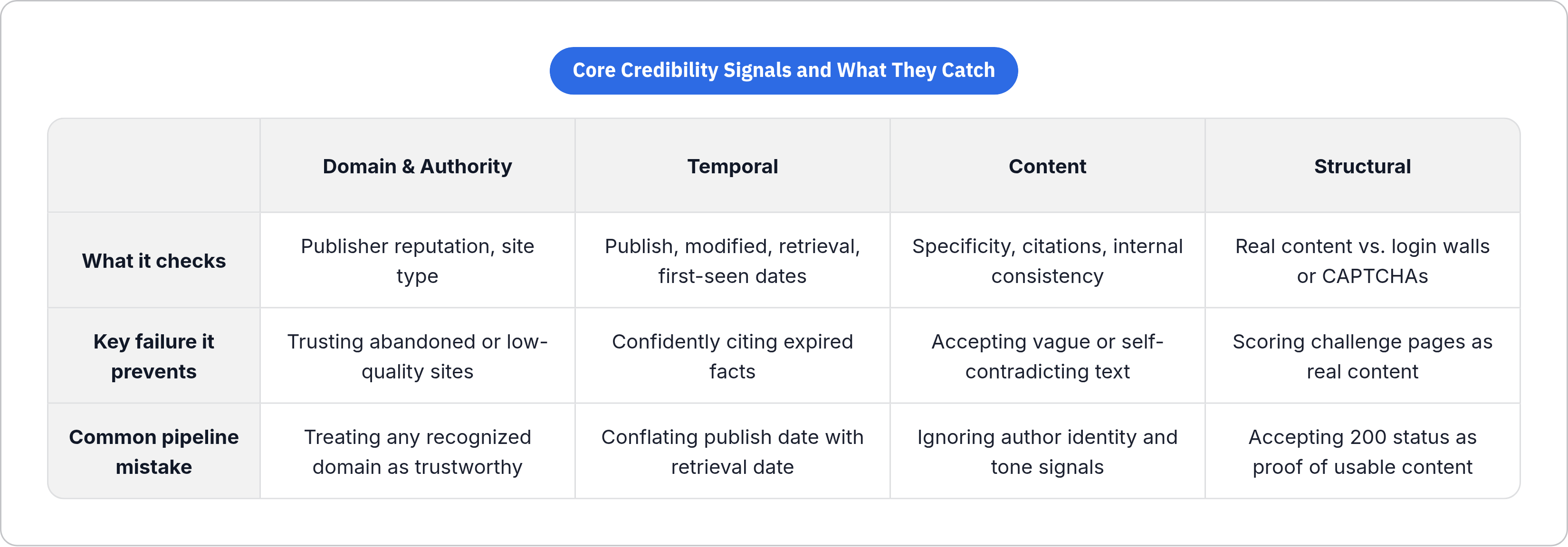
Start with page-type validation, because it comes before everything else. A CAPTCHA wall or a login screen can return a perfectly successful HTTP status while handing over zero usable content. If your pipeline doesn't check for expected page structure, reasonable text length, and the absence of challenge-page patterns, you'll end up scoring garbage as if it were a real page.
Worth repeating: a 200 status code means a successful request, not usable content. Getting past a bot check gets you a response, not proof that the response is the thing you asked for. Pipelines need to check the content behind the status code, not just the code itself.
Temporal validation deserves its own pass. Some pages skip dates entirely. Others reuse a template date across hundreds of articles, or bump the displayed timestamp after a tiny edit that has nothing to do with the actual content. Keeping publication date, modification date, retrieval date, and first-seen date as separate fields lets the system flag a mismatch instead of quietly trusting a stale page.
Content-level signals round it out. How dense and specific is the text relative to the page's length? Is there a named author or institution attached? Is the tone neutral where you'd expect neutral, news rather than opinion? Does the document contradict itself anywhere? That last one gets underrated, because a page arguing two different things in two different paragraphs is telling you something important.
For social and forum content, there's a whole separate set of signals: account age, follower ratios, verification badges. Research on conversational credibility, like the CreCDA approach, leans on exactly this kind of account-level metadata instead of just the text of the post itself.
Two infrastructure notes people tend to skip. First, CSS selectors and XPath expressions break the moment a site redesigns its layout, and when that happens the pipeline doesn't crash, it just quietly starts feeding garbage downstream with no error to catch anywhere. Second, latency is part of credibility whether anyone admits it or not. Response times that creep past a few seconds line up with noticeably higher failure rates across multi-step agent pipelines. A slow retrieval layer doesn't just annoy people waiting on a result, it breaks the loop entirely.
How to structure retrieved content so credibility signals survive into the reasoning step
You can score a source perfectly and still waste the whole effort if you hand the model raw HTML. The model burns its token budget wading through nav bars, cookie banners, and repeated footer text instead of actually reasoning about the content itself.
Clean Markdown fixes most of this. It keeps the structure that matters (headings, lists, tables, link text) and drops the chrome that doesn't. It costs a fraction of the tokens raw HTML does, and it chunks predictably, which matters a lot if you're feeding an embedding-based retrieval system downstream.
Token efficiency isn't just a cost line item, it's a credibility issue too. A smaller footprint per source means more sources fit in one reasoning pass, which means better coverage without the bill climbing alongside it.
Metadata has to travel with the content, not sit off in some separate database the model never actually sees. Each chunk needs its original URL, page title, publication and retrieval dates, author where one exists, a credibility score or tier, and a topic or domain category. Skip this, and the model has no way to tell a fresh, authoritative source from a five-year-old forum rant. All the scoring work done earlier in the pipeline evaporates the second it reaches the model.
JSON makes sense for structured extraction tasks, while Markdown fits text-heavy RAG setups better, so the choice comes down to the job at hand. Either way, the credibility metadata rides along with it, full stop.
Worth a mention: llms.txt, a Markdown file some sites now publish to point AI tools toward their most useful pages. It's mostly showing up in developer documentation right now, and it works well there, since it saves an agent from crawling an entire docs site when there's one canonical page it actually needs.
Architecting a multi-signal credibility pipeline for agents doing live web research
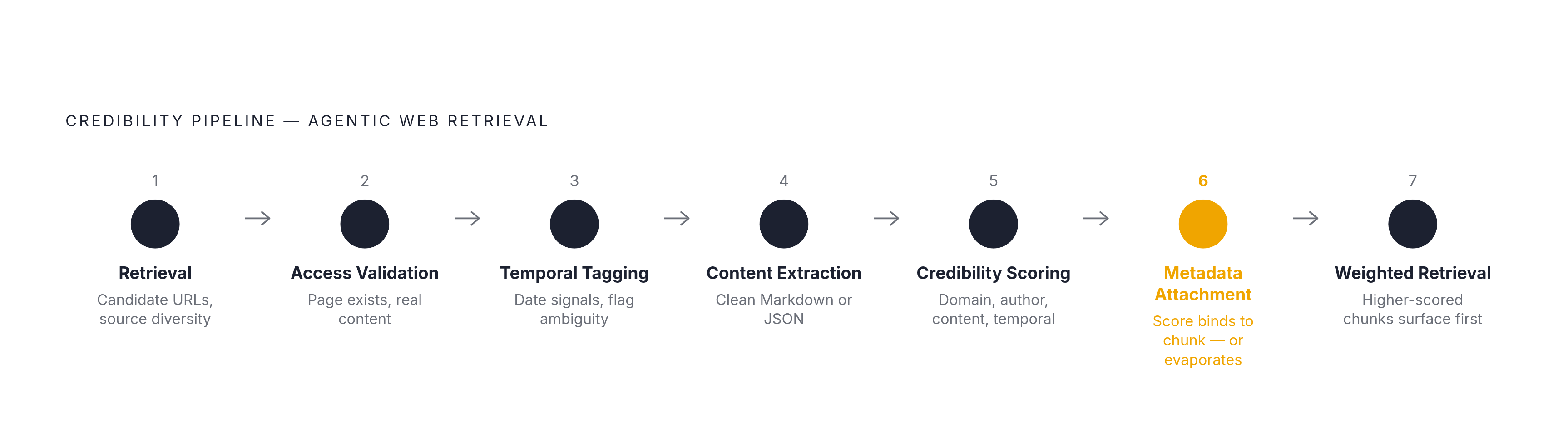
Most data infrastructure was built for batch jobs: run overnight, process, done by morning. Agents run on a continuous loop instead, observe, decide, act, repeat, with no nightly cron job to pause things. Credibility scoring has to live inside that loop, since bolting it on afterward doesn't work.
Laid out in order, a working pipeline looks something like this. Retrieval comes first, pulling candidate URLs, with source diversity enforced on purpose rather than hoped for. Access validation follows, confirming the page is actually there and actually has content before any scoring even starts. Temporal tagging comes next, pulling every date signal available and flagging anything ambiguous.
Then content extraction, converting the page into clean Markdown or structured JSON and stripping the chrome. Credibility scoring applies domain, author, content, and temporal signals to land on a score or tier. Metadata attachment binds that score, plus every provenance field, to the chunk before it ever touches a vector store or a prompt. Weighted retrieval closes the loop, surfacing higher-scored chunks at query time, so credibility shapes what the agent sees rather than just filtering junk out after the fact.
A multi-agent setup earns its complexity here. A dedicated evaluation agent can chew through the evidence and hand off something clean, separating "is this retrieval any good" from "what's the actual answer." That separation matters more than it sounds like it should.
The curated-versus-open-web tradeoff shows back up here as an architecture decision. Curated corpora need upkeep but cut down the scoring burden. Open web pipelines skip the upkeep but need scoring at every single stage. No shortcuts either way.
Some tools offer a single API covering search, scraping, crawling, and monitoring, outputting clean Markdown with structured metadata already attached. That matters in practice: instead of stitching together a scraper, a separate extraction tool, and a formatter before you can even start scoring, the data shows up already shaped the way a credibility pipeline needs it. The scoring logic still has to be built separately. What this removes is the plumbing work that usually sits in front of it.
Evaluating whether a credibility pipeline is actually working in production
A pipeline you never check on will rot, quietly. Sites redesign and your selectors stop working without telling you. A domain you trusted gets bought out and its editorial standards drop overnight. Sources that were current a month ago drift into stale without a single alarm going off at retrieval time.
A few things worth actually measuring. Citation faithfulness: does the agent's answer match what the cited source really says? You can check this directly, by re-pulling the source and comparing it against the output word for word. Temporal validity: is the source within a reasonable age window for the type of question being asked, tight for anything time-sensitive, looser for evergreen topics. Score calibration: are the sources you rated highly actually producing better downstream answers than the low-scored ones? If not, the scoring logic needs a redo, not a shrug and a shrug alone. Access success rate: what fraction of retrievals return real content instead of a challenge page, an empty shell, or a login wall?
Reinforcement learning fits nicely as a long-term fix here. If an agent gets feedback on whether its output was actually good, that signal flows back into how sources get scored, and sources tied to accurate answers gradually earn more weight over time.
Gartner's projection that a large share of agentic AI projects get shelved by the end of 2027 isn't really about the models being bad. It's about teams shipping agents with no way to prove the outputs are grounded in anything real, and stakeholders losing patience once that becomes obvious to everyone in the room.
A reasonable place to start: log source scores next to every output, then go dig through the cases where the agent's answer doesn't match what the source actually said. Those mismatches are the most useful failures you'll find, because they tell you exactly where the scoring logic is lying to you.
Nothing here gets solved once and left alone. The web keeps changing, anti-bot systems keep getting cleverer, and agent behavior keeps shifting underneath all of it. Credibility scoring is upkeep, week after week, not a box you check once and walk away from.