Structured Retrieval and Grounding Layers in Deep Research Agent Frameworks
Deep research agents iterate through retrieval and reasoning loops to synthesize answers.

A language model trained on a fixed body of text cannot answer questions the world hasn't finished asking yet. That's the whole problem, and it's a structural one, not a matter of needing a bigger model or a cleverer prompt. Standard retrieval-augmented generation (RAG) patches part of this by tacking retrieved chunks onto a prompt, but it fires off one or two queries against a fixed knowledge base and stops there. It doesn't dig, and it doesn't follow a lead.
The Ampcome enterprise guide puts a clean line through this problem: if you already know which document has your answer, RAG will fetch it just fine. If you don't even know whether the answer exists anywhere, you need something that can go looking. That's the fork in the road this whole piece is about. On one side sits "deep search," where the system casts a wider net and hands a human a pile of sources to read. On the other sits deep research: a system that reasons about what it's found, decides what to check next, and hands back a synthesis with its receipts attached. Everything from here on is about how that second category actually gets built.
The four defining capabilities of a deep research agent
A deep research agent stands on four legs, and kicking out any one of them doesn't make it slightly worse. It makes it a different, weaker kind of system entirely.
The first leg is autonomous planning: the agent takes a messy, open-ended question and breaks it into sub-questions on its own, without a human handing it a checklist. The second is multi-hop retrieval, where each search is shaped by the one before it, so the system's tenth query looks nothing like its first because it's learned something along the way. The third is tool use. This is where the agent moves beyond what it memorized during training, reaching for web browsers, document parsers, database queries, code execution, and internal APIs to grab evidence that no training run could have contained. The fourth is cited synthesis: the output is a structured report where every real claim traces back to a source, and disagreeing sources get flagged instead of quietly blended into mush.
The leading academic treatment of this category, a systematic examination published on arXiv, describes deep research agents as systems that use large language models as their cognitive core, pulling in external knowledge in real time through browsers and structured APIs, and calling on analytical tools through either custom toolkits or standardized interfaces. The survey offers a formal definition: these are agents powered by LLMs that integrate dynamic reasoning, adaptive planning, multi-iteration external data retrieval and tool use, and comprehensive analytical report generation for informational research tasks. Keep that definition in your back pocket. Every architectural choice discussed from here forward is really just an answer to the question of how you build each of those pieces well.
The search-reason loop: how iterative retrieval separates deep research from everything before it
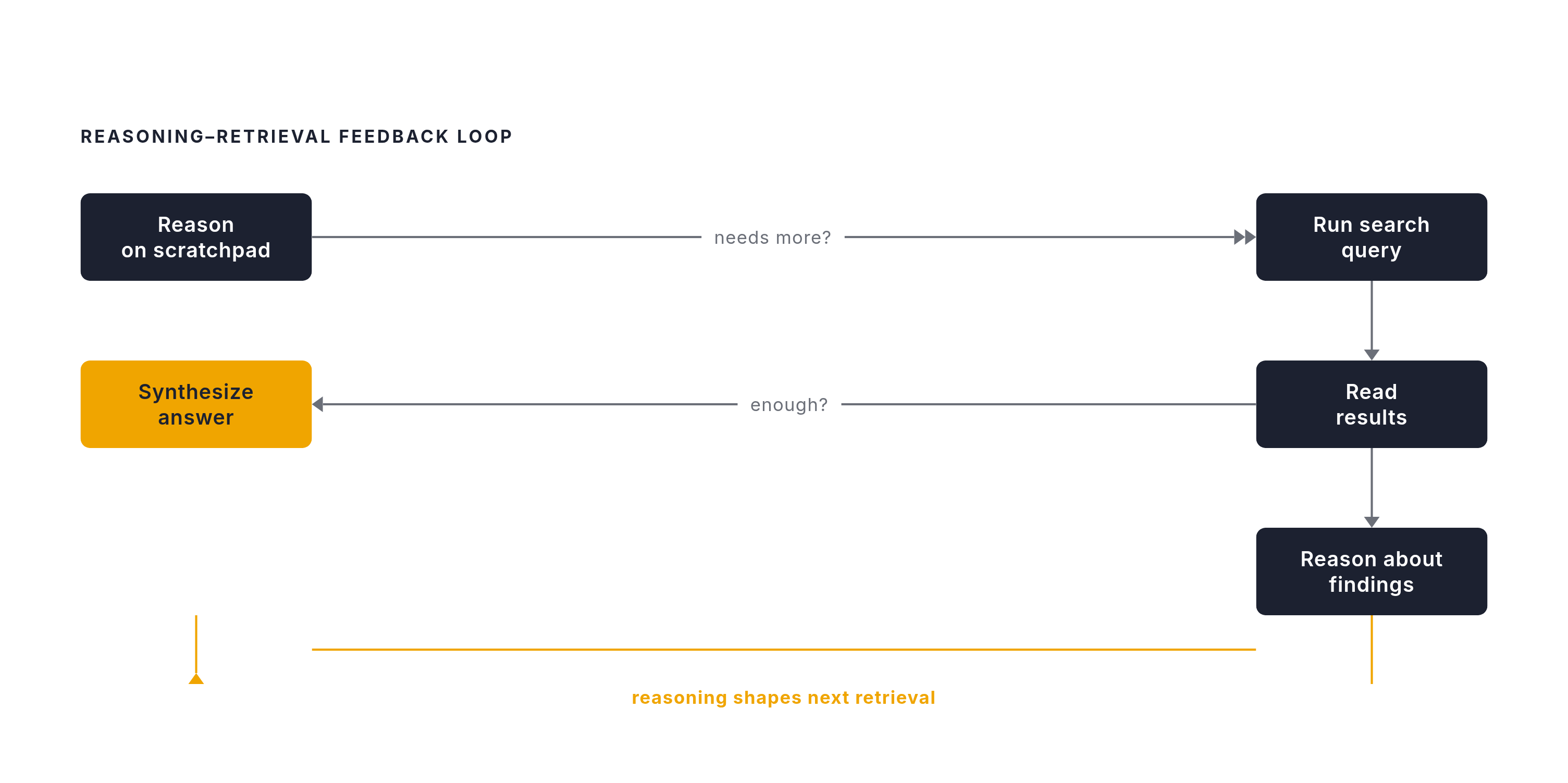
The mechanism that makes any of this work is a loop, not a lookup. A deep research agent fires off dozens of queries, each one shaped by what the last one turned up, against sources that are live and changing rather than frozen in an index somewhere. RAG asks a question once or twice against a static pile of documents and calls it done. A deep research agent keeps asking, adjusting its next move based on what the previous one revealed.
Picture the shape of a single round: the agent reasons inside something like a scratchpad, decides it needs more information, runs a search, reads what comes back, reasons about that, and either runs another search or decides it finally has enough to answer. It's a feedback loop where retrieval shapes reasoning and reasoning shapes the next retrieval, with the two running interleaved rather than one after the other in a straight line.
This interleaving is the actual engine behind multi-hop reasoning. It's how an agent can chase a thread across five different sources that no single query, no matter how well phrased, would ever have surfaced in one shot. And because each hop in the chain can introduce a small error, those errors stack up over long sequences of reasoning. Grounding and citation tracking have to happen at every step of the loop, not just bolted onto the final answer as an afterthought, because that compounding risk builds with each hop.
The two retrieval modes every deep research agent must choose between and their structural trade-offs
Every deep research agent has to decide, at the retrieval layer, how it's actually going to go get information. Every retrieval layer in a deep research agent must resolve a fundamental trade-off between API-based retrieval, which is fast, structured, scalable, and deterministic, and browser-based retrieval, which is slower and costlier but capable of reaching dynamic and unstructured content that APIs cannot touch.
API-based retrieval talks to structured sources, things like search engine APIs or scientific database APIs, and it's fast and cheap because it skips the overhead of rendering a full web page. Browser-based retrieval, by contrast, simulates human-like interactions with web pages and enables real-time extraction of dynamic or unstructured content by leveraging an LLM's long-context, code understanding, and multimodality capabilities. The academic framing of this trade-off is blunt: it's speed and predictability versus completeness. A page whose content is rendered on the fly rather than present in the raw page source simply requires a real browser, which is slower and costlier.
Mature systems don't pick one mode and live with it forever. The choice is not binary in mature systems: a well-designed retrieval layer uses API-based methods as the first-pass default and falls back to browser-based methods when structured APIs cannot reach the required content. When that fallback kicks in, the baseline setup is headless Chromium paired with a fingerprint patcher, since plain HTTP scraping gets blocked by the anti-bot defenses that most public sites run today. Raw HTML pulled straight from a browser is mostly dead weight, with only a small fraction of the tokens being content the agent can actually use. That waste becomes a real cost problem once a pipeline is feeding that raw page into an LLM at any scale.
Structured, clean output formats as the interface between retrieval and reasoning
Raw HTML fed straight into a reasoning model is a cost that gets charged on every single request, and any team treating Markdown or structured JSON as a nice-to-have is paying that cost over and over at scale. Most of the tokens in a raw web page are markup, navigation menus, and boilerplate the agent will never reason about. Markup, navigation menus, and boilerplate bury the signal the agent actually needs.
Indexing thousands of pages across a RAG pipeline multiplies that waste with every single retrieval call. Switching to Markdown-first output isn't a stylistic preference, it's a cost decision that pays compounding dividends the larger the pipeline gets. Clean output does more than save money, too. It directly determines whether grounding even works. An agent reasoning over clean, segmented content can point to the exact passage behind a claim. An agent wading through raw HTML cannot reliably do that, because the content it needs is tangled up with markup that means nothing to the final report.
Passing raw HTML into a reasoning LLM is not a retrieval strategy, it is a tax on every downstream step, and teams that treat Markdown or structured JSON output as optional are paying that tax on every request at scale. Markdown is built for reading and citation. JSON is built for pulling data programmatically and dropping it straight into a database. The smartest tools built for AI-native retrieval collapse search, crawling, and content transformation into one call that hands back clean Markdown directly, which turns what used to be a multi-step pipeline into a single operation and cuts both latency and the amount of code a team has to maintain. A single unified API that handles search, scrape, and clean formatting in one shot avoids that problem by design.
The report generation layer: structure control and factual integrity
Once the evidence is in hand, there are actually two separate problems left to solve, and treating them as one is where citation failures sneak into the pipeline.
Structure control is the first problem: organizing multi-step reasoning and a pile of retrieved material into something that reads like an actual report instead of a wall of paragraphs. The second is factual integrity: making sure that report stays faithful to what was actually retrieved, rather than drifting into claims the evidence never supported. Factual integrity is where hallucination gets in, specifically when this layer is missing or built halfheartedly.
A system called Deep-Reporter tackles both of these head-on rather than hoping a good base model will sort it out. It uses something called Checklist-Guided Incremental Synthesis to keep images and text working together coherently and to place citations where they belong, and it uses Recurrent Context Management to hold a long report together without losing the thread sentence to sentence. That pairing shows engineers design these things on purpose; they are not properties that show up automatically once a model gets smart enough.
It's tempting to assume that better base models will eventually handle structure and grounding without any extra scaffolding. That assumption doesn't survive contact with long-horizon tasks, where small errors stack on top of each other across dozens of reasoning steps and hallucination rates climb sharply no matter how strong the underlying model is. Explicit grounding mechanisms don't become optional once the model gets better. They become more necessary, because there's more room across a longer task for a small mistake to snowball into a report that confidently states something nobody ever actually found.
How named research systems have instantiated these architectural choices
Different teams building deep research agents have made genuinely different bets about where to put their effort, and lining a few of them up side by side shows the range of those bets rather than crowning a winner.
Gemini Deep Research leans into multi-source interfaces, most notably the Google Search API and the arXiv API, to retrieve across hundreds or even thousands of web pages and roll that into aggregate analysis. The bet here is on retrieval breadth above everything else.
DeepResearcher takes a different approach, spreading the work across a multi-agent setup where separate browsing agents pull relevant information out of all sorts of differently structured web pages. Instead of one system trying to be good at everything, retrieval gets distributed across specialists.
FlowSearch builds a dynamic, structured knowledge flow that evolves as the system works, using that flow itself as the thing holding the research together and driving what gets investigated next.
Separating those roles directly addresses the citation discipline raised in the last section.
WebThinker folds thinking, searching, navigating, and drafting into a single continuous loop, and treats that loop itself as the mechanism holding the output accountable to the evidence.
Deep-Reporter, already mentioned for its report generation work, also pushes the category into multimodal evidence, pulling in and filtering not just text but tables, charts, and infographics, on the argument that real expert reports lean heavily on visuals that text-only systems simply miss.
And the enterprise case extends the pattern even further outward. A governed deep research stack built for business use pulls from internal documents like contracts, SOPs, and tender packs, enterprise databases, the public web, news feeds, and analyst material, and it needs vision-capable extraction to handle complex PDFs and scanned documents that text-only tools can't read.
The developer tooling layer for reliable retrieval and grounding at scale
None of the architecture above matters if the infrastructure underneath it is shaky. A deep research agent's retrieval and grounding depends directly on the quality of the web data tools feeding it, and the gap between a well-built API and a cobbled-together stack of mismatched tools gets wider at every layer the data passes through.
The commercial tooling market has settled around a short list of things any serious retrieval infrastructure has to provide: unified search and crawl in one place, clean output formats, handling for anti-bot defenses, and the ability to batch requests at scale without falling over.
A few examples show how that list plays out in practice. One major player focuses on AI-native retrieval with a single API covering search, scraping, crawling, URL discovery, and transformation into clean Markdown or structured data, aimed squarely at RAG pipelines, research agents, and coding assistants that need reliable web context. Another is built specifically as an AI search API for agents and RAG pipelines, handing back real-time web results, summaries, and source-backed information in a format easier for LLMs to use. A third is built for enterprise scale, backed by strong uptime and success-rate guarantees, and returns data in JSON, Markdown, HTML, or whatever format the pipeline needs.
A unified API covering search, scraping, crawling, and structured output in a single call is architecturally preferable to stitching together multiple tools, because every tool boundary is a point of failure, a format inconsistency risk, and an engineering maintenance burden. Native SDK support for Python and Node.js, webhook events, MCP server access, and CLI tooling matter because both human developers and autonomous agents need to access web data with minimal friction, so the tooling must serve the agent as its own user as explicitly as it serves the human developer.