Evaluating Research Agent Output Quality
Benchmark scores miss the multi-step failures that tank agents in production.

Research agents ace the demo, then fall apart in production. A March 2026 survey of 650 enterprise tech leaders found 78% had AI agent pilots running, but fewer than 15% got any of them to production scale. People keep calling that gap a maturity problem, something you fix by waiting. The evidence points elsewhere: teams can't trace failures or measure quality in any real way, and that evaluation gap is what actually stalls production scale.
Benchmark scores measure single-turn, static inputs. Production is multi-step, messy, and stuck dealing with whatever the web looks like at the exact second someone hits enter. A high score on BrowseComp or AgentBench won't tell you what happens when a tool call dies halfway through a chain, or a source updates mid-task, or a user asks something the benchmark writers never dreamed up.
PwC's 2025 Agent Survey put agent adoption at 79% of organizations. Most of those same companies can't trace a failure through a multi-step workflow, and most can't measure quality in any real way either. That's the actual gap, and it's why every production incident lands as a surprise. Debugging turns into archaeology: digging through logs, guessing at what broke, instead of checking the one layer built to catch it in the first place.
How agent evaluation differs structurally from evaluating a standalone LLM
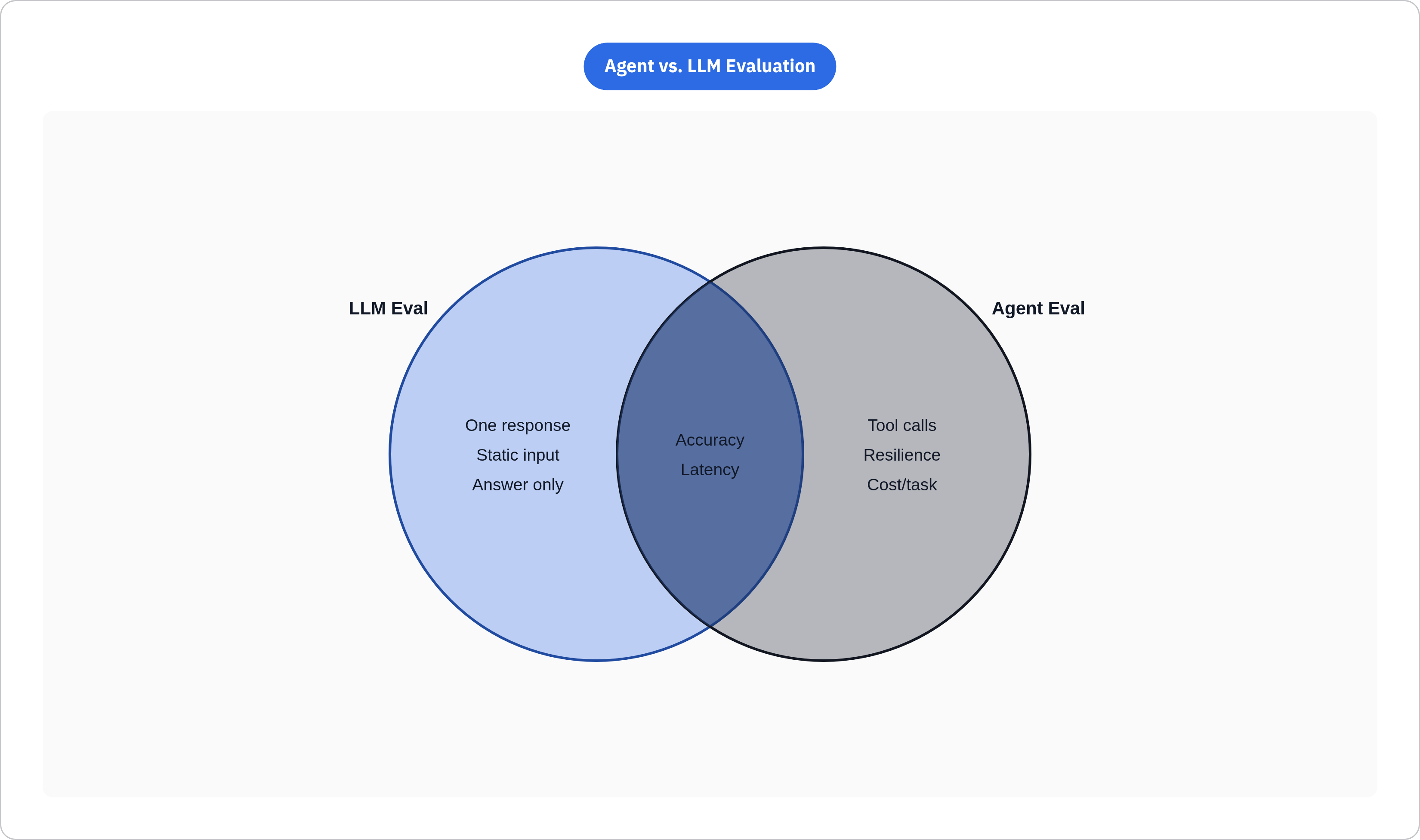
Grading a plain LLM means grading a response. Grading an agent means grading a trace, and that's a much bigger job than it sounds.
A trace is the whole record: reasoning steps, tool calls, error recovery, state changes along the way. Each piece can fail on its own, completely separate from what the final answer says. A wrong answer might come from a perfectly sound process that grabbed the wrong evidence at the wrong moment. A right answer might have limped in despite two broken steps in the middle that happened to luck out anyway. Grade the answer alone and you miss both stories.
More autonomy means more places for things to break: tool selection, planning, handoffs between steps, safety behavior, latency, cost. Answer quality stops being the whole test and turns into one line item among many.
The type of agent you're running decides what you even measure. Generator or RAG-style agents answer a prompt using retrieved context, no tool chaining involved, and metrics like Answer Relevancy, Faithfulness, and Contextual Recall map onto them pretty directly. Tool-calling agents decide when to call which tool (a search API, a database, an MCP server) and in what order, so you also need to check sequencing and whether the agent recovers when a call fails partway through. Pick your metrics before you know which type you're dealing with, and you're just guessing.
The five dimensions that cover the full failure surface of a research agent
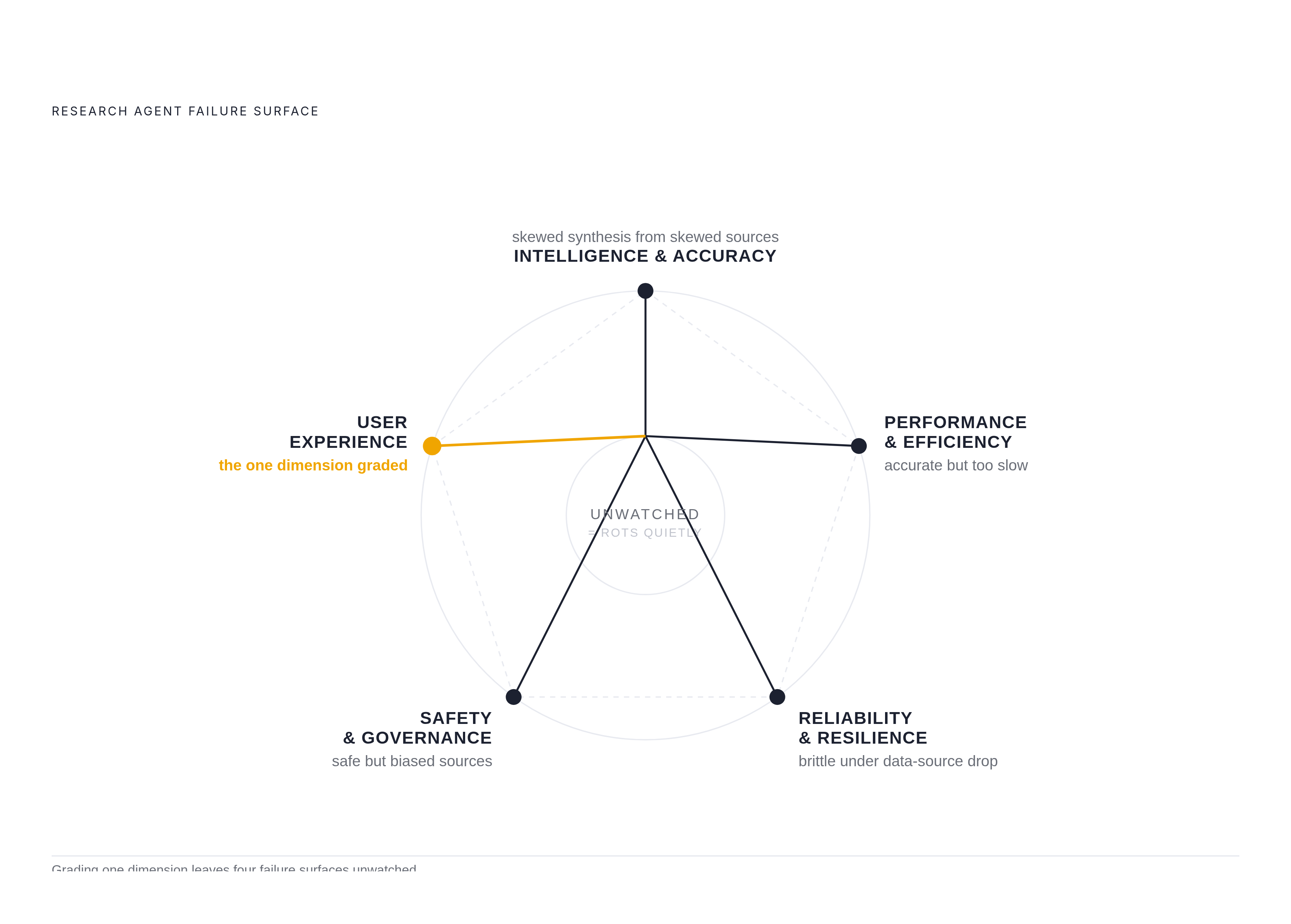
Five things cover the ground a research agent can fail on: intelligence and accuracy, performance and efficiency, reliability and resilience, safety and governance, and user experience.
Grade on just one and the rest rot quietly, out of view. An agent can be accurate and still too slow for anyone to bother using it at production latency. It can be fast and accurate and still brittle, with zero recovery when a data source drops mid-task. It can clear every safety filter in testing and still hand back a synthesis that's quietly skewed, because the sources feeding it were skewed from the start.
A LangChain survey found 41% of tech leaders name performance quality as a top concern, but "quality" by itself doesn't tell you where to look. Break it into five and suddenly you've got something you can act on.
Treat these five as a design-time checklist, not something bolted on after launch. Map each one to the failure modes your agent could realistically hit, given its actual tools and data sources, and don't weight them evenly. A research agent pulling from live web data carries a much heavier reliability and accuracy burden than a read-only agent summarizing documents someone already vetted by hand.
Measuring factual grounding and faithfulness where research agents actually break
Three words get thrown around like they mean the same thing. They carry distinct, separable meanings in practice.
Faithfulness asks whether the answer matches what got retrieved. Groundedness asks whether you can trace the answer back to specific passages. Factuality asks whether the claim is true against the real world, regardless of what got retrieved in the first place.
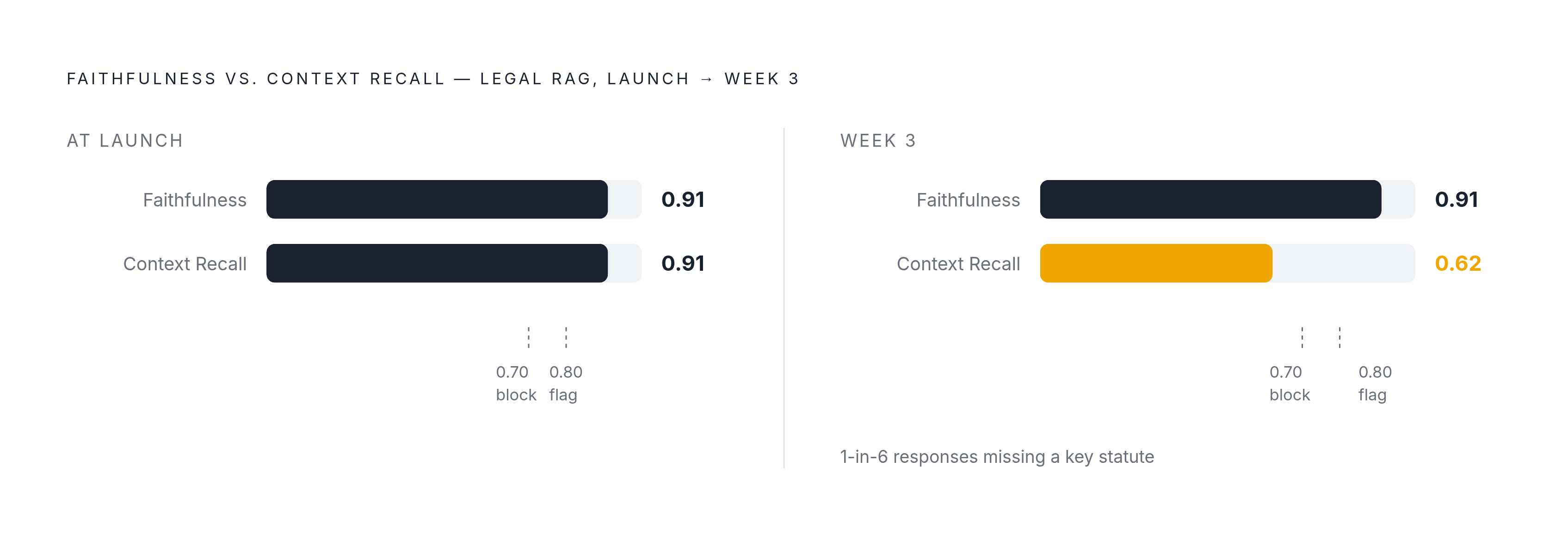
A documented case makes this concrete. A legal research RAG shipped with a faithfulness score of 0.91 on the offline eval set, looked great on paper. Three weeks in, customers start reporting that something like one in six responses is missing a key statute. Pull up the dashboard, faithfulness still reads 0.91. Context recall, meanwhile, quietly dropped to 0.62 and nobody caught it.
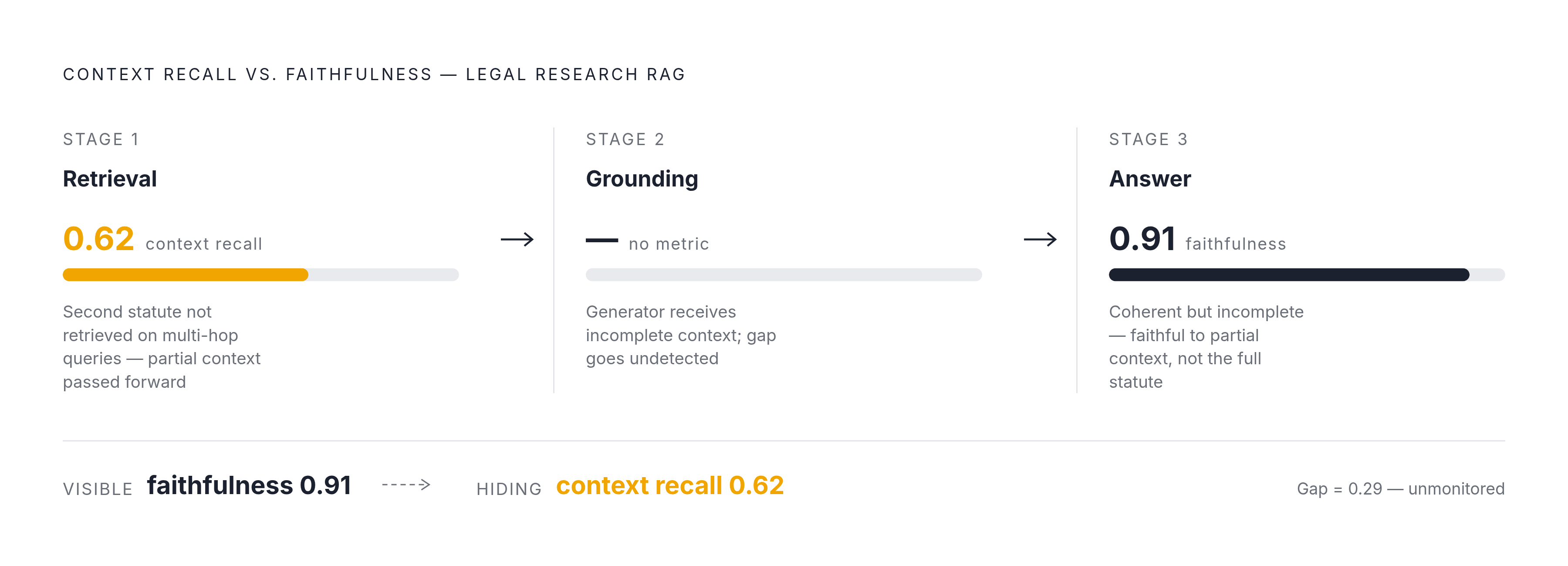
Here's what actually happened: the retriever stopped pulling the second statute on multi-hop questions. The generator, working off whatever partial context it got handed, still wrote something coherent and faithful-sounding, because it was being faithful, just to half a story. Faithfulness stayed high since the model wasn't lying about what it had; it just didn't have enough to work with. No retrieval-stage metric caught the regression, because nobody was watching the retrieval stage. Faithfulness without context recall is a false ceiling: a high score confirms the model isn't lying, nothing more, and it says nothing about whether the model had the full picture.
Retrieval failures are the quiet killer here: documents that sound related but aren't, or the one document that actually answers the question sitting outside the retrieved set entirely. Set hard thresholds in the pipeline for this. Flag anything under 0.80 groundedness for review, and block anything under 0.70 faithfulness before it ever reaches a user.
Longer reasoning traces don't fix grounding, and test-time scaling research shows they can push overconfident, wrong answers up instead of down. Thinking longer doesn't replace better evidence. Hand the model garbage at retrieval, and more reasoning just dresses the garbage up nicer.
Process-level metrics: evaluating how the agent reasoned, not just what it concluded
Outcome metrics tell you what happened. They don't tell you whether the agent recovered cleanly after a tool call errored out, whether it kept its state straight across a ten-step task, or whether anyone could actually go back and audit its reasoning afterward.
Some checks are cleanly deterministic: did it call the right tool, in the right order, did it consult the source it was actually supposed to consult. Grade those pass or fail, no argument needed. Other checks need judgment: was the reasoning coherent, did the agent hedge when the evidence was thin. That's where LLM-as-judge earns a real place in the process, because "partially correct" is a common outcome in practice, and grading everything pass/fail throws away exactly the signal a quality scale exists to capture.
Latency deserves treatment as a distribution, not a single average buried somewhere in a report. The p50 tells you what a typical run looks like. The p95 tells you what most users are actually living through. The p99 is where the ugly tail behavior hides, and tail behavior does most of the work in making an agent feel unreliable, even when the median run looks perfectly fine on paper.
Cost per task might be the most underrated number in the whole stack. Add up LLM calls, tool invocations, and retrieval requests per task, and you find out fast whether the thing scales economically or quietly bleeds money the more people use it.
For reconstructing what actually happened during a run, OpenTelemetry-based SDKs beat hand-rolled instrumentation, especially once the agent's codebase starts shifting under you. They keep capturing streaming traces reliably even as the framework underneath gets upgraded out from under them.
How live web data quality feeds directly into research agent output quality
The chain runs straight through: retrieval quality drives grounding quality, and grounding quality drives answer quality. No clever evaluation trick gets you past bad source data sitting at the front of that chain.
Static vector stores break down fast for research agents specifically. Knowledge cutoffs mean the agent reasons off stale facts, and no indexing schedule keeps pace with anything that moves quickly: legal changes, pricing, competitive intel, take your pick.
Live web search as the retrieval layer solves the staleness problem outright. Fresh, source-cited documents pulled at the moment of the query, no indexing lag sitting between the agent and reality. This retrieval approach suits pipelines that need current information, sourced fresh rather than pulled from whatever got crawled last quarter and left to rot on a shelf somewhere.
"Clean data" isn't just a nice phrase filling space here, it's doing real work. Raw HTML dumped straight into a prompt wastes tokens on navigation menus and formatting junk, and that noise drags faithfulness scores down even when the underlying content was fine all along. Markdown or structured JSON, by contrast, makes passage boundaries explicit and gives the model less room to hallucinate around the gaps. Snippets that arrive pre-chunked and pre-cleaned go straight into the prompt, which kills off a whole category of preprocessing failures before they get the chance to start.
Source provenance matters for the same reason it always has. If the agent can't hand back a traceable URL for every factual claim, there's no way to independently check groundedness at all. Provenance is infrastructure the rest of the evaluation depends on, something built in from the start rather than a feature bolted on later once someone complains.
Smart production teams plan for their data source going down, too: one primary search or scrape provider, one fallback, and an integration layer built so swapping providers doesn't mean rewriting the whole pipeline from scratch. That one architectural call shows up directly in the reliability score, whether anyone notices at the time or not.
What the observability tooling landscape actually gives you to work with
The one thing any evaluation toolchain has to do is capture the trace across the whole workflow, not just the final answer the LLM spits out at the end. Inputs, outputs, prompt versions, every tool call, every intermediate reasoning step, all logged per run.
MLflow is a solid anchor going into 2026, with trace capture across the full agent lifecycle and native hooks into LangChain, LlamaIndex, OpenAI, and Anthropic. That cuts down the instrumentation work across most of the stacks people are actually running day to day.
A few others fill in specific gaps. Langfuse and Arize lean observability-first, with evaluation layered on top afterward. Comet Opik leans into experiment tracking, useful for comparing prompt versions or swapping model variants side by side. LangSmith and Promptfoo are strong on automated regression, particularly for LLM-as-judge pipelines.
Framework choice narrows your tooling options too, whether you plan for it or not. LangGraph has become the default for production agent systems heading into 2026. Its graph structure, explicit nodes and edges, makes the resulting traces much easier for evaluation tools to parse without a pile of custom glue code. Microsoft's Agent Framework, the successor to AutoGen and Semantic Kernel, hit 1.0 general availability across Python and.NET with responsible AI guardrails wired in through Azure AI Foundry. That matters a lot if your shop already lives inside the Microsoft ecosystem.
Interoperability protocols add their own wrinkle for multi-agent setups: MCP where tools need richer features, OpenAPI specs for whatever APIs already exist, A2A for coordinating between agents running independent tool stacks. Every boundary between those protocols is a spot where a trace can quietly go dark if nobody instruments it on purpose.
The trap most teams fall into: pick the framework first, figure out evaluation later, then discover the trace granularity the eval tool wants isn't something the chosen stack actually exposes. Framework and tooling need deciding together, at the same time, from day one.
Building a staged evaluation process that catches failures before they reach users
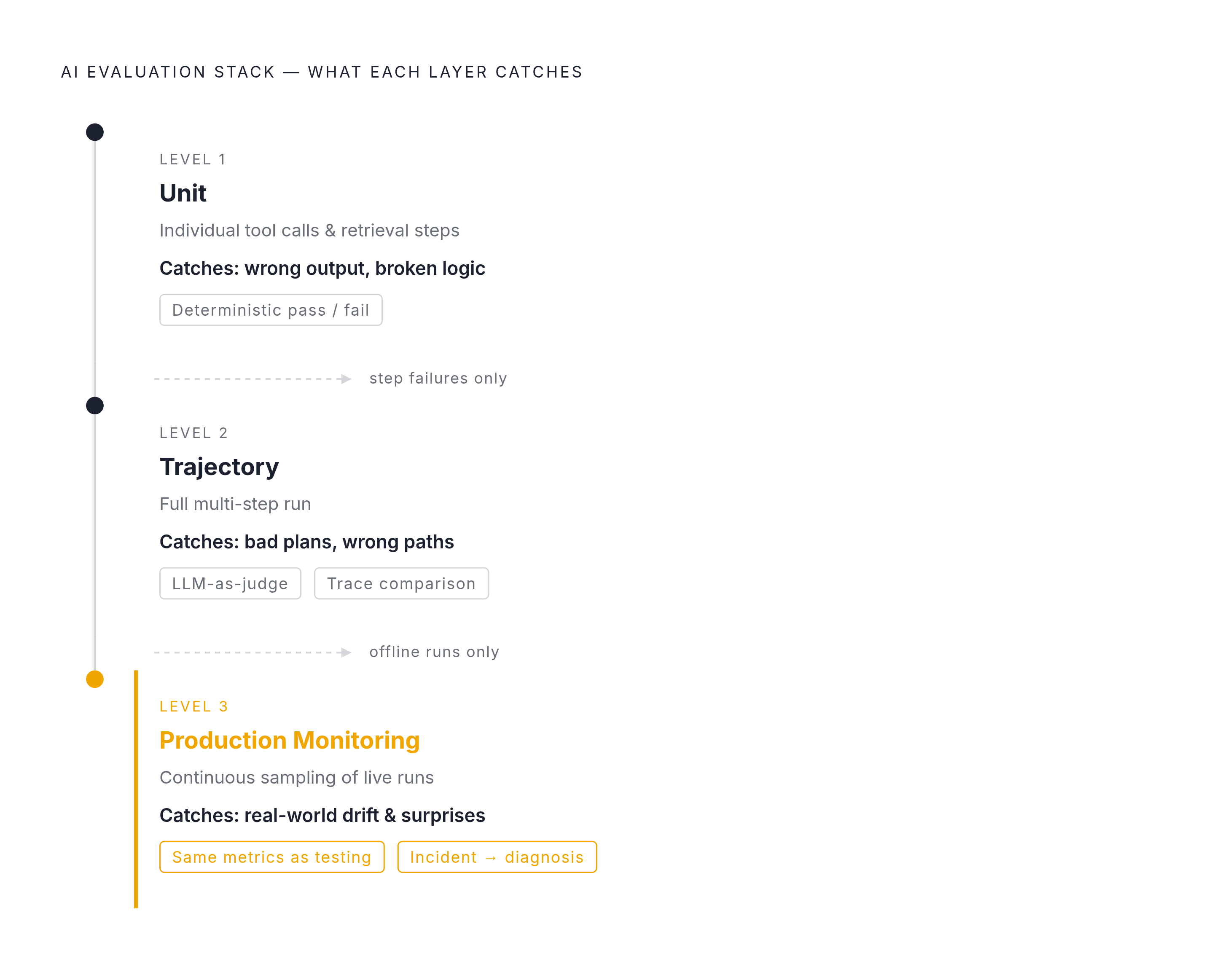
Evaluation works as a sequence of checks running at different levels of granularity. Each one catches something the others can't see.
Unit level covers individual tool calls and individual retrieval steps; deterministic checks belong here. Trajectory level covers the full multi-step run end to end, and that's where LLM-as-judge and trace comparison earn their keep. Production monitoring sits on top of both: continuous sampling of live runs, graded against the same metrics used back in testing, no separate standard for the real world.
The offline eval set matters, but it's not the whole job, and the legal RAG example makes that plain: a 0.91 faithfulness score on a static test set completely missed a context recall regression that only showed up once real multi-hop queries hit production traffic.
Building a golden set worth trusting means including multi-hop queries on purpose, domain-specific edge cases, and questions where the right answer only comes from stitching evidence together across several sources, not just grabbing one document and calling it done.
Regression testing has to be a standing habit, not a one-time setup you configure and forget about. Every model update, every prompt tweak, every change to the retrieval config, rerun the full eval suite, every single time, and track the deltas over time rather than just where the number sits today. A three-point drop in faithfulness after a retrieval change is worth flagging even if the absolute score still looks fine sitting there on the dashboard.
Nobody can grade every live response by hand, so sampling has to be deliberate about where it looks. Set a rate that actually gives statistical confidence, and weight it toward the runs that triggered tool errors or ran unusually long. That's where the real problems hide, almost every time.
Human review still has a place, aimed at the handful of responses automated metrics flag as genuinely needing a person's eyes. Reviewing everything is impossible, and reviewing nothing is worse, and somehow more common than it should be.
Get this staged setup running, and a production incident stops being a surprise. It turns into a diagnosis, one where the framework points straight at the layer that broke. That's the whole difference between a fix that takes an afternoon and an investigation that eats two weeks of everyone's time.