Semantic Search vs Vector Search for Research Agents
Hybrid retrieval outperforms either semantic or vector search alone by combining their strengths.

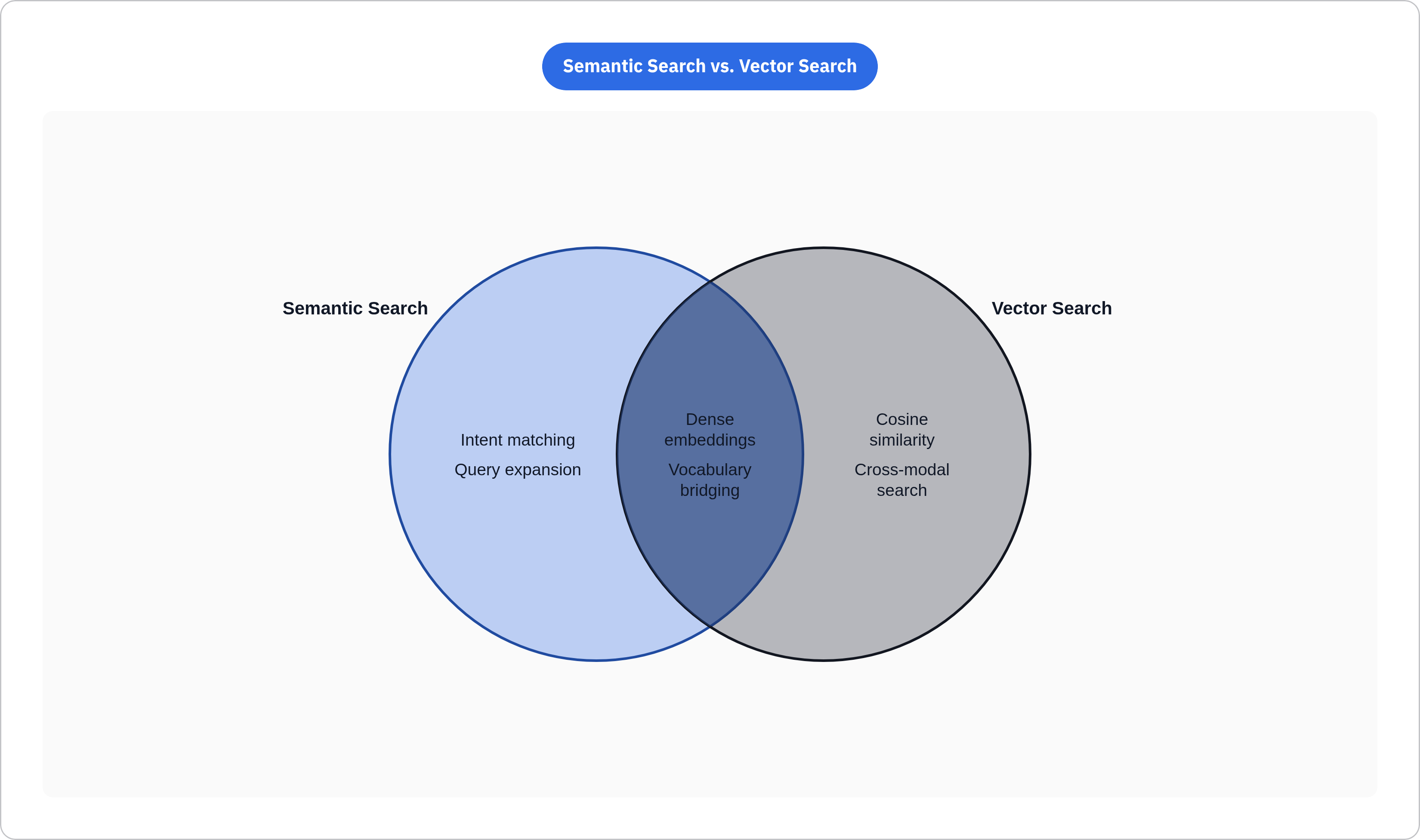
Semantic search and vector search get used like they're synonyms, and mixing them up is how research agents end up confidently retrieving the wrong document. One is a goal (understand what the user means). The other is math (find the nearest neighbor in a big pile of numbers).
Understanding where they overlap, and where they don't, is the difference between an agent that finds the right answer and one that finds the closest-sounding wrong one.
The confusion is fair, honestly. Most modern semantic search runs on vector embeddings, so the two terms got glued together in casual use, the way "Google it" became a verb for search in general even though other search engines exist. Semantic search is the destination, and vector search is one road that leads there among others.
Here's the cleanest way to split it. Semantic search cares about intent, wanting to return the right document even when the query and the document don't share a single word in common. Vector search takes data, turns it into a long list of numbers (a high-dimensional vector), and finds whatever else is sitting closest to it by some distance measure, usually cosine similarity or dot product. It's geometry more than comprehension.
Watch what happens with a real query. Someone types "fix login issue." Somewhere in your corpus sits a document called "Resolving Authentication Token Expiry Issues," with zero shared words. A keyword system would walk right past it. But the embedding for that query and the embedding for that document land close together in vector space, because the model learned, from a mountain of training text, that login problems and token expiry live in the same neighborhood. That's the whole trick, and that's the value vectors bring to the table: matching meaning, not matching strings.
Semantic search often stacks more on top of vectors to sharpen that intent-matching further, things like knowledge graph lookups, named entity recognition, query expansion, reranking models. Each layer nudges relevance upward, but each layer also adds latency and one more thing to babysit in production. That tradeoff runs through basically every decision in this article, so keep it in your back pocket.
One more thing worth knowing: vector search isn't stuck with text. Anything you can embed, you can search this way, images, audio clips, lines of code. It's a general-purpose matching mechanism that happens to wear a text-retrieval costume most of the time.
What keyword search still does that neither semantic nor vector search does well
BM25, the decades-old keyword ranking algorithm behind a lot of classic search engines, is nowhere near dead. On a real, meaningful chunk of queries, it still beats dense embedding models in current benchmarks, and that's a structural fact about how embeddings work, not nostalgia talking.
Think about what an embedding model does to a chunk of text: it squashes the whole thing into one vector, averaged across the entire context window. Now send it a query like an exact SSL error code, ERRSSLVERSIONORCIPHER_MISMATCH. That string is precise, unambiguous, and there's exactly one right answer, but the embedding model doesn't preserve "contains this exact string." It captures something more like "document about SSL problems in general." BM25 finds the exact document because it's matching tokens directly, while vector search might hand you five documents about SSL that don't contain your error code anywhere. Same failure mode hits error codes, product SKUs, legal citation numbers, function names, anything where the string itself is the point.
Vector search has its own blind spot, and it's a sneaky one: it always returns something. Ask it a nonsense question, feed it a query about a topic your corpus doesn't cover at all, and it will still hand back its "closest" match, because nearest-neighbor search doesn't know how to say "none of these are actually good." There's no built-in floor for relevance; it just ranks whatever's there and calls it a day.
Domain-specific work makes this worse. In clinical documentation, financial filings, legal briefs, general-purpose embedding models trained on broad internet text can drift away from the precise, narrow vocabulary that actually carries meaning in those fields. A BM25 index tuned to legal or medical terms will often beat an off-the-shelf embedding model cold, simply because it's matching the exact language professionals in that field actually use.
So neither one wins outright. The real design question is how to combine them without your latency bill or your compute bill exploding.
How hybrid retrieval combines the two and why the combination outperforms either alone
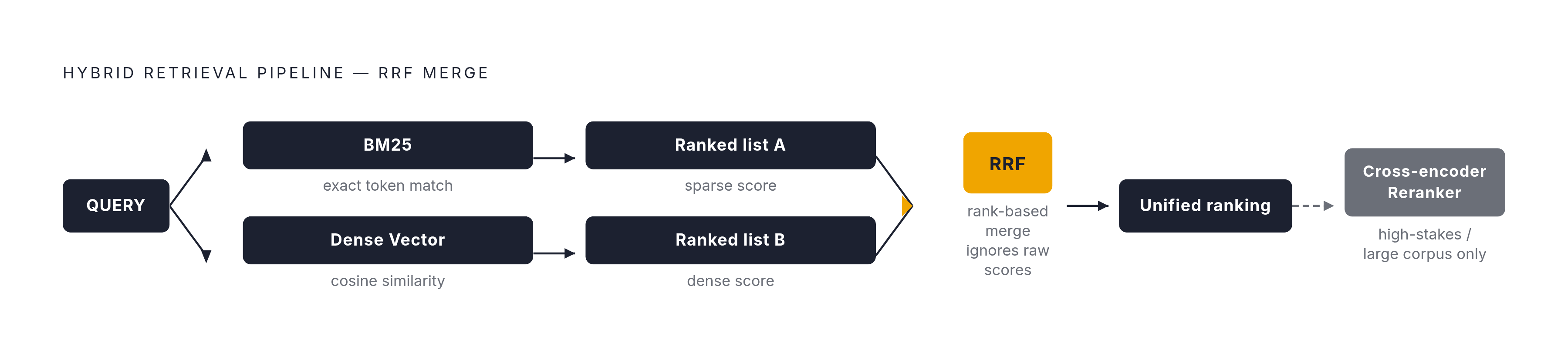
The pattern that shows up again and again in production systems is simple: run both searches at once, not one after the other. A sparse BM25 search scans the text fields for exact token matches, while a dense vector search scans the embedding field for semantic closeness. Each comes back with its own ranked list of document IDs, and neither one knows the other exists yet.
Now you've got two ranked lists on two different scoring scales, and this is where a lot of naive implementations trip. BM25 scores and cosine similarity scores aren't measured in the same units; smashing them together with simple math produces junk. Reciprocal Rank Fusion sidesteps the whole problem by ignoring the raw scores entirely and working off rank position instead. A document that shows up near the top of either list gets rewarded, and the output is one merged ranking that's more reliable than what either method produces solo.
Applied AI research on retrieval consistently shows hybrid dense-plus-sparse setups outperforming pure semantic search across tested benchmarks. The gain isn't magic, it's just each method patching the other's hole. Vectors cover the vocabulary gap, BM25 covers the exact-match gap, and together the blind spots mostly cancel out.
There's an optional third stage for teams that need more precision: take the top handful of fused results and run them through a cross-encoder, a model that scores the query and the document together, as a pair, rather than separately. It's more accurate because it's actually looking at the relationship between the two texts instead of comparing two independent points in space. It's also slower and costs more per query, so it earns its place only when the corpus is big enough or the stakes are high enough to justify the extra hop. Skip it in prototyping, and skip it on small corpora where hybrid retrieval alone already gets you most of the way there.
There's a quieter benefit to this whole setup too: because RRF tracks BM25 and vector contributions separately, you can show, after the fact, which ranker actually surfaced a given result. That matters more than people expect once you're debugging a bad retrieval in production, or explaining a result to a compliance team that wants to know exactly how a document got pulled.
The infrastructure choices that make or break retrieval at scale
Comparing a query vector against every single stored vector, one by one, across millions of documents, at the speed a live query demands, just doesn't work. The math is too heavy, so production systems don't do exact nearest-neighbor search at all; they use Approximate Nearest Neighbor indexes, trading a sliver of recall for search speeds that are orders of magnitude faster.
HNSW (Hierarchical Navigable Small World) is the graph-based index doing most of that work under the hood across major vector databases right now. It builds a layered graph structure that lets a query hop toward its approximate neighbors fast, without ever touching most of the corpus. It's the default for a reason: the speed-for-recall tradeoff lands in a good spot for most production workloads.
Picking a vector database is really a question of matching the tool to your workload, not chasing whichever one is loudest on social media that month.
- Pinecone: fully managed, no infrastructure to babysit, a solid pick when your team's real constraint is operational bandwidth, not cost.
- Weaviate: has native hybrid search and graph support built in, useful when your retrieval pattern is hybrid from day one.
- Milvus: built for corpora in the billions of vectors, aiming for single-digit-millisecond latency.
- Qdrant: strong when you need heavy filtering logic layered on top of vector search.
- Chroma and MongoDB Vector Search: lower operational overhead, a good fit for smaller corpora or teams already living on those stacks.
Retrieval quality gets decided before you even build the index, at the embedding model stage. Context window length matters more than people give it credit for: a model with a short context window forces you to truncate long documents, and whatever got cut off is now invisible to search, permanently. Semantic chunking, splitting a document at natural meaning boundaries instead of just lopping it off every 500 tokens, improves recall noticeably over naive fixed-size chunking. And general-purpose embedding models trained on broad web text can genuinely misfire on specialized corpora; that's a known failure mode, not a rare edge case, and the fix is either a domain-tuned model or a hybrid fallback to BM25.
Latency budgets are real constraints too. Interactive applications generally need retrieval under a hundred milliseconds; anything real-time pushes that closer to fifty. Caching repeat queries with something like Redis avoids redundant vector searches, which matters a lot once query volume climbs. And storage isn't free: tens of millions of documents at a high embedding dimension eats up tens of gigabytes of vector storage, and that number climbs in a straight line as your corpus grows.
Why agentic research loops change which retrieval properties matter most
A plain LLM doing basic keyword search performs poorly on complex, multi-hop research questions, the kind that need several rounds of digging. Agents built around a loop, search, reason about what came back, search again, score dramatically better on those same benchmarks. The retrieval mechanism itself turns out to matter less than whether the whole system is built to loop at all.
That's the real reframe here. The question is less "which retrieval method is best" and more "what does this agent need to do after it gets results back." An agent that can look at a first batch of documents and decide "I need to search again, more narrowly" is a fundamentally different animal than one that fires a single query and reasons over whatever landed in its lap.
This is also where recall and precision stop being an abstract tradeoff and start being a design decision you actually have to make. Missing a document is expensive in some contexts, medical research, legal discovery, competitive intelligence, where the wrong omission means the wrong conclusion. In those cases, cast a wide net and lean toward semantic search's broad reach. Returning a wrong document is expensive in other contexts, compliance flagging, financial record lookups, where a false positive costs real money or real trust. There, keyword search or hybrid retrieval with aggressive reranking earns its keep.
Static corpora and live web content split the architecture down the middle, too. A bounded, stable set of documents can be indexed once, queried with dense vectors, and updated incrementally as things change. Content that's changing fast, or effectively unbounded, breaks that model, because embeddings go stale the moment the underlying page changes, and the agent ends up confidently retrieving yesterday's answer. In that world, the agent may need to retrieve live, at query time, rather than pulling from a pre-built index at all.
Anthropic actually pulled vector search out of Claude Code in mid-2025, and that's worth sitting with for a second. For that kind of agentic workload, just-in-time retrieval through well-built tools beat maintaining a pre-indexed embedding store, because the underlying codebase changes constantly, the queries tend to be precise rather than fuzzy, and the cost of keeping embeddings fresh outweighed what they were buying. The emerging rule of thumb: add embeddings where a workload genuinely needs semantic generalization over a large, mostly stable body of content. Skip them when the corpus is small, moving fast, or the queries are precise enough that exact match does the job.
What happens before retrieval: why the quality of the ingested web content determines retrieval quality
No retrieval method fixes bad input. BM25 and billion-parameter embedding models both hit the same ceiling: garbage in, garbage out, no exceptions.
Raw HTML is full of clutter that never should have made it into an embedding in the first place. Navigation menus, footer links, cookie banners, sidebar widgets, all of it gets embedded right alongside the actual content that matters. The resulting vector ends up representing a page that happens to contain the content, rather than the topic the document is actually about, which quietly drags down every search result that touches it. And since embedding cost scales with tokens, that boilerplate isn't just noise, it's noise you're paying for.
Clean Markdown or structured JSON, stripped of the boilerplate, produces embeddings that actually track the document's real meaning. Semantic chunking on top of that clean text sharpens things further, because each chunk represents one coherent idea instead of an arbitrary slice.
Live web content adds a wrinkle that static corpora never have to deal with: freshness. An index built three weeks ago and never touched again will confidently return outdated pricing, an old regulatory filing, stale news, and the agent has no way of knowing it's wrong. It'll just answer, calmly and incorrectly, which makes the web data pipeline feeding the index just as important as the index itself, not a side concern.
This is where AI-based scraping earns its place over old-school CSS selector scraping. Selectors break the moment a site redesigns its layout, full stop, and someone has to go fix them by hand. ML-based extraction instead understands what data it's actually looking for on the page and adapts when the layout shifts, handing back clean, structured content that's ready to embed with far less cleanup in between.
And there's a wall most naive scrapers just slam into before they ever get a single document: anti-bot systems like Cloudflare, DataDome, and PerimeterX. A research agent that needs to actually work in production needs a scraping layer that gets past that transparently, without requiring a custom engineering effort for every new site it touches.
How to connect a retrieval architecture to a live web data pipeline
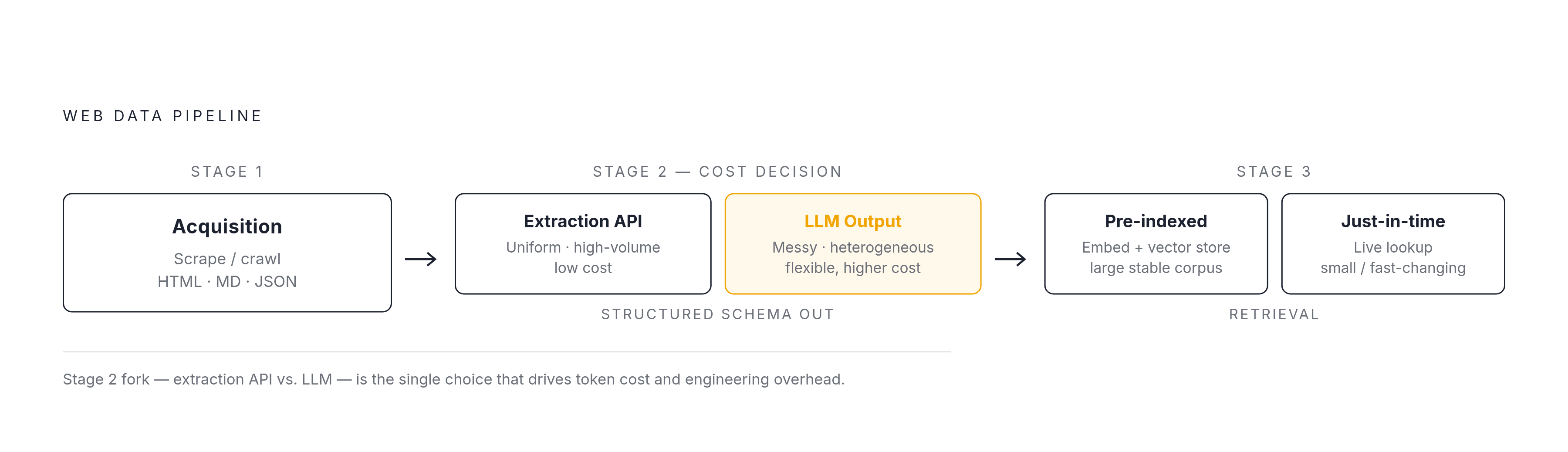
Nearly every production pipeline that reasons over live web data breaks down into the same three stages, whether the team building it knows it or not.
Stage one is acquisition. A scraping or crawling service pulls raw content, HTML, Markdown, or JSON, at whatever rate the pipeline needs.
Stage two is structuring. That raw content either gets parsed into a defined schema directly by the scraping service, or it gets passed through an LLM with a structured output constraint that pulls out the specific fields the agent actually needs to reason over.
Stage three is retrieval. The structured content gets embedded and indexed, or it's held for just-in-time lookup at query time, depending on how big the corpus is and how fast it changes.
Stage two is where cost decisions actually get made. For scraping uniform, high-volume, standardized pages, a dedicated extraction API returning clean JSON is a lot cheaper than paying per-token LLM costs on every single page. For messy, heterogeneous, unpredictable sources, LLM extraction saves the engineering time you'd otherwise burn maintaining custom selectors for every site, one by one, forever.
Crawl4AI is a concrete, open-source option worth knowing here: a Python crawler built specifically for LLM pipelines, and it outputs both a full-page Markdown version and a boilerplate-stripped version. For anyone watching their embedding token costs, the stripped version is almost always the right call.
Firecrawl is another solid managed option for teams that want a hosted scraping layer without building a crawler themselves. And for teams whose bottleneck is specifically anti-bot bypass and JavaScript rendering, ScrapingBee and similar services target that layer directly.
One piece that gets overlooked constantly: a research agent that reads the web also needs to know when the web changes underneath it. Price shifts, new regulatory filings, a competitor shipping a new product page, none of that shows up unless something is actively watching for it. Monitoring APIs that track specific URLs or domains and fire a trigger on change are what close the loop, turning a one-time scrape into an actual feed the agent can react to as things happen, not just a snapshot it forgets about the moment it's indexed.