Deep Research Agents vs Traditional RAG Pipelines
Iterative agents outperform single-pass retrieval on complex reasoning tasks.
Retrieval-Augmented Generation, RAG for short, retrieves once per question and answers from whatever it finds in that single pass. A query comes in, the system embeds it, pulls the top-matching chunks from a vector store or search index, and hands those chunks to the model to generate a response. Three steps, each one firing exactly once: embed, retrieve, generate. There's no second look, no changing your mind halfway through. It's a vending machine, not a conversation: you put in a query, you get back whatever the machine already had stocked.
That doesn't mean RAG is primitive. The field has moved well past the early days of "grab some chunks and hope." Production pipelines today combine dense and sparse retrieval in hybrid search, add cross-encoder reranking to sort the results by actual relevance, and break complicated queries into multiple smaller ones before retrieval even starts. All of that makes the single pass smarter. None of it changes the fact that it's still a single pass. Better fishing gear still only gets you one cast.
What RAG does well, it does very well. The pipeline is deterministic and interpretable, so you can trace exactly which chunk produced which part of the answer, which matters enormously for connecting an LLM to private company data that will never appear in a foundation model's training set. A support bot answering questions from internal documentation, a compliance tool checking a policy manual: these are jobs where the knowledge is fixed, the questions are bounded, and one good retrieval pass is enough to get the job done.
The trouble starts when the task stops being bounded. RAG is good at facts. It was never built for sustained reasoning, and it has no way to revisit a retrieval decision once that decision has already been made. It's the architecture working as designed, just not designed for this kind of problem.
What deep research agents do differently at the architecture level
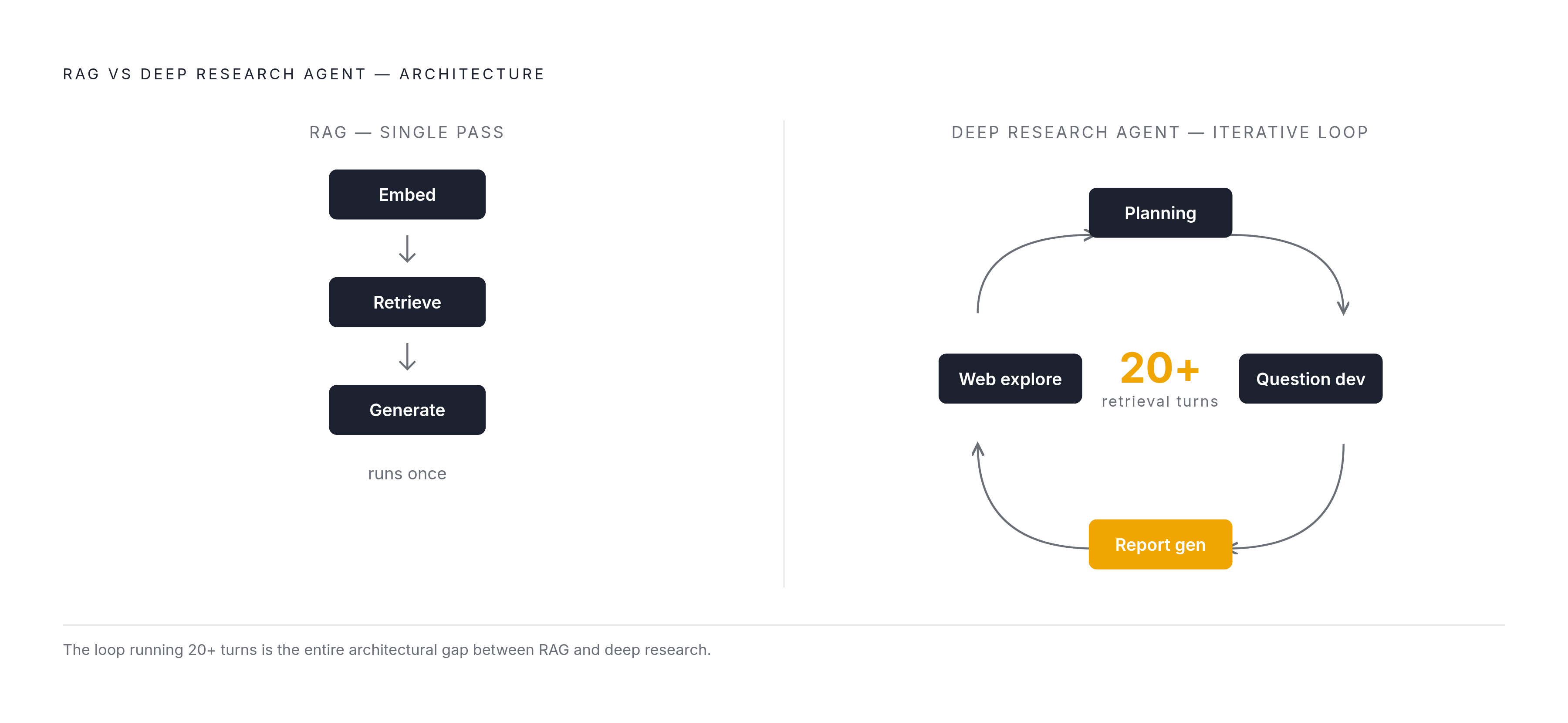
Deep research agents solve a different problem by refusing to stop at one retrieval pass. Instead of retrieving once, they loop: plan a research strategy, retrieve, look at what came back, revise the plan, retrieve again, and keep going until the evidence looks sufficient. That loop, not any single clever trick inside it, is the entire architectural difference from RAG.
The loop breaks down into four stages that repeat as needed: planning, where the agent splits the research question into ordered sub-goals; question development, where it turns each sub-goal into a concrete query; web exploration, where it retrieves and filters out noise dynamically; and report generation, where it synthesizes whatever it has gathered into a structured output. The key difference from RAG sits in that third stage. The LLM isn't just writing the final answer, it's deciding what to look for next, which puts the model inside the retrieval loop rather than waiting downstream of it.
The number of times this loop runs is not a minor technical detail. These systems can run more than 20 retrieval turns on a single task, resolving in minutes what would take a person hours of manual digging. Each one of those turns is shaped by what the previous turns returned, so the agent is adjusting its search on the fly rather than firing the same query over and over. That multi-turn, multi-hop structure is what lets these agents handle long-horizon reasoning tasks that RAG, by its single-shot design, simply can't reach.
Two main patterns have emerged for building this loop. The first is explicit multi-agent collaboration, where separate specialist agents divide the labor: one plans, one writes queries, one evaluates sources, producing a pipeline you can actually inspect step by step. The second is reinforcement-learning-based optimization, where a single agent gets trained end-to-end on outcomes rather than rules, learning through trial and reward when to retrieve, when to stop, and how to sharpen a query. No need to get into the math behind that training. The loop itself, not just the retrieval inside it, can be optimized. Either way, the agent pulls in outside knowledge in real time through web browsers and structured APIs, and calls on analytical tools through custom toolkits or standardized interfaces like the Model Context Protocol, or MCP.
Why the Iterative Loop Demands Live, Structured Web Data
A loop that runs 20 times is only as reliable as the data available on turn 20, and that's where the data infrastructure argument actually starts. Feed it stale, messy, or unstructured information at any point, and the damage doesn't stay contained to that one step. It spreads into every reasoning step that follows.
RAG can get away with a batch-updated index because it only retrieves once. The freshness window just has to cover the moment the query lands, nothing more. A deep research agent doesn't get that luxury: it's retrieving repeatedly across a task that might stretch many minutes, so data that was accurate at turn one can be out of date by turn fifteen. The infrastructure feeding it has to be built for real-time access instead of a periodic refresh schedule. Most web data pipelines, though, were built around schedules: crawl every few hours, update once a day, on the assumption that the web doesn't change fast enough for that cadence to matter. That assumption holds up fine for RAG. It falls apart the moment you put an iterative agent loop on top of it.
Format matters just as much as freshness. Raw HTML is a poor fit for a reasoning loop, since a page built for human eyes comes stuffed with markup, navigation bars, and styling code that eats up far more tokens than the actual content requires. AI coding tools that fetch documentation pages run into this constantly, pulling down bloated HTML when all they needed was a few paragraphs of text. Every extra token the agent has to chew through at each turn adds latency and cost, and because the loop runs dozens of times, those costs don't add up, they multiply. Clean Markdown or structured JSON lets the agent spend its attention on the content instead of untangling the presentation around it. Clean formatting is an operational requirement, not a cosmetic preference.
Two emerging conventions address this directly. The llms.txt convention is a Markdown index file sitting at a site's root, giving agents a way to find and pull structured content without wading through full HTML pages. Adoption so far clusters around developer tools, AI companies, and developer-facing SaaS platforms, though it's been spreading into mainstream SaaS, publishing, and enterprise content systems as well. MCP takes the idea further. Rather than handing the agent a static file to read once, an MCP server turns a site's content into a queryable, dynamic layer the agent can hit at any point in its loop.
Put together, this means RAG and deep research agents need retrieval infrastructure that differs in kind, not just in scale. The ability to run dynamic, multi-turn retrieval, where each turn shapes the next, depends on agents being able to call on live, structured web data whenever they need it. A web scraping and crawling API built for that kind of scale handles the browser automation, proxy rotation, and anti-bot plumbing that keep those loops running across dozens of turns without stalling out.
How Reliability Problems Compound Inside an Iterative Loop
The loop structure that gives deep research agents their reach also gives their mistakes somewhere to travel. A flawed retrieval decision or a misread source at turn three doesn't just produce one bad answer. It reshapes every query and every synthesis step that comes after it.
In single-shot RAG, a bad retrieval produces a bad answer, and that's the end of the damage; there's no chain of downstream reasoning for the error to ride along. An iterative agent has no such containment. A shaky intermediate conclusion becomes the premise the agent builds its next query on, so errors can stack up well before the agent decides it has seen enough.
DeepTRACE, an audit framework built primarily by Salesforce AI Research with Microsoft Research contributing, measures deep research systems across eight dimensions covering the answer text, the sources used, and the citations attached to them. The findings cut in both directions. Deep research configurations show less overconfidence than generative search engines, but they still produce large fractions of unsupported statements, with citation accuracy ranging from 40 to 80 percent depending on the system. Misreadings of sources and shaky citations remain common, and the retrieval and ranking processes inside these systems stay largely opaque, which raises real questions about reproducibility and hidden bias.
Some of the failure modes here aren't retrieval problems at all, they're planning problems. An agent can decompose a research question badly and burn its retrieval budget chasing sub-goals that never converge on an answer. It can misuse its own tools, retrieving when it should be synthesizing, or stopping before the evidence is actually complete, since calibrating that stopping point remains an unsolved problem. It can also waste a turn retrieving information it already has sitting in context, adding cost and delay without adding anything useful. Safety behavior gets harder to predict across a multistep pipeline too, raising the odds of a harmful or off-base output compared to a single-turn system. No retrieval tool covers everything, so production pipelines need fallback strategies built in from the start, not bolted on after something breaks.
None of this is a case against building with deep research agents. It's a map of where the sharp edges are, and knowing where they are is what makes the choice between architectures a decision you can actually reason through instead of a gamble.
When to use RAG, when to use a deep research agent, and when to combine them
The choice between RAG and a deep research agent isn't a verdict on which one is better. It comes down to the shape of the task, how much latency you can tolerate, and how fast the underlying data changes.
RAG fits when the task is bounded, the knowledge behind it is stable enough to index ahead of time, answers need to come back in under a second, and someone needs to be able to trace exactly where an answer came from. That covers a lot of ground in practice: customer-facing Q&A over product documentation, compliance and legal lookups against an internal policy corpus, enterprise knowledge bases built on private data that will never surface in a foundation model's training set. The most underappreciated reason companies build RAG pipelines in the first place isn't hallucination control, it's access: connecting a capable model to organizational knowledge without retraining it. Modern RAG, with hybrid retrieval and reranking built in, is well understood and debuggable at every stage, which matters a great deal when the pipeline needs to survive an audit.
A deep research agent fits when the task is open-ended, the answer depends on following evidence across several sources, and the relevant information is moving faster than a scheduled index can keep up with. These agents exist for exactly the complex, evolving, knowledge-heavy research scenarios that RAG's limited exploration and static retrieval setup can't reach. Competitive intelligence pulled from live competitor sites, synthesis of a technical topic that's changing by the week, multi-hop questions where the next source depends entirely on what the last one said, these are agent territory. The cost profile looks different too: each additional retrieval turn adds a marginal cost at the search-API layer, and the full loop runs in minutes rather than milliseconds. Fine for a research task running in the background. Not something you'd want standing between a user and a chat response.
The hybrid version puts RAG on the inside and the agent on the outside: RAG handles fast, deterministic retrieval against known corpora, while the agent plans, orchestrates, and reaches out to the live web for anything the index doesn't cover. The Personalized Deep Research framework is a working example of this, running dual-stage retrieval that splits private indexed knowledge from public external sources, pairing RAG's speed against known data with the broader reach of iterative web retrieval for everything outside it. MCP makes this pairing cheaper to build, since an MCP server can expose internal systems like Redis or BigQuery as queryable layers the agent reaches alongside live web retrieval, sidestepping a pile of fragile point-to-point integrations.
What data infrastructure each architecture requires from the retrieval layer
Whichever architecture a team picks ends up dictating the retrieval infrastructure underneath it, and the two don't share much at the data layer at all.
RAG's needs are well-trodden ground: a vector index kept reasonably fresh on a schedule, a dependable embedding pipeline, a reranker, and a retrieval API that hands back clean chunks. Every piece of that is a solved engineering problem with mature tooling behind it.
A deep research agent asks for something built to a different standard: structured, current content served on demand, at whatever volume a loop running dozens of turns requires. That means infrastructure purpose-built for agent-scale, real-time access rather than periodic batch jobs. Deep research agents iterate precisely because they need real-time signals, a source published an hour ago, a price that just changed, sentiment that shifted overnight, none of which a static vector store can supply. Infrastructure purpose-built for web data retrieval at scale, able to batch-process thousands of URLs and return clean, structured output, becomes the backbone that makes those live reasoning loops workable at production speed.
Olostep's unified API, covering search, scraping, crawling, batching, mapping, and monitoring, is built for that exact contract: Markdown or JSON delivered at whatever request volume and latency an iterative agent loop demands, without forcing a team to stitch together a pile of separate tools to get there. For a team building the fast, deterministic inner layer of a RAG pipeline, the solved tooling already on the market gets the job done. For the outer loop, where an agent is making dozens of live calls against a web that refuses to sit still, the infrastructure has to be built for exactly that kind of demand, not adapted from something that wasn't.
Sources
- DeepTRACE: Auditing Deep Research AI Systems for Tracking Reliability Across Citations and Evidence
- Should You Be Using RAG in 2026? - DEV Community
- Deep Research Agents: A Systematic Examination And Roadmap
- Personalized Deep Research: A User-Centric Framework, Dataset, and Hybrid Evaluation for Knowledge Discovery