AI-Powered Answer Engines vs Research Agents
Research agents dig deeper and cost more, but they learn as they go.

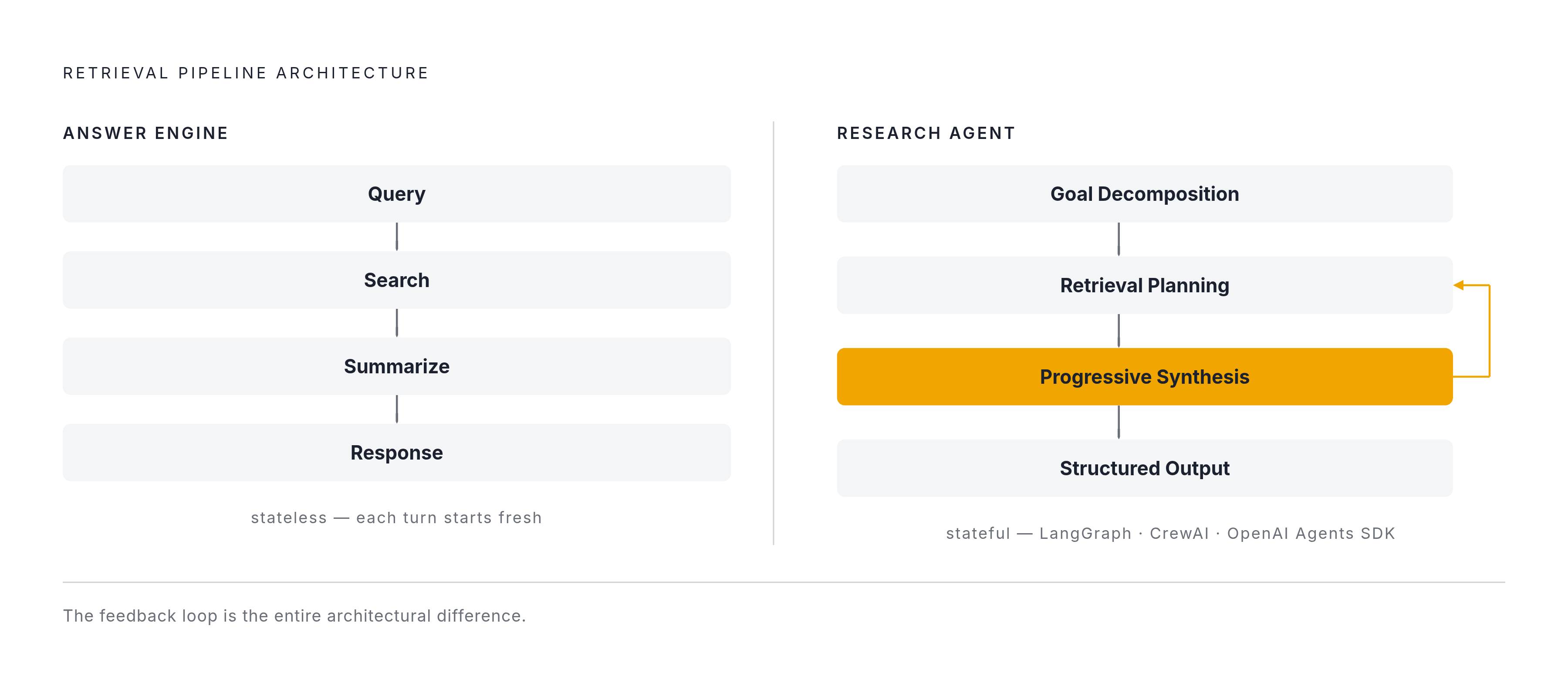
An answer engine pipeline is shallow by design. Like a fishing line dropped once into a lake. Query goes in, the engine searches, grabs the top results, summarizes them, and returns a response. Fast. Clean. Done. If you want to go deeper, you ask again. The system doesn't take what it just found and use that to decide where to look next. That's a deliberate tradeoff for speed, not a design flaw.
A research agent pipeline works in stages:
- Goal decomposition. The agent takes a broad objective and breaks it into a sequence of sub-questions it needs to answer before it can make real progress.
- Retrieval planning. It decides which tools to call and in what order. Search APIs, scrapers, crawlers. It sequences them based on what it actually needs.
- Progressive synthesis. Findings from each step update an internal working state. What the agent learns in step two shapes where it looks in step three.
- Structured output. At the end, it assembles a real artifact. A report, a comparison table, a timeline. Not a conversational reply.
What makes this possible is the orchestration layer. Frameworks like LangGraph, CrewAI, and the OpenAI Agents SDK give agents the ability to hold state across tool calls. Answer engines typically don't have this layer at all. They're stateless by design. Each turn starts fresh.
Memory is where the architectural gap really shows. A research agent maintains a running picture of what it's found and what it still needs to find. An answer engine treats each turn as a brand new question. Neither is wrong. They're just solving different problems.
Token consumption reflects this split pretty clearly. A multi-stage agentic pipeline can burn an order of magnitude more tokens than a single prompt, because reasoning and retrieval are interleaved at every step. That hits cost. It hits latency. And if you're deciding what to build, you need to account for it upfront. Not after your first production bill arrives.
What Each Architecture Demands from Web Data Infrastructure
Answer engines need two things above everything else: speed and freshness. A low-latency search API returning clean, structured content is the bottleneck. Raw HTML is a liability. If the engine has to wade through navigation menus, ad scripts, and boilerplate before it gets to the actual content, that noise fills up the context window and degrades the response.
Research agents need something different. Depth. Coverage. They have to crawl full pages, follow links, re-query with refined terms, and pull content from many sources in a single session. The infrastructure requirements are just bigger.
Format matters for both, but for different reasons. For an answer engine, noise in one fetched page wastes context window. For a research agent, noise compounds across dozens or hundreds of sources, and a small error rate per page becomes a real distortion in the final output.
Markdown has become the practical standard for LLM consumption. Lightweight like plain text. Structured enough to preserve heading hierarchy and code blocks. It reduces token waste compared to raw HTML and gives the model enough scaffolding to reason with. For structured data like prices, dates, and entity attributes, JSON output from an extraction layer beats prose every time.
Freshness applies to both architectures, but it's existential for agents. Research agents get deployed specifically for questions where current information matters. A static knowledge base answers yesterday's question.
Scale asymmetry is the other big difference. An answer engine makes a handful of retrievals per query. A research agent doing deep analysis can make dozens to hundreds. That turns reliability and cost-per-request from a minor operational detail into something that compounds fast.
The Five Infrastructure Failure Modes That Break Agentic Pipelines in Production
Demos hide the hard parts. A research agent prototype can look spectacular in a controlled test and fall apart completely in production. The failure modes are predictable. They're just invisible until you're actually at scale.
HTML overload. Modern pages can contain enormous token counts as raw HTML. Navigation, ads, scripts, boilerplate. All of it lands in the context window. An answer engine feels this occasionally. A research agent feels it at every step of every session.
Access friction. Bot detection infrastructure (CAPTCHAs, JavaScript challenges, geo-blocking) interrupts retrieval mid-pipeline. A failed fetch at step three of a ten-step agent run can corrupt the entire synthesis. The agent keeps going, now working with a gap in its evidence base that it doesn't know about.
Selector brittleness. CSS selectors and XPath queries break silently when sites update their layouts. An agent relying on traditional scraping returns empty or malformed data without raising an obvious error. The LLM downstream fills in the gap however it can. That's how you get output that looks like hallucination but is actually a retrieval failure. Two very different problems with nearly identical symptoms.
Scraper debt. Teams that maintain brittle extraction scripts spend engineering time on upkeep instead of agent logic. The infrastructure absorbs the capacity that should go to the product. This one is an organizational failure mode, not a technical one. It's just as damaging, and it's a lot harder to spot on a roadmap.
Cost compounding. When an agent makes many retrievals to answer one question, the difference between a fast, cost-efficient data API and a slow one multiplies across every session. A recurring tax on every run, not a one-off.
Self-healing extraction, where LLM-based extractors interpret meaning across markup variations, is a partial answer to selector brittleness. If a price appears in a span, a div, or nearby prose, a schema-driven extractor can map it to the same field regardless. It adds latency and model cost. But it reduces silent failures, and silent failures are almost always the worse tradeoff.
The Tooling Ecosystem That Has Grown Up Around Each Paradigm
The reason a distinct category of LLM-optimized web data APIs exists at all is that existing crawlers were built for humans. Markdown output, token efficiency, and structured extraction weren't part of the original design. They became first-class API features because teams got tired of building preprocessing pipelines that existed solely to strip HTML tags.
Tools oriented toward answer-engine use cases:
- Exa. A neural search API that returns clean content alongside results. Well-suited to RAG pipelines where you need fast, focused retrieval.
- Tavily. A search API designed specifically for LLM and RAG consumption, optimized for structured, low-noise output that models can use directly.
- Linkup. A search API with an emphasis on verified, high-quality sources.
Tools built for deeper crawling and agentic use cases:
- Firecrawl. Popularized the "web scraping for LLMs" category. Offers an agent endpoint that accepts a research prompt and autonomously browses multiple sources, and an interact endpoint for session-persistent browsing. Deep integrations with LangChain, LlamaIndex, and CrewAI make it a common starting point for teams already in those ecosystems.
- Crawl4AI. A local-first Python crawler that outputs clean markdown without external API calls. Popular with teams building RAG pipelines on their own infrastructure, where keeping data in-house matters.
- Bright Data. A large proxy network with pre-built site-specific APIs. Useful for teams that need to get through access friction at scale.
MCP wrappers are becoming a common integration pattern across this ecosystem. Several tools now offer MCP-compatible wrappers that let agents call scrape, crawl, and extract endpoints through a standardized interface. That lowers the barrier to connecting any orchestration framework to web data without custom glue code.
One pricing detail worth actually paying attention to: token-based pricing means your cost depends on content complexity you can't fully control. Per-page or credit-based pricing is easier to budget. For research agents making many retrievals per session, predictable per-request pricing is a real operational constraint. Not just a finance team concern.
Where Each System Genuinely Outperforms the Other
Answer engines win on:
- Speed
- Conversational iteration
- Low cost per query
- Accessibility for non-technical users
- Tasks where a well-sourced paragraph is the right output
Research agents win on:
- Breadth of source coverage
- Following citation trails across documents
- Cross-referencing findings from many sources
- Identifying contradictions across a body of evidence
- Producing structured artifacts (reports, comparison tables, timelines) that require assembling information rather than summarizing it
Worth naming plainly: research agents have a real ceiling. They're good at mechanical research. Searching, screening, extracting, drafting. But interpreting findings in context, identifying genuinely novel insights, designing the right research questions in the first place, and making methodological judgment calls. Those still require a human. Research agents are not replacing researchers. They're handling the parts of research that are time-consuming precisely because they're tedious.
A practical task-fit heuristic:
- Use an answer engine when the question has a retrievable answer and you'll refine it conversationally.
- Use a research agent when the objective requires synthesizing many sources, when you can't predict which sources will matter, or when the output is a structured artifact rather than a reply.
Hybrid deployments are becoming common. An answer engine handles day-to-day queries. A research agent runs for periodic deep-analysis tasks. The infrastructure underneath both needs to handle both retrieval patterns reliably, which is one reason teams are pushing toward unified data layers rather than maintaining separate tools for each use case.
As answer engines add multi-step research modes and research agents add conversational interfaces, the product category labels are getting less useful. The architectural differences still matter. The names matter less.
What Building for Either Paradigm Requires from Your Data Layer
The shared requirement underneath both is clean, structured, fresh web content delivered reliably. That sounds obvious right up until retrieval failures start corrupting synthesis and infrastructure costs start compounding across every agent session.
For answer-engine pipelines: optimize for latency and content cleanliness. A search API that returns LLM-ready markdown directly cuts out a preprocessing step that would otherwise eat context window and engineering time.
For research-agent pipelines: optimize for coverage, reliability at scale, and structured extraction. The ability to crawl full pages, handle access challenges without intervention, and return consistent output format across heterogeneous sites is what separates a working agent from a fragile one.
Monitoring deserves to be treated as a first-class concern for agents. Not something you add after the first mysterious failure. When a pipeline runs autonomously on a schedule (daily competitor tracking, continuous market monitoring), silent retrieval failures are worse than loud ones. Loud failures are fixable. Silent ones accumulate into wrong answers that look right, and by the time you notice, you've already made decisions based on them.
The operational overhead of maintaining separate tools for search, scraping, crawling, and monitoring multiplies as agent complexity grows. A single API that handles all retrieval modes reduces integration surface area and gives both humans and autonomous agents a consistent interface to the web.
The data infrastructure underneath autonomous web research needs to be treated as seriously as any other production dependency. Not bolted on after the model work is done. A prototype-grade solution running in production because nobody got around to replacing it will cost you. The failure modes in this piece are predictable. The teams that get burned by them aren't unlucky. They just made the infrastructure decision too late.