Agentic Design Patterns for Web Research Workflows
How agentic design patterns behave differently when tools call live web data.

Web research is the leading production use case for AI agents right now, and most of the failures happening in the real world are not the model's fault. The LLM is reasoning fine. The architecture around it is the problem. When the primary tool your agent is calling is a live web endpoint (a search API, a scraper, a crawler), every design decision you made upstream either holds up or falls apart in ways that are genuinely painful to debug.
The canonical agentic design patterns (ReAct, Reflection, Tool Use, Planning, Multi-Agent Orchestration) all behave differently when the tool being called is the live web. Sources change. Pages block access. Results arrive in inconsistent formats. Multi-hop questions require chained tool calls that compound every earlier mistake. Choosing a pattern for a web research workflow is not a stylistic preference. It determines whether your agent retrieves accurate, grounded information or collapses into hallucination and retry loops.
Here is what each pattern actually costs you, and what it earns you, when the tool is live web data.
What "Agentic Design Patterns" Actually Means Before You Apply Them to Web Data
Patterns are not frameworks or libraries. They are recurring architectural decisions about how a model reasons, acts, checks itself, and delegates work. Think of them as blueprints, not code.
The canonical set as of 2026 includes:
- ReAct (interleaved reasoning and action)
- Reflection (self-critique and revision)
- Tool Use (calling external systems)
- Plan-and-Execute (front-loaded planning, then execution)
- Multi-Agent Collaboration (splitting work across specialized agents)
- Sequential Workflows (fixed-order pipelines)
- Human-in-the-Loop (escalating to a person at defined checkpoints)
Each one carries a distinct cost, accuracy, and latency profile. Picking one is a foundational decision with consequences that ripple through every other part of your system.
Here is the part most tutorials skip: these patterns are composable. A mature web research agent typically layers Tool Use inside ReAct inside a Planning shell, with Reflection running as a quality gate on top of all of it. So the question is less "which pattern should I use?" and more "how do these nest together, and what breaks when one layer misbehaves?"
This piece will not benchmark models or review frameworks in the abstract. Every pattern discussed below gets interrogated for its specific behavior when the tool being called is a search, scrape, or crawl endpoint. That is the only context that matters here.
How ReAct Behaves Differently When Each Action Is a Live Web Call
ReAct's core mechanic is simple on paper: interleave Thought, Action, and Observation in a tight loop. Each observation informs the next thought before the agent acts again. In tutorial examples, the action is usually a fast, deterministic call (a calculator, a database lookup) and the loop is cheap.
When the action is a live web call, three things change immediately.
Latency compounds. Each Observation step now costs real wall-clock time. Across a multi-step research loop, this adds up fast. A ten-step ReAct loop where each web call takes three seconds is already thirty seconds of execution time, and that is before you account for any failures.
Variability breaks assumptions. A scraped page or a SERP result is not deterministic. The same query on different days returns different content. That inconsistency can send the model's reasoning in an entirely different direction on a retry, which makes debugging maddening.
Failure modes get weird. The tool can return a bot-blocked page, a paywall, or a redirect. ReAct's default behavior is to pass whatever the tool returns directly into the model's next Thought. If that thing is an error page or a login wall, the model will try to reason over it anyway, and the results are not pretty.
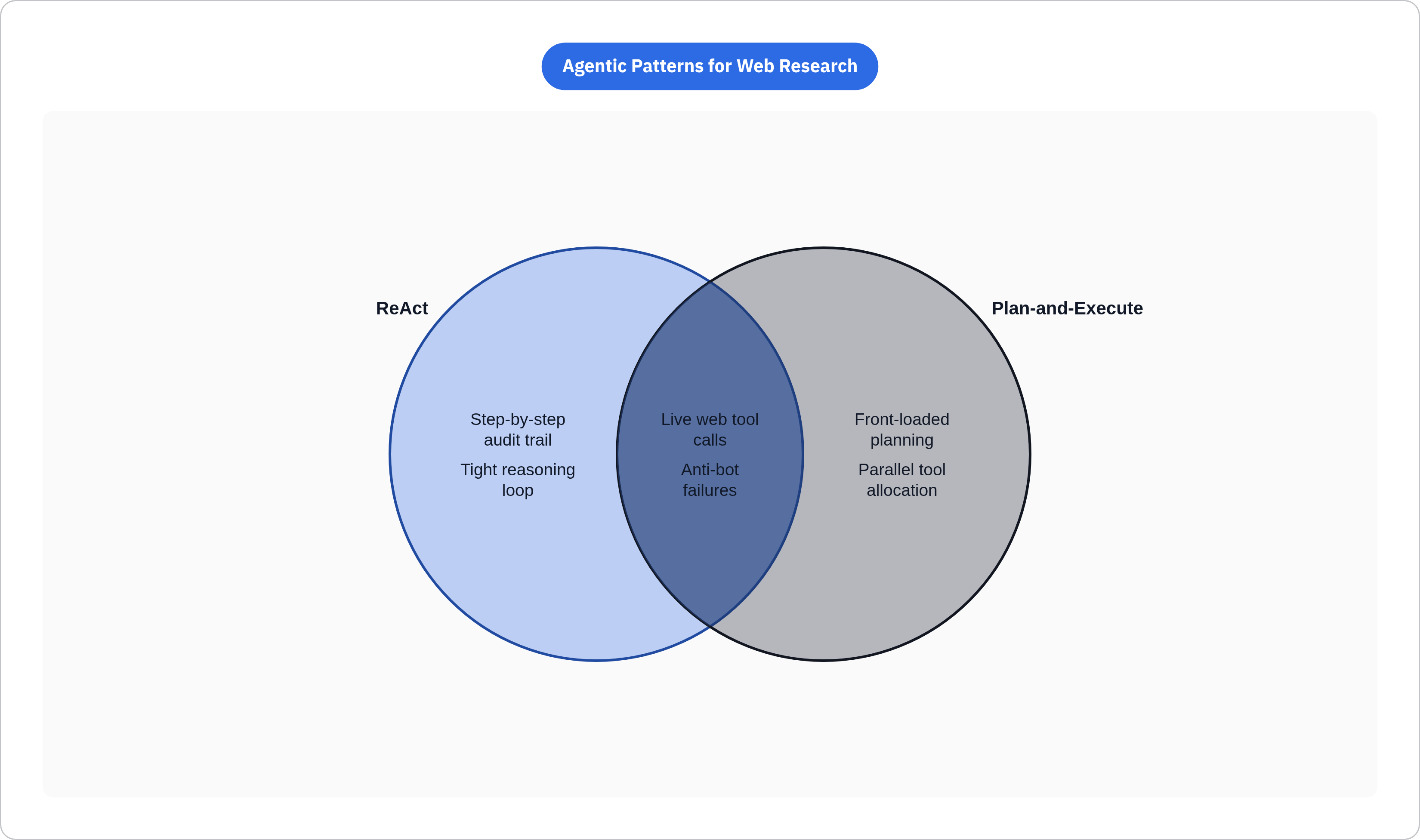
ReAct's genuine strength in web research is auditability. Every Thought-Action-Observation triple is logged. A failed research run can be diagnosed step by step, which is more than you can say for a black-box pipeline.
The practical design fix: pair ReAct with a tool layer that normalizes output. The model's Thought step should reason over clean markdown or structured JSON, not raw HTML. An agent that spends cognitive budget parsing markup instead of understanding content is wasting its best resource.
Research benchmarks consistently show that systems built around iterative retrieval (search, reason, search again) outperform systems using basic keyword search on complex multi-hop questions. That is exactly the structure ReAct enables, but only when the tool layer is fast and reliable enough not to turn every loop iteration into a coin flip.
Where Plan-and-Execute Earns Its Place in Multi-Source Research Tasks
Plan-and-Execute separates the thinking from the doing. Generate a complete research plan first. Execute each step. Trigger replanning only when something fails. That separation sounds obvious, but it matters a lot when the task has known structure upfront.
"Compare pricing across six competitor sites" is a Plan-and-Execute task. "Extract earnings data from ten company pages" is a Plan-and-Execute task. You know the shape of the work before you start. The plan can allocate the right tool to each step before any web calls are made.
A typical plan for a structured research task might look like this:
- Step 1: Search API call to discover the target URLs
- Steps 2 through N: Scrape calls against those URLs for the specific data fields
- Final step: Synthesis pass to combine findings, possibly with a crawl to follow links found in the initial pages
There is also a real cost lever here. Smaller, cheaper models can handle execution steps once the plan is set. The expensive reasoning model only runs at planning time and at replanning triggers. For research workflows running at scale, that cost difference is meaningful.
The risk specific to web research: plans go stale. A URL that existed when the plan was generated may 404 by the time execution reaches it. A page may have changed its structure. Replanning logic needs to distinguish between "the tool failed" and "the plan is obsolete," because those two problems require completely different responses.
When should you not use Plan-and-Execute? Open-ended research questions where the next source to check depends entirely on what the previous source revealed. That kind of reactive, evidence-driven exploration is where ReAct's tight loop handles things better than a front-loaded plan that cannot anticipate what it does not yet know.
Tool Use as an Architecture Decision, Not Just an API Call
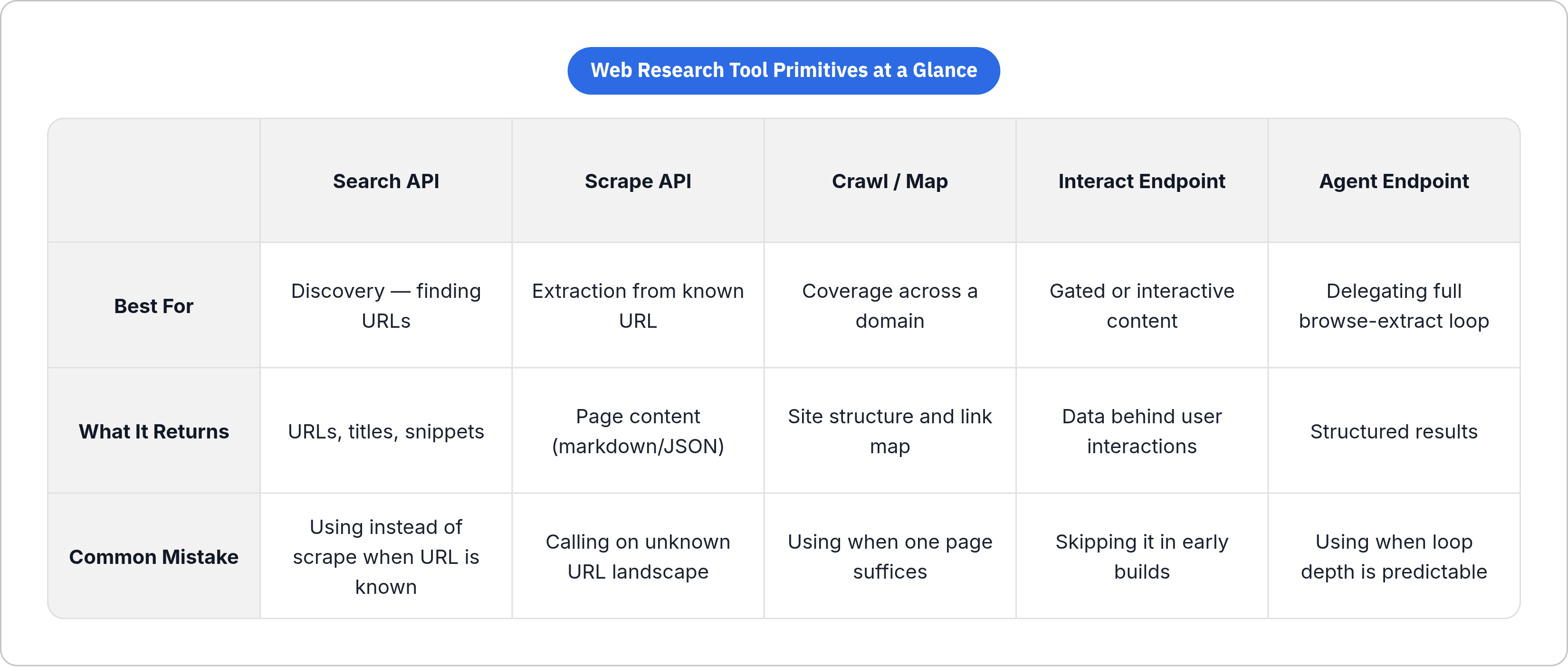
In web research, Tool Use is not a single tool. It is a toolkit with distinct primitives that serve different moments in a research loop. Treating them as interchangeable is one of the most common architectural mistakes I see.
Here is the core web research tool stack and what each primitive actually does:
- Search API: Best for discovery. Returns URLs, titles, and snippets. Tells the agent where to look next, not what a page actually says.
- Scrape API: Best for extraction. Takes a known URL and returns the page's content in a format the model can reason over.
- Crawl / map: Best for coverage. Follows links from a root URL to build a picture of a site's structure. Use this when the agent does not know which sub-page holds the target data.
- Interact endpoint: Best for gated content. Maintains a browser session across multiple actions (clicking, form submission, pagination) to reach data that only appears after user interaction.
- Agent endpoint: Delegates the entire browse-search-extract loop to a managed layer and returns structured results. Useful when the research prompt is well-defined and the loop depth is unpredictable.
Most of the web data that actually matters sits behind something. A login. A "Load More" button. A search form that requires a submitted query before any results appear. That makes the interact primitive disproportionately important for real-world research tasks, even though it is the most commonly skipped in early agent builds.
Tool selection logic should be explicit in the planning step, not left to the model to improvise. An agent that defaults to a search call when a scrape call would suffice wastes latency and budget on every loop iteration. That waste compounds.
One practical point worth making: a unified API that surfaces search, scrape, crawl, and interact under one interface removes a whole class of integration failures. When those primitives come from different vendors, output format inconsistencies between them become a hidden reasoning tax on the model. It has to adapt to different schemas mid-loop, and that friction shows up in output quality.
How Reflection Changes When the Thing Being Verified Is a Live Web Claim
Standard Reflection framing: the agent critiques its own output, identifies gaps or errors, and revises. That loop produces real accuracy gains on coding benchmarks, where you can check output against a deterministic test.
In web research, Reflection has a second job that does not exist in code generation: verifying that the retrieved source actually says what the agent thinks it says.
Two distinct reflection tasks show up in a web research agent:
Content reflection. Does the scraped content actually support the claim the model extracted from it? This is a hallucination check against the source material, not against the model's training data. An agent can hallucinate about a page it just retrieved.
Coverage reflection. Are there sources the agent has not checked that might contradict or qualify what it found? The agent may have retrieved accurate information from one source and missed a more authoritative source that says something different.
There is also a third layer worth thinking about: infrastructure-level reflection. Self-healing scrapers are a real example of this. When a page's structure changes, the system detects the mismatch between what it expected and what it received, then re-maps its extraction logic. The human role shifts from fixing broken selectors to validating data quality. That is a meaningful shift in where your time goes.
The design implication: Reflection in web research agents should be triggered not just on model uncertainty but on retrieval signals. A page that returns a bot block, a redirect, or a schema that does not match the expected structure should fire a reflection pass before that content ever reaches the model's reasoning context. Do not let garbage into the reasoning loop and then ask the model to figure out that the garbage is garbage.
When Multi-Agent Orchestration Makes Sense for Web Research and When It Just Adds Overhead
Multi-agent systems split research work across specialized agents: a planner, one or more researcher agents, a synthesis agent, and optionally a verification agent. The coordination overhead is real, and it is not always worth paying.
Here are the legitimate reasons to split into multiple agents for web research:
Parallelism. Simultaneous scrape calls across many URLs. Sequential execution across fifty pages is architecturally different from running ten agents in parallel against five URLs each.
Specialization. One agent handles authenticated sessions for paywalled sources. Another handles open-web search. Keeping session management isolated to the agent that needs it avoids a class of state management bugs.
Scale. Crawling an entire domain while simultaneously extracting data from already-discovered pages. One agent feeds the other.
Now here are the reasons multi-agent adds overhead without proportional benefit:
Inter-agent communication cost. Passing scraped content between agents introduces serialization, context window management, and handoff latency. None of that is free.
Coordination failures. If the orchestrator loses track of which URLs have been visited, agents duplicate work or produce conflicting findings that the synthesis step has no way to resolve cleanly.
Debugging difficulty. A failure in a multi-agent web research system is significantly harder to trace than a failed ReAct loop. The audit trail spans multiple agents running concurrently.
A useful heuristic: if the research task can be parallelized across URLs but the synthesis step is singular, multi-agent is probably worth it. If the research is inherently sequential (each source depends on what the previous source revealed), a single ReAct or Plan-and-Execute agent is simpler and more reliable.
One more wrinkle specific to web research: concurrent scrape requests from multiple agents hitting the same domain are more likely to trigger rate limiting or IP blocks than sequential requests from a single agent with managed proxy rotation. The anti-bot environment does not care about your architecture diagram.
What the Anti-Bot Environment Means for Every Pattern's Reliability Assumptions
Every agentic pattern assumes that when a tool is called, it returns useful output. Web research is the domain where that assumption fails most often, and it is failing more frequently as time goes on.
AI training crawler traffic grew substantially through mid-2025, then growth flattened sharply as major platforms deployed anti-scraping measures. Cloudflare now enforces AI bot restrictions by default. Major publishers have adopted machine access policies that treat automated retrieval differently from human browsing. The supply side is actively contracting while demand grows.
Here is what that means for each pattern specifically:
ReAct: A bot-blocked Observation poisons the next Thought. The model may hallucinate content or abandon a valid research direction based on a retrieval failure, not an actual knowledge gap. The agent cannot tell the difference unless the tool layer explicitly signals the failure type.
Plan-and-Execute: A URL that existed at plan time may be inaccessible at execution time. Replanning logic needs explicit handling for access failures, not just 404s. "I could not reach this page" and "this page does not exist" require different responses.
Reflection: A reflection pass that re-fetches a source for verification may hit a different block state than the original fetch. Freshness and accessibility are not guaranteed to be stable across calls to the same URL.
Multi-agent: Concurrent requests from multiple agents to the same domain are more likely to trigger blocks than a single managed session. Scale works against you here.
The practical design responses are proxy rotation, managed browser sessions, and backoff-and-retry with jitter built into the tool layer. These should be infrastructure concerns, completely invisible to the reasoning loop. The agent should not be writing retry logic. If it is, the tool layer is not doing its job.
This is where platform choice becomes a pattern-level decision. A tool that handles anti-bot bypass at the infrastructure level changes the reliability calculus for every pattern sitting above it in the stack. That is not a small thing.
Choosing the Right Tool Infrastructure for the Pattern You Are Running
The pattern you choose should drive tool selection. Not the other way around. A ReAct loop optimized for speed needs different infrastructure than a Plan-and-Execute system optimized for coverage.
Four dimensions worth evaluating against any web data tool:
Output format. Does it return clean markdown, structured JSON, or raw HTML? Agents need the former to reason without a parsing step. Raw HTML is a reasoning tax.
Latency profile. Predictable or variable? Latency that compounds across a ten-step agent loop is architecturally different from a one-off scrape. Variance matters as much as average speed.
Anti-bot handling. Is bypass managed at the platform level, or does the agent need to handle it? Platform-level handling is almost always the right answer.
Primitive coverage. Does it offer search, scrape, crawl, and interact under one interface? Stitching together multiple vendors creates format inconsistencies that become hidden reasoning costs.
A few tools worth knowing:
Firecrawl is widely adopted across AI developer teams and has deep integrations with LangChain, LlamaIndex, and CrewAI, which makes it a common default for teams already in those ecosystems. It is worth noting that anti-bot bypass is not included by default, which matters specifically for patterns that retry against protected domains.
Tavily is LLM-native search that returns summarized, answer-ready results rather than raw page content. It fits well into ReAct loops where the agent needs fast, pre-digested context. It is less appropriate when the agent needs full source fidelity for Reflection passes, since summarized output loses the detail a content reflection check needs.
Brave Search API runs an independent index not reliant on Google or Bing infrastructure. That is useful when you want diversity of results or need to avoid a third-party dependency. It is best positioned as the search primitive in a search-then-scrape pipeline rather than a standalone solution.
Firecrawl's MCP integration deserves a separate mention for teams building with Claude or other MCP-compatible models. The ability to call search, scrape, and crawl through a single standardized interface without managing format translation between primitives removes a meaningful layer of integration complexity.
The honest summary: no single tool wins across every pattern. A ReAct-heavy research agent that needs speed and pre-digested context will weight Tavily differently than a Plan-and-Execute agent running coverage-oriented crawls across dozens of URLs. Match the tool's strengths to the pattern's demands, and build anti-bot handling into the infrastructure layer so none of your patterns have to think about it.
The agents that work reliably in production are not the ones running the most sophisticated models. They are the ones where someone made deliberate architectural decisions about how each pattern behaves under real web conditions, and then built infrastructure that makes those assumptions hold.