Crawl Budget Management and Prioritization
Managing crawl budget by prioritizing high-value pages over waste saves indexation at scale.

Crawl budget is a finite resource with real limits. It's made of two things: how many pages a crawler wants to fetch (demand) and how fast it's willing to hit your server without knocking it over (rate). Multiply those together and you get your actual budget, and a site can have massive demand and still get throttled by a slow server. Most teams never think about this until pages stop showing up in search, and by then the fix is a lot more work than it needed to be.
The budget gets handed out per hostname, not per folder, which matters more than people assume when they're planning site structure. Google's own Search Central documentation, updated in December 2025, flatly says the web "exceeds Google's ability to explore and index every available URL," which is just a formal way of saying there's more internet than there is time to crawl it.
Here's the part that saves a lot of teams from wasted anxiety though: this only bites hard at scale. Gary Illyes said in 2025 that crawl budget becomes a real bottleneck around one million pages updated weekly, or ten thousand pages changing daily. Below that, John Mueller has called crawl budget "overrated," and he's right to. If you run a fifty-page site and wonder why page forty isn't indexed, the answer almost never lives here. Where it does matter: big e-commerce with faceted navigation, portals full of parameter-heavy URLs, sites that have been through a migration or two, and news operations publishing at a sprint pace all day long.
How crawlers decide which pages deserve the most attention
Crawlers don't fetch pages at random, and the scoring they run on each one relies on signals that are mostly computable and mostly boring, in the way that anything effective usually is.
Domain authority sets the baseline; sites with more inbound trust get bigger budgets, and internal links concentrate that trust on whatever they point to. Server speed matters a lot too, with a sub-400ms response time serving as a good practical bar to aim for, because a slow server tells the crawler to back off before it's even looked at your content. Freshness signals demand: pages that update often get revisited often, and crawl history builds or burns trust over time, since a page that keeps throwing errors slides down the list fast.
Illyes laid out the actual priority order in 2025: server speed first, content quality second, URL volume third. That ordering should change how teams spend their time. Chasing volume before fixing your server response times is like buying a bigger garage before you've fixed the car that won't start.
It helps to think in tiers instead of treating every URL as equally deserving:
- Tier 1: revenue pages, flagship products, top categories, high-demand guides, breaking news, key location pages. These should eat most of your crawl budget.
- Tier 2: long-tail products, supporting articles, evergreen reference content. Worth crawling, but fine waiting for the next pass.
- Everything else: pages that exist but generate zero search value, and quietly eat budget that Tier 1 needs.
Sitemaps function as a signal, not a command. Googlebot uses them to find URLs and compare freshness hints, but it still makes its own call based on the signals above. Treating a sitemap submission as a guarantee of crawling is one of the most common misunderstandings in SEO, and it's an expensive one to hold onto. And since May 2025, Google runs what practitioners call dynamic crawl budgeting, where your allocation can shift based on how your site is currently performing rather than staying fixed as a grant you get once.
Where crawl waste comes from and how it compounds on large sites
Crawl waste happens whenever a crawler spends part of its budget fetching a URL that adds nothing to indexation quality, so the budget gets spent while nothing useful comes back. That waste compounds. On a large site, a Tier 1 product page going weeks without a recrawl is often explained simply: the crawler burned its allocation on URLs that never should have existed in the first place.
Faceted navigation is the biggest offender by far. A shoe category with filters for size, color, brand, and price can mathematically generate thousands of distinct URLs from a handful of filter options, each one technically unique, each one worthless on its own. Session ID URLs do the same thing with query strings, tricking the crawler into treating identical pages as different ones. Add in thin tag pages, empty search results, auto-generated archive pages, near-duplicate color and size variants, and redirect chains where every hop burns a bit of budget before the crawler even reaches the real destination, and you've got a server serving mostly noise.
None of this shows up in a normal analytics dashboard. It lives in server logs and crawl stats, which is exactly why most teams miss it.
The fixes, roughly in order of how aggressive they are:
- Canonical tags consolidate near-duplicates into one preferred URL without deleting anything.
- Robots.txt disallow rules stop crawlers from ever requesting whole parameter patterns or directories.
- 301 redirects retire dead weight and route its equity somewhere useful.
- Noindex tags tell Google not to index a page, but the crawler still has to fetch the page to read that instruction, so it's a partial fix at best, not a budget recovery.
Google's own December 2025 documentation names two real levers for expanding your budget: fix server errors that cause hostload problems, and improve content quality so more of your pages look worth repeated visits.
Reading crawl data to find and fix priority problems
The question worth asking on a recurring basis is simple: is Googlebot spending its time where you want it to?
Server logs are the ground truth here. They show exactly which URLs got fetched, when, and how often, and no dashboard tool fully replaces that at scale. Google Search Console's Crawl Stats report gives you a faster, shallower view: total requests, response codes, file types. It's good for catching a sudden spike or drop before you go digging through raw logs.
A sane cadence looks something like this. Some teams also pipe their crawl monitoring through a large-scale crawling API that handles the browser and proxy infrastructure so the audit tooling itself doesn't become the bottleneck. Check Crawl Stats weekly for anything that jumps or drops unexpectedly, since a sudden dip usually means a server hiccup or an accidental robots.txt block. Run a full crawl monthly with a tool like Screaming Frog or Sitebulb to catch new redirect chains and orphan pages before they pile up. Dig into the raw server logs quarterly to confirm Googlebot is actually reaching your Tier 1 pages as often as it should, and any time you do a migration, template overhaul, or URL restructuring, audit immediately, because that's when budget problems show up fastest.
What you're looking for in the logs: heavy crawl traffic on thin or duplicate pages (waste), little or no traffic on revenue pages (a priority failure), a pile of 404s or 5xx errors getting fetched (a health problem eating your budget), and parameter URLs showing up in bulk (usually faceted nav or tracking tags gone rogue).
Since Google's budget can now shift daily, a single audit a year isn't enough anymore, which means the schedule matters as much as the tooling.
How the explosion of AI crawlers has changed the server-side calculus
The old mental model, Googlebot versus your server capacity, doesn't describe what's actually hitting most servers anymore.
Imperva's Bad Bot Report for 2026 found automated traffic made up 53% of all web traffic in 2025, up from 51% the year before, which means most of what's hitting your server isn't a person. Cloudflare's Year in Review for 2025 broke that down further: as of December 2025, 44% of HTML requests came from non-AI bots, with roughly 9% coming from AI bots and Googlebot combined. That's a smaller slice, but the growth rate is nothing like the older bot category ever produced.
The numbers on that growth are steep. GPTBot's raw request volume grew 147% between July 2024 and July 2025, and Meta-External Agent grew 843% over the same window. TollBit's Q3 and Q4 2025 State of the Bots report counted one AI bot visit for every 31 human visits by the end of 2025.
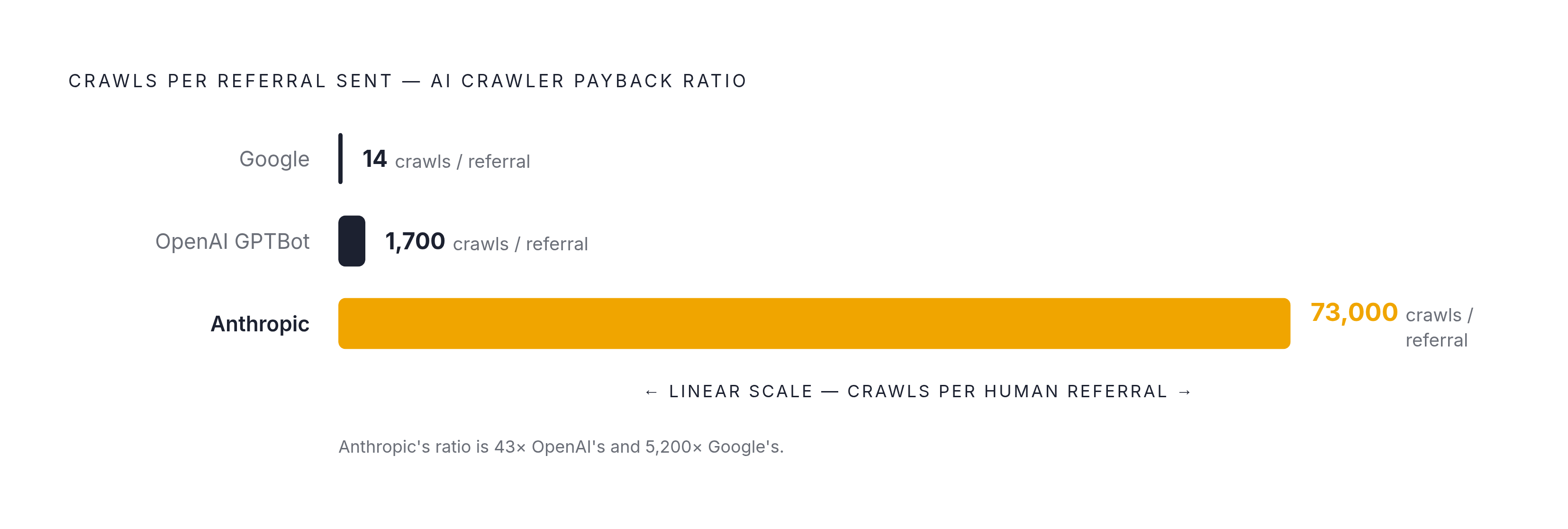
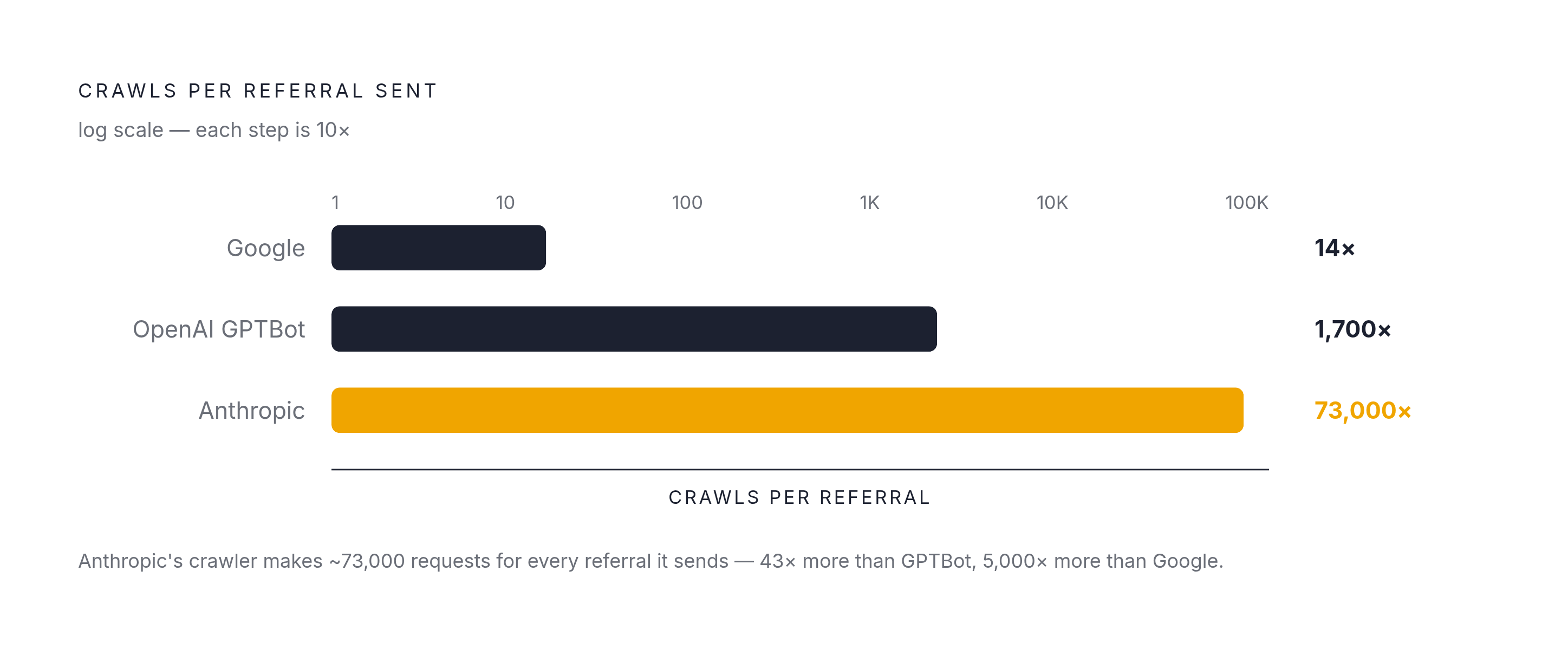
The real problem is the exchange rate. Cloudflare data from mid-2025 put Google's crawl-to-referral ratio at around 14 crawls per human visit sent back to the site. OpenAI's crawler came in at roughly 1,700 crawls per referral, and Anthropic's crawler hit about 73,000 to one, meaning content gets consumed at massive scale while almost nothing comes back in return traffic.
Infrastructure providers noticed. Cloudflare, which routes more than 16% of global internet traffic, started blocking AI crawlers by default in July 2025, the first time a major infrastructure provider treated non-human access as something you opt into rather than something you get by default. Between July 2025 and January 2026, the number of sites actively blocking AI crawlers ran nearly seven times higher than the number blocking traditional search crawlers, marking a rewrite of the rules.
For anyone managing crawl budget, this means the old playbook (size your server for Googlebot, write your robots.txt for Googlebot) doesn't cover the territory anymore. Every crawler now has its own rate behavior, its own relationship with robots.txt (some respect it, some don't bother), and its own wildly different payback rate.
What developers building crawlers and data pipelines need from the web at scale
Everything above applies in reverse too. If you're the one building a crawler, you're now managing rate, priority, and waste on your own infrastructure, not Google's, and the stakes are just as real.
The core problem at scale is that raw HTML poisons the context window for an LLM and inflates token costs for no reason. Navigation bars, footers, and ad markup bury the actual content that needs to get chunked and embedded, and you end up paying to process garbage.
Format choice matters more than it sounds like it should. Markdown is the sweet spot for most LLM pipelines, since it's light and keeps heading structure intact, which matters a lot during the chunking step of a RAG pipeline. A trimmed-down version sometimes called "fit markdown," which strips out navigation and sidebars and leaves just the real content, is the right default when token cost is the thing keeping you up at night, though it gets shakier on pages with unusual layouts. JSON is the right call when you already know the schema you're extracting into. Raw HTML carries the most risk as a primary input; only accept it if you know it's getting cleaned before any model touches it.
Selector strategy should match the source. CSS or XPath selectors are fast, cheap, and predictable, and they're the right tool for structured, consistent sources like government data portals or Wikipedia. LLM-based extraction, using a schema plus a plain-language instruction, is what you reach for on chaotic, freeform pages where selectors keep breaking, but it costs more per page, sometimes a lot more.
The infrastructure bill has gone up across the board. Industry reporting has found more than 60% of scraping professionals saw their infrastructure costs rise year over year, and pointed to increasingly adaptive anti-bot defenses as a growing obstacle, with the barrier to running high-volume crawling getting noticeably higher as a result. Rate limits often bite before your infrastructure does: at roughly two LLM calls per page for extraction and validation, processing any real volume inside an hour can hit an API rate ceiling well before your servers even break a sweat, and token costs scale linearly with page count, with no bulk discount waiting for you around the corner.
There's also a case for consolidating tooling instead of stitching together five different services. A JavaScript renderer, a proxy pool, a content cleaner, and a storage layer each represent a separate point where things can break, and every seam is one more place your crawl priority logic can quietly stop working.
Enforcing crawl priority programmatically rather than hoping crawlers honor it
At the end of the day, crawl budget is a resource allocation problem, and the goal is control you can guarantee, distinct from behavior you're hoping a crawler chooses to respect.
Robots.txt is the fastest lever you have. Disallow rules stop a crawler from ever requesting a waste URL, which recovers budget at the server level before any content even gets served. Segmenting your sitemaps, so Tier 1 pages live in their own sitemap with accurate lastmod timestamps, gives crawlers a clean signal about where the freshest content actually is. Internal link structure matters just as much: crawl budget follows links, so an orphan page with zero internal links gets almost no attention no matter how good the content is, and fixing orphan pages is a structural fix to how budget actually flows, not cosmetic SEO housekeeping.
For teams running their own crawlers, setting a crawl delay per domain and per path keeps you from tripping anti-bot defenses that could shut down your whole pipeline in one shot. And for monitoring use cases, triggering a targeted recrawl the moment a change is detected beats running a broad scheduled crawl every time, since it's the pattern behind most competitive intelligence and change-monitoring tools.
Internally, batching and priority queues are your version of Google's crawl demand signal. Queue by expected value, revenue impact, freshness need, change frequency, not by whatever order the URLs happened to get discovered in.
MCP (Model Context Protocol), introduced by Anthropic in November 2024 and now a vendor-neutral standard under the Linux Foundation, points toward a different shape entirely: AI agents calling crawling and search tools on demand, instead of pre-crawling the whole internet speculatively and hoping something useful turns up. That shifts the whole model from broad periodic sweeps to something a lot more targeted, and probably a lot less wasteful.