Human-in-the-Loop Checkpoints for Research Agents
Four tiers of action gates keep research agents fast while catching mistakes before they spread.

Research agents in 2026 run multi-step tasks at machine speed, and those tasks produce real-world consequences: a report gets filed, a record gets updated, a message goes out the door. Speed is the whole appeal of these systems, and it's also the structural risk, not some edge case you'll run into once in a blue moon. The trouble is that errors compound across the chain: a wrong extraction at step three quietly reshapes the context for step four, which then feeds bad data into step five, and by the time anyone notices, the root cause is buried under three layers of downstream work. Layered on top of that is a calibration problem. Models trained with RLHF tend to sound confident whether they're right or wrong, so a high-confidence score tells a reviewer almost nothing about whether a human needs to look. Run that miscalibration through a three-agent chain, where each agent's real accuracy trails its claimed confidence by something like fifteen percentage points, and the odds that all three steps land correctly fall off a cliff compared to what you'd get just multiplying the claimed scores together. A bad write, a citation invented out of thin air, a decision triggered by a misread source, a message sent on a flawed summary, is expensive because it is usually irreversible by the moment anyone spots it. That's the problem checkpoint design exists to solve.
The governing principle: reads run free, writes require a gate
The rule that holds up under real production load is simple: split every action an agent can take into reads and writes. Let the agent search, fetch, scrape, summarize, and recommend without asking permission first, and put a mandatory human checkpoint on anything that sends, pays, commits, deletes, or changes a record that matters. A 2026 guide on HITL agent design describes this as the pattern most real deployments eventually land on: the agent handles the bulk of the grind, drafting and pulling context, while a person spends a few seconds approving the one step that actually carries weight. The logic behind the split is pure cost asymmetry. A wrong summary is cheap to catch and cheap to fix, a wrong outbound action is neither. For a research pipeline specifically, that means publishing a findings summary downstream, inserting extracted data into a system of record, sending a report to an external stakeholder, and triggering any follow-on automation off the research output all belong on the write side of the line, gated every time. Pairing the read/write split with sandboxing, restricting which systems the agent can touch, gives the pipeline two independent safety layers instead of one. The obvious objection is that some reads carry consequence too (think of fetching a page that logs the request, or pulling from a restricted dataset), and the objection is fair. Those cases just get reclassified as external or sensitive reads and handled by the four-tier system in the next section. The read/write split is the governing principle here, a starting point rather than a complete taxonomy of every risky action an agent can take.
A four-tier action classification that tells you which checkpoints are mandatory
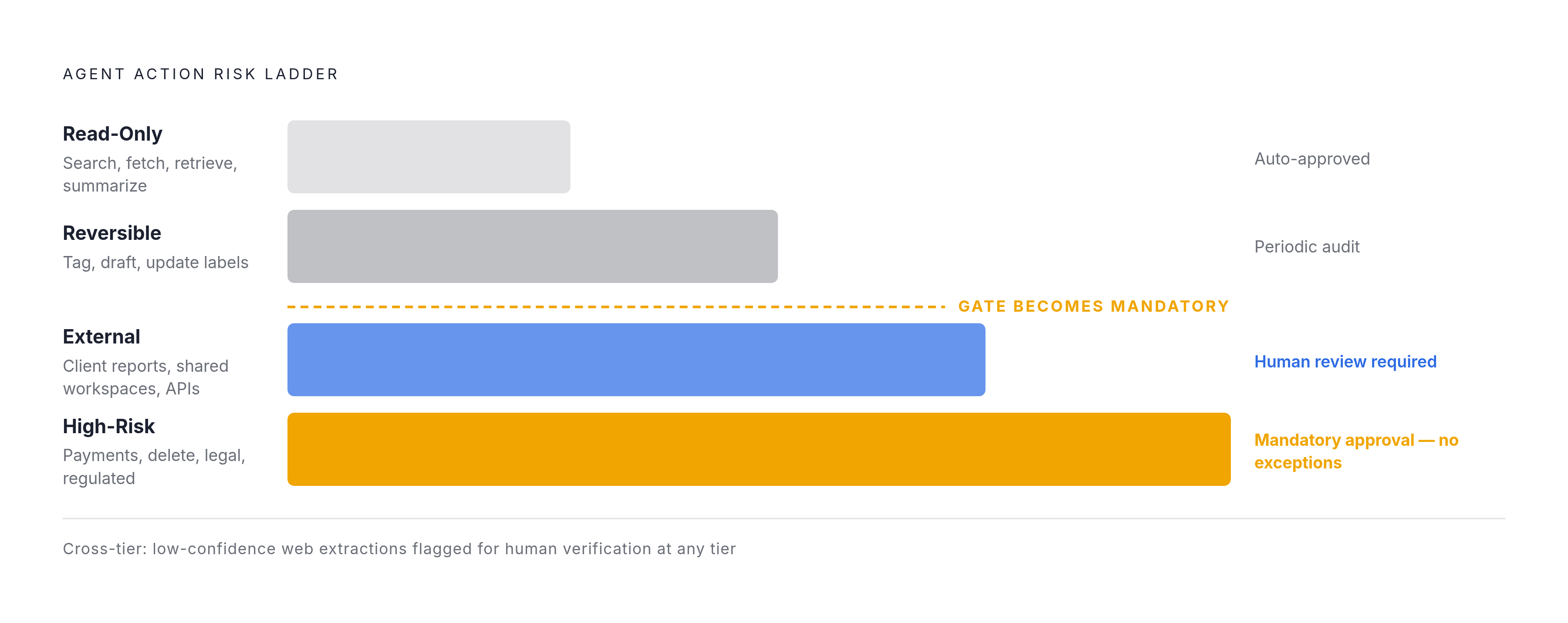
Not every action deserves the same level of scrutiny, and treating them all the same way either buries reviewers in approvals they don't need or waves through the ones that actually matter. The fix is a risk-tier classification applied to every action the agent is capable of attempting, which is the practical tool for turning the read/write principle into a decision a person can make in seconds. A 2026 escalation design guide lays out four tiers, read-only, reversible, external, and high-risk/irreversible, and reserves mandatory human approval for the cases where the cost of a mistake outweighs whatever time the automation saved. Mapped onto a research pipeline, read-only covers web search queries, URL fetching, document retrieval, and summarization, all of which get auto-approved with no gate. Reversible covers things like tagging, drafting internally, or updating an internal label, which can run with periodic audit rather than a synchronous stop-and-check. External covers any output that leaves internal systems, a report sent to a client, a finding posted to a shared workspace, an API call to an outside service, and every one of those requires review before it fires. High-risk and irreversible covers anything that triggers a payment, deletes a source record, commits to a legal or contractual action, or feeds findings into a regulated process, and none of that moves without a mandatory approval gate, no exceptions carved out for a good track record. A separate trigger category sits across all tiers: low-confidence extraction from unstructured web data, scraped HTML, inconsistently formatted imports, needs to be flagged for human verification before it propagates downstream, because hallucination risk concentrates exactly in the places where being wrong looks most credible. Is a wrong output hard to undo, and will it be seen outside the organization? Either answer bumps the action up a tier.
Why web data ingestion is itself a checkpoint-sensitive layer
Everything a research agent produces is only as good as the web data it started with, and raw HTML is a genuinely hostile format for reliable extraction. It's heavy with tokens that carry no meaning, cluttered with scripts and navigation chrome, and it gives the model no built-in signal for which part of the page is actually the content worth reading. That mismatch makes low-quality ingestion a silent checkpoint failure, one that happens before the agent has even taken an action anyone would think to review. When the agent is working through unstructured input, scraped pages, inconsistently formatted document imports, research sets stitched together from multiple sources, low-confidence extractions need to get flagged for a human to check before they move one step further down the pipeline. This is exactly where hallucination risk piles up, because a confidently wrong extraction and a correct one look identical at the point someone actually uses them. A checkpoint placed only on the final write catches the symptom and misses the cause. Treating ingestion itself as a checkpoint-sensitive layer catches the problem before it has a chance to compound through three or four downstream steps.
How the pause-resume mechanism works without corrupting agent state
Most HITL checkpoints that fail in production fail for a boring reason: the plumbing underneath the decision logic gives out. A synchronous approval model runs into gateway timeouts, token expiry, and stale cursors, and when that happens, the agent either throws an error or restarts from zero, taking all the context it had accumulated down with it. Building a pause-resume mechanism that survives contact with real infrastructure means getting a handful of engineering details right. The agent's full working state, retrieved documents, intermediate summaries, which plan steps are already done, needs to get written to durable storage the instant the pause happens, not held in memory where a dropped connection wipes it out. Every pending approval needs an idempotency key attached, so a duplicate response or an accidental retry doesn't trigger the action a second time. Each pending approval also needs a defined time-to-live with clear expiry behavior: a seven-day TTL for ordinary research operations and 24 hours for anything sensitive is the default most practitioners report using, and when that TTL runs out, the system should escalate the decision or cancel the action, never auto-approve it just because nobody showed up in time. And resuming needs to mean actually resuming, picking execution back up from the serialized checkpoint rather than restarting the task, so the human's approval doesn't accidentally throw away all the reasoning that came before it. Multi-agent research pipelines raise the stakes on all of this, because one agent's output is the next agent's input. If an agent fails or restarts in the middle of that chain, it doesn't just lose its own progress, it risks handing a stale or half-finished output to whatever agent comes next in line.
The context package a checkpoint must contain for fast reviewer decisions
A checkpoint that hands a reviewer a decision with no supporting context isn't oversight, it's a rubber stamp waiting to happen, and reviewers rubber-stamp precisely when they're given nothing real to reason with. The quality of a human's judgment at a gate depends entirely on the quality of the context the system puts in front of them. For a research agent specifically, the package surfaced at a write-action gate needs to cover the ground a reviewer actually checks against. It should state the proposed action and its exact scope, spelling out precisely what will be sent, saved, or changed. It should list the sources the agent used to reach its conclusion, document titles and extraction timestamps, so the reviewer can catch a hallucinated or outdated citation without having to open some separate system to cross-check it. It should include the agent's actual reasoning or the plan step that led to this particular action. It should carry a confidence signal, and that signal should not be a raw model probability pulled straight from the weights. It should be something structured and readable, like a flag noting the finding was extracted from a single source with no corroboration, the kind of thing a reviewer can interpret without a background in statistics. And it should clearly label how reversible the action is, so the reviewer calibrates how hard to scrutinize it against how bad it would be to get it wrong. If approving the action means the reviewer has to go open three other systems just to verify it, the checkpoint is sitting in the wrong place or showing the wrong information, and reviewers will start clicking approve without actually reading anything. A Stanford paper on decoupled HITL systems makes a structural point: human interaction management should be decoupled from the application workflow through explicit interfaces, treating human oversight as its own independent system component rather than something buried inside application logic. The translation layer that turns raw agent state into something a reviewer can actually read is its own piece of engineering, not an afterthought bolted onto the approval button.
Confidence-gated routing so human reviewers see only the decisions that need them
Routing every single action through a human gate just rebuilds the old manual process and stacks an AI bill on top of it, which defeats the point of building the agent in the first place. The design that actually scales is confidence-gated routing: the agent auto-approves actions that are high-confidence and low-risk, and escalates only the ones that are genuinely uncertain or sit at the edge of the rules, so the human workload grows with real uncertainty instead of growing with raw volume. A 2026 HITL guide frames this as the thing that makes the whole approach scale at all. Without routing, the review queue grows with every new task until people simply stop checking it, and with routing in place, reviewers spend their limited attention on the decisions that actually move the outcome. The one thing the routing signal can't be is raw model confidence by itself, since RLHF-trained models run systematically overconfident, and a claimed high-confidence score isn't a trustworthy basis for deciding who gets a gate and who doesn't. Better signals exist, and they're specific to how research agents actually work. Extraction consistency checks whether the same schema-directed query returns the same result across repeated attempts. Task-difficulty escalation has the agent raise its own check-in rate as a task gets harder, and that self-escalation behavior is a more honest signal than any single confidence score the model reports about itself. Reviewers who only ever see the genuinely hard cases, the ambiguous citation, the source that contradicts the summary, the extraction that came back with nothing to corroborate it, are reviewers who still trust the queue enough to read what's in front of them.