Proxy Infrastructure for Agent-Driven Scraping
Agents silently act on bad proxy responses, turning blocks into corrupted data.

AI agents changed one layer of the pipeline. Just one. The fetch layer is exactly what it was before, and if that foundation cracks, every layer above it comes tumbling down.
You still have to load pages. That's still ordinary web access, subject to all the same blocking, throttling, and detection it always was. DataImpulse put it plainly: the AI only changes the extraction layer. Everything underneath is unchanged, and if that foundation breaks, every layer above it breaks too.
The failure mode that gets people is subtle. The proxy gets blocked. A page comes back. The parser fails because the HTML is wrong. The agent replans because the content looks empty. The model reasons over garbage. None of this shows up in your logs because the HTTP status was 200.
Scrapfly documented this exact pattern. A block page returning HTTP 200 with "Access Denied" in the body is the worst case. A traditional scraper trips on it and stops. An agent extracts from it, decides it has data, and passes corrupted output downstream. No error signal. No alert. Just bad data moving silently through your pipeline, compounding at every step.
This is the thing that catches teams off guard. Agents don't fail loudly on bad proxy responses. They act on them.
The Four Proxy Types and What Each One Actually Costs an AI Pipeline
Four proxy types. They have genuinely different cost profiles, and not in the way most people think when they first look at the pricing.
Datacenter proxies are server IPs. Fast, cheap, easiest to detect. Costs start around $0.50 per IP per AIMultiple's July 2026 figures. Fine for open, unprotected pages. Rough on anything with real bot protection.
Residential proxies are real consumer ISP IPs. They carry much higher trust on protected sites because they look like actual people browsing. Cost runs $3 to $15 per gigabyte depending on provider and pool quality.
ISP proxies, sometimes called static residential, are the middle option. ISP-assigned IPs running on datacenter hardware. You get the trust profile of residential with the speed and stability of datacenter. Particularly good for sessions that need to hold a consistent identity over time, which matters a lot for agent workloads.
Mobile proxies are the premium tier. Shared IPs across large numbers of real mobile users, which makes sites very reluctant to block them. Most expensive, often 12 to 20 times datacenter cost per gigabyte, and they have reliability quirks that are genuinely hard to predict.
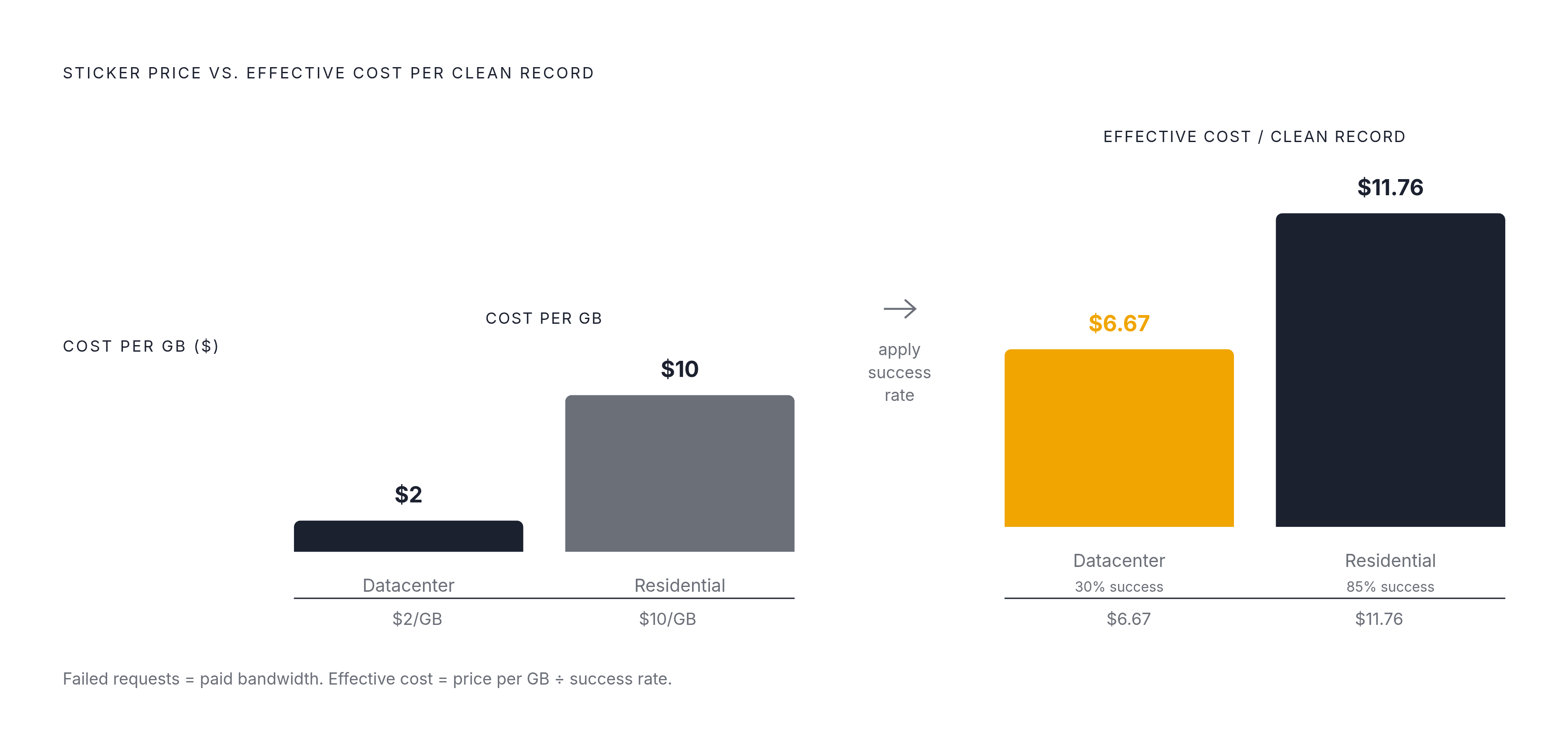
Now, here's where people get confused: cost per gigabyte is the wrong metric entirely. Cost per successful request is what you should be running.
ScrapeBadger worked this out. Datacenter proxies at $2 per gigabyte with a 30% success rate on a protected target end up costing more per clean data record than residential at $10 per gigabyte with an 85% success rate. Failed requests are paid bandwidth. You're paying for the block pages. The upfront savings on a cheaper proxy tier become a downstream expense once you account for failure rates. It's like paying for a taxi that only shows up three times out of ten — the fare looks cheap until you count the rides that never came.
Run the math that way and the effective cost gap between mobile and datacenter narrows significantly. In practice, closer to 6 to 10 times more expensive, not 12 to 20, because mobile succeeds so much more often per request. For residential proxies in the $3 to $6 per gigabyte range, Oxylabs' research (cited by SparkProxy) points to this tier as the best effective cost-per-successful-request across most use cases.
Most serious teams end up running a mix: datacenter for open pages, residential for protected ones, ISP or mobile for sessions and hard cases. ISP proxies in particular are underused relative to how well they fit agent session workloads.
How Detection Logic Has Shifted from IP Reputation to Behavioral Fingerprinting
IP is still the primary identifier. It's also still the easiest thing to rotate. That tension is exactly why the detection systems have evolved the way they have.
What modern anti-bot systems actually look at goes well beyond IP:
- Browser fingerprints and TLS signatures
- Request timing patterns
- Mouse movement and interaction signals
- Dozens of behavioral signals on top of all of that
The numbers here tell an interesting story. Datacenter IPs account for over 70% of all detected automated traffic, per DataDome's 2025 Bot Threat Report, despite representing a tiny fraction of actual internet users. That's why datacenter gets flagged so aggressively. The flip side: only 16% of websites successfully detect bots using residential proxies. That forces sites to rely on behavioral detection rather than just blocking at the IP layer.
Akamai's bot management suite blocks over 82% of automated traffic on select product pages, according to Mordor Intelligence's 2026 research. That number forces real investment in pool size, browser automation, and behavioral evasion. Rotating IPs alone doesn't get you there.
The JavaScript rendering shift made this messier. As more sites moved to SPA architectures and dynamic rendering, HTML-only scrapers started failing more often. More browser automation became necessary. More browser automation creates more behavioral surface area to manage.
Where agents specifically create exposure: a multi-step agent session produces a behavioral signature that doesn't look like a human, and also doesn't look like a traditional scraper. It's consistent in a way humans aren't. The timing and navigation patterns are unusual. Residential IPs buy you trust at the IP layer, which is real and worth having. But behavioral consistency across a multi-step session is a completely separate problem that better IPs don't solve.
What Session Management Means When an Agent Is the Client, Not a Human
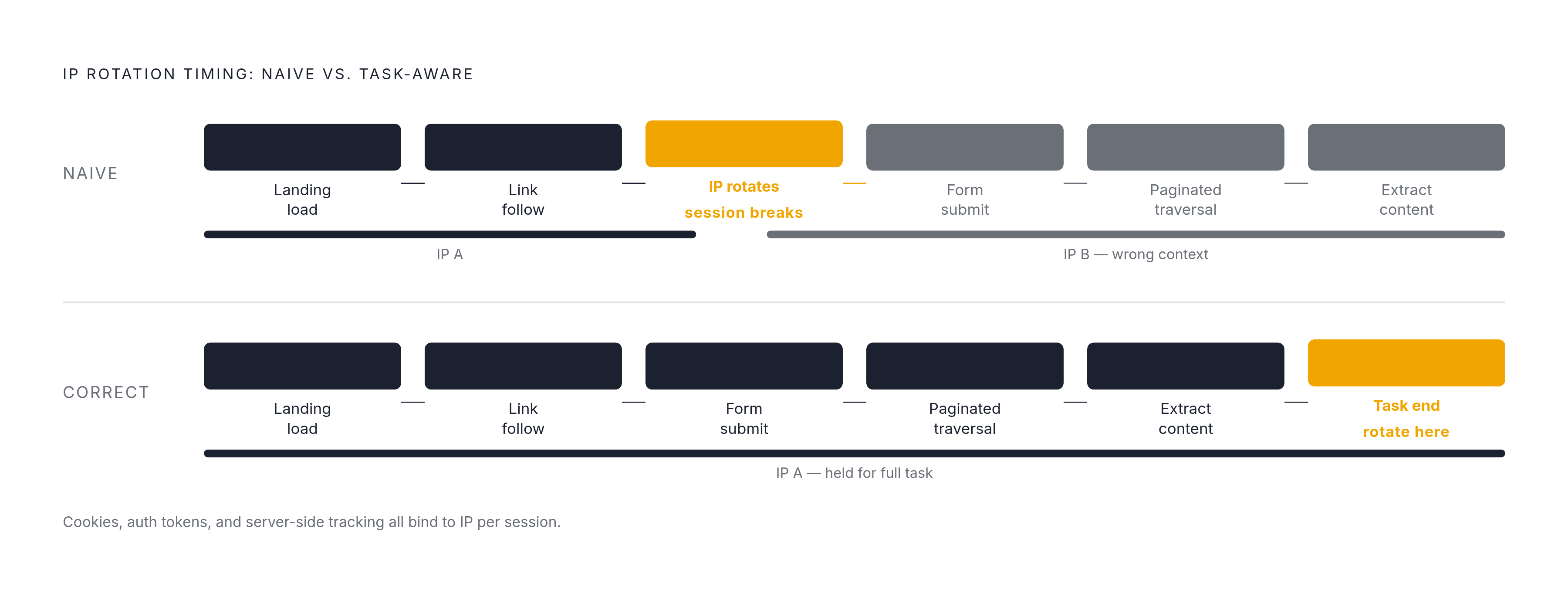
Traditional proxy rotation is built on one assumption: requests are stateless. Rotate the IP every N requests, optimize for throughput. That assumption falls apart the moment an agent is the client.
A single agent task involves a landing page load, a link follow, a form interaction, a paginated result traversal, and content extraction at the end. One logical task. Dozens of HTTP requests. Rotate the IP mid-task and you break session state. Cookies, authentication tokens, server-side session tracking, all of it tied to the originating IP.
A site seeing the same session token arrive from three different IPs treats that as a replay attack or an anomaly. It triggers blocking or CAPTCHA walls mid-task. A CAPTCHA wall mid-reasoning is worse than a block at the start because the agent is partway through a workflow it can't restart cleanly.
ISP proxies and sticky residential proxies were designed for exactly this. Hold the same IP for the duration of a logical task. Rotate only at task boundaries.
What that actually requires: the agent, or its orchestration layer, needs to signal task start and task end to the proxy layer. Request count is irrelevant. Timers are insufficient. Task boundary is what matters. That's a fundamentally different integration model than what most proxy setups expect, and most teams don't build it explicitly until they've debugged a few mysterious mid-task failures.
The cadence problem compounds everything. Agents don't fire requests on fixed intervals. They pause to reason, sometimes for a few seconds, sometimes longer, then burst through a navigation sequence. Naive rate-limiting on the proxy side will either throttle too aggressively during a reasoning pause, misreading the quiet as a session drop, or allow patterns during a navigation burst that trip behavioral detectors. Either way, the infrastructure ends up fighting the agent.
Proxy selection in this context can't be static configuration. It has to be dynamic, informed by the target site, the task type, and the current session state. A script scraping 10,000 product pages in parallel has predictable load characteristics. An agent doing open-ended research does not. The infrastructure has to know the difference.
Proxy Pool Quality After the IPIDEA Takedown and What It Means for Pool Selection
On January 28, 2026, Google Cloud dismantled IPIDEA, at the time the world's largest residential proxy network. Millions of exit nodes, gone overnight, per Olostep's April 2026 coverage, Olostep is a web scraping and crawling API for developers and AI teams, and the takedown directly affected the residential proxy pools that infrastructure like it depends on.
The real damage wasn't pool size. It was what the takedown revealed about the market structure underneath. Multiple proxy brands had been secretly reselling the same compromised device pools under different labels. Customers who thought they had diversified across independent providers discovered, at the worst possible moment, that those providers were all drawing from the same source. One takedown, simultaneous failures across what looked like separate stacks.
That changes the evaluation criteria permanently. Pool size is now an obsolete primary metric. Before IPIDEA, bigger meant more resilient. That argument doesn't hold anymore.
What actually matters now:
- Geographic and ISP distribution across genuinely independent sources
- Provider transparency about how IPs are sourced. Ethically enrolled devices versus compromised hardware is a real and important distinction.
- Success rate on your specific target-site categories, not aggregate uptime figures
- What happens to your pipeline when a pool segment goes down
That last point is what most practitioners overlook until it bites them. An agent mid-task when a pool segment collapses doesn't just fail a request. It corrupts a multi-step workflow that was partway through reasoning. There's no clean retry. There's a half-finished task state that needs to be unwound, and that's often messier than it sounds.
For enterprise-grade reliability, Bright Data and Oxylabs are the reference points. Bright Data crossed $300 million in annualized revenue per Forbes' November 2025 coverage. Oxylabs runs a pool of over 175 million IPs and reports success rates approaching 99.95%. Those numbers exist because pool source diversity and redundancy are engineered features in their infrastructure.
How Cloudflare's AI Bot Controls Are Redrawing the Access Landscape for Agents
Two numbers set the context. AI crawler traffic surged 757% in 2024. By June 2026, automated requests account for 57.5% of all HTML traffic, the first time machines hold the majority. Cloudflare CEO Matthew Prince put that figure out publicly on June 3, 2026.
Cloudflare's response has been systematic. In July 2025, they announced default blocking of AI crawlers across client sites and introduced a pay-per-crawl model that lets publishers monetize AI access instead of just blocking it. Crawlers were divided into three categories: Search, Agent, and Training. Publishers can independently block or charge each type. By September 2026, Training and Agent bots are blocked by default on ad-supported pages.
The mechanic built specifically for agents is the x402 / HTTP 402 flow. An agent receives a 402 response, sees the stated price, pays in stablecoins, and retries with cryptographic settlement proof, without human input. HTTP 402 was technically defined for this kind of machine-readable payment requirement for decades. It just took agents becoming the dominant traffic source to make it operationally viable.
The practical implication is straightforward. When major platforms close their gates to honest crawlers by user agent, demand shifts to tools that make traffic indistinguishable from human traffic. Cloudflare processes 50 billion AI crawler requests per day. The scale at which these defaults operate is not small. That pressure lands on proxy design, specifically behavioral proxy design, not just IP rotation.
Rotation Logic That Accounts for Agent Behavior Patterns Rather Than Request Counts
Count-based rotation is the wrong model for agents. Rotating every N requests ignores session boundaries and breaks agent tasks at arbitrary points mid-reasoning.
The correct trigger is task completion. Here's what that integration actually looks like in practice:
- The orchestration layer signals task start and task end to the proxy layer
- Within a task, the session holds to one IP
- At task boundary, rotate to a fresh IP for the next task
Most proxy clients aren't built to receive those signals. It's worth building that integration explicitly rather than hoping count-based or timer-based rotation happens to align with task boundaries. It usually doesn't.
Target-aware routing matters alongside this. Different sites need different proxy types, and routing should reflect that dynamically rather than using one tier for everything:
- Open pages: datacenter. Fast and cheap.
- Protected pages or login-gated content: residential or ISP.
- High-value targets with aggressive behavioral detection: mobile or carefully managed residential with realistic timing patterns.
Timing realism is a specific issue with agent cadence. Long pauses between reasoning steps, then clusters of requests during navigation. That pattern looks different from human browsing and different from traditional scraping. Proxy infrastructure needs to tolerate irregular cadence without misreading a reasoning pause as a dropped session.
Retry logic needs rethinking too. A traditional scraper retries a failed request immediately. An agent should re-evaluate whether the task approach needs to change before retrying. That means the proxy layer needs to surface failure type clearly. Block? Rate limit? Empty response? HTTP 402? Each should trigger different agent behavior, and the proxy layer needs to communicate clearly enough to make that possible.
The silent HTTP 200 failure stays the hardest case. A block page returning status 200 with "Access Denied" in the body passes through most retry logic untouched. Infrastructure must validate response content, not just HTTP status. A clean 403 is more useful to an agent than a successful-looking block page, because at least the agent knows something failed.
What Structured Output Requirements Add to the Proxy Infrastructure Design Problem
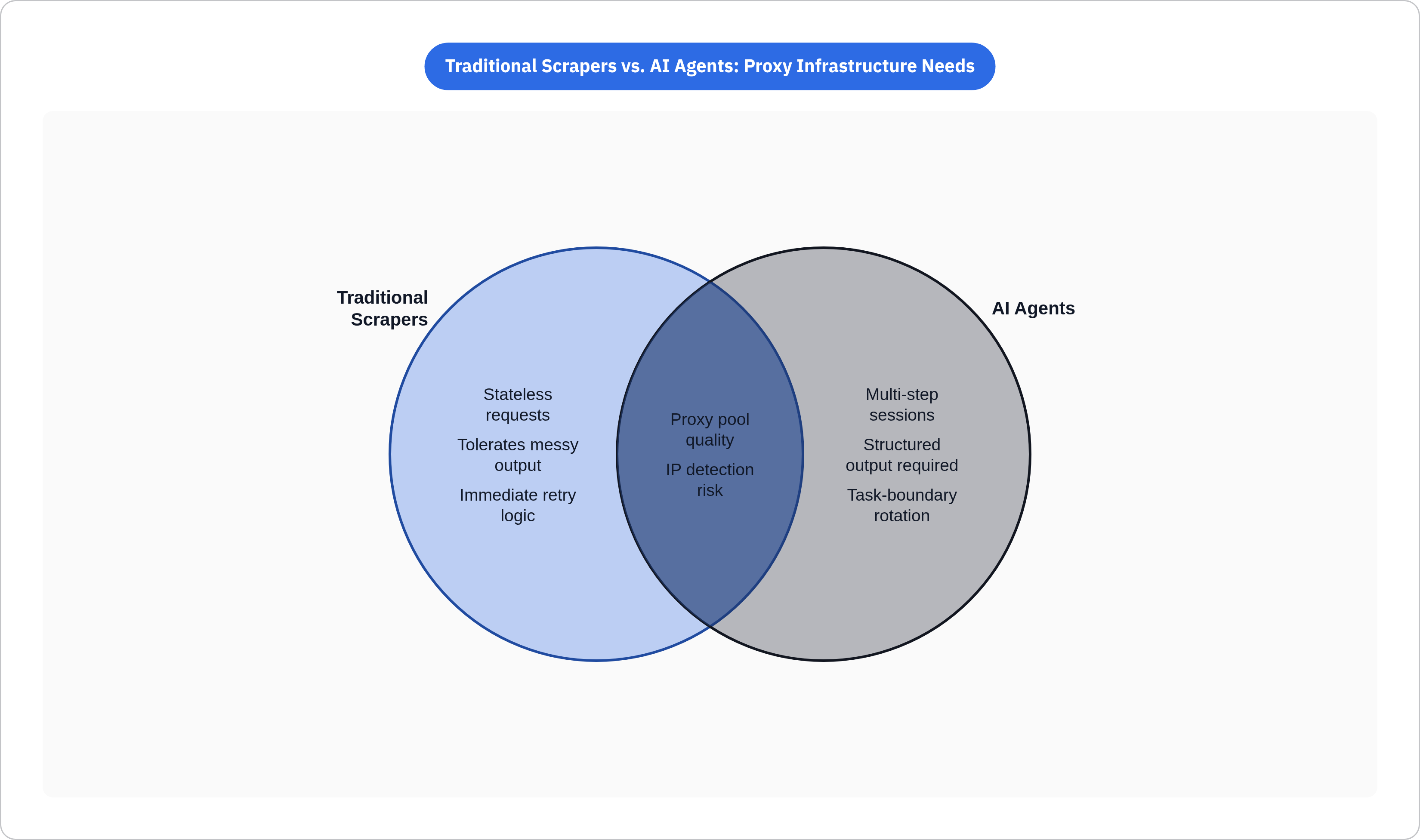
Traditional scrapers tolerate messy output. Partially correct extraction, missing fields, extra whitespace. A human downstream sorts it out eventually.
Agent pipelines don't have that buffer. Output feeds directly into LLM reasoning, RAG retrieval, or another agent's context window. The downstream system doesn't flag bad input. It reasons over it. That's a meaningfully different failure mode than what most teams are used to managing.
One enterprise case GPTBots documented in 2026: a team replaced manual scraping with an AI-driven system and moved data accuracy from 71% to 96% while cutting costs from $4.1 million to $270,000 in year one. That accuracy improvement only holds if the fetch layer is working. The cost savings evaporate if the proxy layer is producing phantom failures that the agent silently acts on.
What structured output requirements actually change about the infrastructure design:
- Every proxy failure is now an accuracy problem, not just an availability problem
- Content validation needs to happen at the fetch layer, before the agent sees the response
- Partial page loads are worse for agents than for scrapers, because the agent interprets a partial page as a complete one
- Rate of clean successful fetches is the metric that matters, not raw request volume
In a traditional scraping stack, a bad proxy makes the pipeline slower. In an agent pipeline, a bad proxy makes the pipeline wrong. Wrong is harder to detect, slower to surface, and more expensive to fix than slow.
That's the actual infrastructure problem agent-driven scraping creates. Not just faster rotation or larger pools. Different requirements at every layer, starting with the fetch layer, running through session management and rotation logic, and ending with how output gets validated before an LLM ever sees it.