Headless Browser Scraping with Playwright and Puppeteer
Playwright outpaces Puppeteer with cross-browser support and auto-waiting reliability.

Puppeteer was built by Google's Chrome DevTools team and released in 2017. Its purpose was deliberately narrow: give developers a programmatic interface to headless Chrome via the Chrome DevTools Protocol (CDP). It filled a genuine void and quickly became the default for anyone automating a Chromium-based browser in JavaScript.
The Playwright story starts with a personnel move. The engineers who built Puppeteer at Google left for Microsoft and released Playwright in 2020. This was not incidental timing. Playwright was designed to address specific problems those engineers had already spent years watching in production: fragile timing dependencies, no cross-browser support, no multi-language clients, insufficient session isolation. The design reflects what years of Puppeteer deployments actually taught them, which is a different foundation than a greenfield project would have.
Both ship under the Apache-2.0 license, and their APIs are close enough that a developer fluent in one can read the other without much friction. Puppeteer has crossed 88,000 GitHub stars as the established Chrome automation library. Playwright, newer by three years, has passed 64,000 and now commands a majority of new browser automation projects in recent developer surveys. Per Scrapingbee's 2024 survey, the two tools together account for 34% of web scraping solutions currently in use.
That concentration has a practical consequence: both ecosystems are large enough that obscure failure modes tend to be documented before you encounter them. Production gaps in the documentation have largely been filled by people who already hit the same walls.
Browser and Language Support: Where the Two Tools Part Ways Early
Puppeteer runs on Node.js and targets JavaScript and TypeScript. Comparisons that describe it as Chrome-only are now outdated: as of Puppeteer v25.3.0, Firefox support is officially included alongside Chromium, with both controlled through CDP or WebDriver BiDi.
Playwright's scope is wider. It ships official clients for JavaScript, TypeScript, Python, Java, and.NET, and controls Chromium, Firefox, and WebKit through a single unified API, all three as first-class citizens with full API parity.
The WebKit inclusion is practically meaningful for scraping in a way that is easy to dismiss as a niche feature. Scraping fleets routing all traffic through a single browser signature create a detectable fingerprint pattern. Routing some sessions through WebKit, fingerprinting as Safari, is a real diversification lever.
The multi-language support is the more consequential divergence. But what if your team's primary infrastructure is Python data pipelines, or Java and C# backend services? Puppeteer's JavaScript requirement is not a problem for teams already working in that ecosystem, but it is a genuine constraint for polyglot teams who would otherwise be forced to introduce Node.js processes solely to manage browser sessions. That constraint tends to be invisible at project start and visible by the time you are rearchitecting something that has already shipped.
Auto-Waiting: How Playwright Cuts the Race Conditions That Make Puppeteer Scrapers Break
Anyone who has maintained a Puppeteer scraper in production has a waitForTimeout story. The element is in the DOM but not interactive. The selector fires before a component finishes mounting. Navigation completes per the network event, but the data the page loads afterward arrives late. Standard remedies are explicit waits: waitForSelector, waitUntil: 'networkidle0', and, when those feel insufficient, a fixed timeout buffer added as insurance.
Those buffers work until they do not. Set them too short and the scraper fails intermittently. Set them conservatively long and you are paying dead time on every page load. I have seen production Puppeteer scrapers carrying multiple seconds of safety margin per page, and that dead time accumulates fast across a large crawl. The subtler problem is that every wait encodes an assumption about timing that can drift out of alignment as the target site changes. When it drifts, the scraper starts failing in ways that are annoying to diagnose because the timing assumption is implicit rather than explicit.
Playwright handles this differently. Before acting on any element, the engine automatically runs actionability checks, verifying that it is attached to the DOM, visible, not animating, enabled, and capable of receiving events. This is a retry loop running invisibly before every interaction, so the code reasons about intent rather than timing. In a benchmark against a Next.js application, Playwright achieved a total response time roughly 1.6 seconds faster than Puppeteer under identical load, a gap largely attributable to eliminated wait buffers. Playwright also batches CDP commands internally, reducing per-call round-trip latency, a small difference per action that compounds across dozens of interactions in a full session.
Explicit waits are a category of bug, not a stylistic inconvenience. Every one you write is a prediction about future site behavior encoded in code that will outlive the conditions that made it accurate. That raises an important question: how many of those predictions are silently wrong in scrapers you already have running in production?
Browser Contexts and Parallel Scraping: Many Sessions, One Process
Parallelism is where the two tools' architectures diverge most consequentially for anyone running scraping at scale.
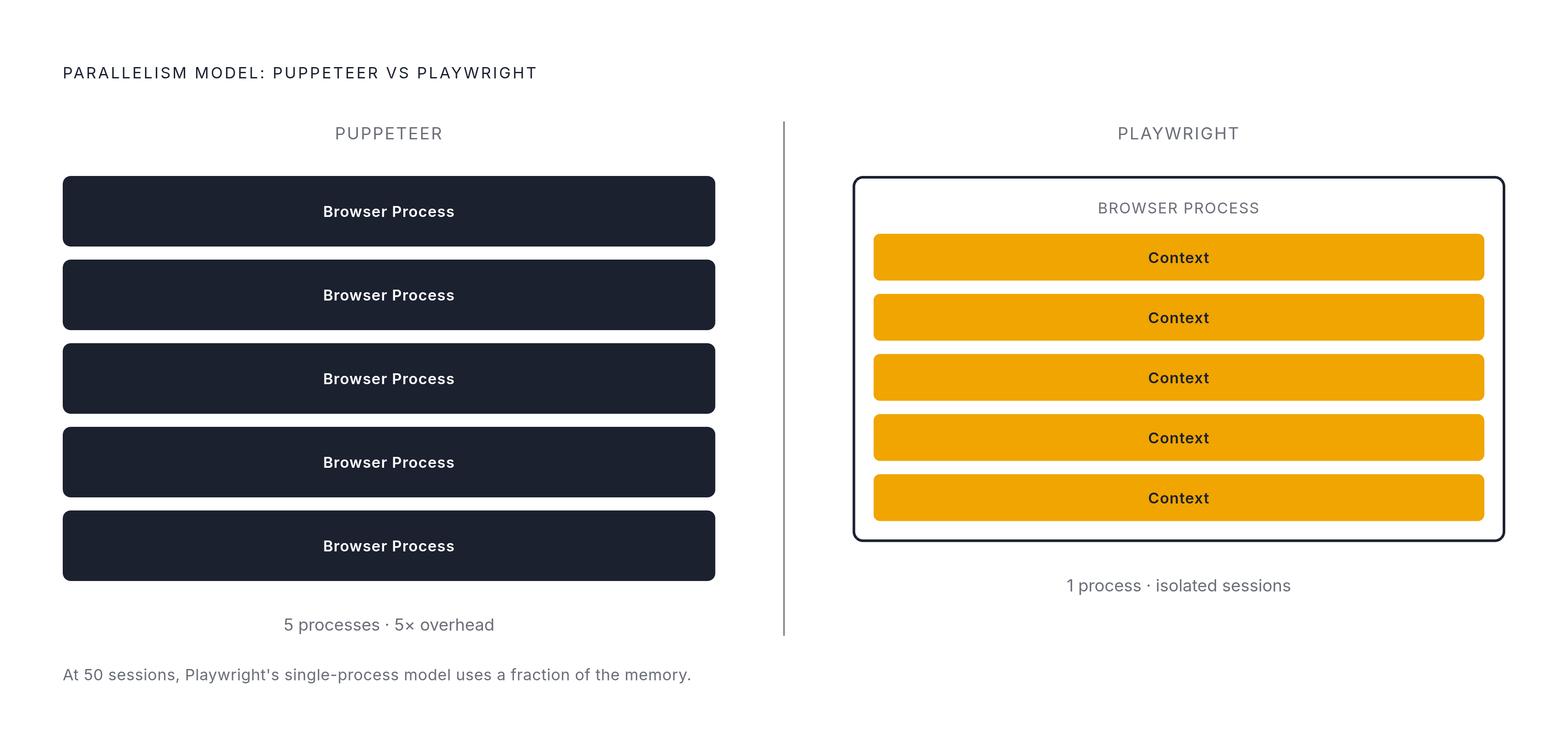
Puppeteer's model for session isolation is direct: separate browser instances per isolated session. Each instance carries full browser process overhead. At modest concurrency this is unremarkable. At fifty parallel sessions it becomes a resource problem that requires substantial infrastructure to absorb.
Playwright introduces the BrowserContext primitive. Multiple contexts run as fully isolated sessions, each with separate cookies, local storage, and authentication state, within a single browser process. The fifty parallel sessions that would exhaust memory under Puppeteer's model require a fraction of that overhead under Playwright's. Whether your scraping operation runs on affordable hardware or expensive hardware can hinge on this difference.
A reasonable starting point for parallel scraping on consumer hardware is three to five concurrent contexts, increased gradually while monitoring for rate-limiting responses and memory pressure. Use a semaphore or concurrency limiter. Uncapped concurrency accelerates detection by anti-bot systems that monitor request volume per IP, and it risks memory exhaustion before it even gets to that point.
It is also worth considering the tradeoff this architecture introduces. All contexts share the same underlying browser process, so a crash takes down every context simultaneously. Any architecture that depends on session-level fault isolation needs to account for this. Running multiple browser processes, each hosting a bounded number of contexts, distributes that risk at the cost of some resource efficiency.
Puppeteer retains a legitimate advantage in the single-session case. Where you need one isolated extraction with no concurrency requirements, Puppeteer's lower process overhead is a reasonable consideration.
Network Interception, Proxy Setup, and Configuration Ergonomics
One of the most useful capabilities in either tool is intercepting network requests before they leave the browser. Playwright exposes this through page.route, which lets you match request patterns and abort them, modify them, or capture their responses.
The scraping applications are concrete. Aborting requests for images, fonts, and stylesheets cuts bandwidth and speeds page loads substantially. More usefully, request interception lets you capture the JSON a site's frontend fetches from its own internal APIs. That JSON is often cleaner, more structured, and more stable than the rendered HTML you would otherwise be parsing. The first time you pull structured product data directly from a site's internal API call rather than scraping it out of markup, it reframes what browser automation is actually for.
Puppeteer supports request interception as well, but the implementation is more verbose and the abstraction less composable. For scraping purposes, Playwright's interface is meaningfully better.
Proxy configuration follows the same pattern. In Playwright, a proxy is passed as a single configuration object at browser launch, authentication included. In Puppeteer, the proxy server address is a launch argument, but per-page authentication requires a separate page.authenticate() call on each page object. Neither is complex, but Puppeteer requires you to track two configuration surfaces simultaneously, which produces subtle bugs under time pressure.
Playwright also ships two development tools Puppeteer lacks. Codegen records live browser interactions and generates a working scraping script from them. The trace viewer records all network requests and browser actions from a session and presents them in a navigable GUI, which is useful for diagnosing why a scraper failed on a specific page rather than trying to reconstruct the failure from logs.
How Anti-Bot Systems Detect Headless Browsers, and What Both Tools Expose
Detection is the adversarial layer that most scraping tutorials either minimize or skip. Understanding it concretely changes how you architect solutions.
Modern anti-bot systems operate across several independent detection layers. IP analysis examines request volume, datacenter IP reputation, and rotation patterns. TLS and JA3 fingerprinting works at the protocol level: the TLS handshake exposes which cipher suites and TLS extensions the client supports, producing a signature that identifies the HTTP client independently of the User-Agent header. JavaScript fingerprinting collects screen resolution, font sets, WebGL renderer details, audio context behavior, and canvas rendering output. Behavioral analysis watches mouse movement paths, scroll speeds, and interaction timing; automated sessions move in straight lines at constant velocity and tend not to misclick.
Both Playwright and Puppeteer, used without modification, expose themselves across several of these layers simultaneously. The navigator.webdriver flag is set to true by default. Default headless configurations are also missing browser APIs that real sessions provide, including certain WebGL extensions and consistent audio context behavior. A Chrome User-Agent paired with navigator properties that reflect a headless environment creates inconsistency that detection systems flag without difficulty.
Why exactly does this matter? Detection is not a single check you either pass or fail. To clear a modern anti-bot system, a scraper must look authentic at the TLS layer, at the HTTP/2 frame order, at the JavaScript fingerprint layer, and at the behavioral layer, concurrently. Passing three of four is not partial credit. Platforms like Cloudflare combine JavaScript challenges, JA3 and TLS fingerprinting, and behavioral scoring. HUMAN Security collects deep client-side sensor data including WebGL, canvas, and motion signals. Each applies multiple layers independently, and they are not naive about what evasion looks like.
Stealth Plugins: What Still Works, What Has Been Deprecated, and What Has Replaced Them
The scraping community's response to detection has historically been stealth plugins: libraries layered on top of Puppeteer or Playwright that patch the most obvious fingerprinting signals.
Puppeteer's stealth ecosystem, built around puppeteer-extra and its plugin architecture, is mature and extensively documented. It supported stealth patching, ad blocking, and CAPTCHA solving integrations. puppeteer-extra-plugin-stealth was deprecated in February 2025. Current Cloudflare detection identifies it. Using it against hardened targets is not just ineffective; a patched-but-detected session can behave in ways more suspicious than an unmodified one. undetected-chromedriver is in similar condition.
Playwright's stealth ecosystem centers on playwright-stealth, which patches the webdriver flag, Chrome runtime signals, and JA3 hash mismatches. It is newer than Puppeteer's tooling and was historically less tested against the hardest targets, though that gap narrowed substantially through 2024 and 2025. Combined with residential proxy infrastructure, modern Playwright stealth setups clear most anti-bot detection.
For harder targets, the current approaches address detection at a lower level than either plugin ecosystem can reach. Camoufox is a Firefox-based anti-detect browser that injects fingerprint data at the C++ level, exposes the Playwright API, and rotates fingerprints automatically through BrowserForge. It is the most viable option for medium to hard protection targets. SeleniumBase UC Mode offers undetected ChromeDriver with built-in CAPTCHA bypass handling, suited to lighter protection levels. Nodriver avoids the WebDriver protocol entirely, removing several detection vectors at the source.
One clarification worth holding onto: stealth plugins address JavaScript fingerprinting and some TLS inconsistencies, but they do not touch IP reputation or proxy quality. Those operate at a completely different layer of the detection stack. No amount of client-side patching compensates for a flagged datacenter IP.
Basic Scraping Patterns in Playwright and Puppeteer Side by Side
The proximity of the two APIs is easier to see in code than to describe in prose.
Launching a Browser and Opening a Page
Playwright (Python)
from playwright.sync_api import sync_playwright

with sync_playwright() as p:
    browser = p.chromium.launch(headless=True)
    page = browser.new_page()
Puppeteer (JavaScript)
const puppeteer = require('puppeteer');

const browser = await puppeteer.launch({ headless: true });
const page = await browser.newPage();
The structural shape is identical. Method names differ by convention, not logic.
Navigating to a URL and Waiting for Content
Playwright
await page.goto('https://example.com/products')
# Auto-waiting handles timing; no explicit selector wait required
title = await page.inner_text('h1.product-title')
Puppeteer
await page.goto('https://example.com/products', { waitUntil: 'networkidle0' });
await page.waitForSelector('h1.product-title');
const title = await page.$eval('h1.product-title', el => el.innerText);
Playwright's auto-waiting removes both the navigation strategy decision and the explicit selector wait. Puppeteer requires both, and the choices embedded in each are future brittleness waiting on a site update.
Extracting Text and Attributes
Playwright
price = await page.get_attribute('.price', 'data-value')
description = await page.inner_text('.product-description')
Puppeteer
const price = await page.$eval('.price', el => el.getAttribute('data-value'));
const description = await page.$eval('.product-description', el => el.innerText);
Handling Pagination
Playwright
while True:
    items = await page.query_selector_all('.product-card')
    # process items
    next_button = page.locator('a.next-page')
    if not await next_button.is_visible():
        break
    await next_button.click()
    await page.wait_for_load_state('networkidle')
Puppeteer
while (true) {
    const items = await page.$$('.product-card');
    // process items
    const nextButton = await page.$('a.next-page');
    if (!nextButton) break;
    await nextButton.click();
    await page.waitForNavigation({ waitUntil: 'networkidle0' });
}
Intercepting a Network Request to Capture an API Response
Playwright
api_data = {}

async def handle_route(route, request):
    if '/api/products' in request.url:
        response = await route.fetch()
        api_data['products'] = await response.json()
        await route.fulfill(response=response)
    else:
        await route.continue_()

await page.route('**/*', handle_route)
await page.goto('https://example.com/products')
Puppeteer
await page.setRequestInterception(true);
page.on('request', request => request.continue());
page.on('response', async response => {
    if (response.url().includes('/api/products')) {
        const data = await response.json();
        // store data
    }
});
await page.goto('https://example.com/products');
Playwright intercepts at the request level before network dispatch, giving you control over the full request-response cycle in a single composable handler. Puppeteer separates request and response handling into different listeners, which works until the logic for both needs to coordinate around shared state.
Parallel Sessions
Playwright
async def scrape_url(context, url):
    page = await context.new_page()
    await page.goto(url)
    data = await page.inner_text('h1')
    await page.close()
    return data

async with async_playwright() as p:
    browser = await p.chromium.launch()
    contexts = [await browser.new_context() for _ in range(5)]
    results = await asyncio.gather(*[
        scrape_url(ctx, url) for ctx, url in zip(contexts, urls)
    ])
Puppeteer
const browsers = await Promise.all(
    urls.map(() => puppeteer.launch({ headless: true }))
);
const results = await Promise.all(
    browsers.map(async (browser, i) => {
        const page = await browser.newPage();
        await page.goto(urls[i]);
        return page.$eval('h1', el => el.innerText);
    })
);
The memory implication is visible in the code. Puppeteer launches a separate process per session. Playwright creates a lightweight context within a shared process. At five sessions the difference is modest. At fifty it is not.
Both tools expose page.evaluate() for running arbitrary JavaScript in the browser context, useful for extracting data that does not map cleanly to selector-based queries or for manipulating page state before extraction.
Choosing Between Playwright and Puppeteer for a Given Project
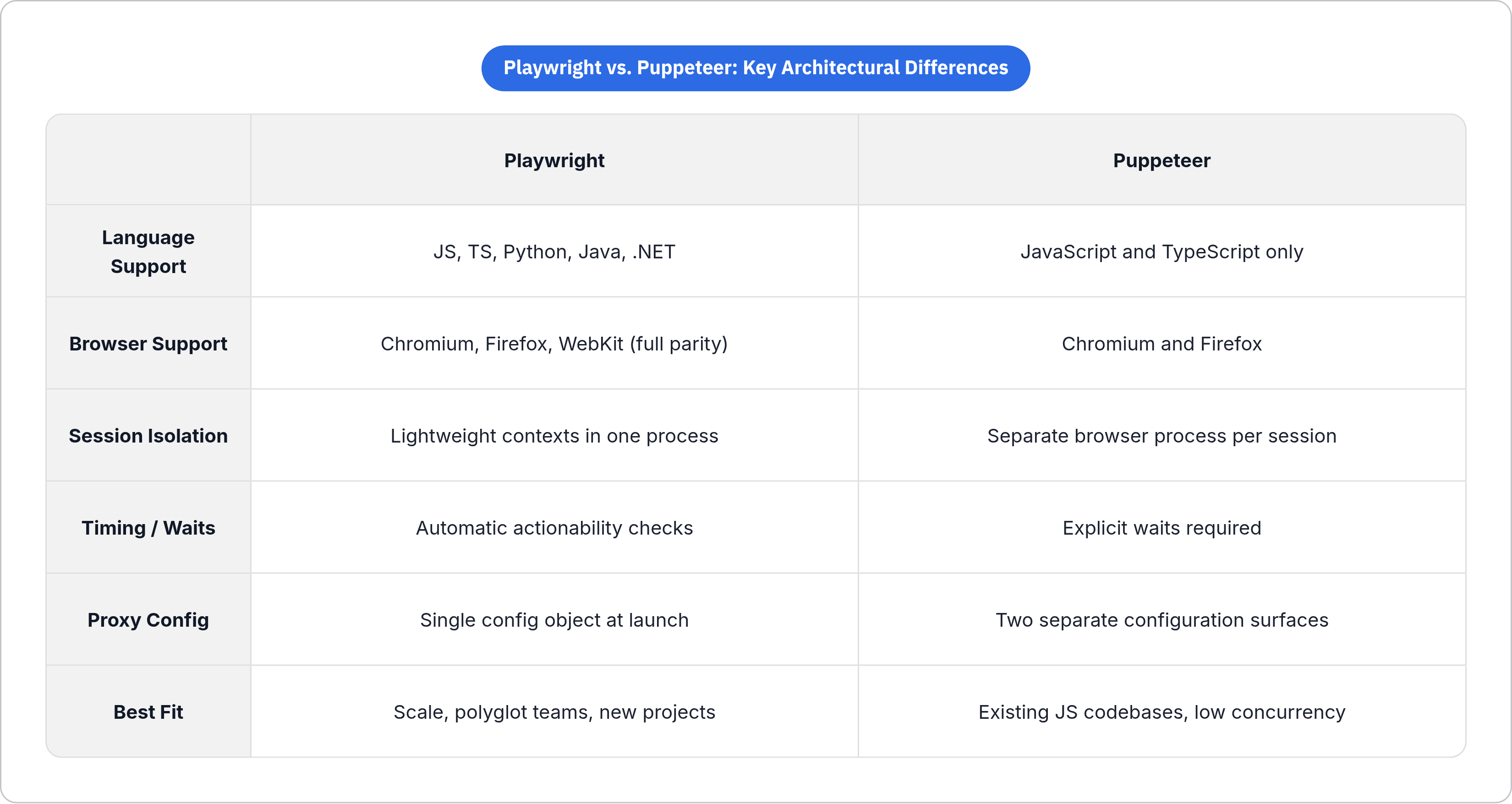
Playwright is the reasonable default for new projects. Auto-waiting reduces scraper flakiness by eliminating a class of timing-related race conditions. Context-based parallelism is architecturally superior at scale. Multi-browser support enables fingerprint diversification. The multi-language SDK removes the JavaScript requirement for teams working in Python, Java, or C#. The performance gap on JavaScript-heavy pages reflects the structural advantage of eliminating wait buffers across every page load in a long crawl, and that advantage compounds with crawl size.
Puppeteer remains the right choice when an existing codebase already uses it and the scraping workload does not strain its architecture. Migration carries real cost: syntax changes, testing, validation of behavior parity, and the risk surface of deploying rewritten scrapers against production targets. For single-page, low-concurrency, Chrome-specific workloads, Puppeteer's simpler architecture fits. Price trackers, scrapers for pages behind basic authentication, dashboard monitors: cases where the additional complexity Playwright introduces is complexity the project does not need.
Stealth considerations do not strongly differentiate the two tools at this point. Both ecosystems have seen significant deprecations in their older stealth plugins, and the harder targets in 2026 require approaches like Camoufox or Nodriver that operate below both API layers. When detection is the primary engineering challenge, the choice between Playwright and Puppeteer matters less than proxy infrastructure and fingerprint patching strategy.
The decision actually hinges on three things: team language constraints, concurrency requirements, and whether the cost of migrating an existing Puppeteer codebase is justified by the reliability and scalability gains Playwright offers on the specific workload in question. The difference between the two tools shows up not in what they can accomplish, but in how much scaffolding you write around them and how much of your engineering time goes toward managing their failure modes.