Incremental and Freshness-Based Crawling
AI systems need fresher data than analytics, or they confidently deliver wrong answers.

Incremental crawling exists because re-fetching an entire web dataset from scratch, every single cycle, is the kind of waste that breaks budgets and servers alike. The fix is simpler than it sounds: fetch only what actually changed, and leave the rest alone. The core design behind this runs on a crawl manifest keyed by URL, storing when a page was last fetched and a hash of its content; re-crawl decisions then get governed by freshness TTLs and change signals like HTTP Last-Modified headers and sitemap modification timestamps, which keeps the dataset current at a fraction of what a full crawl would cost. Search engines hit this constraint long before anyone was building RAG pipelines. Bandwidth is finite and servers expect politeness, so the crawl-rate optimization literature treats the whole thing as maximizing freshness under a bandwidth ceiling.
What falls out of that constraint is a system with two dials: how many new pages to go discover, and how many old pages to go refresh. Turning one dial up grows coverage, and turning the other up improves freshness. The entire engineering discipline of incremental crawling is really just the art of tuning those two dials against each other without starving either one. For decades, this tradeoff was manageable, because the people reading the output were, well, people. A human looking at a stale price on a comparison site raises an eyebrow and moves on. That tolerance for staleness is about to get a lot less forgiving.
AI Systems as Downstream Consumers of Crawled Data
An analytics dashboard with stale data looks stale. An AI pipeline built on the same stale data doesn't produce a visible error at all. It produces a fluent, well-formatted, entirely confident answer that happens to be wrong, and nothing about the output format tells you so. Downstream consumption used to mean a person squinting at a report. Now it means a model generating prose that reads exactly the same whether the underlying document is an hour old or a year old.
Production post-mortems on RAG systems keep naming the same culprit: documents that never got re-indexed, causing the model to confidently cite information that stopped being true a while ago. Picture a RAG system grounded in government policy pages that are a week stale. It will answer policy questions with total conviction, using rules that no longer apply. Picture a job-matching engine that pulls listings that haven't refreshed in a while. It will represent a labor market that doesn't exist anymore, matching candidates to jobs that may already be filled. Neither system throws an error. Both just answer, cheerfully, incorrectly.
The tolerance window has compressed by an order of magnitude. Traditional analytics pipelines could often live with freshness measured in months. AI systems downstream of a crawl need freshness measured in days, because the gap between "current" and "stale" is the gap between a correct answer and a wrong one delivered with equal confidence. The uncomfortable part is how invisible this failure mode is inside most organizations right now. Most enterprise teams are running analytics-grade pipeline tooling, built for a world where staleness was a cosmetic problem, and pointing that same tooling at AI workloads without adjustment. The gap between what the tooling assumes and what the AI system actually needs doesn't announce itself. It just sits there until a bad answer makes it into production, at which point it becomes a very expensive lesson in why freshness infrastructure matters.
The mechanisms: how a freshness-aware crawler detects change
A freshness-aware crawler runs on three mechanisms working together: content hashing, HTTP and sitemap signals, and adaptive scheduling. None of the three can carry the job alone.
Content hashing comes first, and it does something subtler than it sounds. Document-level freshness metadata captures the moment source content was last verified current, which is a different timestamp entirely from when it was ingested. The crawler compares a content hash, or a source-side Last-Modified header, against whatever value it stored last time, and it only updates the verification timestamp when an actual change gets confirmed. This matters because a crawl run can complete successfully, log a fresh ingestion timestamp, and still have fetched a cached or rate-limited version of the page underneath. The index says the data is current. The content says otherwise. Run-level freshness means the crawler ran; document-level hashing confirms the content actually changed.
Second comes scheduling, and the choice of scheduling strategy turns out to matter independent of how much bandwidth is available. Greedy and adaptive crawl schemes produced a substantially higher average ChangeRatio than round-robin, proportional, or frequency-based scheduling in head-to-head comparisons. Scheduling strategy alone is a freshness lever you can pull, no matter the budget.
Third, for teams building specifically for LLM consumers, there's a layer of semantic change detection sitting on top of both of the above. The OwlerLite prototype applies SimHash over 5-gram shingles, so it can tell meaningful content updates apart from cosmetic ones, like a navigation menu shifting or an ad rotating. That distinction keeps a RAG pipeline from burning re-indexing budget on pages whose surface changed while the substance stayed the same.
The freshness-versus-coverage tension
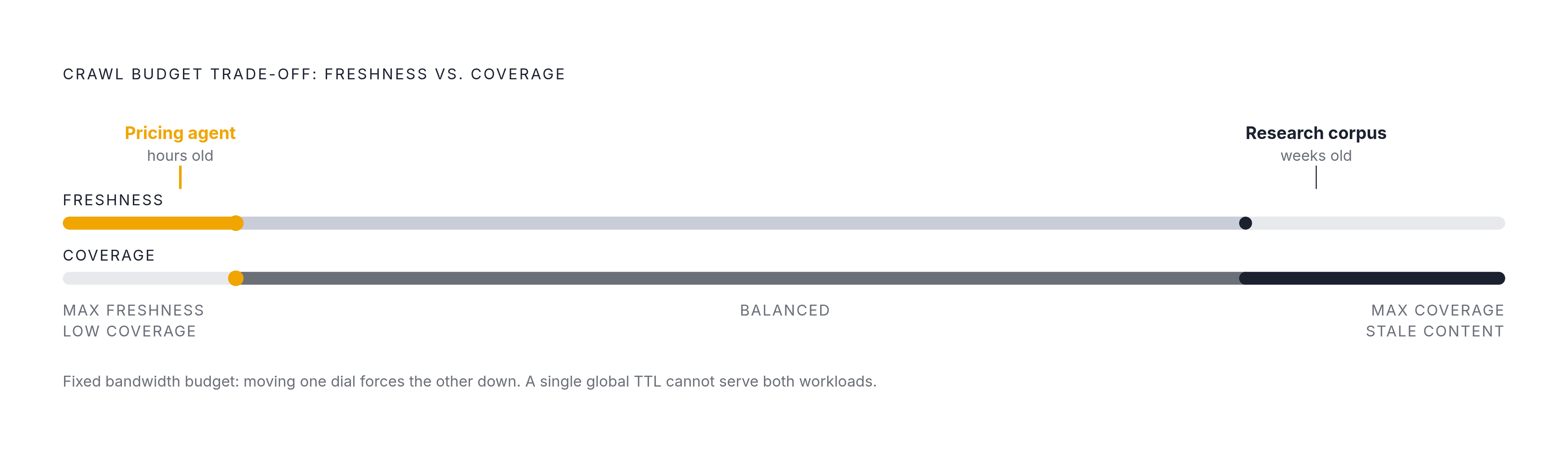
If you fix the bandwidth budget, freshness and coverage compete for the same resource, so no single crawl policy applied uniformly across a dataset will serve both well. The only workable approach is defining per-use-case SLA thresholds instead. If you push every page toward maximum freshness, the crawler burns its budget re-checking pages that rarely change. If you push toward maximum coverage, the deep, less-visited pages can sit months stale before anyone notices.
The practical fix is to stop treating "freshness" as one number. A pricing agent needs documents that are hours old. A research corpus can tolerate documents that are weeks old. You should define the maximum acceptable age for each downstream application, store that threshold explicitly, and evaluate retrieved documents against it at query or indexing time, instead of trusting a single global TTL to serve every use case equally well.
When a document in a critical source set ages past its threshold, that event deserves an alert carrying the same priority as a service outage, because from the standpoint of whether the output is correct, it is one. A useful artifact for making this concrete is a coverage manifest: a written definition of which sources the pipeline is supposed to collect from, what document types or URL ranges each source should produce, and the expected volume range per source on each run. That document functions as a contract between the crawling pipeline and whatever application sits downstream of it.
The obvious objection here is that chasing daily freshness on a page that changes once a month is just waste dressed up as diligence. That objection is correct, and the fix for it is historical change-frequency analysis done per URL rather than a single tight TTL slapped across the whole dataset. Some pages earn a daily check. Most don't.
How data format multiplies or undermines freshness economics
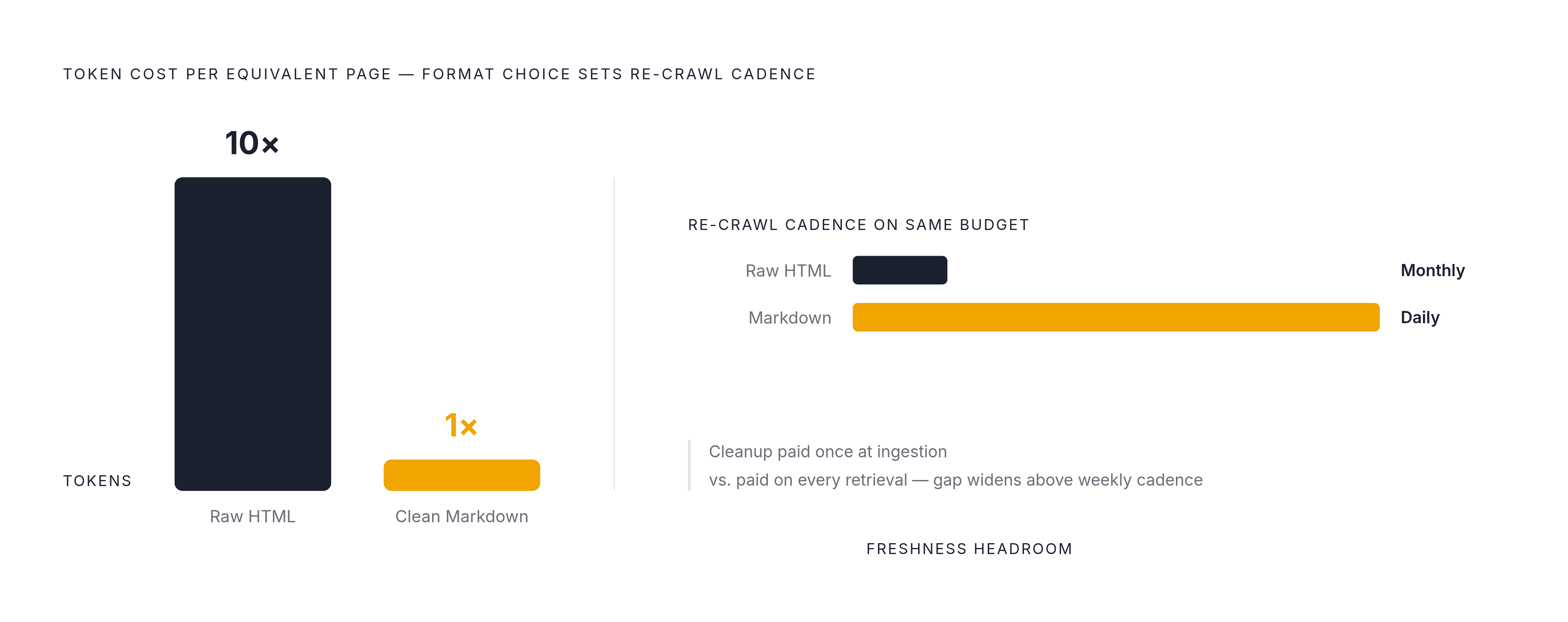
Format decisions compound freshness costs in a way you can miss until the bill arrives. At high re-crawl frequencies, the token cost gap between raw HTML and structured Markdown is what decides whether frequent re-indexing is affordable at all. A webpage rendered in HTML eats roughly ten times the tokens of the same content rendered as Markdown, and at high crawl frequency that ratio is the line between a freshness cadence a team can sustain and one that quietly bankrupts the project.
If you feed a model raw HTML, you pay for markup tokens it has no use for, so per-page inference cost goes up without making a single answer better. Production guidance on RAG architecture is consistent on this point: save crawled content as Markdown, and strip the navigation bars, footers, sidebars, and cookie banners at crawl time, not at query time. Doing the cleanup once, at ingestion, is cheap. Doing it on every retrieval is a tax that gets charged repeatedly, since each query re-triggers the same cleanup work.
That's the real trap in cleaning at query time instead of crawl time. A team that crawls to raw HTML and defers cleanup to the query stage is paying the format tax on every single retrieval, not just once at ingestion, and that cost compounds fast once the freshness cadence gets tighter than weekly. So when you choose an output format, you're really choosing a crawl frequency ceiling. Pick HTML and accept a slower, costlier refresh cycle. If you pick clean Markdown, you buy headroom to re-crawl far more often for the same budget.
The anti-bot environment as a structural threat to freshness
Freshness also runs into an opponent that has nothing to do with scheduling algorithms: the modern web is actively hardened against being crawled at all, and that hardening is getting more sophisticated every year. The harder a page is to fetch, the wider the gap grows between verified-current snapshots, and that gap is exactly the freshness budget a pipeline is trying to protect.
Detection and blocking systems have gotten sharp enough that keeping stable, high-frequency scraping access at scale is a real operational challenge on its own. A crawl that completes but pulls back a cached or rate-limited version of a page looks, at the run level, identical to a clean successful fetch. That's precisely the scenario document-level content hashing exists to catch, because run completion alone tells a pipeline nothing about whether the content actually changed.
The anti-bot environment doesn't tax every page equally, either. It hits hardest where freshness matters most: pricing pages, news, and product listings are the pages a team most wants to re-crawl frequently, and also the pages most aggressively defended against being re-crawled. Teams running self-hosted crawling infrastructure at very high page volumes also face compounding maintenance overhead from both shifting anti-bot defenses and legal uncertainty around scraping. Managed crawling infrastructure absorbs a meaningful share of that complexity for teams that don't want to run this arms race in-house, which is one reason the build-versus-buy calculus tilts the way it does once volume gets high enough.
AI agents as a new class of freshness-signal consumer, not just crawl operators
Everything so far has treated freshness as a problem that belongs to whoever runs the crawler. That framing is only half the picture now. AI agents aren't just crawling the web outbound anymore; they're also arriving at pages inbound, as consumers that expect fresh, machine-readable signals the same way a search engine bot would.
The shift happened fast: Anthropic's Computer Use public beta launched in October 2024, OpenAI Operator followed in January 2025, Google Chrome's auto browse feature rolled out to US Google AI Pro and AI Ultra subscribers by August 2026, and Anthropic took Claude in Chrome to general availability on August 26, 2026.
That changes what "freshness infrastructure" needs to serve. Sitemaps, Last-Modified headers, and structured data used to be tuned mainly with search engine bots in mind. Now they need to work for AI agents too, and the failure mode is subtle: an agent that fetches a page carrying a stale Last-Modified header may simply decide not to re-fetch it, even though the underlying content changed since that header was last updated. The header lied, essentially by accident, and the agent believed it.
Tracking this properly means a framework built around coverage, meaning which priority URLs actually got fetched by AI bots in the last N days; recency, meaning how fresh the last crawl is for the pages that matter most; and the AI visibility gap, which flags pages getting cited by AI systems despite low crawl activity, or conversely pages getting crawled heavily but never cited. That third measure is the one most teams haven't thought to build yet, and it's often the one that reveals the biggest mismatch between what a site assumes AI systems are reading and what they're actually reading.
What freshness observability looks like inside an AI pipeline
Freshness doesn't report itself.
That framework is necessary for an AI pipeline, but not sufficient on its own. A sixth pillar, semantic integrity, has to sit alongside it to catch the case where a field passes every structural check in the book while the actual business meaning behind it has quietly shifted. Structural monitoring checks whether data arrived in the expected shape, on time, in the expected volume. None of that tells you whether the definition behind a metric is still the right one.
Inside this framework, freshness monitors whether data shows up within the window downstream consumers expect. For an AI pipeline, a metric definition that hasn't been updated in many months counts as a semantic freshness violation, even though every structural check on it comes back green. The dashboard says healthy. The agent's output says otherwise.
Schema drift sits right next to this as a companion risk. A selector built to extract a given field needs testing against the live page structure on every run, not just at setup. A selector that suddenly matches zero elements on a page that used to have content there is a drift signal, and treating it as a quiet success lets stale or broken extractions slip past monitoring undetected.
For RAG applications specifically, a query-time safeguard is flagging thin domains, where retrieved context is sparse or low-confidence, and surfacing a confidence signal to whoever or whatever is consuming the answer. None of these checks, on their own, catch everything. Stacked together, document hashing, source-level SLA thresholds, schema drift detection, and semantic freshness monitoring form the layered defense that keeps a pipeline's confident answers actually matching what's true on the live web, which is the entire point of building the thing in the first place.