Sitemap Generation and Automated Site Mapping
AI crawlers now rely on sitemaps for training data, making accuracy critical.

Sitemaps used to be a box you checked for Google. They are the primary discovery layer for AI crawlers and automated ingestion pipelines, not only for search engines, which is a very different job than the one they started with. Two forces are pushing that shift at the same time. GPTBot, ClaudeBot, PerplexityBot, Google-Extended, and a growing list of other bots now read sitemaps the same way search crawlers always have, using them to find and rank pages for training data and for the citations that show up in real-time answers. A sitemap that goes stale, drops a language variant, or simply falls out of date no longer just costs search rankings. It costs AI visibility too; the practical downside of neglecting a sitemap has roughly doubled.
What a sitemap contains for AI crawlers
The XML sitemap protocol has limits most teams don't think about until they hit them, and those limits matter more now that AI crawlers are reading the output. Every sitemap file has a hard ceiling: 50,000 URLs and 50 MB uncompressed, and for image or hreflang sitemaps, the byte limit usually gets hit before the URL count does. Practitioners who build these at scale tend to keep individual sitemap files well under that ceiling, since smaller files process faster on both the crawler side and the generation side. Large sites solve this with sitemap index files, which group individual sitemaps by content type or date range so the whole catalog stays navigable.
Of the metadata fields available, only one still earns its keep: lastmod. Google only uses it when the date is "consistently and verifiably accurate," so a sitemap that skips the field entirely does better than one that fakes it. Quality control matters just as much as the dates. A sitemap full of broken links, redirect loops, or duplicate non-canonical URLs can get a search engine to stop trusting the sitemap altogether and fall back to slower, link-by-link discovery. That same failure now hits AI ingestion pipelines just as hard: feed a crawler garbage URLs and it ingests garbage.
Google deprecated its sitemap ping endpoint after a June 26, 2023 announcement, and as of a test run on August 23, 2026, that endpoint returns HTTP 404 while Bing's equivalent returns HTTP 410 Gone. The current submission path runs through Search Console or the Search Console API, not a ping URL, so any pipeline still pinging is pinging nothing.
How AI crawlers behave when they hit your sitemap
AI crawlers are not one undifferentiated swarm. Each has its own crawl strategy, depth preference, and traffic pattern, and those differences decide what actually gets pulled out of a sitemap. ClaudeBot, for instance, runs at moderate volume and trails GPTBot by a meaningful margin. That assessment is based on a 30-day study of crawl volume and cadence across twelve production sites.
Sitemap structure should match the bot you care about most. Teams building pipelines meant to ingest documentation or API references should expect ClaudeBot to crawl deeper into the structure, while teams optimizing for broad coverage should design sitemaps that put top-level paths front and center.
robots.txt is a request, not a lock, and some crawlers treat it that way. Real protection has to happen at the edge, because an aggressive bot can simply ignore the file. One independent study found that Meta-WebIndexer sent the large majority of its traffic straight to articles and never checked robots.txt at all. That cost appeared directly for at least one developer, whose serverless bill jumped by orders of magnitude in a single month after Meta's crawler generated millions of requests. It is a line item, not a policy debate.
Sitemap-first ingestion versus blind crawling
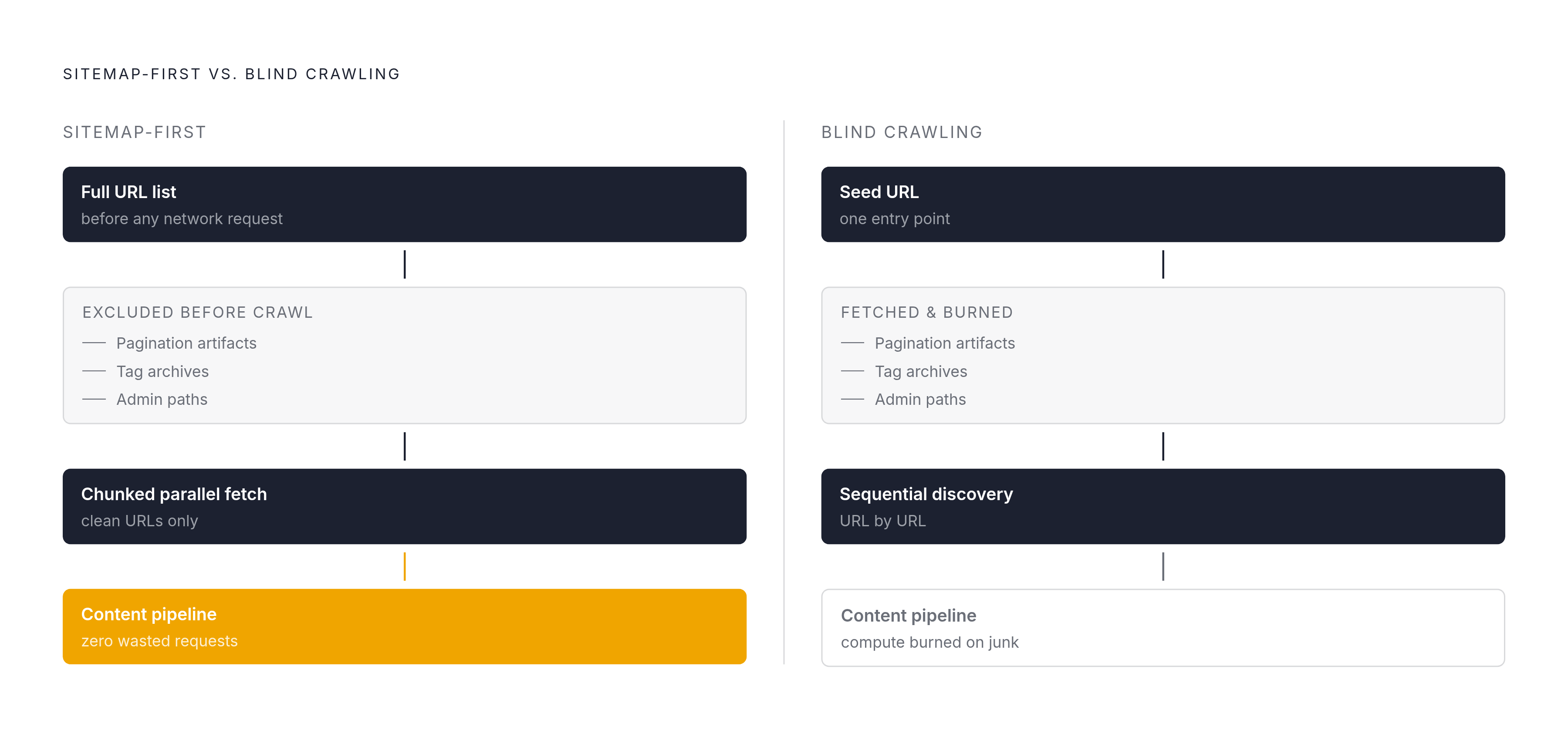
For anyone building a RAG pipeline or an agent that needs to ingest a large site, starting from the sitemap beats starting from nothing every time. The reason comes down to scope. A sitemap gives engineers the full URL list before a single network request goes out, so the work can be chunked, run in parallel, and prioritized from day one instead of discovered page by page as the crawl stumbles forward. A blind crawl, by contrast, burns compute on pagination artifacts, thin tag archive pages, and admin paths that never belonged in the dataset to begin with, none of which would show up in a clean sitemap.
That upfront scope enables a pattern that is becoming standard in AI data engineering: generate selectors once, run cheaply at scale. An LLM writes deterministic scraper code once against the known URL set pulled from the sitemap, and that code runs cheaply afterward without needing a model in the loop for every page. A lightweight agent can watch those scripts and regenerate them when a site's structure changes, which keeps the pipeline reliable without paying the cost of running a full agent on every single extraction. None of it works, though, if the sitemap itself is stale. The entire pattern depends on the URL list being an accurate map of what's actually live, so a sitemap that lies about scope breaks the whole chain before it starts.
Format matters here too. Feeding raw HTML to a language model is a bad idea: the scripts, nav menus, and layout noise bury the actual content and degrade reasoning quality. Markdown has become the standard output format for AI pipelines precisely because it strips all of that away and leaves clean, structured text. And the economics have shifted fast. Structured extraction with frontier models now costs well under a cent per page, and open-source models have made local inference practical on a single GPU. Sitemap-first ingestion was already the more efficient architecture. Now it's also the cheap one.
Automated sitemap generation as a pipeline prerequisite
A manually maintained sitemap on an active site goes stale within days. It can't be trusted as the scope definition for any automated pipeline built on top of it. The failure mode is specific and easy to picture. A site that publishes at 9 AM but doesn't regenerate its sitemap until end of day has already let crawlers, AI and search alike, visit based on yesterday's map, and on a high-frequency publishing schedule that lag stacks up with every single post. A sitemap still listing pages that were deleted weeks ago throws error responses at every crawler that tries to fetch them, and crawlers respond by downgrading trust in the whole sitemap and falling back to slower link-following discovery.
Dynamic sitemaps, the kind a CMS or framework regenerates automatically whenever content changes, solve both problems and are close to mandatory for any site publishing at real volume. Static, manually edited sitemaps simply can't keep pace. For headless or API-driven setups, the most reliable mechanism is a webhook: a publish event in the CMS fires immediate sitemap regeneration and resubmission, with no human in the loop at all.
Automation alone still leaves a gap between the moment content goes live and the moment a crawler gets around to checking the sitemap again. IndexNow closes that gap. Supported by Bing, Yandex, Naver, Seznam.cz and others, IndexNow pushes an instant, URL-level notification the moment a page changes, instead of waiting for a crawler to stumble back onto an updated sitemap on its own schedule. A sitemap is a map. IndexNow is a tap on the shoulder. Running a pipeline on one without the other is like mailing someone a new address and hoping they check their mailbox before they show up at the old one.
The tools available for automated sitemap generation in 2026
The tooling landscape has bifurcated between CMS-integrated plugins that handle publication-triggered updates and crawler-based or API-based tools that give engineers programmatic control over scope, format, and submission.
Sight AI sits in the first camp and is built for teams that want sitemap automation bundled with their content workflow. It's an all-in-one platform connecting AI content generation, automatic sitemap updates, and IndexNow submissions into a single pipeline, so when a piece of content goes out through the platform, the sitemap regenerates and IndexNow fires without anyone touching a separate tool. It also tracks how models like ChatGPT, Claude, and Perplexity mention the brand, with sentiment analysis and prompt tracking across six or more AI platforms depending on the plan. It fits marketing teams and agencies publishing at high volume who want content creation, indexing, and AI visibility monitoring handled in one place, with pricing listed at trysight.ai/pricing and scaled to which of those features a team actually uses.
Yoast SEO covers the zero-configuration end of WordPress. It's the most widely used SEO plugin on the platform, and its sitemap regenerates instantly on every publish, update, or delete, with nothing to configure by hand. It also handles WordPress multisite installs, keeping sitemap behavior consistent across every property on the network without per-site setup. The free version already includes full sitemap functionality, and Premium layers on redirect management and internal linking suggestions.
Screaming Frog SEO Spider is built for technical SEOs and dev teams who want granular control rather than a hands-off plugin. It's a desktop crawler that builds sitemaps from actual crawl data, catching orphaned pages and technical problems before they ever make it into the sitemap file. Scheduled crawls automate the regeneration on a set interval, and a command-line interface lets it plug directly into a CI/CD pipeline. It supports standard XML sitemaps, image sitemaps, and hreflang annotations, with regex-based URL filtering for fine control, and it handles sites with millions of URLs without slowing down.
Each of these solves a different problem: Sight AI for teams that want content and indexing in one loop, Yoast for WordPress sites that want automation with zero setup, and Screaming Frog for teams that want to see the crawl data behind every sitemap they ship. Picking between them comes down to where the sitemap sits in the pipeline, not which one is objectively faster.