Production AI Pipeline Requirements That Disqualify Most Scraping APIs
AI agents need fetch layers that return clean, fast, complete data or fail visibly.

Production AI pipelines need scraping APIs that return content they can use on time, render the data that is on the page, and keep failures from derailing an agent. Clean output, synchronous responses, complete rendering, failure containment, and inspectable metadata are disqualification tests. An API that fails one cannot make up for it by excelling at the others.
Why AI pipelines impose a different contract on the fetch layer than traditional scraping ever did
Traditional scraping had a largely binary test for success. Did the data arrive? A CSS selector ran, rows landed in a database, and an asynchronous job could take its time without holding up a reasoning process. The fetch layer’s job was to deliver material for later use. What happened between the request and delivery was often an operational concern.
An agent operating in a ReAct loop has a different dependency. It blocks on external I/O because the next reasoning step needs the result of the current tool call. RAG pipelines also need fetched content in a form the model can use, beyond a sign that a server answered. Delivery alone is no longer enough. The orchestrator imposes a contract on the fetch layer, and every call must satisfy that contract before the pipeline can proceed usefully.
Raw HTML output as the first disqualifying property
Raw HTML gives an LLM far more of the code that runs a page than of what the page says. Nested containers, navigation menus, cookie banners, and JavaScript loaders compete with the content the model was asked to understand. The model gets the scaffolding with the building. That noise consumes tokens and floods the attention mechanism with material that does not help the task. Returning a page successfully can therefore be a poor substitute for extracting its content.
The cost follows the noise downstream. A typical web page contains mostly material other than its core content, so an API that returns only HTML imposes a processing burden on each inference call that receives it. This is not a one-off formatting nuisance. When the pipeline repeatedly passes that material into the model, the token expense recurs while the reasoning process must keep separating useful text from page furniture. The output format affects both the bill and the quality of the input.
Clean Markdown suits context windows, RAG ingestion, and LLM readability, while structured JSON suits data pipelines and recurring analytics. Schema-based extraction serves a narrower requirement when the pipeline must enforce a specific object shape. These formats do different jobs. Raw HTML remains defensible when the team owns and maintains downstream parsing, but that means the API has not performed the extraction work the pipeline needs. For a managed service meant to remove that burden, native Markdown or structured output is the first gate.
Synchronous latency as a hard ceiling for agentic loops
Once the output is usable, it must arrive in time for the agent to use it. Every scraping call pauses a synchronous reasoning chain, so slow responses inflate the user’s wait for the first token. The agent cannot think past missing evidence. An API designed around triggering a job, polling its state, and retrieving a dataset adds a workflow between the tool request and its result. That workflow may work well for data harvesting but clash with how the agent runs.
Batch-oriented APIs are unsuitable for a loop that needs the fetched result before it can choose its next action. The relevant comparison is therefore architectural. An asynchronous handoff does not become a synchronous tool result simply because both eventually deliver content. The waiting remains part of the reasoning path.
Some agent tasks can tolerate a slow call. That objection holds for a single wait, but it weakens when a multi-hop task pays the same delay at every step. TLS negotiation, JavaScript execution, and payload delivery can each sit between the agent and its next decision. Repetition turns tolerable delay into an unusably slow research task. Low, predictable latency consequently depends on warm pools of headless browsers maintained between requests, avoiding a fresh browser startup for every call. Browser lifecycle management is part of meeting the timing contract.
JavaScript rendering with network-idle awareness as a baseline, not a premium feature
A fast response is still useless if the requested data has not arrived in the page. Modern web applications often fetch that data through XHR requests after the page first loads, especially in single-page architectures. The initial HTTP payload may contain only the shell. A scraper can therefore return a structurally valid empty document without reporting an error or throwing an exception.
Partial JavaScript rendering creates a particularly misleading version of this failure. Executing scripts does not establish that the asynchronous data requests have settled, so an initial render can look like completed work while still lacking the information the agent needs. A clean error gives the pipeline a visible failure to handle. A content-empty success can instead reach the model and produce confidently wrong output that reaches users.
Complete rendering requires management of the headless browser lifecycle, waiting for network idle states, and capturing the fully rendered DOM. A switch that turns on JavaScript falls short of that requirement. The distinction is between starting page execution and collecting its usable result. For targets dominated by single-page applications, an API that stops at the former fails the rendering filter even if its response is valid in every other respect.
This requirement also connects rendering fidelity to latency. A headless Chromium process has substantial RAM overhead, and starting a new instance for each request is not viable at meaningful scale. Session pooling belongs in the production design. Intelligent routing between lightweight and heavyweight paths also helps match the work to the page, rather than treating every request as a reason to launch the same expensive machinery.
Anti-bot failure handling that never propagates exceptions back to the orchestrator
A fully rendered response can still be the wrong page. When an API treats a Cloudflare interstitial or a 403 as a successful content response, the orchestrator receives bot-detection material in place of the requested information. The agent then tries to extract product data from a CAPTCHA screen. It is an absurd assignment. The fetch layer has failed while presenting the model with something that looks available for use.
That disguise makes failure propagation more damaging than a stopped request. Because the orchestrator cannot see the failure, the agent continues planning around bad input and burns tokens treating challenge content as signal. Without a stop condition, retries can continue indefinitely. A runaway retry loop becomes a major cost driver because the pipeline keeps paying to revisit a problem it has not identified.
The API boundary must contain the anti-bot work. Resolution should happen inside the service before a response reaches the caller, rather than leaving the orchestrator to detect challenges and triage raw infrastructure errors. When that work fails, a structured error must make clear that the response is a failure rather than extracted content, while keeping an unhandled exception from derailing the loop.
An API that delegates bot-detection handling to the application transfers infrastructure responsibility back to the team. That defeats a central reason for using a managed service. Resilience belongs in the same contract as clean output and synchronous delivery, because the agent needs all three to use the result at all.
Observability and structured metadata as requirements for debugging inside an autonomous loop
Contained failures still need to be inspectable. An autonomous pipeline has no human watching each fetch, and a bad input can influence several reasoning steps before the final answer exposes the problem. There is no convenient shoulder to tap. Debugging only the answer leaves the team searching backward through a chain whose earlier failures may already have compounded.
Every response therefore needs status, timing, retry, and cost metadata alongside extracted content. Those fields let engineers tell a rendering timeout from an anti-bot block or malformed extraction without having to replay the whole run. A nominally successful response is not enough if the team cannot tell what happened while producing it.
This becomes more important as scraping calls recur throughout the loop. LLM call chains are already prone to errors, and fetch failures add to those problems as they spread through the chain. Even a moderate scraping failure rate can have a disproportionate end-to-end effect. Observability lets the team find the step that went wrong, with more to go on than the final wrong answer.
Does the scraping API support MCP natively, or require glue code?
The Model Context Protocol is an open standard through which agents discover and invoke external tools using a unified interface. A native MCP server lets an agent discover available tools, read their schemas, and invoke scraping, crawling, and search as first-class tool calls. The protocol becomes the integration. That is a different arrangement from making the team build a separate bridge between its agent framework and each scraping endpoint.
Without native support or an equivalent agent-native integration, the team owns that bridge and its maintenance. Custom glue code reintroduces the fragmentation a unified API was meant to remove. If the service needs caller-owned parsing, post-processing, and tool integration before an agent can use it, it has left much of the original problem with the caller.
A tool schema is useful only if the invoked operation returns suitable content, meets the loop’s timing needs, renders the target correctly, and makes failures inspectable. Adding an MCP surface to a raw-HTML proxy endpoint does not establish any of those properties.
Native MCP support is therefore a useful proxy test. APIs built for agents tend to meet these requirements so their tool interface can work reliably, while APIs adapted for agents may carry old limits into a new protocol. The practical use is pre-screening. MCP presence or absence gives a team a quick architectural signal before it evaluates output, latency, rendering, failure containment, and observability in depth.
Applying the filters as a sequential disqualification checklist
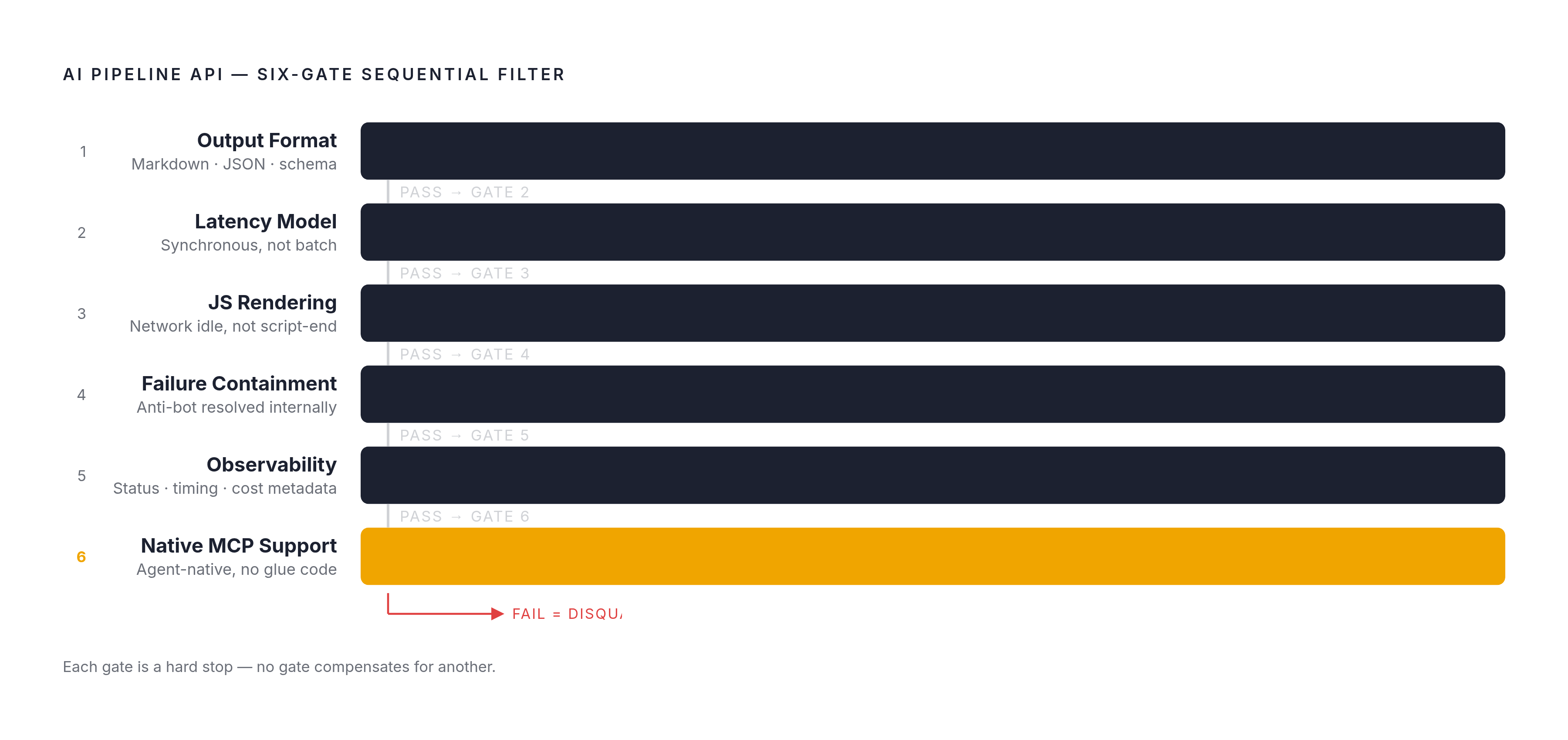
Begin with output format and reject an API that cannot natively return clean Markdown, structured JSON, or schema-based extraction. Then examine the latency model. A batch-first service is disqualified for synchronous agent-loop use, regardless of how attractive its completed datasets may be.
Next, test whether JavaScript rendering waits for network idle after it runs the scripts. Without that behavior, the API is disqualified for targets dominated by single-page applications. Follow with failure containment, asking whether the service resolves anti-bot challenges internally and returns structured errors when it cannot succeed. A CAPTCHA is not a product record. The orchestrator should not have to discover that distinction after the model has already tried to use it.
The fifth gate is observability, requiring status, timing, retry, and cost metadata on every response that the team can inspect without replaying the run. Missing metadata disqualifies the service for production use. Finally, check for native MCP support or an equivalent agent-native integration. This protocol check identifies who owns the remaining integration layer rather than excusing failures in the five underlying requirements.
These filters apply within the right tool class. Static public pages can be served well by lightweight open-source tools, while managed APIs are justified for JavaScript-heavy or moderately protected targets. Enterprise platforms are needed for targets that are high-volume, geo-sensitive, or strongly protected. The production filters apply to those managed and enterprise tiers, while a simple fetch need not turn into a search for an enterprise platform.
Most scraping APIs were designed before these requirements existed. Their original job was to collect data. That explains the high disqualification rate. The bar has not been unfairly raised so much as attached to a different job.
Sources
- The Agentic Web Requires New Normative Infrastructure
- Infrastructure for the Agentic Web: Gap Analysis and Architecture from the Agentverse Platform
- Search Depth vs. Latency in AI Agents: How Deep Should Your Agent Search?
- Browser Run: give your agents a browser
- Best Anti-Bot Bypass Tools for Web Scraping in 2026
- What Is Agent Observability? A 2026 Developer Guide
- Agentic Services Computing
- How to build AI agent observability that catches agent failures - Vercel