Data Cleaning and Normalization After Web Extraction
A staged pipeline turns messy scraped records into data AI can trust.

Getting LLM-ready structured data from web pages takes more than turning HTML into text. Data cleaning and normalization after web extraction turn inconsistent fields, noisy content, and duplicate records into data an AI system can reason over. The reliable approach is a staged pipeline that validates incoming records, cleans and normalizes them, checks their quality, and delivers structured output with provenance.
Why raw web extraction leaves AI pipelines with unusable data
The web is a distributed publishing environment. Its inconsistency is structural. Each publisher chooses its own fields, formats, and page layouts. One site calls a field cost, another calls it price_usd, and a third calls it amount_inc_tax. Those labels may conceal differences in meaning, so renaming them without checking their meaning gives an agent tidy-looking confusion.
The same problem appears inside individual fields. “Jan 12th, 2026” and “a few days ago” both express time, but neither arrives in a consistent format that a pipeline can sort or compare. Dynamic JavaScript and inconsistent HTML can also leave products without SKUs or descriptions, and reviews without ratings. A successful fetch is not a complete record.
The 360Zhinao technical report found that content taken from structured web pages still has a lot of junk text. Navigation menus, cookie banners, and footer links consume context space without helping retrieval. An LLM does not need the cookie banner’s life story. Cleaning must separate useful content from the rest of the page, even when the scraper has returned something.
What breaks downstream when dirty data enters an AI pipeline
In a RAG pipeline, retrieval determines what evidence the model receives. Wrong formats, missing values, and duplicate records can skew that evidence before the LLM starts to reason. A chatbot may then produce a wrong price, or an agent may return an incorrect specification, from context that appears perfectly respectable. Fluent output can hide a broken input. The failure is not necessarily in how the model reasons, but in what it has been given to reason over.
Once bad records have been indexed and embedded, the damage becomes harder to isolate. The system can keep retrieving wrong or incomplete context without an obvious processing failure. Duplicate content also distorts the information available to the model, while errors in a training or fine-tuning corpus can generalize beyond their original records. Small defects gain a much wider audience. That is why cleaning belongs before ingestion into these downstream systems, rather than after someone spots an embarrassing answer.
The cost is asymmetric. Preventing a malformed record from entering an index is cheaper than rebuilding corrupted embeddings, just as correcting a training corpus first is cheaper than retraining later. Manual cleanup also diverts engineering and analytics effort from the work the pipeline was meant to support. Cleaning is a correctness requirement.
The seven-stage cleaning pipeline and what each stage actually does
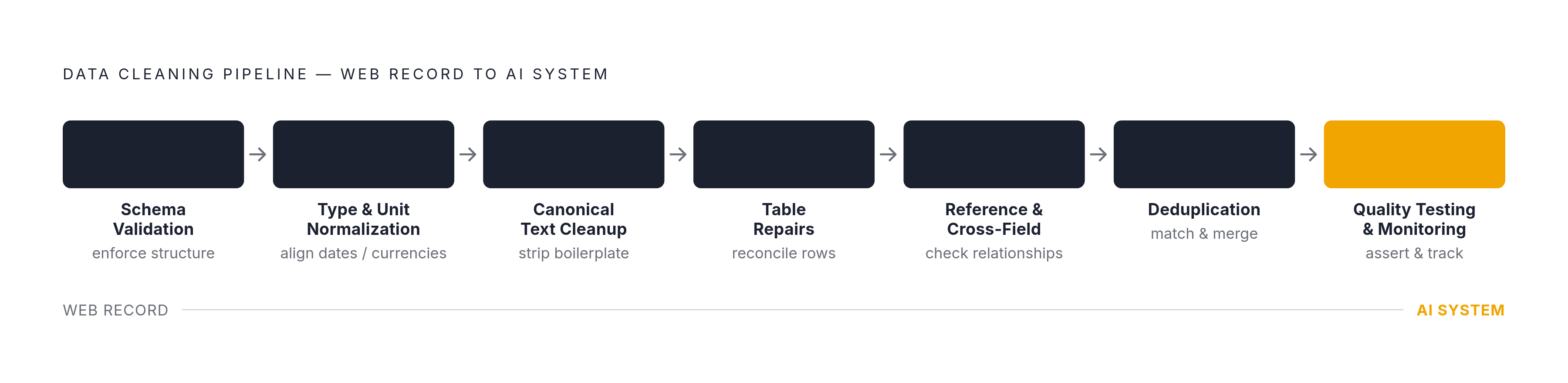
The sequence begins with schema validation, which checks whether incoming JSON or CSV matches the expected structure. JSON Schema and Pydantic provide ways to enforce this boundary, with Pydantic fitting Python-native workflows. A string arriving where a number is required must be caught before it reaches later processing. Across the broader system, the flow runs from API through validation, cleaning, and QA to the warehouse.
The second stage is type and unit normalization. It converts raw values into the target schema’s formats, including ISO 8601 dates expressed as YYYY-MM-DD, consistent decimal separators, and standard measurement units. Currency symbols are removed, with conversion to a base currency where required. Field names are aligned here too. Mapping cost, price_usd, and amount_inc_tax to one canonical field requires compatible meaning, while relative dates require enough context to resolve them.
The third stage, canonical text cleanup, removes the mess inside otherwise usable fields. It normalizes casing and Unicode, collapses excess whitespace, and strips HTML tags or scripts that escaped extraction. It also removes boilerplate such as ads, copyright notices, and related-content recommendations. The report shows how heuristic rules and classification models are used for paragraph-level and document-level cleaning. This stage comes after structural normalization so that the fields have a consistent shape by the time their strings are clean.
Table repairs are the fourth stage because multi-row data needs more than clean text. Headers must agree across sources, line items must align, and totals must reconcile. Invoices and product listings can have columns out of place even when each value looks valid. The relationships are the problem here. Repairing them before cross-record checks prevents later stages from judging values in the wrong positions.
The fifth stage checks references and cross-field consistency. A vendor ID must exist in the vendor table, a currency code must be a valid ISO code, and an inventory count must not be negative. Individually valid fields can still contradict one another. These checks therefore test the record as a connected whole, after its types, text, and tabular relationships have been repaired.
Deduplication comes sixth, after earlier stages have made records more alike in how they look. Exact matching compares identifiers such as SKUs, product IDs, or URLs, while fuzzy matching catches typos and slight text variations. Not every repeat is a duplicate, however. The process must preserve legitimate repeats and retain the most complete or authoritative version when several sources supply the same record. Source tracking supports that choice rather than leaving it to whichever record arrived first.
The seventh stage is quality testing and monitoring. Automated assertions flag defects before production, while trends in missing values, duplicates, and anomalies reveal deterioration over time. Great Expectations supports these checks on batch pipelines, and detailed cleaning logs support debugging and auditing. Scale also affects how this sequence runs. Apache Arrow or Parquet can improve memory efficiency and processing speed during cleaning, while Pandera provides schema enforcement across Pandas, Polars, Dask, and other DataFrames.
Where rule-based cleaning breaks and what LLMs can actually fix
Deterministic rules work well for sources that stay the same and supply a lot of data. A traditional pipeline parses the DOM with XPath or CSS selectors, cleans fields with regular expressions, and maps the results to a target schema. It is fast and precise when the expected structure holds. Then the website changes its layout. Selectors can break, site-specific regex patterns may fail elsewhere, and the growing patchwork becomes hard to understand.
A regex can match a known phrase, but it cannot infer unfamiliar intent in the way an LLM can. “Ships within 2 business days” expresses shipping time, while “Call us at 800-555-1212” supplies a support phone number. The wording does not announce the schema. LLM-assisted normalization can bridge that gap by interpreting content and producing fields under explicit constraints.
For example, an LLM can receive a cleaned HTML chunk and instructions to return name and brand as strings, price_usd as a number, and shipping_time_days as an integer. Availability can be constrained to IN_STOCK, OUT_OF_STOCK, or PREORDER. AI-assisted normalization can also identify probable duplicates and adapt to format variation, while AI-assisted extraction can recognize equivalent page elements when structures change.
That flexibility has a bill attached. LLM processing is slower and more expensive per record than deterministic rules, and reliability is harder to guarantee at scale. Calling a powerful model for every record across millions of pages can be prohibitive. The practical recommendation is a hybrid pipeline. Use deterministic rules for stable structured fields, reserve LLMs for semantically complex or cross-site content, and keep their output subject to the same validation gates.
How do you get web content into a format your LLM can actually use?
Markdown is useful for preparing web content for LLMs, particularly in RAG systems, but readable text is not automatically a good canonical record. A Markdown blob can flatten relationships that structured chunks and metadata preserve. That affects how well a system can retrieve the right evidence. The practical choice is to keep JSON or an equivalent structured object as the authoritative cleaned record, then derive Markdown, plain text, or prompt-ready chunks at indexing or query time.
An agent that reasons over named fields gets a consistent schema, while a retrieval step that works with text gets data in a form it can use. JSON, CSV, and API feeds also fit downstream analytics and machine learning workflows. Metadata belongs in that design from the start. Source URL, extraction timestamp, and schema version let a retrieval system assess freshness and authority rather than treating every chunk as equally current and trustworthy.
Live-web pipelines also need a way to avoid repeating unchanged work. SHA-256 content hashing supports re-embedding only pages whose content has changed, reducing vector API costs without full re-indexing. A page that has changed still needs to go through the cleaning sequence.
For teams that want usable content without building every cleaning step themselves, the delivery API becomes part of the engineering decision. The relevant criteria include clean Markdown or structured JSON output, reliable delivery, and a developer-friendly interface. No format alone removes the need for task-specific checks. An API can reduce the cleaning burden at extraction, but its output must still fit the consuming agent’s schema and quality requirements. That boundary needs monitoring, even when the response looks clean.
Monitoring cleaned data pipelines for drift, PII, and silent degradation
Web sources change without consulting the pipeline owner. SKU formats shift, new feeds add currency symbols, category labels change, and page redesigns alter what extraction returns. These changes need not cause a visible failure. A pipeline can continue running while its output becomes less useful, so operational success must mean more than “the job finished.”
The monitoring layer should track trends in missing values, duplicates, and anomalies. Those signals can reveal upstream changes before degraded records spread through production. Batch assertions check data automatically, without waiting for someone to have time to look at a sample. Logs make the diagnosis possible. Recording cleaning operations gives teams a basis for tracing silent failures, refining rules, and supporting compliance requirements.
PII requires its own filtering at the pipeline boundary. Web-extracted content can contain personal information, and many tool responses in agentic pipelines arrive without built-in PII filtering. This is especially relevant to tool-calling and MCP integrations. Publicly accessible does not mean ready for unrestricted agent use. Input and output filtering should redact PII before it reaches agents and mask sensitive fields in tool responses.
Monitoring also has to distinguish broken collection from meaningful source changes. In pricing monitoring, competitive intelligence, or market-trend work, a changed value may be the signal the system exists to detect. The task is not to scrub away every surprise. A unified platform combining extraction, cleaning, and change-monitoring can reduce failure points and the burden of watching fragmented tools, while keeping data quality and actual content changes in view.
Building the cleaning pipeline as permanent infrastructure, not a one-off script
A one-off script fixes today’s sample, while infrastructure deals with tomorrow’s changes at the source. The distinction is automation, monitoring, and integration with the extraction layer. Cleansing belongs at the ingestion boundary, before defects reach indexes, embeddings, or agent workflows. Continuous collection then feeds automated normalization, quality checks, anomaly detection, and structured delivery as one maintained system.
Fragmented tools can make that system harder to operate. Separate scrapers, cleaning scripts, deduplication jobs, and monitoring dashboards multiply integration points and engineering overhead. A unified API can reduce that burden, particularly when it returns clean Markdown, structured JSON, or AI-ready answers at extraction. It does not abolish the quality contract. The fields an agent reasons over still need checks suited to the task, regardless of which service prepared them.
The lesson for teams building these pipelines is to prioritize critical fields and give them the strictest validation. Over time, refined rules, new drift checks, and an evolving schema make the infrastructure more useful.