Google AI Overviews Impact on Organic Traffic
Being cited in an AI Overview now matters more than ranking position.

Google AI Overviews’ impact on organic traffic is a structural split. Queries with an Overview and queries without one now offer different chances of winning a click. For teams adapting to that split, the decisive question is no longer just where a page ranks, but whether Google cites it in the answer above the results.
How Google AI Overviews mechanically suppress organic clicks
An AI Overview changes what a searcher needs from the results page. Instead of presenting links that lead to an answer, Google supplies an answer on the page itself. When that summary satisfies the query, visiting a source becomes optional. The answer has arrived before the website gets a knock at the door.
That mechanism applies when an Overview appears. A query without an Overview does not have this particular answer layer standing between the searcher and the organic results. The distinction matters because longer queries and questions trigger Overviews at substantially higher rates. These are also the searches that informational content has historically served to build authority and reach people early in their decision process. Exposure therefore follows the shape of a content strategy.
This makes the breadth of Overview coverage central to understanding traffic. A site built around answering questions can face repeated exposure across its core content, rather than an isolated change on a few results pages. Treating all those queries as part of one undifferentiated search environment hides the mechanism doing the damage.
The two traffic realities the data reveals
Ahrefs’ December 2025 analysis of hundreds of thousands of keywords found that the position-one organic result loses more than half its average clickthrough rate when an Overview appears. The finding describes an association, not a promise that every page will lose the same share of clicks. Even so, the pressure falls hardest on the position that historically captured the largest share.
Pew Research’s behavioral data from a panel of US adults in March 2025 shows the same split from the searcher’s side. Users who encountered an AI summary clicked a traditional result far less often than users who did not. Clicks on links within the Overview itself were nearly negligible. Together, these findings describe two separate clickthrough-rate environments, rather than one search market experiencing a general slowdown. Taking their average is like reporting the weather halfway between a rainstorm and a sunny day.
Seer Interactive’s early-2026 update adds an important qualification. Clickthrough rates climbed from their December 2025 floor, so the rebound is real and belongs in the account. Seer attributes it to a Google search results page change. Ahrefs’ position-one data through December 2025, meanwhile, showed worsening losses into that floor. The rebound tempers the picture without erasing the structural split or establishing that the underlying problem is resolving.
Why ranking position no longer predicts whether you get cited or clicked
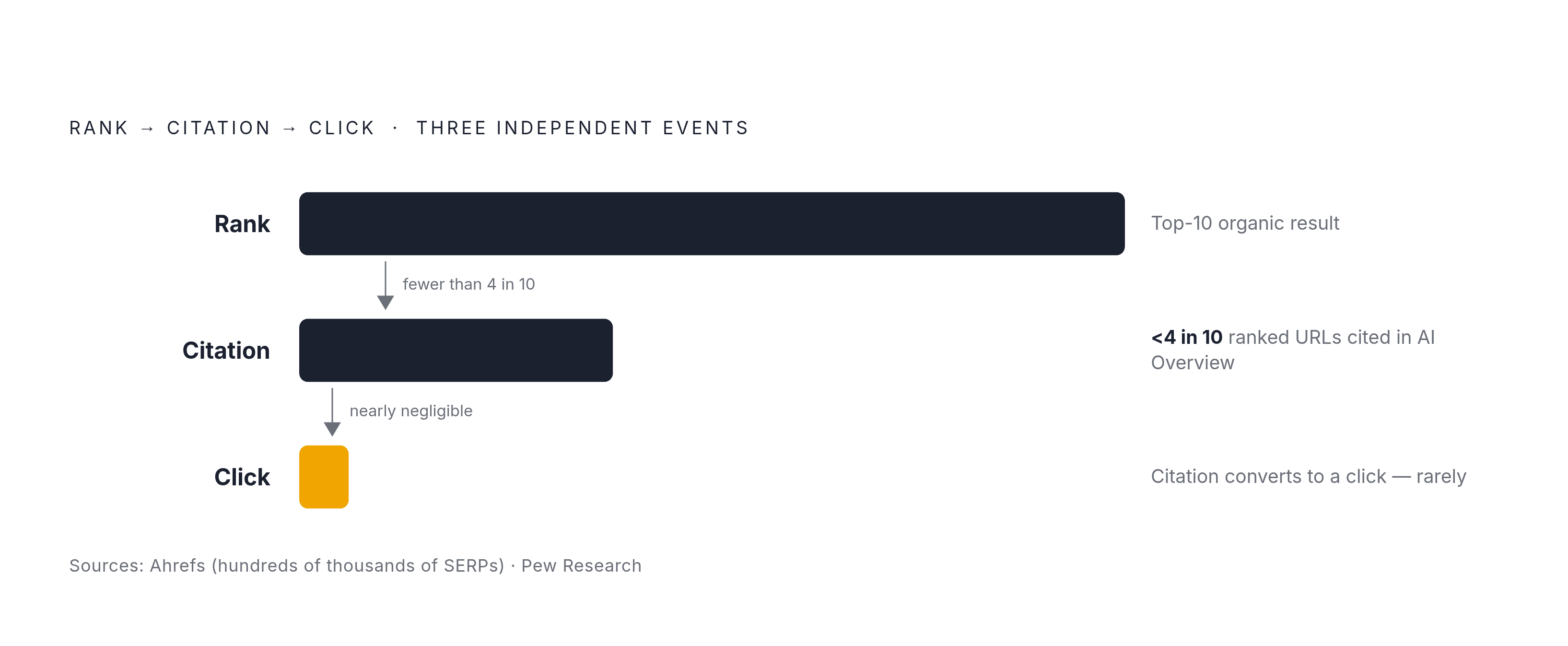
The deeper break is between organic rank and AI visibility. Ahrefs’ citation analysis across hundreds of thousands of keyword results pages and millions of AI Overview URLs found that fewer than four in ten cited URLs also appeared in the top-ten organic results. The Overview is not simply a condensed version of the organic leaderboard. Winning a place near the top of that leaderboard does not establish that a page will appear in the answer.
This breaks the central assumption behind ranking-first SEO. A team can hold the top organic position for a query and still be absent from the Overview above it. The page has won the contest the team measured, but not the placement that now sits between the searcher and its result. Rank, citation and click are separate outcomes. Treating the first as a reliable proxy for the other two conceals the change.
Authoritas’ data shows that the separation is also unstable over time. Over a two-to-three month period, the majority of pages cited in AI Overviews changed, without those changes being linked to shifts in traditional organic rankings. Teams watching only blue-link positions may see traffic fall while their rank report stays reassuringly green. The dashboard is watching the wrong door.
What being cited in an AI Overview is actually worth
Seer Interactive’s 2026 update found that cited pages got far more organic clicks per impression than uncited pages on the same queries. Non-cited brands absorbed the full force of the clickthrough-rate collapse. Once an Overview is present, being included changes the odds materially, without necessarily restoring the traffic available before it appeared.
This finding also fits with what Pew Research found: links within summaries got very few clicks. A low overall tendency to click an Overview link and an advantage for cited pages are different measurements. The former describes search behavior, while the latter compares performance within the affected environment. The pie can shrink while one seat at the table becomes much better than another.
The visitor’s purpose also matters. Someone who clicks through after reading a condensed answer is seeking something beyond that summary, including detail or depth. That makes the traffic worth assessing for what it does after arrival. Tracking how often a page is cited along with its conversion rate tells more than sessions alone.
Who the structural shift is hitting hardest
Informational content businesses face disproportionate exposure because the searches they serve are especially likely to trigger an Overview. Publishers, content-led SaaS businesses and media properties have built audiences by answering questions. When Google gives those answers directly, readers have less need to visit the source. The vulnerability sits in the match between the query and the summary. Established authority does not remove that mechanism.
Within B2B SaaS, blog, glossary and comparison pages typically sit in the highest-exposure zone. Each serves a reader looking for an explanation or help understanding a choice. Pricing and navigational pages are more insulated because their query patterns differ. A stable part of the site can coexist with substantial pressure on the content that once brought new readers in.
Scale offers no automatic immunity either. A large library of informational pages can represent a broad set of exposed queries. That changes how the library’s performance should be interpreted. A decline across question-led pages says something different from a decline across every page type. The useful distinction is where the answer layer replaces a visit.
Why teams optimizing for a ranking-first world are now solving the wrong problem
The strategic failure is continued reliance on ranking position as the signal that explains search visibility. Many workflows still move from identifying a keyword to ranking for it and then reporting clicks. That sequence assumes rank does most of the work in getting people to visit. On Overview-present queries, that sequence leaves out whether a page gets a citation.
Think of a team holding position one while its page disappears from the Overview during a citation reshuffle. Its rank report shows no corresponding movement, but its traffic can fall. Search Console impressions and position alone cannot show that the page lost its citation. The workflow has no observation for the event that changed its exposure. More attention to the same ranking report will not supply the missing evidence.
Click totals have a second blind spot. Content can inform AI-generated answers and influence decisions without producing a session that appears in site analytics. That influence should not be mistaken for a conversion, but neither should an absent visit be mistaken for absent visibility. A sessions-only report collapses those distinct outcomes into one number. It can hide gains in citations and make losses hard to explain.
The diagnosis is therefore narrower and more useful than declaring SEO dead. Traditional ranking remains relevant, especially where no Overview appears. The failure is asking it to explain an answer surface whose citations do not reliably follow organic position. Teams need a workflow that measures the placement they are trying to win.
What adapting to the citation economy actually requires
Adaptation starts with how content answers a query. A direct, query-answering summary near the opening gives the answer a clear place in the document. The page can then develop the depth that a reader may want after the summary.
How content is delivered matters because AI systems retrieve it in separate chunks instead of reading every page as one continuous essay. Less superfluous JavaScript, more resolved HTML and cleaner data surfaces make the content easier for AI reading systems to retrieve. Schema markup also serves as a citation legibility signal across AI Overviews, AI Mode responses and other AI answer surfaces. Together, structure and delivery help make content readable by the systems selecting material for answers.
Measurement then needs to reflect the split. Teams should track citation frequency and share of voice in AI responses as well as raw click volume. Conversion rate and engagement help establish the value of the visits that follow, rather than treating every lost session as an identical loss. Keeping Overview-present and Overview-absent queries distinct makes these measures interpretable. Otherwise, a combined traffic total can hide both citation progress and continued suppression.
That measurement requires current evidence of what Google is surfacing. For teams building AI pipelines, real-time search results monitoring and structured web data provide the infrastructure for tracking citations. Traditional analytics tracks visits to the site, while citation monitoring tracks where the site is cited outside it. Both are needed to explain the gap between being used in an answer and receiving a visit. Citation-aware strategy becomes operational when that gap is something the team can observe.
What the Google AI Mode trajectory means for teams planning beyond 2026
Google AI Mode extends the same mechanism into a more conversational, agent-driven search experience. Its steeper zero-click behavior points toward a compounded version of the current problem. AI Overviews are therefore a waypoint rather than a final design teams can optimize around indefinitely.
Information Agents add another kind of reader to that environment. A Googlebot visit establishes what a page says at a point in time, while an Information Agent monitors for changes related to a user’s question. The distinction makes freshness and update cadence relevant to whether information is worth surfacing. Static evergreen content may remain correct yet lose citation visibility if it does not register as current to an agent following a live interest. Correctness and currency are related, but they are not interchangeable.
Real-time monitoring, citation tracking and structured data pipelines help teams see what answer systems select and how that selection changes. Building those capabilities now prepares a team for more than the present Overview layout. It creates a way to understand visibility as search becomes less dependent on a source visit. Teams that distinguish the two traffic realities today are better positioned to plan for a world in which being found, being cited and being clicked are increasingly separate events.