Generative Engine Optimization Fundamentals
Retrieval eligibility, not ranking position, determines whether AI systems cite your content.

Generative Engine Optimization prioritizes becoming a source an AI retrieves and trusts over climbing a ranked list. That distinction changes the work for developers and content teams. The priority is to make content accessible, relevant, and usable as evidence, then measure whether it enters the answer and survives synthesis intact. Polishing a page that never gets retrieved is decorating a locked shop.
Why generative engines select sources rather than rank pages
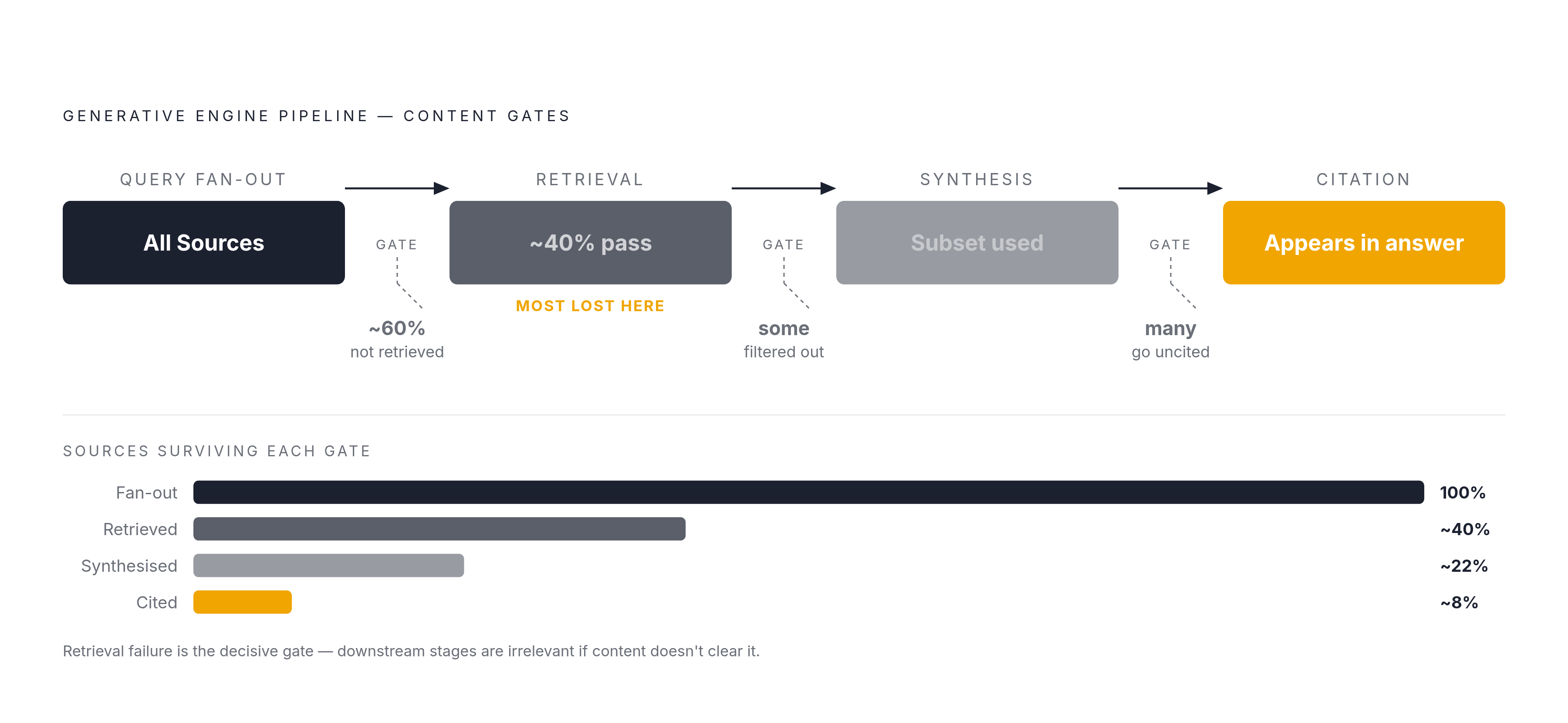
A generative engine expands a question into several sub-queries, retrieves candidate passages, and merges sources into a single response. It then credits some sources through citations while leaving others uncredited. These four stages, namely query fan-out, retrieval, synthesis, and citation, create separate opportunities for content to drop out. The engine assembles an answer from a small evidence pool.
That changes what visibility means. A source must enter the retrieved set before it can contribute to the answer, and entering that set does not guarantee a citation. Ranking still matters within the pipeline, but a page’s position is not the final product the reader sees. For a brand absent from the evidence pool, there is no “page two” waiting patiently for an adventurous click. Inclusion comes before prominence.
Researchers from Princeton, IIT Delhi, Georgia Tech, and the Allen Institute for AI gave the discipline its name with “GEO: Generative Engine Optimization,” published on arXiv in November 2023 and later accepted at KDD 2024. The terminology has been less orderly than the origin story. GEO, AEO, LLMO, AIO, and AI SEO are used interchangeably, with no consensus academic definition separating them as of early 2026. The useful distinction is therefore not between acronyms but between stages of the mechanism. Engines differ in how they retrieve, synthesize, and cite, so each puts the same content through a different selection process.
Why retrieval failure — not reasoning failure — is where GEO outcomes are decided
A study led by a university, published May 2026, tested six commercial chatbots and found that the large majority of their mistakes came from retrieval failures, with reasoning errors making up a smaller share. When the models retrieved the right source, they almost always answered correctly. That finding puts findability and machine-readability ahead of persuasion.
The July 2026 critical survey of GEO describes visibility as a multistage pipeline. Its model starts with search activation and indexing, then moves through retrieval, context allocation, citation, and the effects on users. Improving a later stage does not repair an earlier failure.
The same survey draws a crucial boundary around the foundational Princeton paper’s visibility gains. Those gains apply when a source is already present in a fixed context, so they establish neither organic discoverability nor durable traffic effects. Practitioners therefore face separate problems in sequence, which are getting retrieved, earning a place within context, and being selected for synthesis. Technical and topical signals bear on the first problem, authority and freshness on the second, and extractable evidence on the third. If retrieval is the bottleneck, the first practical task is to understand what lets content through it.
What signals actually govern whether content enters the retrieved set
Retrieval eligibility rests on three layers, which are technical accessibility, topical relevance, and entity authority. Accessibility comes first because content that cannot be crawled or rendered cleanly cannot enter the index an engine draws from. JavaScript-rendered content, login walls, and thin or duplicate pages can get in the way.
Once content is accessible, it must match what the engine is actually seeking. The July 2026 critical survey identifies topical relevance and context position as the two most reproducible levers across the reviewed studies. Relevance must extend to the sub-queries produced during query fan-out. That makes a cluster of related queries more useful as a target than a single phrase. Content needs to answer the related questions the engine retrieves evidence for, rather than repeat the surface question in increasingly elaborate headings.
Entity authority adds clarity about what a brand is and what it knows. Schema markup gives engines an explicit vocabulary for interpreting a page, including Organization, Article, FAQPage, HowTo, and BreadcrumbList in JSON-LD. Structured data can reduce ambiguity and improve entity recognition through the search indexes and knowledge layers engines rely on, even when an engine does not consume the schema directly. JSON-LD is the format to implement, but the markup must be valid. Invalid markup signals poor technical quality and is worse than no schema, so adding it is not a box-ticking exercise. Together, these layers make content eligible for retrieval without guaranteeing that it will be used.
How content must be structured to survive synthesis and earn a citation
After retrieval, the task changes from entering the evidence pool to being useful inside it. A source must contain passages the model can extract, attribute, and integrate without ambiguity. Writing may persuade a reader who follows the whole argument, but synthesis needs evidence that stays clear when taken out of its surroundings. Extractable beats ornamental here. The goal is not to make prose sound more like a machine, but to make its meaning less dependent on guesswork.
Format supports that goal. Markdown is a natural fit for long-form retrieval-augmented generation because headings allow clean splits. JSON fits content that already has a structure, such as product records, and LLMs trained on code and API documentation know its key-value structure. The useful distinction is between a connected explanation and a structured record. Choosing a format that preserves that distinction helps keep the content usable when it becomes part of an answer.
Evidence matters as much as packaging. Citations act as a proxy for confidence because sources that can be traced to authoritative origins are easier to verify and attribute. That favors evidence-backed explanations, clear definitions, and transparent methodologies over unsupported opinion. Generative engines also draw on Reddit and review ecosystems to identify real-world patterns and validate or challenge first-party claims.
These practices still need testing on the specific surfaces that matter to the brand. The July 2026 critical survey finds moderate support for extractable evidence and structure as facilitating factors, while generic heuristics transfer poorly across engines and query types. It also warns that citation-oriented rewrites can impair retrieval when they weaken topical clarity.
What the research actually establishes — and where the evidence runs out
The strongest evidence comes from work on content already in the retrieved set. The July 2026 critical survey concludes that changes to such content can causally alter its citation or use. Within the reviewed research, however, no technique demonstrates a stable, longitudinal, cross-platform causal effect on organic discoverability or downstream behavior.
The survey also reports low source overlap across engines, substantial run-to-run variability, and persistent fidelity gaps in commercial audits. A citation therefore does not establish credibility or show that the generated answer faithfully represents every claim in the source. Success on one engine gives no proof of success on others. These differences matter because a tactic can look convincing in a narrow test while answering very little about deployment. The result and the conditions that produced it belong together.
Metrics and evidence standards also vary across the literature, making “visibility gain” an unstable label. Citation lifts that vendors report need a closer look unless their methods separate organic discoverability from citation inside an existing context. Otherwise, an improvement after retrieval can be mistaken for proof that more users’ questions will retrieve the source.
Competition further limits how durable an individual gain may be. The survey notes that advantages shrink when multiple actors optimize simultaneously. Knowing these limits helps teams spend carefully rather than over-invest in a supposedly universal rewrite. It also makes measurement central to GEO, because the relevant question is not whether a tactic has an attractive name, but which outcome changed under which conditions.
How to measure GEO outcomes without conflating three distinct goals
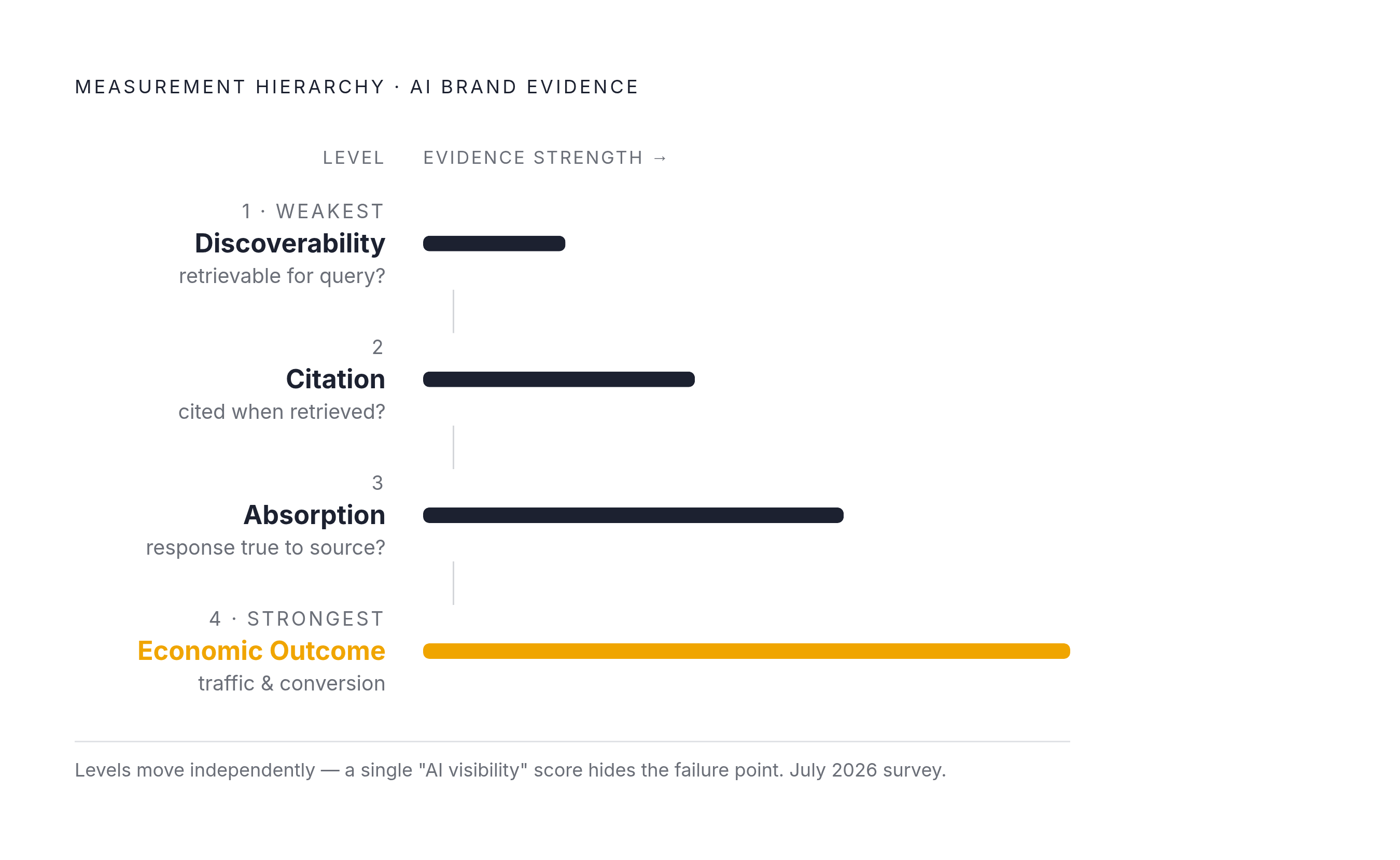
Being named, being cited, and influencing the answer are different outcomes. A brand mention records presence, a citation records attribution, and accurate use of the brand’s content records absorption and fidelity. Collapsing them into one “AI visibility” score hides the point of failure. The July 2026 critical survey proposes a visibility vector separating discoverability, citation, absorption, and economic outcomes. Each dimension can move independently, so more citations do not automatically mean a stronger position in the answer.
The practical measurement hierarchy starts with whether the brand is retrievable for the relevant sub-query cluster. It then asks whether the source is cited when retrieved, measured by surface. It next asks whether the synthesized response stays true to the source’s content. Effects on traffic and conversion come later because the evidence for them is weakest. This order keeps the diagnosis attached to the pipeline rather than to whichever number looks best in a presentation.
Reliable measurement also requires repetition across paraphrases and time. Generative engines are non-deterministic, so they can draw on a different set of sources when asked the same question again. A single snapshot captures noise as well as signal. The survey recommends defining the estimand before collection. It also recommends a minimum factorial design and validation through human review even when LLM judges are used.
Surface-specific reporting is just as important. ChatGPT, Perplexity, Google AI Mode, Google AI Overviews, Gemini, and Claude do not share identical source sets or citation rates. A cross-engine average can therefore obscure performance on the individual surface a team cares about. Repeated, surface-specific measurement gives each result a clearer meaning, but it also requires ongoing collection and review. At that point, measurement is no longer merely a reporting task. It is a web data infrastructure problem.
Why GEO depends on continuous web data infrastructure, not a one-time content audit
Generative engines re-index all the time, and model updates change which sources they retrieve and cite. Those updates can produce step changes rather than gradual movement, removing a brand from citation sets overnight. Competition also erodes gains over time. A one-time audit therefore cannot establish lasting visibility, even if every recommendation in it is sound. Monitoring must be continuous because the selection process does not stop when the audit document is delivered.
Accessibility must also hold as pages change. AI agents were blocked on 61–74% of attempts at sites protected by Cloudflare and another vendor, illustrating how access controls can stand between content and retrieval. A content update that inadvertently triggers bot-detection can remove a page from the retrieved set without a visible signal to the team. A page must therefore stay machine-readable after launch as well as at launch.
The same requirement connects GEO with a brand’s own AI systems. Answer generation, monitoring, and competitive intelligence all depend on accurate, real-time content delivered in a clean, structured form. Content teams and AI engineering teams are solving versions of the same retrieval problem. A unified web data API that handles crawling, scraping, search, and monitoring at scale can reduce the friction between coverage and reliability. Returning clean Markdown, HTML, or JSON makes the output ready to use and saves the work of processing raw page content.
The foundation of GEO is thus a maintained path from source to answer. Content must stay accessible, match the questions being retrieved, and provide evidence that keeps its meaning through synthesis. Measurement must show which of those steps is working without treating a mention as a citation or a citation as influence.