How AI Search Engines Select and Cite Sources
The two mechanisms powering AI search cite sources using fundamentally different logic.

"AI search" is not a single mechanism. It is at least two, operating on fundamentally different principles, and conflating them produces confused expectations about both citations and errors.
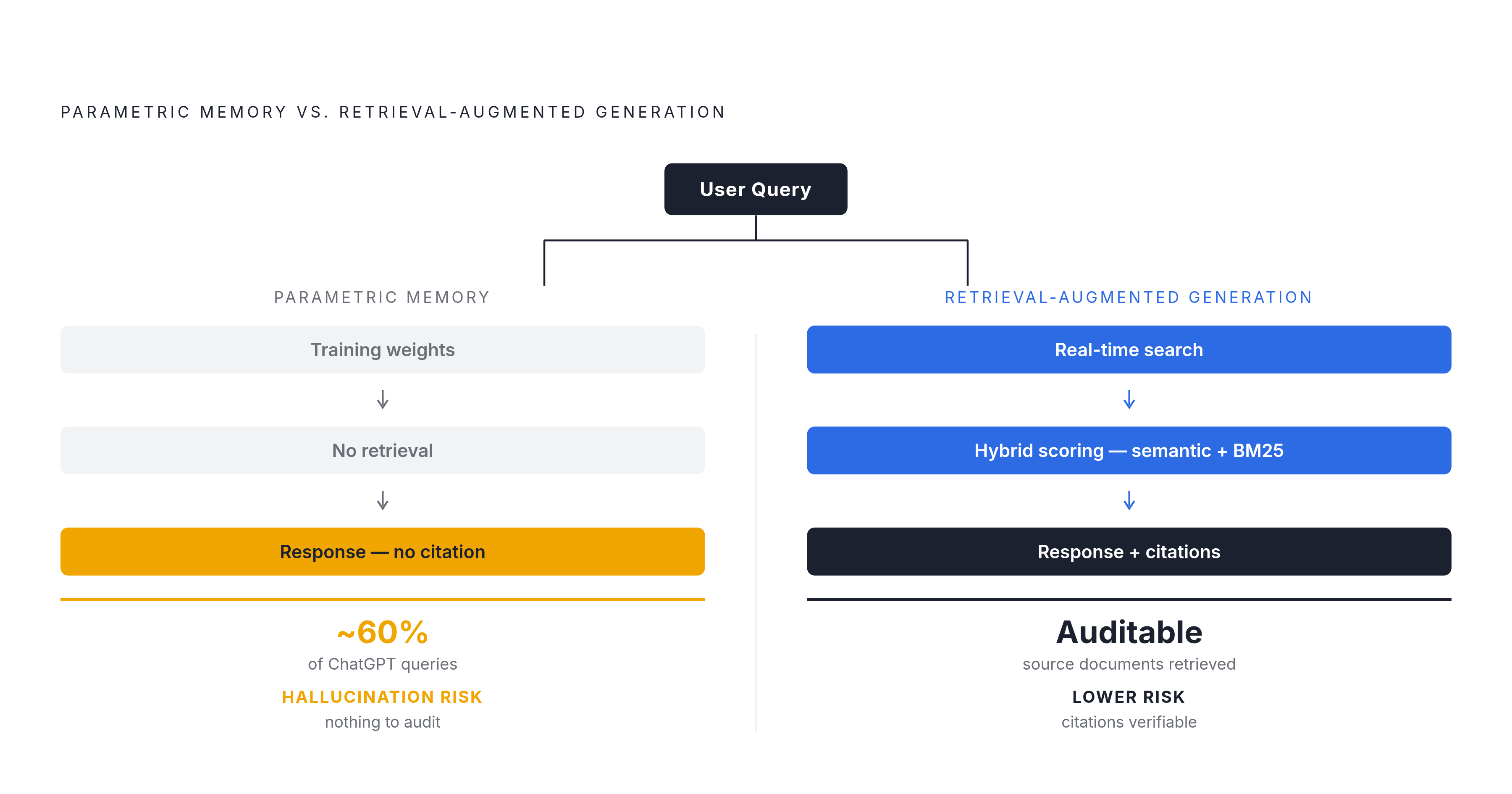
Large language models carry what researchers call parametric knowledge: information compressed into model weights during pre-training. When ChatGPT answers without citing anything, it is drawing on baked-in memory. No document was retrieved; no source was consulted. OpenAI's own usage patterns suggest roughly 60% of ChatGPT queries are answered this way. That figure inverts the assumption most practitioners bring to AI search optimization. The absence of a citation is not evidence of a simple answer; it may be evidence that the model is confabulating from compressed, potentially outdated training data, a failure mode researchers call hallucination, with nothing to audit and nothing to correct.
The alternative is retrieval-augmented generation, or RAG. The model issues a real-time search, pulls external documents, scores retrieved passages against each other, and synthesizes a response grounded in that fetched content. When citations appear in this mode, they reflect a competitive process: a passage won. Modern RAG pipelines typically combine semantic search, which matches by meaning, with BM25 keyword matching. Hybrid retrieval delivers substantially better results than either approach alone, which is why it has become the de facto standard.
This architectural split reframes every subsequent question about citations. When a citation appears, it reflects retrieval logic and is at least auditable. When no citation appears, the model may be speaking from memory, which is the more dangerous case. The reliability failures described later in this piece are, in the main, parametric-knowledge problems, not retrieval failures. Most content strategies have been designed without this distinction in mind, and that gap has consequences for both optimization and risk management.
Crawlability as the Prerequisite That Comes Before Any Other Signal
Before authority, relevance, or recency can factor in, a page has to be reachable. This sounds obvious. It is apparently not obvious enough.
Each major AI search platform deploys its own retrieval crawler under a distinct user-agent identity. OpenAI's documentation states this plainly: a site that disallows OAI-SearchBot will not appear in ChatGPT search answers, regardless of content quality. The critical failure mode is the accidental block. A publisher who adds a robots.txt rule to exclude GPTBot, OpenAI's training crawler, may not realize that OAI-SearchBot, the separate retrieval crawler that powers live search answers, requires its own explicit permission set. The training crawler and the retrieval crawler are different agents; a blanket exclusion catches both. The confusion is understandable, given how quickly this infrastructure has scaled: Cloudflare documented GPTBot's share of crawler traffic rising from 2.2% to 7.7% between May 2024 and May 2025, a 305% increase. Sites that never revisited their robots.txt directives and configurations during that period may have been quietly invisible to retrieval the entire time.
This is the kind of problem that can persist for months without surfacing in any standard analytics report. There is no 404 error, no ranking drop, no alert. Content simply never competes.
Crawlability is pass/fail. A page with meticulous credentials, carefully positioned statistics, and a Wikipedia backlink is invisible to an AI search engine that cannot fetch it. Auditing robots.txt and verifying crawler permissions for each major platform is the prerequisite, not the finishing touch.
How Google AI Overviews and AI Mode Narrow Hundreds of Candidates to a Handful of Citations
Assuming a page is crawlable, Google's process for surfacing AI Overview citations moves through a layered pipeline. Semantic retrieval identifies a large candidate pool, several hundred documents per query. E-E-A-T filtering then functions as a hard threshold, not a gradient: sources below a trustworthiness floor are excluded before passage-level evaluation begins. Wellows' pattern analysis found that 96% of AI Overview citations come from sources with strong E-E-A-T signals. A page can have correct keyword targeting, high entity density, and clean technical structure and still fail to enter the consideration set if author credentials or domain trustworthiness are absent.
Gemini then re-ranks at the passage level, not the page level, a process analogous to passage-level indexing. Most SEO frameworks have been slow to internalize this. Which passage within a document gets extracted matters as much as which document gets retrieved.
The relationship between traditional organic rankings and AI Overview citations is real but eroding. A BrightEdge study tracked this shift over sixteen months: 97% of AIO citations include at least one page from the top-20 organic results, so domain authority still opens the door. But only 38% of AIO-cited pages now rank in the organic top 10, down from 76% less than a year prior. Traditional SEO rank is a necessary but no longer sufficient condition for AIO visibility. Google's systems are increasingly selecting at the passage level from within a trusted domain pool, not mirroring organic ranking order.
AI Mode, Google's more expansive conversational interface, casts a wider net but draws from recognizably the same pool. A Semrush study of 5,000 keywords and more than 150,000 citations found 58% URL overlap and 88% domain overlap between AI Mode and standard AI Overviews. AI Mode references more unique domains per query, but underlying source preferences are largely consistent. One behavioral divergence worth tracking: Conductor's seven-month analysis found AI Mode consistently routes purchase-intent queries toward Google's own properties, including Shopping and Maps, rather than third-party sources. Standard AIO, by contrast, anchored on YouTube for the same intent category. Whether this reflects deliberate algorithmic design or emergent behavior remains unclear, though the pattern is stable enough that it seems unlikely to be coincidental.
Google's query fan-out technique compounds all of this. A single user question is decomposed into multiple simultaneous sub-queries, each pulling its own candidate set, before the system narrows to a cited synthesis. Deep Search, Google's most intensive retrieval mode, produces what the company describes as a fully-cited report. A piece of content may therefore compete not just against other pages on a topic, but against multiple interpretations of the user's question simultaneously, each with its own candidate pool. Traditional search never asked content to clear that kind of bar.
How Perplexity Selects Sources Differently, and Why Its Citations Diverge from Google's
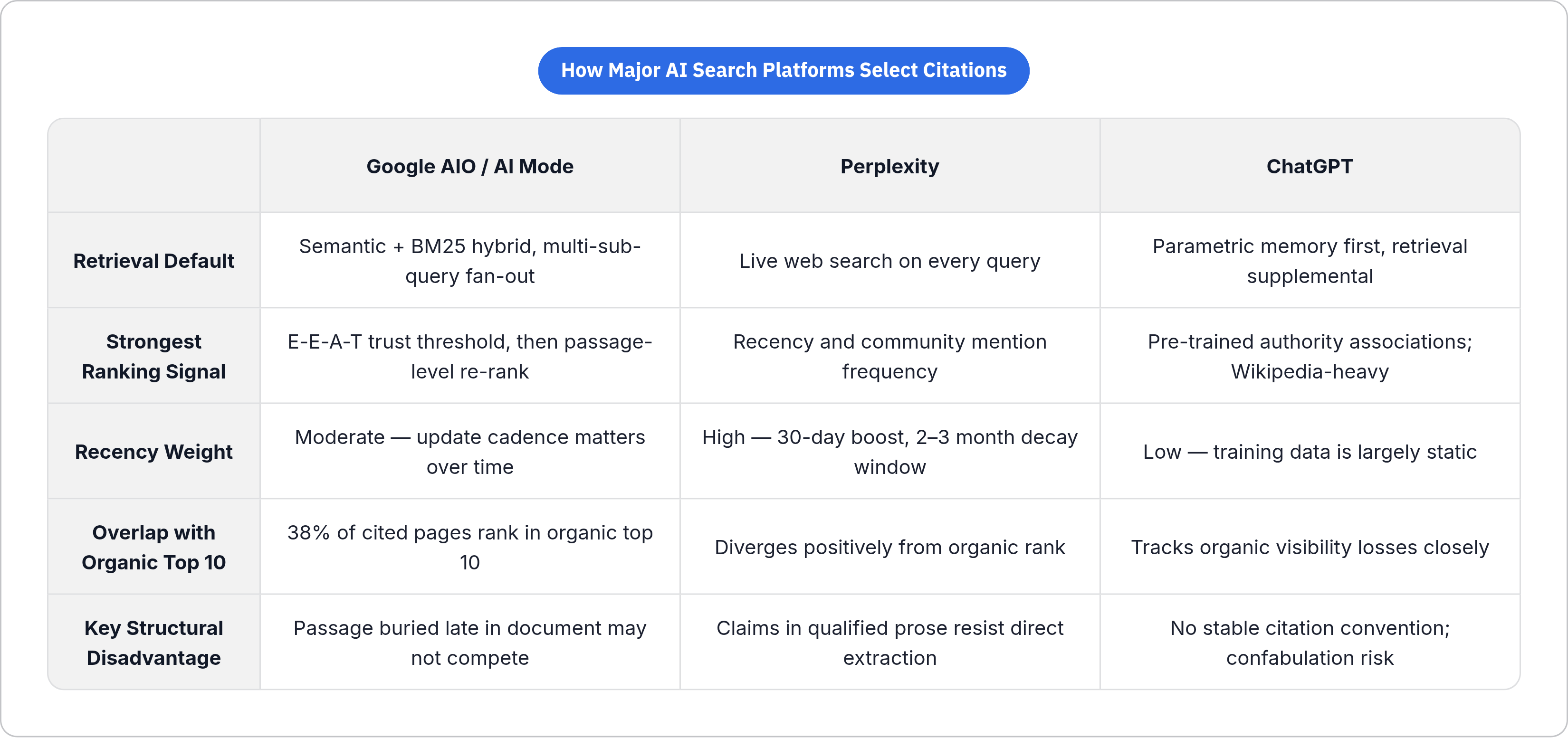
Perplexity makes a different foundational architectural bet. Where ChatGPT defaults to parametric knowledge and retrieves selectively, Perplexity runs a live web search on every query. There is no parametric fallback for sourcing. Recency and extractability consequently carry more weight in Perplexity's selection logic than pre-trained authority associations, and the result is citation patterns that diverge meaningfully from Google's.
The pipeline moves through query intent parsing, hybrid web retrieval, and three reranking layers that weigh relevance, recency, entity clarity, and authority, roughly in that order, before LLM synthesis generates the cited response. Of the pages retrieved per query, only a fraction survive to citation. The gap between being retrieved and being cited is where most content strategies fall short, because the two outcomes require different things and practitioners rarely separate them.
Recency is Perplexity's strongest differentiating signal. Content published or updated within the last thirty days receives a measurable ranking boost, and the platform's citation patterns show Reddit content appearing in nearly half of Perplexity's top citations, with a content decay window of two to three months. Community-backed freshness, where many voices have recently discussed a topic, is heavily favored over a single authoritative but dated source. This is not a quirk of the algorithm; it is a direct consequence of treating the live web as ground truth rather than treating pre-trained associations as the primary index of credibility.
Extractability is the second key variable and the one most consistently underweighted. Perplexity will not cite a page it cannot quote without distorting the meaning. A page structured for Google's semantic relevance scoring may retrieve cleanly but fail to earn a citation if its key claims are buried in qualified prose, distributed across subheadings, or dependent on surrounding context to parse correctly. This single factor explains a substantial portion of the divergence between Google organic visibility and Perplexity citation rates.
Lily Ray's research quantified the divergence across platforms. Google AIO, AI Mode, and ChatGPT citations all track organic visibility losses almost identically, declining in a narrow band between roughly 22% and 28%. Perplexity diverges positively, maintaining or increasing citations even as Google organic visibility declines for the same sources. The inference is that Perplexity weights mention frequency across forums, niche publications, and independent sources more heavily than organic rank. That creates a distinct pathway to citation that traditional SEO metrics do not capture and, for many organizations, have never been designed to pursue.
How ChatGPT Decides What to Cite, and the Outsized Role Wikipedia Plays Across All Platforms
ChatGPT's citation behavior is the least consistent of the major platforms, a product of architecture rather than design oversight. Web search is supplementary, not default. When retrieval does occur, attribution format varies: inline links, end-of-response lists, or nothing at all. There is no stable citation convention, which makes ChatGPT's sourcing logic harder to reverse-engineer than Perplexity's or Google's.
Wikipedia's dominance in ChatGPT's citation behavior is structurally important enough to address directly. Wikipedia accounts for a substantial share of ChatGPT's total citations; across all AI platforms combined, it represents more than a quarter of all AI citations. This is not simply a reflection of Wikipedia's organic search authority. Wikipedia's architecture maps precisely onto what RAG pipelines reward: consistent citation formatting, neutral tone, dense cross-linking, and clean extractability. Each of those properties is something a retrieval pipeline can detect and reward. Organizations without a Wikipedia presence face a structural disadvantage in AI citation across platforms. That is a baseline infrastructure gap, not a niche optimization consideration, and most enterprise content strategies have yet to reckon with it seriously.
For B2B and commercial topics, ChatGPT leans on a recognizable set of intermediary sources. Zenith AI research identifies platforms like Reddit, G2, PCMag, Capterra, and Gartner as frequently cited for B2B SaaS queries. Trusted aggregators and review platforms serve as citation proxies when primary sources are harder for the model to verify independently. A company's own documentation, however accurate, competes against these established intermediaries at a structural disadvantage if the intermediaries have consolidated opinion on the topic.
Cross-platform divergence is larger than most practitioners assume. Only 11% of domains are cited by both ChatGPT and Perplexity; the source pools are mostly non-overlapping. A content strategy that treats "AI search optimization" or answer engine optimization as a single unified target is, in practice, treating three meaningfully different systems as one.
The Signals That Consistently Predict Citation Across Platforms: What the Evidence Shows
Despite the platform divergences, several signals predict citation reliably enough to treat as consistent inputs, and the research here is more granular than most practitioners realize.
Corroboration across sources, not rank position alone, is how AI systems establish authority for a claim. A fact that appears consistently across multiple reliable sources is more citation-worthy than the same fact from a single high-ranked page. Brand search volume and associated click-through rate show a measurable correlation with LLM citations, stronger than traditional backlink signals in available research. Being a recognized entity across multiple contexts matters more than any single page's authority score.
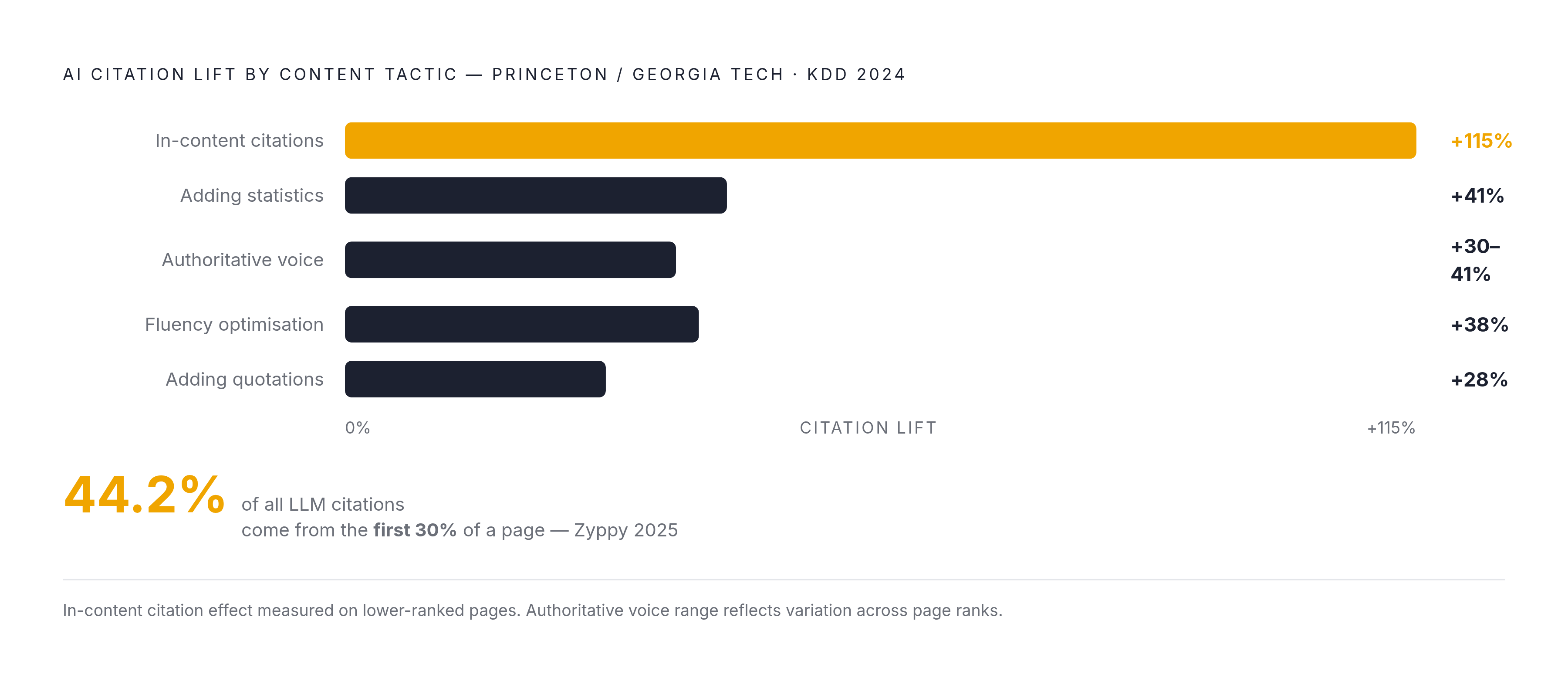
Content structure is the second consistent predictor. Zyppy's 2025 analysis found that 44.2% of all LLM citations come from the first 30% of a page. AI engines identify extractable passages, not documents. A piece that buries its most citable claim in the fourth section is structurally disadvantaged relative to one that leads with it, and no amount of topical authority compensates for that positional problem.
The Princeton and Georgia Tech GEO study, published at KDD 2024, produced the most granular evidence on content-level tactics. Statistics addition improved AI visibility by 41%. Quotation addition improved it by 28%. Citing external sources within the content itself improved AI visibility by 115% for lower-ranked content. Five of nine tested tactics consistently boosted AI citation rates in the range of 30% to 41%: citing sources, adding quotations, adding statistics, optimizing for fluency, and maintaining an authoritative voice. The 115% figure for citation-within-content is striking because it suggests that the structural behavior of a page is doing significant ranking work, independent of subject matter or domain authority. That implication still does not get nearly enough attention in how practitioners approach content planning.
Recency functions as a credibility signal, not merely a freshness preference. Pages on a stagnant update cadence are substantially more likely to lose AI Overview citations over time. Current-year statistics and updated structured data timestamps signal to the retrieval system that the content reflects the present state of the topic.
Citation concentration is the structural reality underlying all of this. Analysis of hundreds of thousands of citations across OpenAI, Perplexity, and Google AI search found that citations concentrate heavily among a small number of authoritative outlets. Being mentioned by those outlets is part of what makes a source citation-worthy in AI systems; the outlets function as corroboration nodes. A content strategy that ignores earned media in those outlets in favor of purely owned content is optimizing for one layer of the pipeline while neglecting another.
How Often AI Citations Are Wrong, and the Specific Failure Modes Behind the Errors
Everything above assumes that AI citations, when they appear, are accurate. The published evidence makes that assumption difficult to sustain, and the failure modes are specific enough to warrant careful attention.
The most rigorous published evidence comes from Columbia University's Tow Center for Digital Journalism, which published its findings in March 2025. The study tested eight leading AI search tools across 1,600 queries and found that tools returned incorrect citations more than 60% of the time. The range across tools ran from 37% incorrect for the best performer to 94% for the worst. These are not edge-case failures. They are the median outcome across the tools tested.
The failure modes the Tow Center documented are distinct. Fabricated links are exactly what they sound like: the model generates a URL that does not exist. Syndication errors occur when tools cite a syndicated or copied version of an article rather than the original, misattributing authorship and surfacing an outlet that did not do the underlying reporting. The third failure mode is the most insidious: the model presents a plausible-sounding citation with all the syntactic markers of reliability, but the underlying claim or source does not support what the summary asserts. This pattern is the one most likely to escape a reader's notice, because the citation looks correct.
These failure modes cluster around the parametric-knowledge problem identified at the outset. When a model answers from training memory and then generates a citation to make the answer appear retrieved, it is constructing attribution rather than reporting it. The citation is a performance of source attribution, not an instance of it. This is structurally different from a retrieval error, where the model fetched the wrong document. It is harder to detect and harder to correct, because there is no retrieval log to audit and no obvious signal that anything has gone wrong.
Appearing in an AI citation and being accurately represented in one are not the same outcome. The selection process described throughout this piece determines whether a source gets cited. The accuracy of that citation is a separate question, governed by different dynamics, and the error rates suggest it should not be assumed.