Why Cron-Scheduled Scrapers Fail AI Agents and What Event-Driven Web Data APIs Do Instead
Change-triggered webhooks keep agents on current data without wasteful polling.

An event-driven web scraping API with webhook support ties extraction to a detected page change and pushes a notification when data is ready, freeing the consumer from polling for results. Cron-scheduled scrapers fail AI agents because they collect data on a schedule that does not match when an agent needs current data. The replacement is change monitoring, webhook delivery, and a downstream queue, with live fetching for queries that cannot wait.
Why the web's data freshness gap is widening, and why agents feel it first
Prices, inventory, product listings, reviews, and competitive signals can change within minutes of a crawl. A stored dataset may therefore lose its usefulness within hours, even though the collection job completed without errors. The gap opens between the moment a page changes and the moment a system learns about it, and fast-moving web data makes that gap harder to tolerate.
Large language models have a fixed knowledge cutoff. Retrieval-augmented generation compensates by supplying outside information, but it transfers responsibility for keeping data current to the retrieval layer, which often depends on scraped web data. A human analyst can notice an outdated claim and flag it before deciding what to do. An agent without that review step acts on whatever retrieval returns, allowing stale inputs to pass straight into its output.
What cron-scheduled scrapers were actually built to do
Cron-based scraping starts with a reasonable batch-collection assumption. A job runs at a fixed interval, collects the available data, stores the results, and repeats. Its original consumer could live with the delay. A human analyst writing a weekly report or a dashboard updated each day could wait for page edits to arrive. Collection and reporting both ran at known times, so it made sense to collect data before it was needed.
The schedule also makes no distinction between change and silence. A job fires at most once per interval whether a page has changed substantially or not at all, and unchanged content is fetched and processed again. Compute, proxy, and storage costs follow each cycle. The system pays for another look, with another useful fact only a possibility. That trade-off can work for reports made at set times, but it is like taking photographs of a river at regular intervals. The photographs are useful records as long as nobody takes them to show the river as it is now.
Why the batch-collection assumption breaks the moment an agent is the consumer
An AI agent runs an inference loop with a latency budget measured in seconds or less. Its retrieval step needs data current at the moment of the query, while the collection job provides data current when it last ran. Those are different promises. An agent answering at 2 p.m. may retrieve a page collected at 3 a.m., with no way to detect the intervening changes. A stale index can therefore produce a confident answer with no obvious sign of failure.
The mismatch is temporal, structural, and economic. The schedule is detached from use, the agent lacks a review step to correct stale inputs, and repeated full-page collection spends resources on content that has not changed. Shortening the interval makes the same architecture run more often, including its redundant work, while leaving a gap between collection and action.
Adding an LLM to the scraper changes a different part of the system. An agentic scraper can navigate and interpret a page autonomously, but running it on a schedule still makes it a scheduled scraper. The architectural fix is event-driven extraction, which makes a detected change, rather than an elapsed interval, the reason to refresh the data.
How do you trigger a scrape when a webpage changes and get notified via webhook?
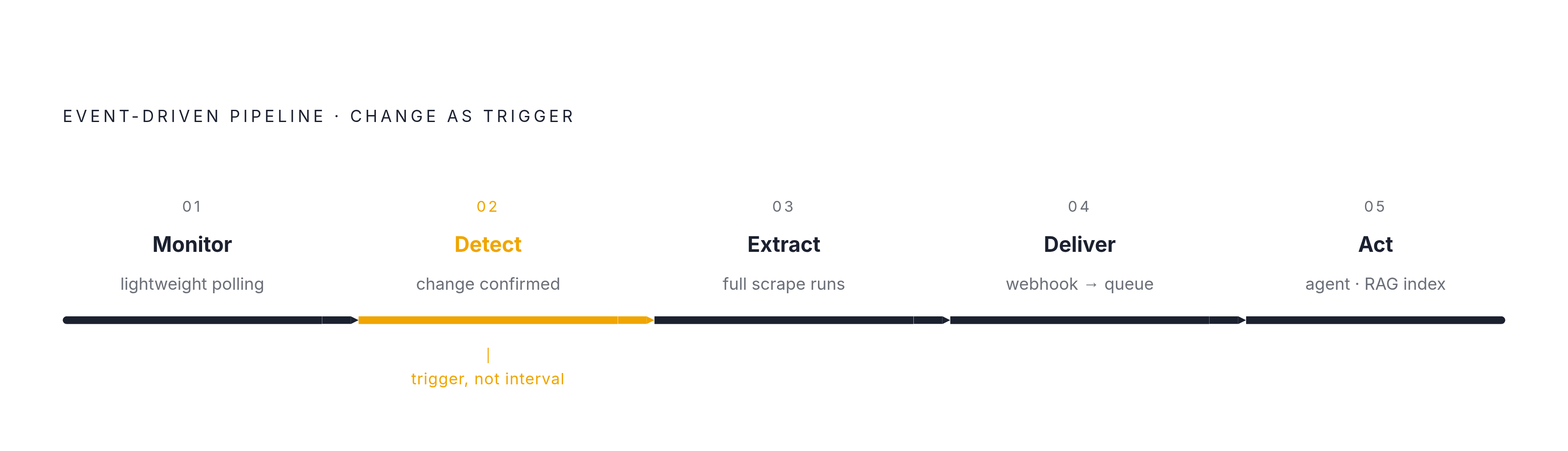
A change-detection layer monitors a page before triggering full extraction. It can use lightweight polling or subscribe to changes, so the design does not necessarily eliminate every timer. It separates monitoring from the expensive collection step. When the monitor detects changed content, extraction runs because there is something new to collect, rather than because another scheduled batch has begun.
The flow is monitor → webhook → queue, with extraction and downstream work tied to that flow. When a change is detected, it can trigger a re-scrape, re-indexing, enrichment, and a notification without a person managing the steps. For an agent or RAG index, the useful distinction is whether the webhook announces a page change or delivers the result when extraction is ready. A completion callback alone does not establish that the API monitors pages for changes.
Some queries cannot wait for monitoring to detect an edit. For those, on-demand extraction fetches the page at query time and returns the result within the inference latency window. Clean, structured output also removes navigation menus, scripts, cookie banners, and advertising elements that would otherwise consume tokens. Selective extraction cuts requests for the same content, and cleaner results leave retrieval with less unwanted material to sift through.
Where the timing mismatch costs most: four production use cases
RAG pipelines expose the most deceptively quiet failure. Retrieval is meant to compensate for a model's fixed training cutoff, but stale context lets the model generate fluent output from outdated facts. Nothing necessarily looks broken. An outdated answer can look complete and useful in a way that a null result cannot. Change-triggered re-indexing addresses the stored-context gap, while query-time fetching serves requests that need the page's current state.
Competitive intelligence and price monitoring face a shorter clock. E-commerce teams and travel platforms need price and availability signals that can update by the minute, so daily or even hourly collection cannot support decisions at that cadence. The failure is a pricing decision based on an expired signal. Change-driven extraction refreshes the relevant data when a change is detected.
Sales lead enrichment has a natural trigger of its own. A new lead entering a CRM can prompt on-demand extraction from company pages, funding announcements, and hiring signals. Weeks-old enrichment can misstate headcount, funding stage, or technology stack, leading an agent to choose outreach based on a company that no longer exists in quite that form. The trigger aligns collection with the outreach workflow. It replaces the last batch's company portrait with information fetched when the lead needs enrichment.
SEO and AI visibility monitoring can be caught out by when changes happen. AI Overviews, ad blocks, and People Also Ask modules can change how much people see while ordinal rank stays the same. A rank line is not the whole page. Monitoring page composition catches changes that a position-only measure misses, including the disconnect between stable rank and falling clicks. For generative engine optimization, monitoring the finite set of source URLs used in AI answers also lets teams catch upstream edits the day they happen.
What the agent-scale traffic environment adds to the problem
Freshness is not the only condition an agent needs. The source must also remain accessible through infrastructure that can handle the web's controls on machine traffic. AI browsing agents are increasingly recognizable as a distinct traffic class, and intelligent navigation does not make them look human. They can stand out when they move straight to target elements, act at irregular times, and skip scroll events. Better interpretation of a page does not, by itself, improve access to it.
The FP-Agent study from UC Davis, published in May 2026, found that behavioral fingerprints could distinguish AI browsing agents from humans and from one another even when browser fingerprints were shared. Its behavioral classifier caught all seven agents in the test, while the bot detection that Cloudflare had deployed caught only one. That is a result from the tested setting.
For agent builders, a managed web data API takes ownership of fingerprinting, proxy rotation, and anti-bot compliance below the agent layer. The API still needs to fetch pages reliably, because even a request made at just the right time gives the agent no useful grounding if it cannot get the page.
The integration layer: how event-driven web data connects to agent frameworks
Fresh data helps only if the receiving framework can consume it. An API that returns usable documents through a supported interface saves each agent builder from having to build a translation layer of their own. LangChain's document loader pattern provides one such connection. A live-fetch or change-triggered API can replace a static loader in a RAG pipeline while leaving downstream retrieval, vector store indexing, and generation unchanged. The source of the documents changes without requiring a redesign of every later step.
The Model Context Protocol provides another integration surface. MCP is emerging as a standard through which compatible agents can call web data tools directly. Exposing a scraping or monitoring API as an MCP server makes it available as an agent tool without bespoke integration work. With tool access established, the API beneath it still controls whether a call fetches live data, serves stored content, or starts monitoring, while webhook delivery passes changes and completed work on for downstream processing.
The legitimate objection: operational complexity shifts, it does not disappear
Event-driven pipelines introduce real engineering work in webhook management, backpressure, schema normalization, and retries at scale. A team building in-house takes on those responsibilities in place of the maintenance burden attached to scheduled collection. The queue does not operate by good intentions. The architecture changes where work enters the system, which also changes how the team must manage its flow and failures.
A second objection is just as strong. Event-driven delivery is only as reliable as the fetch layer beneath it, so a provider that fails under bot protection or high concurrency recreates the access failures of scheduled scraping. It merely delivers the bad news sooner. Faster notification cannot rescue missing data, and a webhook is not a reliability guarantee.
A managed API can absorb proxy rotation, fingerprint management, extraction retries, and schema stability that would otherwise fall on the agent team. The receiving pipeline still has its own work. Webhook handling, downstream backpressure, and the use of delivered data remain part of the integration, so the useful question is which responsibilities the provider actually owns.
What to look for when evaluating an event-driven web data API for agent workloads
Does a request fetch the page live, or return a cached result? If it uses a cache, what is the maximum age, and can that limit be set per request? “Fresh” is not a useful contract on its own. The answer must fit the agent's latency budget as well as the age of data its decisions can tolerate.
Does the API monitor a tracked page and trigger extraction after an edit, or does it only send a callback after a job that the customer started? Both capabilities are useful, but they solve different problems. An event-driven web scraping API with webhook support needs change monitoring for automatic refresh and completion delivery for consumers that should not poll for results. Query-time fetching covers the cases that cannot wait for the monitoring path.
Clean text or Markdown avoids handing raw HTML parsing to the agent, reduces token waste, and improves retrieval accuracy. The connector is another practical test. An MCP server, a LangChain-compatible loader, or native connectors to n8n and Zapier can reduce custom glue code, depending on the receiving workflow. Reliability evaluation should also establish whether fingerprinting, proxy management, and JavaScript rendering are handled below the agent layer.
Batch and monitoring workloads should charge on successful state changes or successful fetches rather than every scheduled attempt, with transparent consumption-based pricing and no forced contracts. Unpredictable demand makes that flexibility valuable. The buying decision is therefore not simply which API has a webhook checkbox, but which one connects change detection, dependable fetching, usable output, and delivery within the agent's actual time budget.